They are experiencing Christianity as joy and hope, having thus become lovers of Christ.

Category: Wisdom & Flourishing

  • Does God Speak Through Our Thoughts?

    Learning to Discern the Voice Within
    A Thought That Changes Everything

    I recently had a realization while reading Jordan Peterson that stopped me in my tracks: if God were to speak to me… how would I even know?

    The answer is both simple and deeply unsettling: it would have to be a thought. Unless God sends an angel in visible form (which He rarely does), His voice would arrive the same way every other voice in my head does—internally, silently, as a thought.

    This means something important:
    We can’t tell the difference between a thought from God, a thought from ourselves, or even a deceptive thought from the enemy… unless we learn how to discern.


    The Still, Small Voice… and the Subtle Lie

    This insight isn’t new to the spiritual tradition. Christians throughout the centuries have said that the mind is a battleground. It’s the place where grace and temptation both try to stake their claim.

    As Peterson highlights, the challenge is not hearing God, but testing what we hear. And this is echoed by C.S. Lewis in The Screwtape Letters, where he shows how the devil doesn’t usually show up with fire and pitchforks. No, he whispers subtle half-truths that sound:

    • logical,
    • moral,
    • even noble—
      but in the end, they isolate us from truth, from others, and from God.

    Clarity or Confusion? How to Test a Thought

    Since God speaks through our inner world, we need to ask not just what the thought is, but what it leads to.

    🔹 God’s voice brings clarity, conviction, peace, and hope.
    🔹 The enemy’s voice brings confusion, shame, accusation, and isolation.

    This is the core of Christian discernment. In a world full of noise—and a heart full of emotions—only time in Scripture, prayer, spiritual direction, and community can help us learn the difference.


    Why This Is Especially Dangerous When We’re Alone

    If someone is alone, exhausted, burdened, or isolated, the inner voices can grow louder and more convincing. In those moments, even a lie whispered in the dark can feel like the truth.

    This is why the Church emphasizes community, sacrament, and prayer. We’re not meant to walk the spiritual life alone. Even saints had spiritual directors and companions to help them test the voices they heard.


    Wrestling with Sacred Things

    If you’re wrestling with this—wondering where a thought came from, asking whether it was God or something else—you’re not spiritually weak. You’re on sacred ground.
    Discerning the difference isn’t easy. It’s the work of a lifetime. But it begins with this kind of honesty and reflection.

    So next time a “holy-sounding” thought enters your mind, ask:

    • Does this draw me toward God and others—or away?
    • Does it bring peace or despair?
    • Does it reflect what I know of Jesus?

    God’s voice restores. The enemy’s voice accuses.
    Our job is to learn to recognize the difference—and help others do the same.

    Written in collaboration with ChatGPT

  • Meditating on the Four Last Things

    How It Changed the Way I Treat People

    Q: What are the Four Last Things in Catholic spirituality?

    A:
    The Four Last Things are death, judgment, heaven, and hell. These are the final realities each soul must face, and they’ve been a traditional focus for Christian meditation for centuries. Saints like St. Francis de Sales recommended regularly meditating on these truths—not to frighten us, but to help us live with deeper purpose and love.


    Q: Why did St. Francis de Sales encourage meditation on death?

    A:
    Because death is inevitable—but always feels unexpected. St. Francis de Sales believed that reflecting often on the reality of death would help us live better lives: more present, more compassionate, and more forgiving. He wrote that death never seems expected, and that truth has stuck with me.


    Q: How has this meditation changed the way you interact with others?

    A:
    It’s made me realize just how fragile human life really is. I’ve started trying to treat each person as if it could be our last interaction. That doesn’t mean living in fear—it means living with intention.
    I ask myself:

    • Would I want this to be the last thing I ever said to this person?
    • If they—or I—weren’t here tomorrow, would I regret anything left unsaid, or the way I treated them

    That perspective makes it much harder to hold grudges or speak harshly. It doesn’t mean I don’t get frustrated—but it helps me pause, breathe, and remember what actually matters.


    Q: Isn’t that kind of reflection morbid or depressing?

    A:
    Not at all. In the Catholic tradition, memento mori (“remember you will die”) isn’t meant to drag us into fear—it’s meant to wake us up. It reminds us that life is short, people are precious, and love is urgent.
    It’s not about obsessing over death—it’s about choosing compassion today because tomorrow isn’t guaranteed.


    Q: How can other men benefit from this practice?

    A:
    For men especially, it’s easy to get caught up in productivity, control, or pride. But meditating on the Four Last Things cuts through all of that. It brings you face to face with your own limits—and from there, you can start building a life based on what actually endures: love, forgiveness, virtue, and eternal hope.

    In my men’s group, these meditations have sparked real conversations—not just about theology, but about how we’re living and who we’re becoming.


    Q: What are some simple ways to put this into practice?

    A:
    Here are a few:

    • Start your day with a 2-minute reflection on the Four Last Things.
    • Bless people silently, especially those who frustrate you.
    • Ask forgiveness quickly—don’t assume there will be another chance.
    • Thank people more often—you might not get to tomorrow.
    • Treat interruptions as opportunities to love more deeply.

    Final Thought:

    Life is fragile. People are fragile. And that is exactly why we must love boldly and forgive freely. The Four Last Things are not a threat—they are a call to holiness. A call to live every day as if it really matters—because it does.

    Developed with assistance from ChatGPT

  • Why Does Christianity Feel Like It’s All About Rules?

    Why Does Christianity Feel Like It’s All About Rules?

    Rediscovering the Love at Its Core

    If Christianity Starts with Love, Why Does It Feel Like It’s All About Rules?

    You’ve probably heard it—or maybe thought it yourself: “If God is love, then why does being Christian feel like following a bunch of rules?”

    It’s a fair question. The Gospel begins with love—God’s love for us, poured out through Christ. But somehow, what many people experience instead is a system of dos and don’ts, loaded with guilt and fear.

    Why the disconnect?

    Let’s explore a few reasons why Christianity often feels rule-heavy—and how we can recover its heart.


    1. Rules Are Love’s Scaffolding

    Just like parents set up boundaries for their toddlers—don’t touch the stove, don’t run into traffic—God, through the Church, gives us moral guidelines not to restrict us, but to protect us.

    Rules aren’t the enemy of love. They’re how love gets a foothold in real life.

    When rightly understood, commandments and Church teachings are like guardrails on a winding road. They exist to help us flourish—not to limit joy, but to preserve it.


    2. We Learn the Law Before We Know the Love

    Most people start their spiritual life with a focus on behavior. It’s natural to want a checklist—especially when you’re unsure what’s right or wrong. “Just tell me what to do so I don’t mess up.”

    But the Christian life isn’t just about doing—it’s about being in relationship.

    Over time, what once felt like a burden can become a bridge. When the heart begins to grasp God’s love, obedience shifts from fear to freedom.


    3. Fear and Guilt Can Eclipse the Gospel

    Let’s be honest—fear is powerful. Fear of messing up. Fear of hell. Fear of not being good enough.

    Rules can offer the illusion of control: “If I do X, I’m safe.”

    But when guilt dominates a person’s experience of religion, the beauty of grace gets buried. Christianity becomes a tightrope walk instead of a relationship of trust.

    Love doesn’t ignore sin—it heals it. But when communities focus only on what not to do, they risk losing sight of what we’re invited into: life in abundance.


    4. History Hardened Some Lines

    Throughout history, the Church has had to respond to real threats—heresies, persecution, cultural confusion. In times of crisis, the tendency is to emphasize clarity and boundaries.

    But those necessary guardrails can become rigid over time, even after the original threat is gone. What started as protection can slowly replace affection.

    This isn’t new. Even in the early Church, the apostles had to strike a balance between truth and freedom (see Acts 15). It’s an age-old tension—and one we still navigate today.


    5. Recovering the Primacy of Love

    Rules without love become dry. But love without truth becomes hollow.

    The good news? Christianity was never meant to be about jumping through hoops. At its core is this breathtaking claim: “We love because He first loved us” (1 John 4:19).

    Every commandment makes sense only when framed as an invitation—not a burden to carry, but a path to joy. When we obey God not to earn His love, but because we’ve already received it, everything changes.


    A Quick Historical Glimpse

    • Old Testament – The law was part of the covenant: “You are My people; this is how we live in union.”
    • Jesus’ Teaching – He summarized all commandments into two: love God and love your neighbor (Matthew 22:37–40).
    • Early Church – Faced with cultural diversity and false teaching, rules were used to preserve unity—but sometimes drifted into legalism.
    • Reformers & Vatican II – The Reformers emphasized grace over works; Vatican II’s Lumen Gentium echoed Paul: “The greatest of these is love” (1 Corinthians 13:13).

    Final Thought & Discussion Prompt

    “Can you think of a commandment that once felt burdensome—but when seen as an invitation into God’s love, became a source of freedom and joy?”

    Let’s talk about it. Share your experience in the comments.

  • What Does It Mean to Truly Meet Jesus?

    Exploring the Transformative Journey from Knowing About Jesus to Experiencing a Personal Relationship with Him

    Understanding the Difference

    In today’s digital age, information about Jesus is readily accessible. Many are familiar with His teachings, miracles, and life events. However, there’s a profound difference between knowing about Jesus and truly meeting Him.

    Intellectual Knowledge vs. Personal Relationship

    • Intellectual Knowledge: Involves understanding facts about Jesus—His birth, teachings, and crucifixion. It’s akin to reading a biography.
    • Personal Relationship: Entails a heartfelt connection, where one experiences Jesus as a living presence in daily life. It’s like conversing with a close friend, sharing joys, fears, and aspirations.

    The Dynamics of a Personal Encounter

    Mutual Communication

    A genuine relationship with Jesus is interactive. Through prayer, we speak to Him; through Scripture and inner promptings, He speaks to us. This two-way communication fosters a deeper bond.

    Transformative Impact

    Meeting Jesus isn’t a passive experience. It reshapes our desires, priorities, and actions. Just as spending time with a compassionate friend can inspire kindness, encountering Jesus motivates us to embody His love and teachings.

    Tangible Presence

    For many, Jesus’ presence is felt tangibly—during worship, in the sacraments, or amidst life’s challenges. These moments affirm that He is not just a historical figure but an active participant in our lives.

    Historical Perspectives on Personal Encounters

    • Early Christians: Testified to the risen Christ appearing to them, emphasizing a direct and personal experience.
    • Desert Fathers (4th Century): Sought solitude to deepen their relationship with Christ, often referring to Him as their constant companion.
    • Medieval Mystics: Figures like St. Julian of Norwich described vivid visions of Christ, emphasizing personal devotion over mere doctrinal understanding.
    • Modern Movements: Emphasize that every believer can experience a personal relationship with Jesus, not just theologians or clergy.

    Reflect and Share

    Have you ever felt Jesus’ presence in a profound way? Perhaps during a quiet moment, in prayer, or amidst a challenging situation? Reflect on that experience and consider sharing it with others.

    With Editing Assistance from ChatGPT

  • “Deus Caritas Est” Summary Sections 1 thru 8

    Exploring the Depths of Christian Love: From Eros to Agape

    Pope Benedict XVI’s Deus Caritas Est explores the nature of love, distinguishing between eros and agape, and emphasizes that true Christian love integrates both. It calls believers to experience God’s love personally and express it through selfless actions toward others.

    DCE 01 Christianity is centered on love—God’s love for us and our love for Him and others. Being Christian isn’t just about rules or ideas, but about meeting Jesus, who changes our lives. God’s love calls us to love in return, not just because we’re told to, but because He loved us first. This message is especially important in a world that sometimes misuses God’s name. The Pope writes this letter to explain God’s love and how we should live it out, both by understanding it deeply and by showing love to others through action.

    DCE 02 God’s love is very important, but the word “love” is used in many different ways today. It can mean many things—like love for family, country, work, or romantic love. Romantic love between a man and a woman often seems like the strongest kind. The section asks whether all these different kinds of love are really the same, or just share the same name.

    DCE 03 The ancient Greeks called the powerful and unplanned attraction between man and woman eros. But the Bible, especially the New Testament, rarely uses this word. Instead, it emphasizes agape—a love that gives, serves, and sacrifices for others. Christianity does not reject eros, but seeks to purify and guide it so it leads to true love and happiness, not selfish desire or misuse of the body.

    In ancient cultures, eros was seen as a divine force that could take over a person like madness. This idea often led to harmful practices, such as temple prostitution. The Old Testament rejected these false forms of love, not because love is bad, but because this version of eros dehumanized people and separated love from true dignity.

    True love must include both body and soul. Human beings are not just spirit or just flesh—we are both. Love matures when body and soul are united in purpose and respect. Christianity has sometimes been wrongly accused of rejecting the body, but the modern world’s way of treating the body as just a tool for pleasure also dishonors it. Christian love sees the body as a sacred part of the whole person.

    The Song of Songs in the Old Testament shows how love can grow. At first, love is uncertain and selfish (dodim), but over time it becomes more selfless and committed (ahabà or agape). Mature love seeks the good of the other, not just personal pleasure. It wants to last forever and include all parts of life.

    Christianity teaches that love must be both giving (agape) and receiving (eros). If love is only about giving, it dries up. If it is only about taking, it becomes selfish. Real love includes both. Jesus is the model of perfect love: He gives completely, and through Him, we receive God’s love. The ladder in Jacob’s dream (angels going up and down) shows how love moves both ways—seeking God and sharing His love with others.

    In the end, love is one reality with different sides. Christianity does not oppose human love, but completes and purifies it. It brings out love’s deepest meaning by showing us who God is and what it means to be truly human.

    This is a summary of Deus Caritas Est sections 1 thru 8 by Pope Benedict XVI, given on 25 December 2005. This summary was created by ChatGPT and is intended to be an abbreviated version of the document, for those who do not have time to read the original. 

    This is not an official translation.

    The original is located at Deus caritas est (December 25, 2005) | BENEDICT XVI 

    Related Posts:

    How Do I Know If I’ve Truly Encountered God’s Love?

    What Does It Mean to Truly Meet Jesus?

    Why Does Christianity Feel Like It’s All About Rules?

     Why John 3:16 Still Matters

  • Unpacking the Prodigal Son Story: A Mythical Hero’s Journey

    The Prodigal Son is one of the most beloved parables from Christian tradition, but when examined through the lens of the mythical hero’s journey, it reveals a deeper, universal narrative of transformation, redemption, and reconciliation. This timeless tale offers a rich exploration of personal growth, rebellion, and the cyclical nature of life. In this post, we’ll delve into how the Prodigal Son mirrors the structure of the mythical hero’s journey and what we can learn from his story.

    1. The Call to Adventure: A Desire for Freedom

    In mythological narratives, the hero often begins their journey with a call to adventure — a desire to explore the unknown. The Prodigal Son’s request for his inheritance marks his own “call” to freedom. He wants to leave behind the familiarity of his home and step into a world where he can forge his own path. This moment reflects the universal human desire to break free from constraints and seek independence, much like a hero departing from their original world to pursue a personal quest.

    2. Crossing the Threshold: Venturing into the Unknown

    The son leaves his father’s house and enters the “distant country,” symbolizing the crossing of the threshold into the unknown. It is here that he begins to indulge in a life of excess, squandering his inheritance. This chaotic journey mirrors the hero’s descent into the “wild” or underworld, where they encounter temptations and distractions that often lead them astray. In mythology, heroes face these temptations as part of their transformation, and the Prodigal Son is no different. His descent represents the dangers of excess and unchecked desires.

    3. The Abyss: Confronting the Crisis

    Every hero must face a crisis — the abyss — a moment of profound despair and self-reflection. For the Prodigal Son, this moment occurs when famine strikes and he finds himself feeding pigs, longing for their food. This marks his lowest point, symbolizing a metaphorical “death” — the hero’s confrontation with their mistakes and the consequences of their actions. The “famine” represents life’s harsh realities and the price one pays for straying too far from balance and wisdom.

    4. The Return: Transformation and Rebirth

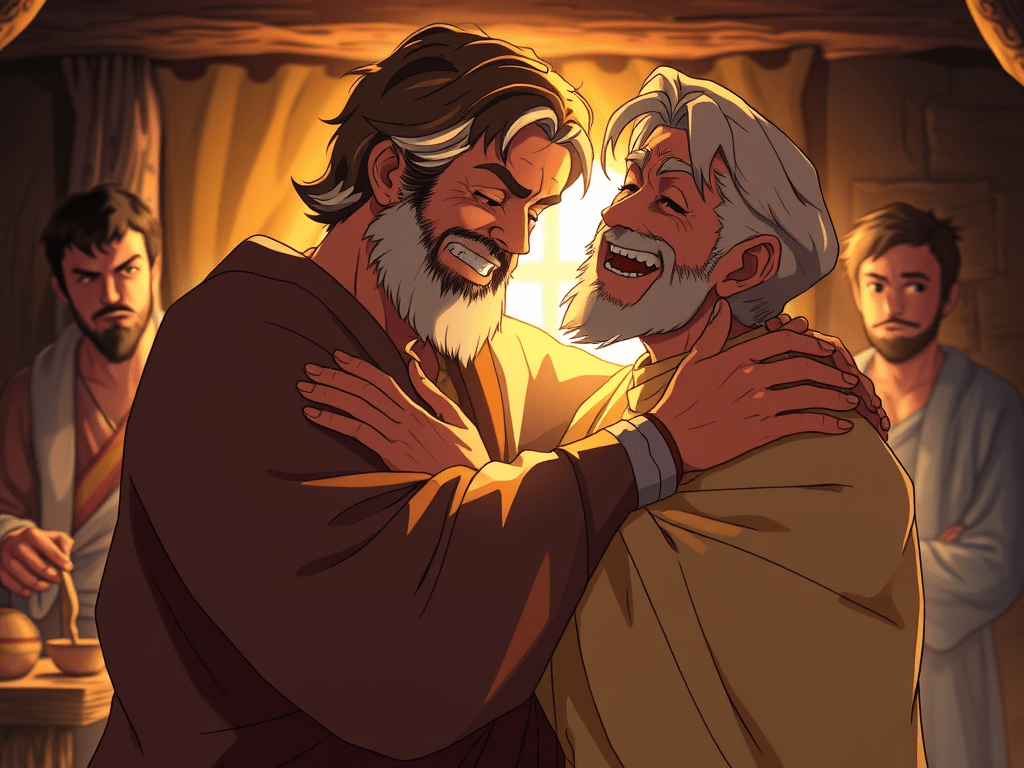
    In many myths, the hero returns home after their trials, but they are forever changed. Similarly, the Prodigal Son’s decision to return home represents a moment of transformation. His journey back is one of repentance and self-awareness, symbolizing a rebirth. When he arrives, his father greets him with open arms, demonstrating that redemption and reconciliation are possible, even after great mistakes.

    5. The Hero’s Reward: Celebration and Integration

    After the son’s return, he is celebrated by his father, who restores him to his rightful place. This is the reward phase of the hero’s journey, where the hero integrates the wisdom they’ve gained into their previous life. For the Prodigal Son, this celebration includes gifts such as a robe, ring, and sandals — signs of his full reintegration into the family. In myth, the hero often returns with newfound wisdom, and the Prodigal Son’s return symbolizes the potential for growth and healing, no matter how lost or estranged one might feel.

    6. The Shadow: Conflict with the Elder Brother

    In many myths, the hero’s return disrupts the status quo, often sparking tension with those who remained behind. The elder brother’s resentment toward the Prodigal Son reflects this mythical conflict. The elder son represents the “shadow” — a figure resistant to change, loyal to the old ways, and unwilling to embrace transformation. His anger symbolizes the internal and external conflicts that arise when old paradigms are challenged, and growth or redemption occurs.

    7. Rebirth: Death and Resurrection

    The narrative concludes with a powerful statement by the father: “This son of mine was dead and is alive again; he was lost and is found.” This moment echoes the cyclical nature of death and resurrection that is central to many mythic stories. The Prodigal Son’s “death” represents his metaphorical fall, and his return symbolizes a form of resurrection — a fresh start rooted in humility and wisdom. The cycle of life, death, and rebirth is essential to the hero’s journey, illustrating that transformation often requires loss and renewal.

    8. The Theme of Repentance and Redemption

    At its core, the Prodigal Son story embodies the theme of repentance and redemption. In many myths, the hero returns after making mistakes, and their journey is celebrated because they have learned from their trials. The father’s willingness to forgive, rather than punish, the Prodigal Son challenges the notion that heroism is about perfection. Sometimes, the hero is celebrated not for their unwavering goodness but for their capacity to learn from their errors and return transformed.

    Conclusion: Lessons from the Prodigal Son

    The Prodigal Son is more than just a biblical tale — it is a powerful reflection of the hero’s journey. Through his story, we learn about transformation, the importance of self-awareness, and the possibility of redemption, no matter how far we’ve strayed. By examining the Prodigal Son through the lens of mythology, we can see that the challenges of life — the mistakes, the temptations, the crises — are all part of the journey toward self-discovery and reconciliation.

    Whether you’re exploring the parable for personal reflection or analyzing it from a mythical perspective, the Prodigal Son’s journey offers timeless wisdom. Embrace your journey, accept the lessons that come with both failure and triumph, and remember that redemption is always within reach.

    Written in collaboration with ChatGPT (OpenAI, 2025).
  • The Parable of the Prodigal Son: A Preference for the Repentant Son Over the Loyal Brother

    The Parable of the Prodigal Son: A Preference for the Repentant Son Over the Loyal Brother

    The Parable of the Prodigal Son is one of the most well-known biblical stories. While often interpreted as a lesson on forgiveness, there’s a deeper, subversive message embedded in the narrative. The story emphasizes the redemption of the repentant son over the loyalty of the older brother, challenging us to reflect on the nature of grace, transformation, and true faith.

    Let’s break down why this story shows more favor to the repentant son than the dutiful older brother.

    1. The Repentant Son’s Journey

    The Prodigal Son embarks on a journey of transformation. He leaves home, squanders his inheritance, and experiences deep suffering. But the key moment in the story is when he “comes to his senses,” realizing that his life has gone astray. Returning home isn’t just about apologizing—it’s about a profound change of heart.

    His journey isn’t just physical; it’s deeply moral and spiritual. Without experiencing loss and humility, the son wouldn’t have gained the wisdom necessary to understand what truly matters. His repentance is not merely saying “sorry”; it’s taking full responsibility and seeking reconciliation.

    2. The Older Brother’s Stagnation

    In contrast, the older brother represents the opposite of transformation. He has remained “loyal” and “dutiful,” yet he lacks the deeper compassion and self-awareness that the younger son gains through his fall. His loyalty is tied to a transactional understanding of his relationship with his father. He believes that following the rules entitles him to rewards.

    However, when he sees his brother return, he becomes bitter and resentful. His jealousy reveals his inability to comprehend the true nature of forgiveness and grace. While he believes that loyalty should be rewarded, he struggles to accept the father’s generosity toward the repentant son. This exposes the flaw in his view of faithfulness: it’s not just about staying loyal; it’s about embracing grace, forgiveness, and love.

    3. The Father’s Preference for the Repentant Son

    The father’s actions in the story speak volumes. He doesn’t just forgive the younger son—he goes out of his way to restore him to his rightful place in the family. The father’s joy and celebration of the son’s return show that he values transformation over mere loyalty. To him, the younger son’s repentance signifies a deeper, more meaningful change.

    The older brother, on the other hand, cannot understand why his brother is being celebrated. His view of loyalty lacks grace, focusing solely on merit. The father’s actions reveal a profound truth: that genuine transformation and repentance are more valuable than blind obedience or duty.

    4. The Parable’s Subversive Message

    What makes the Prodigal Son so powerful is how it subverts conventional expectations. The older brother, who has done everything right, is not the one the father celebrates. Instead, it is the one who has made mistakes, strayed, and then returned with genuine repentance.

    This aligns with a deeper spiritual principle often emphasized in Christian teachings: God values repentance and the willingness to transform oneself over mere outward adherence to rules or social norms. The story challenges the idea that it’s enough to simply “do your duty” or “stay loyal.” True faith requires openness to growth, change, and grace.

    5. The Call to Radical Grace

    The parable points to a radical message: true grace and forgiveness are not about rewarding those who follow the rules but about welcoming the lost, the broken, and the repentant. The father’s unconditional love for the Prodigal Son serves as a model of divine love—extending forgiveness even to those who have fallen farthest, as long as they return with a sincere heart.

    This challenges conventional ideas of justice based on merit and points to a more inclusive form of love. The older brother’s sense of entitlement contrasts sharply with the father’s generosity, showing that grace operates outside systems of merit and deservingness.

    6. The Lesson for the Faithful

    There’s a deeper challenge here for the “faithful” or “loyal” figures in the story, such as the older brother (who represents the “righteous” or those who follow the rules). The story teaches that loyalty and obedience don’t automatically entitle you to special treatment. Instead, the lesson is about embracing the joy of redemption and the value of grace.

    The older son’s bitterness reveals a misunderstanding of true loyalty. Loyalty isn’t about comparison or competition; it’s about love, compassion, and the willingness to rejoice in the redemption of others. The parable emphasizes that doing the right thing is important, but it must be coupled with a generous, forgiving heart.

    Conclusion: The Preference for the Repentant Son

    The Prodigal Son’s story clearly favors the repentant son over the older brother. It places a higher value on transformation, humility, and the willingness to embrace grace over mere fidelity or rigid adherence to rules. The father’s response teaches us a profound lesson about the nature of divine love and forgiveness, encouraging us to look beyond our assumptions about justice, loyalty, and merit.

    The older brother’s jealousy and anger reflect the common human tendency to measure worth based on performance. But the parable calls us to embrace a more radical, compassionate vision—a vision where even the most flawed and broken can be redeemed, and their return is celebrated, not condemned.

    Yes, the story of the Prodigal Son does show a preference for the repentant son—and in doing so, it calls attention to the importance of grace over judgment and transformation over stagnation.

    Written in collaboration with ChatGPT (OpenAI, 2025).

  • Spe Salvi 47

    Section 47 is my favorite in the Encyclical Spe Salvi by Pope Benedict XVI. I never tire of reading and meditating on it. It is available in several locations including Vatican.va I have added sentence numbers, because the individual sentences are priceless. I refer to it a lot to describe the conversion process.


    47.1 Some recent theologians are of the opinion that the fire which both burns and saves is Christ himself, the Judge and Savior.

    47.2 The encounter with Him is the decisive act of judgment.

    47.3 Before His Gaze all falsehood melts away.

    47.4 This encounter with Him, as it burns us, transforms and frees us, allowing us to become truly ourselves.

    47.5 All that we build during our lives can prove to be mere straw, pure bluster, and it collapses.

    47.6 Yet in the pain of this encounter, when the impurity and sickness of our lives become evident to us, there lies salvation.

    47.7 His Gaze, the touch of his heart heals us through an undeniably painful transformation “as though fire”.

    47.8 But it is a blessed pain, in which the holy power of His Love sears through us like aflame, enabling us to become totally ourselves and thus totally of God.

    47.9 In this way the inter-relation between justice and grace also becomes clear: the way we live our lives is not immaterial, but our defilement does not strain us forever if we have at least continued to reach out towards Christ, toward truth and towards love.

    47.10 Indeed, it has already been burned away through Christ’s Passion.

    47.11 At the moment of judgment we experience and we absorb the overwhelming power of His Love over all the evil in the world and in ourselves.

    47.12 The pain of love becomes our salvation and our joy.

    47.13 It is clear that we cannot calculate the “duration” of this transforming burning in terms of the chronological measurements of this world.

    47.14 The transforming “moment” of this encounter eludes earthly time–reckoning–it is the heart’s time, it is the time of “passage” to communion with God in the Body of Christ (39).

    47.15 The judgment of God is hope, both because it is justice and because it is grace.

    47.16 If it were merely grace, making all earthly things cease to matter, God would still owe us an answer to the question about justice–the crucial question that we ask of history and of God.

    47.17 If it were merely justice, in the end, it could bring only fear to us all.

    47.18 The incarnation of God in Christ has so closely linked the two together–judgment and grace– that justice is firmly established: we all work out our salvation “with fear and trembling” (Phil 2:12)

    47.19 Nevertheless grace allows us all to hope, and to go trustfully to meet the Judge whom we know as our “advocate”, or parakletos (cf. 1 Jn 2:1)

    POPE BENEDICT; SPE SALVI; NOVEMBER 30 2007

    Plus, I would like to encourage comments on the content


    Regards

    Tom Neugebauer

    Seized by Christ