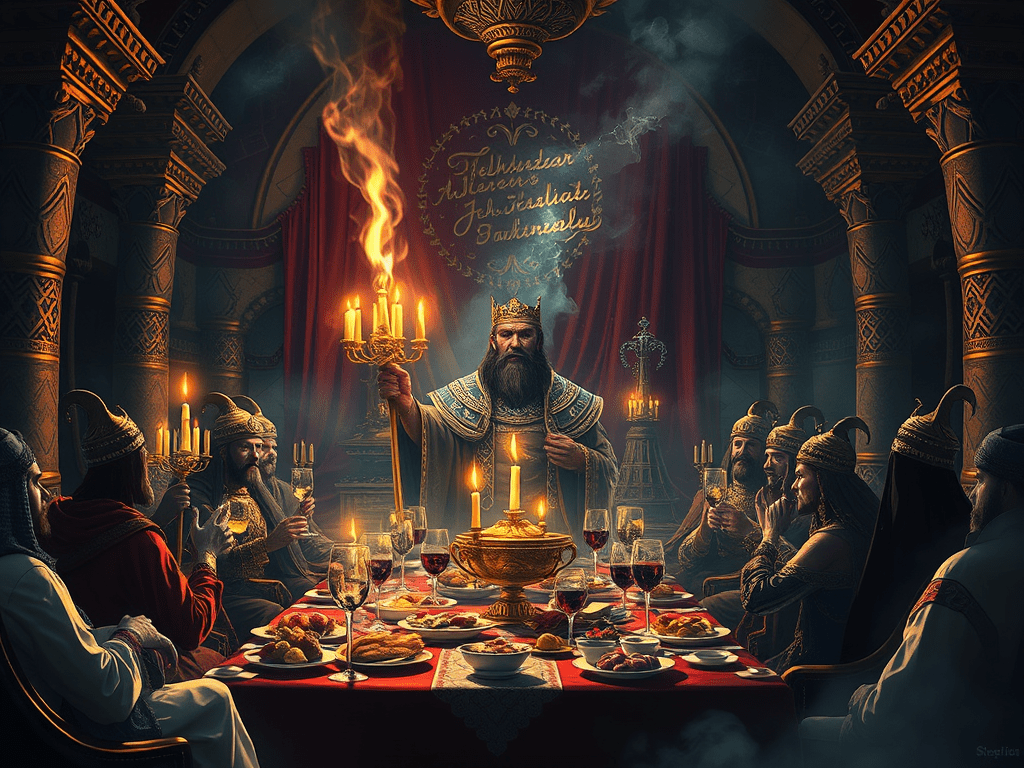
The Timeless Myth of Belshazzar’s Feast
In the Book of Daniel, chapter 5, we find one of the most dramatic stories in ancient scripture: Belshazzar’s Feast. A lavish banquet turns into a night of terror when a disembodied hand appears and writes mysterious words on the wall. The kingdom falls that very night. But beyond the historical account, this is a profound mythological tale about the inevitable collapse of any power built on arrogance, intoxication, and sacrilege.
1. Hubris and Sacrilege: The Banquet as Ritual Defiance
Babylon, in mythic terms, stands as the ultimate “anti-Temple”—a symbol of worldly power that rejects divine order. The banquet isn’t mere excess; it’s a deliberate act of defiance. King Belshazzar commands the sacred vessels looted from the Jerusalem Temple to be brought out. His guests drink wine from them while praising their gods of gold, silver, bronze, iron, wood, and stone.
This profanation is the core sacrilege: these vessels once held the divine presence. Using them to toast idols is hubris incarnate—the mortal claiming superiority over the sacred. It’s the height of arrogance, performed at the peak of empire.
2. The Omen: The Hand That Shatters Illusion
Suddenly, a hand appears, writing on the wall—illuminated, ironically, by the light of the stolen Temple lampstand. The sacred light exposes the profane doom.
Belshazzar’s reaction is visceral: his face pales, his limbs go slack, his knees knock together. This physical paralysis mirrors his moral collapse—the moment the tyrant’s illusion of invincible power crumbles before a higher force.
3. The Hero-Interpreter: Daniel’s Uncompromising Stand
The wise men fail, but Daniel—the exile who refuses to defile himself—is summoned. He deciphers the writing: “Mene, Mene, Tekel, Parsin.”
Before delivering the verdict, Daniel refuses the king’s rewards: purple robes, gold chains, high office. “Keep your gifts,” he says. His authority comes not from Babylon’s system but from allegiance to the divine. He is untouchable, the true hero bridging chaos and cosmic truth.
4. The Cosmic Verdict: Weighed on the Scales of Justice
The words form a threefold judgment:
- Mene: God has numbered your days; your reign is finite and ended.
- Tekel: You have been weighed on the scales and found wanting—your character, deeds, and rule insufficient.
- Parsin: Your kingdom is divided and given to the Medes and Persians.
That night, Belshazzar is slain, and Babylon falls. The scales of cosmic justice tip irrevocably.
Echoes in the Cycle of History
This myth resonates with the ancient observation of civilizational cycles: “Hard times create strong men, strong men create good times, good times create weak men, and weak men create hard times.”
Belshazzar’s story zooms in on the dangerous transition—good times breeding moral weakness, arrogance, and forgetfulness of limits, inviting sudden collapse. It’s a warning echoed in Greek tragedies (hubris-nemesis), Roman histories, and modern reflections on empires.
In an age where powers rise and boast at their zenith, the writing on the wall remains a timeless reminder: all human empires are weighed, and those built on sacrilege and pride will be found wanting.
Content developed with assistance of Gemini AI.
Blog edited with assistance of Grok AI
 Seized by Christ
Leave a comment