They are experiencing Christianity as joy and hope, having thus become lovers of Christ.

Category: Virtue & Effort

  • The Fall of the Tyrant: The Timeless Myth of Belshazzar’s Feast

    The Fall of the Tyrant: The Timeless Myth of Belshazzar’s Feast

    The Timeless Myth of Belshazzar’s Feast

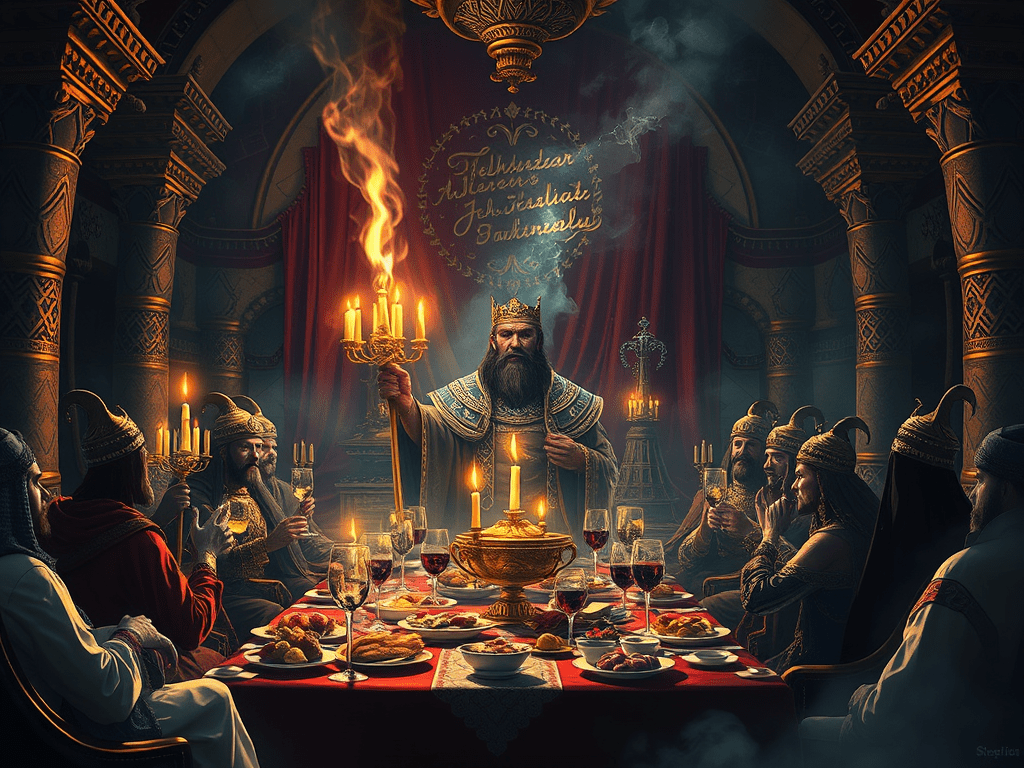
    In the Book of Daniel, chapter 5, we find one of the most dramatic stories in ancient scripture: Belshazzar’s Feast. A lavish banquet turns into a night of terror when a disembodied hand appears and writes mysterious words on the wall. The kingdom falls that very night. But beyond the historical account, this is a profound mythological tale about the inevitable collapse of any power built on arrogance, intoxication, and sacrilege.

    1. Hubris and Sacrilege: The Banquet as Ritual Defiance

    Babylon, in mythic terms, stands as the ultimate “anti-Temple”—a symbol of worldly power that rejects divine order. The banquet isn’t mere excess; it’s a deliberate act of defiance. King Belshazzar commands the sacred vessels looted from the Jerusalem Temple to be brought out. His guests drink wine from them while praising their gods of gold, silver, bronze, iron, wood, and stone.

    This profanation is the core sacrilege: these vessels once held the divine presence. Using them to toast idols is hubris incarnate—the mortal claiming superiority over the sacred. It’s the height of arrogance, performed at the peak of empire.

    2. The Omen: The Hand That Shatters Illusion

    Suddenly, a hand appears, writing on the wall—illuminated, ironically, by the light of the stolen Temple lampstand. The sacred light exposes the profane doom.

    Belshazzar’s reaction is visceral: his face pales, his limbs go slack, his knees knock together. This physical paralysis mirrors his moral collapse—the moment the tyrant’s illusion of invincible power crumbles before a higher force.

    3. The Hero-Interpreter: Daniel’s Uncompromising Stand

    The wise men fail, but Daniel—the exile who refuses to defile himself—is summoned. He deciphers the writing: “Mene, Mene, Tekel, Parsin.”

    Before delivering the verdict, Daniel refuses the king’s rewards: purple robes, gold chains, high office. “Keep your gifts,” he says. His authority comes not from Babylon’s system but from allegiance to the divine. He is untouchable, the true hero bridging chaos and cosmic truth.

    4. The Cosmic Verdict: Weighed on the Scales of Justice

    The words form a threefold judgment:

    • Mene: God has numbered your days; your reign is finite and ended.
    • Tekel: You have been weighed on the scales and found wanting—your character, deeds, and rule insufficient.
    • Parsin: Your kingdom is divided and given to the Medes and Persians.

    That night, Belshazzar is slain, and Babylon falls. The scales of cosmic justice tip irrevocably.

    Echoes in the Cycle of History

    This myth resonates with the ancient observation of civilizational cycles: “Hard times create strong men, strong men create good times, good times create weak men, and weak men create hard times.”

    Belshazzar’s story zooms in on the dangerous transition—good times breeding moral weakness, arrogance, and forgetfulness of limits, inviting sudden collapse. It’s a warning echoed in Greek tragedies (hubris-nemesis), Roman histories, and modern reflections on empires.

    In an age where powers rise and boast at their zenith, the writing on the wall remains a timeless reminder: all human empires are weighed, and those built on sacrilege and pride will be found wanting.

    Content developed with assistance of Gemini AI.

    Blog edited with assistance of Grok AI

  • 🕊️ The Holy Wisdom:

    🕊️ The Holy Wisdom:

    How to Live in the World Where the Wolf and the Lamb Lie Down

    I. The Shoot and the Sevenfold Spirit (The Mythological Order)

    The prophet Isaiah (11:1-10) gives us one of the most sublime visions of the Messianic Age. It begins with the Shoot from the stock of Jesse—the image of radical new life springing from seemingly dead roots. This is the ultimate Anointing, where the seven gifts of the Holy Spirit rest upon the Messiah: wisdom, insight, counsel, power, knowledge, and the fear of the Lord (with the fear of the Lord being his breath, emphasizing reverence).

    This Messianic rule immediately establishes a new cosmic order. It is an end to the primal chaos and conflict that has defined the world since the Fall.

    The imagery—the wolf lives with the lamb, the calf and lion feed together, the infant plays over the cobra’s hole—is pure Mythological Parallel. It evokes the Golden Age or Paradise Restored. . This is the reversal of the natural order of predation and fear. The country is not secured by armies, but by knowledge of the Lord.

    The key insight for us is that this peace is not merely external, but internal: it is the perfect integration of our own conflicting natures.


    II. The Internal Wolf and Lamb (Psychology of Integration)

    We all house the wolf and the lamb. We carry the panther (our wild, unchecked appetites) and the kid (our innocent, vulnerable soul).

    Psychologically, the division in Isaiah’s vision reflects the constant civil war within the human heart:

    • The Wolf/Lion: Represents the passions and the instinctual self—the power of the limbic system and the amygdala—that seek to consume, dominate, and survive at any cost.
    • The Lamb/Calf: Represents the vulnerable, gentle, and receptive spiritual self—the capacity for peace and trust.

    When we are disordered, the wolf preys upon the lamb. Our fear consumes our peace; our lust devours our innocence.

    The Messianic promise is that the Spirit of the Lord (which integrates the powers of wisdom and counsel with knowledge and fear) rests on the leader who reorders this inner landscape. The “little boy” who leads them is the pure Will, guided by Wisdom, that shepherds the powerful animal instincts without destroying them. The lion doesn’t disappear; it learns to eat straw like the ox.

    III. The Wisdom of Children (The Hero’s Revelation)

    How do we gain this integration? The Gospel provides the counterintuitive method.

    Luke 10:21-24 shows Jesus, filled with joy, praising the Father for “hiding these things from the learned and the clever and revealing them to mere children.”

    This is the great Inversion of Wisdom. It is the prerequisite for the Hero’s Revelation. The knowledge that brings true peace is not attained through academic complexity or ego-driven cleverness. It is revealed through humility and simplicity—the state of the “child.”

    • The “learned and the clever” rely on the strength of the Prefrontal Cortex for independent reasoning, often fueling the prideful “wolf” of the ego.
    • “Mere children” rely on trust and direct reception. They are open to the gift of the Spirit (the fear of the Lord—holy reverence) that unlocks true knowledge.

    Only through the eyes of a child can we see the chaos of our inner zoo and accept the reordering delivered by Christ’s Word. Only by becoming small and humble can the Spirit rest fully upon us.

    IV. Call to Action: Practicing the Reordering

    The goal of this Advent is to let the Spirit of the Lord settle upon us, creating that inner sanctuary where no creature does harm.

    Your call to spiritual transformation this week is to practice the Reordering of the Heart:

    1. Identify the Predator: Name the “wolf” in your heart. What is the one instinct (fear, anger, cynicism, lust) that consistently preys upon your peace (the “lamb”)?
    2. Invite the Shepherd: Don’t try to kill the wolf with brute force (that just creates more violence). Instead, invite the Spirit of the Lord into that conflict. When the urge to consume or strike arises, pause and ask for the Spirit of Counsel and Wisdom to lead that wild instinct, turning its energy toward a productive task (like the lion eating straw).
    3. Embrace the Child’s Vision: Seek to simplify your mind. Spend time in quiet prayer not trying to figure out God, but simply receiving Him. Like the Centurion we discussed, surrender the need to be clever. Only in the humility of the child is the fullness of the Lord’s knowledge revealed.

    Let us be the humble remnant, purified and ordered, on whom the Spirit rests, making our hearts glorious and ready for the King.

    Developed with assistance of Gemini AI

  • ⚔️ Hammering Swords into Ploughshares:

    ⚔️ Hammering Swords into Ploughshares:

    The Work of Vigilance

    I. The Journey to the Mountain (The Hero’s Call)

    The liturgical year turns today, beginning the season of Advent. Our destination is clear: The Mountain of the Temple of the Lord .

    The prophet Isaiah (2:1-5) gives us a stunning mythological vision: a towering peak, lifted higher than the hills, drawing all the nations—peoples without number—to learn God’s ways. The outcome of this pilgrimage is radical: “They will hammer their swords into ploughshares, their spears into sickles. Nation will not lift sword against nation.”

    This is the ultimate promise of Eternal Peace (Shalom) and the divine resolution to the problem of human violence.

    In terms of the Hero’s Journey, the journey up the mountain is the Call to Adventure—a call to leave the flat, ordinary world of conflict behind and ascend to the height of revelation. The Law (the oracle) goes out from this place, transforming the very tools of destruction (swords) into the tools of production (ploughshares).

    The pilgrimage is not just historical; it is deeply personal. What are the “nations” of conflict within us that must ascend to the peace of Christ?


    II. The Night and the Burglar (Psychology of Complacency)

    Saint Paul tells us in Romans (13:11-14) that “the night is almost over.” This night is not just a chronological time; it is a psychological state of spiritual drowsiness.

    Jesus illustrates this perfectly in the Gospel with two chilling metaphors: Noah’s Day and the Burglar.

    “If the householder had known at what time of the night the burglar would come, he would have stayed awake and would not have allowed anyone to break through the wall of his house.”

    The burglar represents the unforeseen collapse—the judgment, the crisis, or the moment of death. The wall of the house is the boundary of our interior life, our vigilance.

    Psychologically, the danger is not the outside event; it is the “coarsening” of the heart that makes us fail to stay awake. The twin enemies Paul names—drunkenness and the cares of life—are both methods of spiritual dullness:

    1. Drunkenness/Debauchery: Overloading the system with immediate pleasure, dulling the Prefrontal Cortex (our Will and highest reason) and making us incapable of long-term planning.
    2. Cares of Life: Overloading the system with chronic anxiety, perpetually triggering the Amygdala (our fear center).

    Both states keep us trapped in the Ordinary World, focused only on eating and drinking, leaving the walls of our soul unguarded. We mistake temporary comfort for eternal security.

    III. The Armour and the Ploughshare (The Spiritual Transformation)

    The call to action is immediate and profound: “Let us live decently as people do in the daytime: no drunken orgies, no promiscuity… Let your armour be the Lord Jesus Christ.”

    The transformation required to reach Isaiah’s mountain of peace is a dual effort:

    1. The Work of Divesting (Hammering Swords)

    We must actively give up the things we prefer to do under cover of the dark. This is the Refusal of the Return reversed—we refuse to stay comfortable in the darkness.

    The sword is the symbol of aggression, conflict, and self-defense. What are the swords in your heart?

    • The sword of wrangling (constant conflict).
    • The sword of jealousy (internal war against your neighbor).

    We are called to hammer these weapons into ploughshares—tools for tilling the inner soil, for producing the spiritual fruit of patience, charity, and peace. This process requires daily, painful penance and effort.

    2. The Work of Investing (Donning Armour)

    Paul instructs us: “Let your armour be the Lord Jesus Christ.”

    This is the Apotheosis and Return stage of the Advent journey. We don’t defend our walls with our strength; we defend our soul with Christ. We put on the Mind of Christ and the Virtues of Christ.

    When you are tempted to anger (the sword), your armour reminds you to respond with Christ’s peace. When you are tempted to dull your senses (the drunkenness), your armour reminds you that your Master is coming and you must be awake.

    IV. Call to Action: Walking in the Light

    This Advent, the call is simple: Walk in the light of the Lord.

    The mountain of the Temple is waiting. We are not called to build the perfect society right now, but we are called to build the perfect sanctuary in our own heart. We must make our inner Jerusalem ready for the Prince of Peace.

    Your practical commitment this week is to Vigilance.

    • Identify the Burglar: Name one specific area of your life where you have “allowed someone to break through the wall of your house”—where you are dulling your heart. (e.g., excessive scrolling, obsessive worrying, casual gossip).
    • Hammer the Sword: Take one daily tool of conflict (wrangling, jealousy) and consciously begin to turn it into a tool of peace (patience, prayer).
    • Stay Awake: Resolve to spend your time and energy not on the “cares of life,” but on the saving help Christ offers, so that you are prepared to stand ready.

    Let us walk in the light. Let us start hammering our swords.

    Developed with assistance from Gemini AI

  • “Wake Up and Walk in the Light: Advent and the Great Human Awakening”

    “Wake Up and Walk in the Light: Advent and the Great Human Awakening”

    A 10–15 minute Advent reflection

    Isaiah 2:1-5; Psalm 121(122):1-2,4-5,6-9; Romans 13:11-14; Matthew 24:37-44

    Today is the First Sunday of Advent—the beginning of the Church’s year.
    And the very first word the Church gives us is: Wake up.

    Not “be cozy.”
    Not “ease into the holidays.”
    But Wake up.
    Be alert. Open your eyes.
    Something is coming.
    Someone is coming.

    And the way Scripture tells the story today, this awakening is not optional.
    It is the difference between remaining asleep in the old world—or stepping into the new creation God desires for us.


    1. Isaiah’s Mountain: The Call of the Hero at Dawn

    The prophet Isaiah begins with a vision of the “days to come.”
    He sees Mount Zion—the Temple mountain—lifted above all other mountains.
    Nations stream toward it.
    People without number ascend the hill saying:

    “Come, let us go up to the mountain of the Lord… that he may teach us his ways.”

    This is the biblical version of the call to adventure—the moment in every great myth when humans are summoned upward, summoned out of the ordinary world and toward a divine encounter.

    The mountain is a universal symbol in myth:

    • Mount Olympus for the Greeks
    • Mount Meru in Hindu cosmology
    • Sinai for Moses
    • Tabor for Christ

    The mountain always represents the highest meaning, the place where heaven and earth meet, where God reveals Himself, and where human beings are changed.

    Isaiah’s point is clear:
    Humanity’s future is not down in the valley of violence, distraction, and conflict.
    Our future is an ascent.
    A pilgrimage.
    A transformation.

    Psychologically, this ascent points to the integration of the self—the movement from fragmentation to unity, from instinct-driven living (the lower brain layers) toward a life governed by truth, conscience, and grace (the highest faculties).

    Isaiah describes the result of this ascent:

    “They shall beat their swords into ploughshares.”

    This is transformation—not by force, but by teaching, by truth, by hearing God.
    The weapons of self-destruction become the tools of cultivation.
    What once harmed now heals.

    This is what happens when a person climbs the mountain of the Lord.


    2. “I Rejoiced When I Heard Them Say”: The Joy of a Heart That Is Waking Up

    The psalm today echoes the upward movement:

    “I rejoiced when I heard them say: ‘Let us go to God’s house.’”

    This is the joy of someone who has heard the call.
    Someone whose feet are already on the path.
    Someone who has realized:
    My home is not here. My destiny is above.

    Psychologically, this is the movement from numbness to desire.
    From apathy to longing.
    From spiritual sleep to spiritual hunger.

    St. Augustine described it as the “weight of love” lifting the soul upward.

    Every Hero’s Journey begins—not with skill or strength—but with desire, the dawning awareness that “There must be more.”

    Advent awakens that desire.


    3. St. Paul: “Wake Up Now” — The Battle Between Night and Day

    Then St. Paul tells us plainly:

    “You know the time.
    The night is almost over.
    The day is at hand.
    Wake up now.”

    Paul speaks here like a drill sergeant of the soul.
    He knows we like comfort.
    We like the dark because our weaknesses hide there.
    But Paul says:

    “Give up the things done under cover of darkness…
    and put on the armor of light.”

    This is spiritual psychology at its sharpest.

    The “night” represents:

    • impulsivity
    • old habits
    • addictions
    • self-deception
    • sin we have learned to tolerate

    The “day” represents:

    • clarity
    • responsibility
    • moral courage
    • virtue
    • the renewing power of Jesus Christ

    Paul says:
    Do not wait until you feel ready. Light never begins with readiness.
    It begins with decision.

    Mythologically, this is the moment when the hero must leave home.
    Leave comfort.
    Leave childishness.
    The doorway to the adventure is dawn—and dawn always interrupts our sleep.


    4. Jesus in the Gospel: The Flood Comes to the Spiritually Asleep

    Now Christ speaks the hardest words of the day:

    “As in the days of Noah, so will it be at the coming of the Son of Man.”

    People were living as if nothing mattered:

    • eating
    • drinking
    • marrying
    • working

    None of these are evil.
    The problem is not the activities—it is the unconsciousness with which people lived.

    They were asleep inside their own lives.

    The Flood did not simply wash away bodies—it washed away illusions.
    It revealed who was awake and who was not.

    Then Jesus gives His teaching with startling urgency:

    “Stay awake…
    Stand ready…
    The Son of Man is coming at an hour you do not expect.”

    This is not meant to frighten us—it is meant to awaken us.

    Jesus is not warning about the end of the world;
    He is warning about the end of your illusions.
    The end of self-deception.
    The end of sleepwalking through life.

    In psychological terms, Jesus is calling us to conscious living—to a life where we no longer hide behind distraction, addiction, work, or noise.


    5. The Hero’s Journey of Advent

    Advent is the beginning of the Church’s New Year, but it is also the beginning of your own Hero’s Journey.

    The pattern is always the same:

    1. The Call — “Come, let us go up to the mountain of the Lord.”
    2. The Awakening — “I rejoiced when I heard them say…”
    3. The Separation — “The night is almost over… put on the armor of light.”
    4. The Testing — “Stay awake, for you do not know the hour…”
    5. The Transformation — Christ born in the soul, illuminating everything.
    6. The Return — A transformed life that brings peace and grace to others.

    Mythologies echo this pattern because they echo the deepest truth of the human spirit:
    We were made for ascent.
    We were made for God.


    6. A Call to Action: How to Begin Your Advent Awakening

    Here is the practical challenge of the Gospel:

    1. Identify where you are asleep.

    Where have you allowed routine, distraction, or sin to dull your conscience?
    What parts of your life run on autopilot?

    2. Begin one concrete act of awakening.

    • Set a real prayer time.
    • Go to Confession.
    • Fast from a comfort that keeps you numb.
    • Read Scripture daily.
    • Reconcile with someone.

    3. Put on the armor of light.

    Don’t wait to “feel holy.”
    Act first.
    The feelings follow.

    4. Live today as if the Lord is near—because He is.

    Advent is not pretend.
    It is training.
    It is rehearsal for the real coming of Christ—
    in death,
    in judgment,
    in the Eucharist,
    in grace,
    in the quiet call of conscience.

    5. Make this Advent your turning point.

    Advent is not about nostalgia.
    It is about awakening.

    Christ does not want to catch you off guard.
    He wants to find you alive.


    7. Conclusion: Walk in the Light of the Lord

    Isaiah ends his vision with a simple command:

    “O house of Jacob, come—
    let us walk in the light of the Lord.”

    This is the entire Gospel in one sentence.

    Walk.
    Move.
    Begin.
    Awaken.
    Step toward the mountain.
    Let the Lord teach you His ways.
    Let His light pierce your darkness.
    Let Christ become your armor.

    And when the Son of Man comes—today, tomorrow, or at the end of your life—may He find you wide awake, standing ready, rejoicing to enter the house of the Lord.

    Amen.

    Developed with assistance from ChatGPT-5
  • One Bead, Three Charity Bombs: Ignite the Third Hail Mary

    One Bead, Three Charity Bombs: Ignite the Third Hail Mary

    You’re at the start of the Rosary.

    First bead → Faith (blank map → step; Host → Him; hard thing → anyway).

    Second bead → Hope (pain → temp; failure → fuel; dead-end → done).

    Third bead rolls in:

    “Hail Mary… increase in us charity…”

    …and your heart quietly files for bankruptcy.

    Not anymore.

    Here are three 30-second love detonators to drop before or during that final Hail Mary.

    Pick one. Pick all. Just make it explode.

    Detonator #1 – WILL THEIR HEAVEN, NOT MY COMFORT

    Charity isn’t warm fuzzies. It’s ruthless goodwill.

    Your move:

    Before the prayer, name the person who makes your skin crawl.

    Picture Jesus dying for THEM too.

    Pray: “I want heaven for them—even if they never say sorry.”

    Detonator #2 – DIE A LITTLE, RIGHT NOW

    Real love always kills part of you so someone else can live more.

    Your move:

    During the Hail Mary, pick one concrete discomfort today (skip the reply, take the blame, send the money, shut up).

    Offer it for that person.

    Whisper: “This tiny death is my love letter.”

    Detonator #3 – BORROW MARY’S HEART (SHE’S LOANING)

    She watched her Son butchered and her heart didn’t shrink—it stretched.

    Your move:

    While the words roll, beg: “Mom, lend me your Immaculate Heart for 30 seconds.”

    Feel it expand.

    Then go love with hers because yours is broke.

    TL;DR (because brain)

    Want their heaven > want my comfort.

    Die small today.

    Borrow Mary’s heart.

    Screenshot this.

    Next time that third bead hits your fingers, drop the love bomb.

    Series complete: Faith ✓ Hope ✓ Love ✓

    Stay dangerous, stay Catholic.

  • Charity Is a Supernatural Virtue

    Today when people hear the word “charity,” they often think of donations, fundraisers, or volunteer work. These are good things, but they only scratch the surface of what charity really is.

    In Christian teaching, charity—caritas—is not simply kindness or generosity. It is a supernatural virtue. Saint Paul places it above even faith and hope:

    “Now abideth faith, hope, charity, these three; but the greatest of these is charity.” (1 Cor 13:13)

    Why is charity the greatest? Because it is not something we generate on our own. It is God’s own love, poured into our hearts by grace, enabling us to love as He loves.

    The Natural Foundation

    Even without revelation, human beings are inclined to goodwill toward others. Aristotle called this eunoia—acting with the good of others, and the common good, in mind. This is a natural virtue, and it is real. We can see it in acts of kindness, civic friendship, and common concern for neighbors and strangers alike.

    Yet, natural virtue is fragile. It can be easily distorted by pride, fear, or selfishness.

    Grace Perfects Nature

    Christ calls us beyond this natural level:

    “Be ye perfect, even as your heavenly Father is perfect.” (Mt 5:48)

    On our own, we cannot attain such perfection. But grace builds on nature and lifts it higher. When God infuses charity into the soul, it transforms natural goodwill into supernatural love. We are empowered to love not only as we would want to be loved, but as Christ Himself loves—freely, fully, and sacrificially.

    The Freedom of Love

    Aristotle observed that no act is virtuous unless it is voluntary. Forced “charity” is no charity at all. The same holds true in the supernatural order: Christian love must be freely chosen. It is a gift of grace, but also a response of the heart.

    That is why true charity is always personal. It is not only about writing a check or supporting a program. It is about opening the heart to God and to others—loving in freedom, with the very love of Christ that has first been given to us.

    Edited with assistance of ChatGPT-5

  • Are You Truly Awake?

    Are You Truly Awake?

    Why Faith Needs Daily Self-Denial

    “Now it is high time to awake out of sleep.” — Romans 13:11

    Many of us go through life half-awake—spiritually asleep without realizing it. We may hear the truth, see God’s work in the world, even attend church—but we live as if it’s all just background noise. We mix reality with imagination, and even brief awakenings fade quickly.

    In earlier times, faith was tested by persecution. Early Christians showed courage and joy in suffering because truth demanded sacrifice. Today, faith is easier to display. Religion is respected, even fashionable. Outward appearances of devotion—family prayer, Bible reading, church attendance—are common.

    But here’s the danger: it’s easy to follow God for the wrong reasons—social approval, habit, convenience—rather than love. True faith often goes against the crowd. The Gospel challenges human nature. Real discipleship isn’t about looking good in public; it’s about living rightly when no one is watching.

    So how do we know our faith is real? Jesus gives the answer: self-denial. “If anyone would come after Me, let him deny himself, take up his cross, and follow Me.” (Mark 8:34) Faith is tested not in heroic moments but in daily choices—small sacrifices, resisting laziness, controlling anger, yielding in minor matters, or doing what’s inconvenient for God’s sake.

    Look at your weakest points—your temptations, habits, and hidden struggles. That’s where your cross is. That’s where your faith is proven. Small, consistent acts of self-denial—fasting, discipline, service—train your heart and strengthen your will for greater challenges.

    Even the best of us fail. That’s why we need constant repentance, Christ’s forgiveness, and the guidance of the Holy Spirit. But if we take obedience seriously, faith becomes alive. We awaken fully, living each day for God, confident in His grace and presence.

    Wake up. Take up your cross daily. Live as if your faith truly matters—and watch your life transform.

    Reference:

    Newman, John Henry. Sermon 5: Self-Denial the Test of Religious Earnestness. Newman Reader — Works of John Henry Newman. National Institute for Newman Studies, 2007.

    Developed with assistance from ChatGPT

  • Praying and Doing

    The Battle We’re Called to Fight

    “You can’t just pray and do nothing. And you can’t just do and forget to pray. Victory requires both.”

    This Sunday, the deacon shared a story that stuck with me. A soldier, preparing for battle, asked a priest:

    “If God already knows the outcome, why do we need to pray? If He wants us to win, we’ll win. And if He wants us to lose, we’ll lose.”

    The priest thought for a moment and asked in return:

    “If the outcome is already determined, why are you putting on your armor and picking up your sword?”

    That hit home.

    Just like the soldier needs armor and a sword to stand a chance in battle, we need the armor of God and the power of prayer to face the spiritual battles in our lives. But it’s not one or the other—it’s both.

    Too often, we fall into one of two traps:

    • We pray, but we don’t act.
    • Or we act, but we forget to pray.

    But true Christian life—true victory—requires both faith and action. We must pray as if everything depends on God… and then go out and live, serve, speak, and love as if everything depends on us.


    A Faith That Moves

    This reminds me of James 2:16:

    “If one of you says to them, ‘Go in peace; keep warm and well fed,’ but does nothing about their physical needs, what good is it?”

    Prayer should move us to action. It draws us closer to God and closer to those He puts in our lives. When we pray for someone, it’s not just words. It’s a moment of deep connection that should stir us to respond.


    The Armor of God Is for Battle

    We don’t wear spiritual armor to sit in the pew and wait for God to fix things. We wear it because we are in a battle.

    • A battle for truth
    • A battle for love
    • A battle for souls
    • A battle for the broken

    Prayer prepares us. But we must still show up—with courage, sacrifice, and love.


    Summary: Pray. Then Go.

    The message is simple:

    • Don’t pray without doing.
    • Don’t do without praying.
    • God doesn’t need our armor or action—but He chooses to work through them.

    When we pray with faith and act with love, we become part of God’s answer to the world’s cries.


    ✍️ Reflect & Respond:

    • Who are you praying for right now?
    • Is there a way God might be asking you to take action for them?
    • Are there battles in your life where you’ve been waiting—but not fighting?

    🔔 Like what you’re reading?

    Subscribe, share, or comment below—and join the journey of living fully alive in Christ.

    Written with assistance from ChatGPT

  • False Mercy: When Help Hurts

    Why some forms of charity can do more harm than good — and how to offer real support instead

    We all want to help. We see someone struggling, and we reach for kindness. We give money, offer shelter, send the care package.

    But sometimes, the very thing we do to help… ends up holding someone back.

    That’s what we mean by false mercy.


    What Is False Mercy?

    False mercy looks like kindness.
    It feels like compassion.
    But in reality, it removes the opportunity for growth.

    It’s the kind of help that:

    • Solves a problem for someone instead of with them
    • Removes consequences that are meant to teach
    • Replaces responsibility with rescue
    • Makes us feel good, but leaves the other person stuck

    When Help Becomes Harm

    Imagine this:

    A young man is floundering. He can’t hold a job. He avoids responsibility.
    His parents step in to pay rent. Then groceries. Then car insurance.

    Now he has no pressure to grow, no urgency to change, and no sense of agency.

    What looked like love became a trap.
    What felt like mercy became a cage.

    This isn’t rare — it’s happening all around us.
    In families. In schools. In churches. In governments.

    And it often starts with good intentions.


    Charity Without Challenge

    Indiscriminate charity — the kind that gives with no structure, no expectation, and no relationship — can do more than waste resources.

    It can:

    • Block transformation
    • Reduce dignity
    • Delay calling
    • Send the message: “You can’t do this on your own.”

    That’s not love.
    That’s quiet sabotage.


    The Call Must Be Answered — Personally

    In every story worth telling, the hero has to choose.

    • The Prodigal Son had to return on his own feet
    • Moses had to leave the wilderness and face Pharaoh
    • You had to go back to school and finish your degree

    The turning point always requires agency.

    And when we step in too hard, too soon, or too often…
    We may be keeping someone from their turning point.


    So How Do We Truly Help?

    We don’t need less compassion — we need wiser compassion.

    Here’s what that can look like:

    • Support with accountability
      → “I believe in you. What are you going to do next?”
    • Help that invites responsibility
      → “I’ll match your effort — not replace it.”
    • Challenge as a form of care
      → “You’re capable of more. I won’t take that from you.”
    • Trust in someone’s potential
      → “I won’t rescue you because I respect you too much.”

    Real Mercy Looks Different

    It doesn’t always feel soft.
    It doesn’t always feel “nice.”

    But it’s the kind of love that leads to real growth, not quiet dependency.

    Because real mercy doesn’t remove the fire.
    It walks beside someone through it — and trusts that they will rise.

  • 🎺 Trouble in River City

    Why America Needs a Hero’s Journey, Not Just a Marching Band

    How The Music Man, myth, and modern comfort expose our spiritual apathy—and what we can do about it

    What if America’s crisis isn’t scarcity—but too much abundance with too little meaning?

    There’s an old quote—often attributed to Alexander Tyler—that outlines the cycle of civilizations. It begins in bondage, rises through faith, courage, and liberty, peaks in abundance, and then falls through complacency, apathy, and dependence, finally returning to bondage. If that cycle rings true, we have to ask: Where is America right now?

    Most signs point to somewhere between abundance → complacency → apathy. And that’s why so few seem interested in growing in faith, taking on responsibility, or answering the call of purpose. We’re not hungry for transformation—because we don’t feel the need.

    But here’s the problem: bondage doesn’t always look like chains.

    Sometimes, it looks like endless entertainment. Like ultra-comfortable lives that make us restless, numb, and detached. In other words, like a pool hall in The Music Man.


    🎱 “Ya got trouble… right here in River City!”

    In Meredith Willson’s The Music Man, Professor Harold Hill warns the town of River City that their boys are sliding into ruin—through the game of pool. Of course, he’s a con man, using fear to sell band instruments. But there’s an ironic twist:

    He’s right.

    The pool hall becomes a symbol of a deeper drift. The boys aren’t just wasting time—they’re losing direction, virtue, and vitality. Hill’s proposal—form a boys’ band—is more than a scam. It accidentally becomes a call to purpose, discipline, and beauty.

    That’s myth in action. Even flawed messengers can stir people toward the Hero’s Journey.


    🧭 Apathy is a disguised form of bondage

    In myth, bondage is always the starting point. Think of Israel in Egypt, Odysseus stranded far from Ithaca, or Luke Skywalker stuck on a desert farm. There’s always something wrong, and the Hero must see it before he can leave it.

    But what if the enemy isn’t external?
    What if it’s spiritual numbness?
    What if our “Egypt” is a dopamine-soaked feed full of shallow pleasures?

    In that case, we’re in bondage—and we don’t even know it.

    That’s why abundance alone won’t save us. It’s not enough to be comfortable—we need to be called. Until people realize they’re stuck, they won’t rise. And that’s where myth, music, and moral imagination can crack open a soul.


    🎺 The Band Must Play

    In the end, The Music Man is a strange but beautiful parable.

    • The boys need something higher to aim at.
    • The town needs to remember what virtue looks like.
    • And even the con man finds redemption when he stops running and chooses to care.

    Today, we don’t need another hustle. We need a band—a higher aim, a moral discipline, and a song to march toward.

    The Hero’s Journey always begins in bondage. But only if we see it. Only if we hear the call.

    So let the music start.

    Written in collaboration with ChatGPT (OpenAI, 2025)