They are experiencing Christianity as joy and hope, having thus become lovers of Christ.

Category: Conscience, Discernment, and Hearing God

How to recognize God’s voice—and navigate the inner life with integrity and clarity.

  • Build on the Rock:

    Build on the Rock:

    A Hero’s Journey of Real Spiritual Transformation

    Thursday, December 4th — Advent Reflection

    Readings: Isaiah 26:1–6 • Psalm 118 • Matthew 7:21,24–27
    Liturgical Color: Violet (Advent)

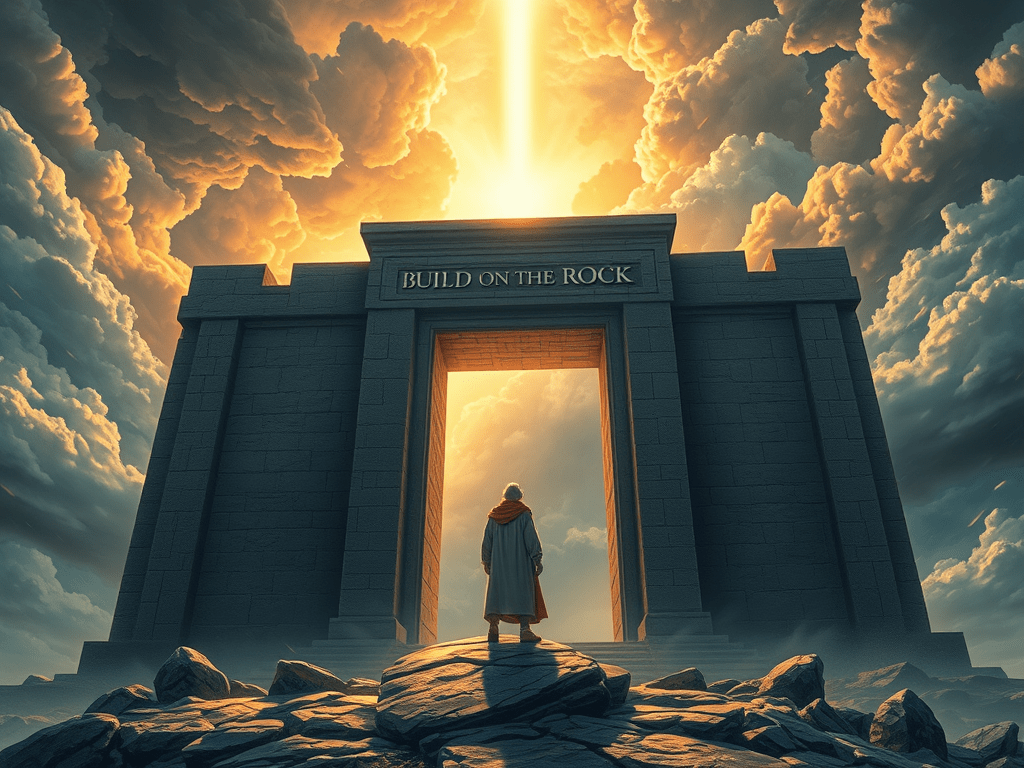
    Advent is a season of waiting, watching, and rebuilding the inner life. The readings for today speak with a single voice: your soul must be founded on the Rock, because storms will come. Not just external troubles, but the storms inside the human heart—fear, temptation, pride, confusion, and despair.

    Isaiah, the Psalmist, and Jesus Himself give us three images:
    a strong city, a sacred gate, and a house on solid rock.
    Together, they outline the path of every spiritual hero—from the prophets, to the saints, to ordinary men and women trying to follow God today.

    Let’s walk through the readings with Catholic wisdom, mythological insight, and psychological truth—so we can act on them, not just hear them.


    Isaiah: Open the Gates and Enter the Strong City

    Isaiah sees a vision of the soul as a strong city, built by God Himself:

    “We have a strong city… Open the gates! Let the upright nation come in… Trust in the Lord forever, for the Lord is the everlasting Rock.”

    The imagery is rich and precise:

    • The city is the human soul
    • The walls and ramparts are the virtues that protect us
    • The gates are the choices of the will

    Only those who trust in the Lord, who keep their minds “steadfast,” can enter.

    In mythic language, this moment is the hero approaching the threshold.
    Every great story has this scene:

    • Odysseus at the gates of the underworld
    • Aeneas at the temple doors
    • Frodo at the borders of Mordor
    • Christ at the entrance of the tomb

    But Scripture adds something deeper:
    The strength of the city is not your own willpower. God Himself is the foundation.
    The hero does not face chaos alone. The hero faces chaos with God.


    Psalm 118: The Gate of Holiness

    The Psalm continues the same theme:

    “Open to me the gates of holiness… This is the Lord’s own gate where the just may enter.”

    The pilgrim approaches the Temple and knocks. The question from inside is implied:
    Who may enter?

    The answer is not:

    • “I am strong.”
    • “I am important.”
    • “I have influence.”

    The answer is:
    “The Lord is my refuge.”

    Psychology says the same:
    When your core identity rests on anything unstable—success, emotions, reputation, strength—your inner world collapses when those things shift.
    But when identity rests on God, the soul stands firm.


    Jesus: Build Your House on the Rock

    In the Gospel, Jesus gives the image most people know:
    Two builders. Two foundations. Two futures.

    But He adds a detail that cuts straight to the heart:

    Both men hear His words. Only one acts.

    This is the decisive moment of the Hero’s Journey—when knowing is no longer enough.
    The hero must obey.
    The hero must choose.
    The hero must cross the threshold into action.

    Jesus says plainly:

    “Everyone who listens to these words of mine and acts on them will be like the wise man who built his house on rock.”

    Storms hit both houses.
    Faith does not guarantee ease.
    Faith guarantees endurance.


    The Psychology: Two Builders, Two Brains

    There’s a psychological layer here too.

    The house on rock

    represents a life governed by the higher faculties:

    • Reason
    • Conscience
    • Long-term vision
    • Stability
    • Sacrifice
    • Grace-supported will

    The house on sand

    represents a life governed by the lower systems:

    • Impulse
    • Emotion without discipline
    • Ego and appearance
    • Social pressure
    • Immediate pleasure

    Neuroscience confirms what Scripture teaches:
    When stress comes, the “lower” regions dominate unless the higher faculties are formed and anchored.

    Storms—suffering, fear, temptation, failure—expose the foundation of the soul.


    Mythic Parallels: Every Hero Faces the Storm

    Every ancient story knows this truth:

    • Gilgamesh meets the flood
    • Jonah meets the tempest
    • Odysseus meets the sea
    • Aeneas meets the burning city
    • Christ meets the Cross

    Heroes are not defined by the absence of storms, but by the strength of their foundation.

    Myths point to it.
    Psychology explains it.
    Catholic faith reveals it:
    The foundation is Christ Himself.


    Catholic Exegesis: The Rock Has a Name

    The Church Fathers are unanimous:

    • Christ is the Rock (1 Cor 10:4)
    • His teaching is the Rock
    • The Church is the Rock
    • Grace that strengthens the will is the Rock

    St. Augustine:
    “The house is faith; the foundation is Christ.”

    St. Gregory the Great:
    “To hear without acting is to build in the imagination.”

    St. Thomas Aquinas:
    “The foundation of the spiritual life is humility.”

    So the Rock is not self-help.
    The Rock is not moralism.
    The Rock is not positive thinking.

    The Rock is a Person.
    A relationship.
    A covenant.
    A surrender.


    How to Build on the Rock Today

    Here is the practical plan Jesus gives:

    1. Listen to His words

    Read Scripture.
    Study the faith.
    Let the Church teach you.

    2. Act on His words

    Do one concrete thing today:
    Forgive.
    Pray.
    Serve.
    Confess.
    Cut out a vice.
    Re-establish order.

    The hero’s gate is action.

    3. Trust God more than yourself

    Say:
    “Lord, I want Your will more than comfort.”

    4. Build habits that hold under pressure

    Virtue is spiritual architecture.
    The sacraments are reinforcement beams.
    Prayer is the daily maintenance.

    5. When the storm comes, choose to stand

    Do not fear the wind.
    Do not panic at the rain.
    Do not believe the lie that you are alone.

    The storm is not your enemy.
    The storm reveals your foundation.


    The Call: Enter the Gate. Stand on the Rock.

    Advent invites you to rebuild your life on Christ.

    Isaiah says: Enter the city.
    The Psalm says: Come through the gate.
    Jesus says: Stand on the Rock.

    The message is simple and strong:

    Your life has a structure.
    Your soul has a destiny.
    Your choices build a house that will either stand or fall.

    So today, choose to act.
    Choose to trust.
    Choose to build.
    Choose the Rock.

    And when the rains fall and the floods rise and the winds tear at everything—
    you will stand.
    And your endurance will give glory to God.

    Developed with assistance from ChatGPT-5

  • One Bead, Three Hope Bombs: Ignite the Second Hail Mary

    One Bead, Three Hope Bombs: Ignite the Second Hail Mary

    You’re at the start of the Rosary.

    First bead: “increase in us faith.”

    (If you missed it, we lit that fuse yesterday: blank map → step; Host → Him; hard thing → anyway.) One Bead, 3 Faith Bombs:

    Now the second bead rolls in:

    “Hail Mary… increase in us hope…”

    …and your mind blanks again.

    No more.

    Here are three 30-second mental detonators to drop before or during that single Hail Mary.

    Pick one. Pick all. Just make it explode.


    Detonator #1 – ANCHOR YOUR HEART IN HEAVEN

    Scene: Every cross you carry is a temp rental.

    Heaven is the forever address.

    Your move:

    Before the prayer starts, picture your heaviest pain nailed to the Cross—then vanishing at the empty tomb.

    “I bank on eternity, not the invoice.”


    Detonator #2 – GOD RECYCLES FAILURES INTO GLORY

    Fact: Your worst faceplant is raw material.

    Joseph: sold → pit → prison → palace.

    Your move:

    During the Hail Mary, hand God one specific failure.

    Whisper: “Turn this trash into throne.”

    (Pro tip: He’s the ultimate up-cycler.)


    Detonator #3 – RESURRECTION ALREADY CASHED THE CHECK

    Fact: Christ rose. Death lost. Hope won.

    Your move:

    Name one dead-end staring you down today.

    Lock eyes on the Risen One while the words roll.

    “I rest in the victory lap already run.”


    TL;DR (because scroll)

    Pain → temp.

    Failure → fuel.

    Dead-end → done.

    Screenshot this.

    Next time that second bead hits your fingers, light the fuse.

    Love bead dropping soon—stay locked in, stay Catholic.

  • One Bead, Three Faith Bombs: Ignite the First Hail Mary

    One Bead, Three Faith Bombs: Ignite the First Hail Mary


    You’re at the start of the Rosary.

    The first bead rolls under your thumb.

    “Hail Mary… increase in us faith…”

    …and your mind blanks.

    No more.

    Here are three 30-second mental detonators to drop before or during that single Hail Mary.

    Pick one. Pick all. Just make it explode.


    Detonator #1 – TRUST THE UNSEEN PROMISE

    Scene: Abraham, 75, no map, no preview.

    God: “Pack up. I’ll show the land… later.”

    Abe: “Let’s go.”

    Your move:

    Before the prayer starts, picture your unknown road.

    That nudge you’re dodging?

    Step onto the dirt.

    “I trust the Giver, not the preview.”


    Detonator #2 – JESUS IS LITERALLY HERE

    Fact: The Eucharist isn’t symbolic.

    It’s Body, Blood, Soul, Divinity.

    Storm-calmer → 1-inch host.

    Your move:

    During the Hail Mary, zoom in on the tabernacle.

    Whisper: “You’re in there. I believe—even if feelings bail.”

    (Pro tip: imagine the Host glowing like it holds the universe. It does.)


    Detonator #3 – FAITH IS A VERB ON MUTE

    Feelings: “This is trash.”

    Circumstances: “Quit.”

    Faith: “Still moving.”

    Your move:

    Name one hard act for today—forgive, pray, show up.

    Lock it in as the words roll.

    “I obey when everything screams stop.”


    TL;DR (because scroll)

    1. Blank map → step.
    2. Host → Him.
    3. Hard thing → anyway.

    Screenshot this.

    Next time that first bead hits your fingers, light the fuse.Hope bead dropping soon—stay locked in, stay Catholic.

  • Inventio:

    Inventio:

    Finding Before Creating

    In classical rhetoric, inventio was the very first step in preparing a speech. It meant discovering the arguments or proofs already available to support your case. The orator didn’t create truth—he uncovered it, drew it out, and presented it persuasively.

    This same spirit carries into the life of faith. We don’t create the truths of God. We don’t design our own reality. Instead, we are called to find what God has already revealed, to discover His grace present in the world, and to allow our lives to bear witness to it.

    Think of the way we form relationships. A stranger gradually becomes an acquaintance, a friend, and perhaps even a close companion. We don’t create that person; we discover who they are through time and trust. Faith works in the same way—truth draws closer to us as we seek it, until it becomes intimate and lived.

    The modern world often prizes “creativity” in the sense of originality. But for Christians, true creativity begins with discovery. Before we can offer something beautiful, we must first receive what is already there.

    Think of an artist painting a landscape. He doesn’t invent the mountains, trees, or sky. He finds them, attends to them, and renders them in a new way. So it is with us—we must first seek and find God’s truth before we can share it with others.

    What would happen if we lived our faith this way? Instead of trying to invent our own way to God, we would practice inventio—the humble, attentive discovery of His presence in Scripture, in tradition, in the sacraments, and in the quiet places of our daily lives.

    Our task, then, is not to create faith but to uncover it. Not to invent truth but to find it. And once we do, the act of creation follows naturally, as our words, our lives, and our love give new expression to what we have discovered.

    Developed with assistance from Gemini AI and ChatGPT-5

  • From christian to Christian: The Heart of Vocations

    Vocations start with knowing Christ — the decisive question every Catholic must face

    Introduction

    In our previous blogs, we examined priestly vocations first through statistics, then through seven questions from Catholic to consecrated vocation. But even those questions assume something deeper: a man must already know Christ to respond faithfully. Without that encounter, the questions remain unanswered, the call unnoticed.

    This is where Cardinal Joseph Ratzinger (Pope Benedict XVI) offers a decisive lens for understanding vocations and Christian life itself. He asks:

    Have you experienced an event or person which gives life a new horizon, and a decisive direction? Do you experience it as joy and hope? Are you inwardly seized by Christianity, and have you become a lover of Christ?

    This is the question behind all vocations. Many Catholic men do not pursue the priesthood, not because of celibacy or rules, but because they have never fully experienced Christ in this way.


    The Core Reality

    A vocation is not primarily about a career path, a calling to serve a group, or a set of obligations. It is about responding to a personal encounter with Christ.

    • If a man has not experienced this decisive horizon in his life, celibacy will always seem like an obstacle.
    • If a man does not trust God with his life, obedience to a religious community will feel impossible.
    • If a man does not recognize the presence of Christ in others, service will seem burdensome.

    In other words, the foundation of all vocations is being seized by Christ Himself. All the statistical analyses, discernment questions, and organizational structures build on this first encounter. Without it, the rest is form without life.


    Creating Environments for Encounter

    This insight also shows what the Church can do to support vocations: create spaces and experiences where people can meet Christ personally. This is not just about instruction, programs, or prayer for vocations — it is about real-life encounters, mentorship, and communities where faith comes alive.

    As I have often reflected: when I pray for more workers in the harvest, God often shows me what I can do to move things forward. We cannot simply hope for miracles; we can build environments that foster encounter, trust, and spiritual growth.


    Conclusion

    The question for vocations — and for Christian living — is not primarily about celibacy, obedience, or even statistics. It is about Christ taking hold of a person’s life.

    Without that encounter, no numbers, programs, or rules will generate vocations. With it, even one man saying “yes” can change countless lives.

    Vocations begin at the heart, and the heart begins with Christ.

    Developed with assistance from ChatGPT-5

  • Seven Questions from Catholic to Consecrated Vocation

    From possibility to discernment — a practical guide for those considering priesthood or consecrated life

    Introduction: From Coin Toss to Questions

    In our last reflection, we looked at priestly vocations through the lens of statistics. With one diocesan priest for every 3,000 Catholic men, vocations today can seem almost miraculous — like flipping twelve coins and getting heads every time.

    But what if we replaced those twelve coins with seven questions? Questions that, if answered honestly and faithfully, could help a man discern whether he is called to a consecrated vocation. This approach moves from mere probability to spiritual discernment, from abstract numbers to personal reflection.


    The Seven Questions from Catholic to Consecrated Vocation

    1. Grace

    • Are you being honest with yourself?
    • Are you committed to putting God’s will first?
    • Do you trust God’s providence for your future?
    • Are you aware that those who give all for Christ will bear much fruit and be rewarded with joy and peace?

    2. Vocation Fit

    • Is there an organization or charism that complements your perceived vocation or interests?
    • Could you see yourself participating fully and happily in that community?

    3. Trust

    • Are you comfortable that the group is faithful to Church teaching, transparent, and well-governed?
    • Can you entrust your future obedience to this group with confidence?

    4. Celibacy

    • Are you willing to accept celibacy as a sign of trust and commitment to God?
    • Do you recognize the benefits of consecrated celibacy over marriage within this vocation?
    • Could your vocation be fulfilled outside a celibate life?
    • Would marriage prevent you from living this vocation fully?
    • Do you believe that, by God’s grace, a person can sacrifice personal benefit for God’s plan?

    5. Service

    • Do you understand the importance of the presence of consecrated religious for the well-being of families, the Church, and the salvation of souls?
    • Is the vocational need significant enough to justify the sacrifices required?
    • Are you aware that Christ is present in each person you will serve?

    6. Compatibility

    • Will consecration to this group allow you to achieve your broader vocation?
    • Will the group allow flexibility as your vocation evolves with your faith?

    7. Timing

    • Do you believe God is calling you now, or might the call come at a later time?

    Reflection

    Most of the stumbling blocks I’ve observed are not about rules or regulations, but trust in God. Many men hesitate to surrender personal freedom — especially sexuality — because they do not truly know God or experience His providence in their lives.

    In reality, this is the same reason many do not fully live as Christians in the first place. Cardinal Ratzinger phrased it poignantly:

    Have you experienced an event or person which gives life a new horizon, and a decisive direction? Do you experience it as joy and hope? Are you inwardly seized by Christianity, and have you become a lover of Christ?

    Vocations grow from a foundation of encounter with Christ. Without that, no set of questions, rules, or statistics can bear fruit.


    Conclusion

    By replacing the coin tosses with these seven questions, we can move from seeing vocations as statistical miracles to seeing them as discernible possibilities. But the first and most important step is always the same: knowing Christ and trusting Him with your life.

    Developed with assistance from ChatGPT-5

  • Vocations by the Numbers:

    Why Priestly Life Looks Like a Miracle

    About fifteen years ago, I began to investigate the state of vocations in the Church. What I found was sobering. At that time, in my own diocese, there was about one diocesan priest for every 3,000 Catholic men.

    To an engineer like me, those numbers were staggering. If something happens only once in 3,000 tries, statisticians don’t call it normal — they call it an anomaly, an outlier, or even an error. The positive spin we use in the Church is “miracle.”

    But think of what that means: if vocations really were chosen at random, it would take the equivalent of tossing a coin twelve times and having it come up heads every time before a man became a priest. If that actually happened, most of us would laugh, say it was a bum toss, and start over.


    What if Priestly Vocations Were Realistic?

    Just for the sake of discussion, I asked myself: what if one priestly vocation came from every 100 men? That’s still not a majority, but it’s at least in the realm of possibility.

    In statistical terms, that would be like tossing seven coins and having them all land heads — odds of about 1 in 128. Far more likely than 1 in 3,000.

    If we applied this across a parish or diocese, the numbers look very different:

    • Assume people live about 83 years, or roughly 1,000 months.
    • That means people are born and die at about the same rate: one born, one die, per 1,000 people each month.
    • If a priest’s ministry spans half his life, then at any given time there whould be 1 priest for every 200 men.
    • With half the Church being women, that would mean 1 priest for every 400 Catholics.
    • There would be every year 1 new priest for every 16,000 Catholics.

    Take a parish of 2,000 families — say 5,2000 parishioners. By this ratio, we should have 12 to 13 priests in that one parish. And it would produce roughly 1 new priest vocation every 3. years. (16,000 / 5,000)
    Take my diocese, with about 1.6 million Catholics. By this measure, we should have 4,000 priests. And we should have about 100 men becoming new priests every year.

    The reality, of course, is nowhere near that.


    A Sobering Comparison

    We treat marriage very differently. Even with falling rates, still around half of people marry. When it drops, we call it a tragedy.

    But imagine if marriage happened at the same rate as priesthood — once in 3,000. Would we even call it a “vocation,” or just a statistical accident?

    That is the dilemma with vocations today. By the numbers, the priesthood no longer looks like a reasonable life option for Catholic men. It looks like winning the lottery.

    And yet, the Church depends on it.


    To be continued: In the next reflection, I’ll share how I asked myself: what if we replaced the seven coin tosses with seven questions? If a man could answer “yes” to all seven, maybe he should seriously consider a consecrated vocation.

  • 8 Questions on the Road from Christian to Catholic

    From following Christ to belonging to His Church

    After reflecting on the eight questions that move a person toward Christ, I realized there is a further journey: the road from being Christian to being Catholic. Many stop halfway, content with believing in Christ without entering the fullness of His Church. But if Christianity is real, it must lead to the Church Christ founded.

    Here are eight questions that guide that second step:

    1. Is the Catholic Church the Church that God founded?
    2. Do you believe its history?
    3. Are you Catholic because you are Christian?
    4. Is the Church the Body of Christ?
    5. Do you profess with the Nicene Creed: One, Holy, Catholic, and Apostolic?
    6. Do you recognize the Church as the fullness of goodness?
    7. Do you accept her teaching as the fullness of truth?
    8. Do you see her life as the fullness of beauty?

    These questions deepen the challenge. To be Catholic is not merely to add rules, traditions, or identity markers. It is to believe that Christ did not leave us orphans but founded a visible Body — one, holy, catholic, and apostolic — where His truth, goodness, and beauty are made present.

    The first eight questions bring you to Christ. These eight lead you all the way home.

  • 8 Questions on the Road to Christ

    From seeking the truth to being seized by Christ

    On my journey of reflection, I came across a simple yet profound set of questions often used to guide a person from unbelief to faith. These eight steps move from basic honesty with oneself to the heart of Christianity:

    1. Are you being honest with yourself?
    2. Do you seek the truth?
    3. Is there some kind of God? (atheism vs. theism) — 5/6 of the world believes in some kind of god.
    4. Is it one God or many? (monotheism vs. polytheism) — about half of the world believes in one God.
    5. Is all God, or is He present but separate? (pantheism vs. Creator).
    6. Is God morally good, or is He indifferent to good and evil?
    7. Did God simply wind up the world, or is He present in history?
    8. Is God one person or three? Is Jesus His Son? One-third of the world is Christian.

    Each of these questions acts as a step on the “road to Christ.” They push us to examine what we believe, and why. Yet, even after answering all eight in favor of Christianity, there is still a deeper question that cannot be ignored.

    Joseph Cardinal Ratzinger (later Pope Benedict XVI) expressed it this way:

    Have you experienced an event or person which gives life a new horizon, and a decisive direction? Do you experience it as joy and hope? Are you inwardly seized by Christianity, and have you become a lover of Christ?

    That final question makes all the difference. It cuts to the heart: how many who call themselves “christian” (with a small c) have truly become Christian (with a capital C) in this deeper sense?

    The journey is not only about intellectual assent but about encounter, transformation, and love. Without that, the “road to Christ” remains unfinished.

  • The Best Version of Yourself—or Something Greater?

    I first heard the phrase “the best version of yourself” on a business trip to Singapore. Later I heard Matthew Kelly use it, and I wondered—who said it first? Did he pick it up somewhere, or did others pick it up from him?

    Either way, whenever I hear it, I start asking questions. How many versions of myself are there supposed to be? It almost sounds like we’re meant to carry around a closet of personalities. “Today I’ll be Mr. Jekyll. Tomorrow I’ll be the thief. On Sunday I’ll put on my Christian self.” If that’s the case, then which one is the authentic self? And if I have to choose my “best” version, what does that say about all the rest?

    Maybe I’m on version 2.8 of my “best self” today—but what about 2.9, or 3.0? What if the best I can muster still isn’t very good? Do I just keep patching and upgrading like faulty software? Or will people ask, “Is that really your best version, or are you holding something back?”

    The more I hear this phrase, the more I think it misses the point. It makes “the best version of yourself” sound like something you accomplish on your own. But the truth is different: the best version of me is nothing compared to letting Christ live through me.

    And strangely enough, the more I put others first, the more “myself” I become. When I serve, I am surrounded by love and goodwill that multiplies my life far beyond what I could build alone. My “best version” is not about polishing up a private identity—it’s about creating the best version of my service, the best version of my vocation.

    So maybe the question isn’t, What’s the best version of yourself? but Who lives in you? Who do you belong to? Because if it’s just me, the best I can do is never enough. But if it’s Christ—then there is no limit.


    Epilogue: Where Did the Phrase Come From?

    The phrase “the best version of yourself” has become popular in motivational and self-help circles, but it has been especially tied to the work of Matthew Kelly, the Catholic author and speaker. Kelly made it a central theme in his books and talks, and for many people, the phrase is now inseparable from his message of spiritual renewal.

    That said, the idea itself isn’t unique to him. The broader self-improvement world has long promoted similar concepts about unlocking your potential, achieving your highest goals, or striving to become your “best self.”

    But here is the caution: when this phrase is left vague or purely self-focused, it can become just another slogan. It risks making people restless, always chasing after some imagined “best” that never arrives.

    Which brings us back to the Christian answer. The “best version” of you is not something you design or manufacture—it is what happens when Christ lives in you. Left to ourselves, we are always chasing. With Him, we are finally becoming.

    Developed with assistance from ChatGPT-5