They are experiencing Christianity as joy and hope, having thus become lovers of Christ.

Tag: writing on the wall

  • The Fall of the Tyrant: The Timeless Myth of Belshazzar’s Feast

    The Fall of the Tyrant: The Timeless Myth of Belshazzar’s Feast

    The Timeless Myth of Belshazzar’s Feast

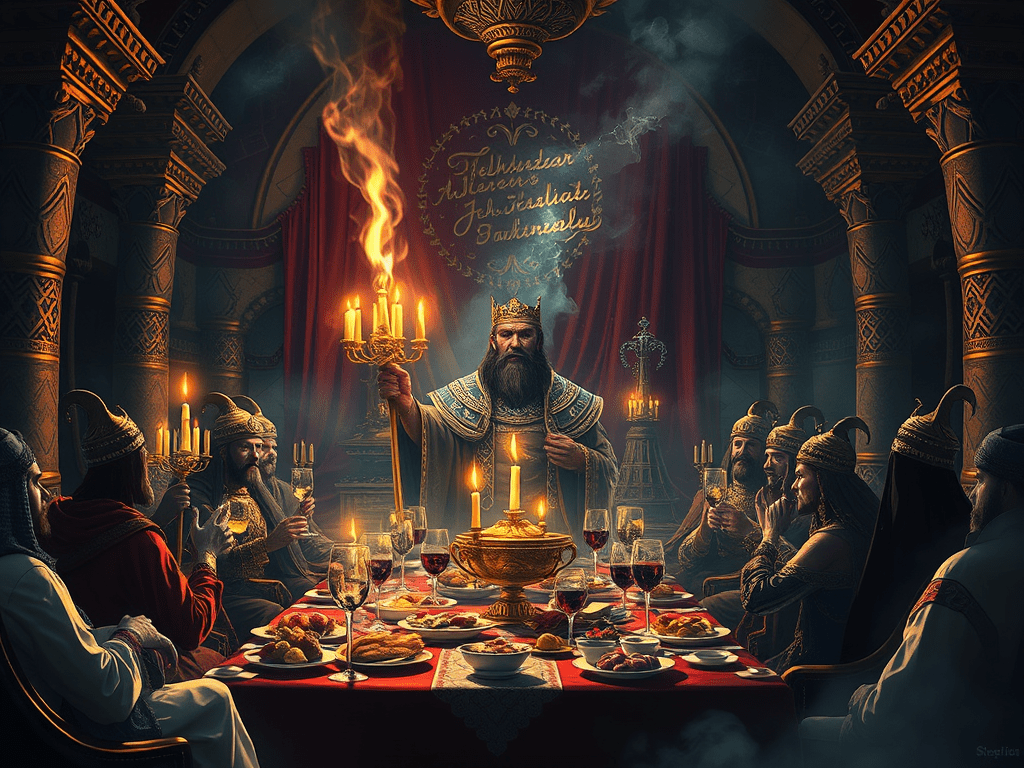
    In the Book of Daniel, chapter 5, we find one of the most dramatic stories in ancient scripture: Belshazzar’s Feast. A lavish banquet turns into a night of terror when a disembodied hand appears and writes mysterious words on the wall. The kingdom falls that very night. But beyond the historical account, this is a profound mythological tale about the inevitable collapse of any power built on arrogance, intoxication, and sacrilege.

    1. Hubris and Sacrilege: The Banquet as Ritual Defiance

    Babylon, in mythic terms, stands as the ultimate “anti-Temple”—a symbol of worldly power that rejects divine order. The banquet isn’t mere excess; it’s a deliberate act of defiance. King Belshazzar commands the sacred vessels looted from the Jerusalem Temple to be brought out. His guests drink wine from them while praising their gods of gold, silver, bronze, iron, wood, and stone.

    This profanation is the core sacrilege: these vessels once held the divine presence. Using them to toast idols is hubris incarnate—the mortal claiming superiority over the sacred. It’s the height of arrogance, performed at the peak of empire.

    2. The Omen: The Hand That Shatters Illusion

    Suddenly, a hand appears, writing on the wall—illuminated, ironically, by the light of the stolen Temple lampstand. The sacred light exposes the profane doom.

    Belshazzar’s reaction is visceral: his face pales, his limbs go slack, his knees knock together. This physical paralysis mirrors his moral collapse—the moment the tyrant’s illusion of invincible power crumbles before a higher force.

    3. The Hero-Interpreter: Daniel’s Uncompromising Stand

    The wise men fail, but Daniel—the exile who refuses to defile himself—is summoned. He deciphers the writing: “Mene, Mene, Tekel, Parsin.”

    Before delivering the verdict, Daniel refuses the king’s rewards: purple robes, gold chains, high office. “Keep your gifts,” he says. His authority comes not from Babylon’s system but from allegiance to the divine. He is untouchable, the true hero bridging chaos and cosmic truth.

    4. The Cosmic Verdict: Weighed on the Scales of Justice

    The words form a threefold judgment:

    • Mene: God has numbered your days; your reign is finite and ended.
    • Tekel: You have been weighed on the scales and found wanting—your character, deeds, and rule insufficient.
    • Parsin: Your kingdom is divided and given to the Medes and Persians.

    That night, Belshazzar is slain, and Babylon falls. The scales of cosmic justice tip irrevocably.

    Echoes in the Cycle of History

    This myth resonates with the ancient observation of civilizational cycles: “Hard times create strong men, strong men create good times, good times create weak men, and weak men create hard times.”

    Belshazzar’s story zooms in on the dangerous transition—good times breeding moral weakness, arrogance, and forgetfulness of limits, inviting sudden collapse. It’s a warning echoed in Greek tragedies (hubris-nemesis), Roman histories, and modern reflections on empires.

    In an age where powers rise and boast at their zenith, the writing on the wall remains a timeless reminder: all human empires are weighed, and those built on sacrilege and pride will be found wanting.

    Content developed with assistance of Gemini AI.

    Blog edited with assistance of Grok AI
  • ⚖️ Weighed and Found Wanting: The Fatal Mistake of Hubris

    ⚖️ Weighed and Found Wanting: The Fatal Mistake of Hubris

    Why Your Greatest Gifts Can Become Your Greatest Danger

    The story of King Belshazzar is the story of every person who has ever looked at their talents, their success, or their good fortune and thought, “This is mine. I earned it. I control it.”

    It’s the story of Hubris—that fatal, self-centered mistake that comes before the fall. Our readings today (Daniel 5 and Luke 21) show us the anatomy of this spiritual disease and reveal the only cure: active, enduring faithfulness.


    1. The Party and the Problem: The Banality of Blasphemy

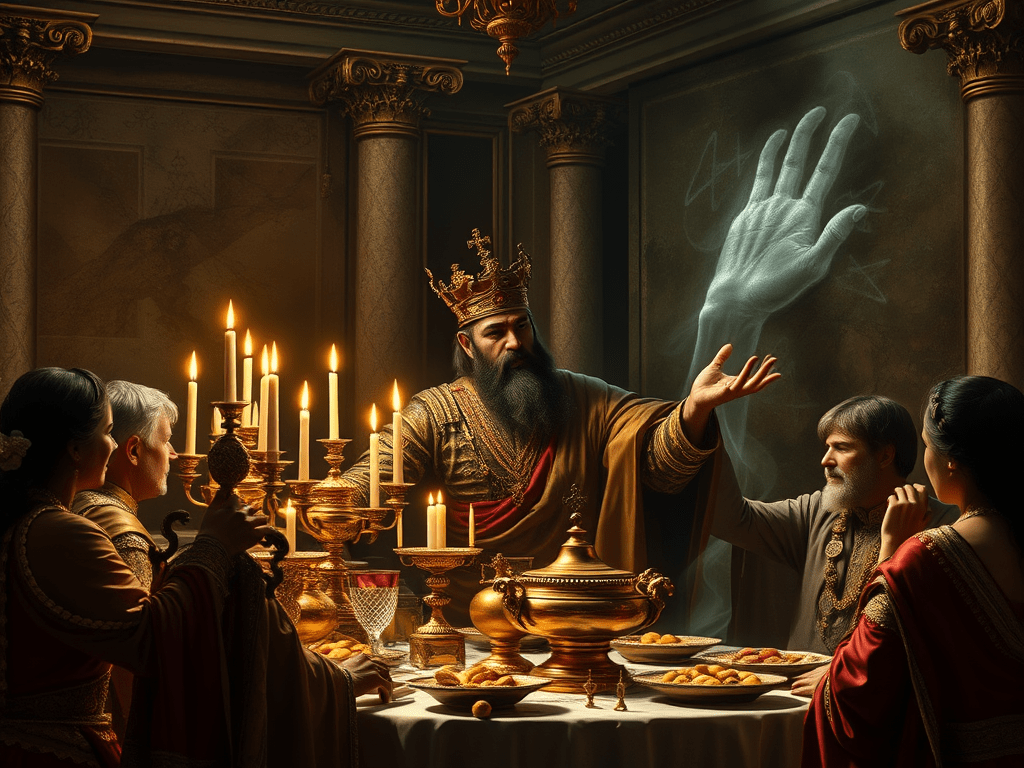
    King Belshazzar, in our first reading, throws a magnificent, drunken banquet. His act of blasphemy is not a simple mistake; it’s a defiant spectacle. He demands the holy gold and silver vessels looted from the Temple in Jerusalem be brought out and used for a pagan party.

    This is the spiritual state of radical entitlement. Belshazzar treats the holy (gifts from God) as merely a trophy for his own ego.

    The Psychology of Entitlement

    This is what happens when the Adversary’s whisper takes root: it convinces us that our talents, our wealth, and our relationships are entirely our own doing, meant solely for self-gratification.

    But at the height of his pride, the visible world breaks down: “Suddenly the fingers of a human hand appeared, and began to write on the plaster of the palace wall.”

    The writing is the ultimate accounting of a life lived without reference to the sacred:

    • Mene: Your power has been measured and ended.
    • Tekel: You have been weighed in the balance and found wanting.
    • Parsin: Your kingdom has been divided and lost.

    Belshazzar failed because he refused to glorify the God who held his breath and all his fortunes in his hands. His life, measured against the standard of the sacred, collapsed.


    2. The Hero’s Forge: The Necessity of Endurance

    If Belshazzar’s downfall is the consequence of Hubris and Pride, the Gospel (Luke 21) provides the antidote: Endurance and Trust.

    Jesus tells His disciples not of palaces, but of persecution, betrayal, and even death. This is the moment in the Hero’s Journey where the hero is stripped bare, entering the chaotic belly of the whale where all external support is lost.

    In the face of this absolute chaos, Jesus gives two counter-intuitive commands:

    1. Don’t Prepare Your Defence: Jesus commands us to relinquish the primal urge to control the narrative. Our brain, our ego, wants to be prepared, to argue, to win the court case. But He says, “I myself shall give you an eloquence and a wisdom…” We are called to suppress our own iron strength and rely on the Holy Spirit’s divine wisdom.
    2. Endure: The ultimate secret to salvation is revealed: “Your endurance will win you your lives.” Endurance is not passive survival. It is the active, faithful confrontation with suffering—a sustained posture of obedience that forges character and secures the soul.

    3. The Call to Live with Consecration

    We are called to move past the judgment of the decadent palace and into the endurance of the faithful disciple.

    A. Examine Your Holy Vessels

    Where are you taking the consecrated gifts God gave you—your time, your talents, your intelligence, your relationships—and treating them as merely trophies for your own consumption?

    • Do you use your intelligence to build yourself up, rather than to serve the Truth?
    • Do you treat your days off simply as hours for personal indulgence, rather than a chance to glorify God and love others?

    All we have is a consecrated vessel, a gift from God. The shift begins when we recognize this truth and use our gifts for their intended, holy purpose.

    B. Stay Awake in the Chaos

    The Gospel Acclamation instructs us: “Stay awake, praying at all times for the strength to stand with confidence before the Son of Man.”

    The courage to endure is won in the small battles:

    • In the willingness to suffer a slight and not seek immediate revenge.
    • In the resolve to remain faithful to your commitments when they become boring.
    • In the continuous choice to seek God’s wisdom instead of relying on your own prepared script.

    Do not be afraid of the chaos. It is merely the process by which God measures our foundations. Let us stand with confidence, relying not on our own power, but on the wisdom and eloquence of Christ, so that when our lives are weighed, we may be found faithful.


    Discussion Prompt:

    What is one “holy vessel” (a gift, talent, or resource) in your life that you have been treating like a “trophy” for your own pride or indulgence? What is one concrete action you can take this week to reconsecrate it to God’s purpose?

    Share your commitment below.

    Developed with assistance from Gemini AI, ChatGPT-5 and GROK 4.1