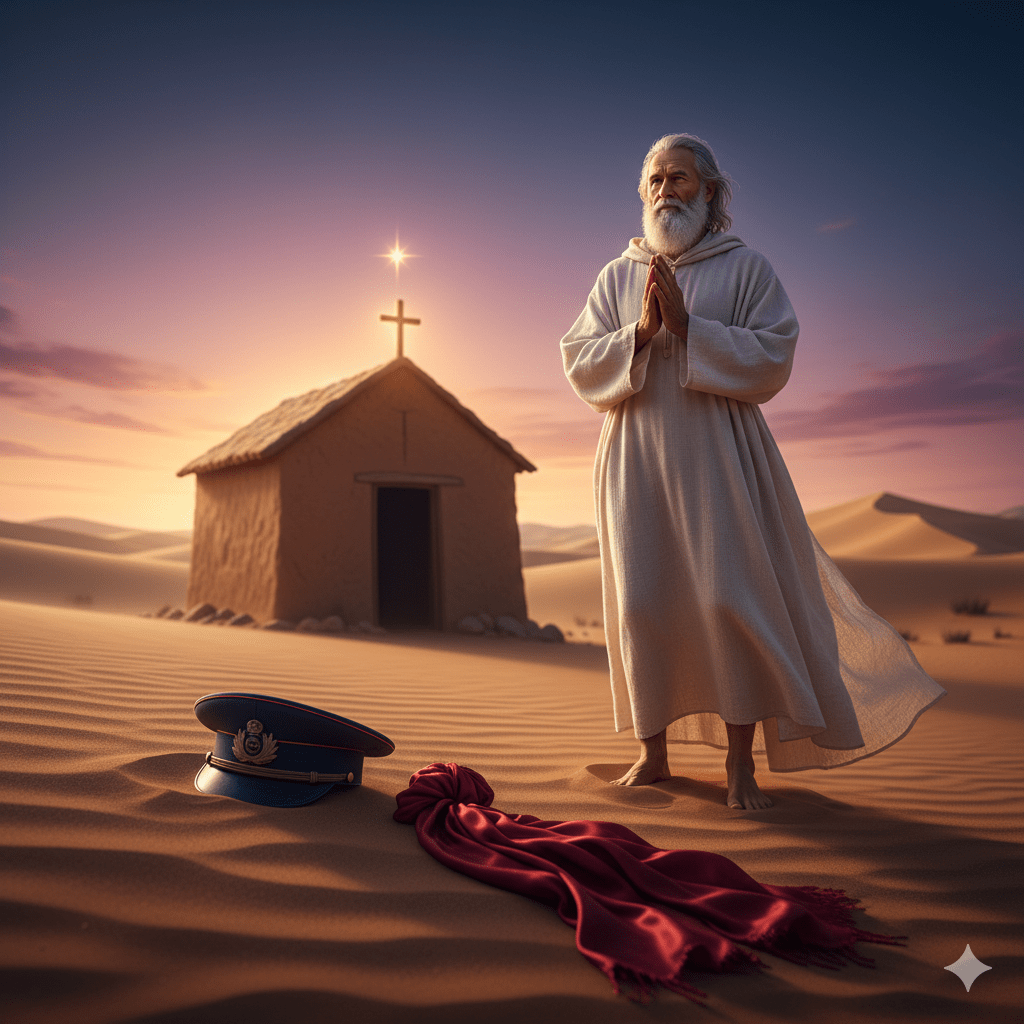
They are experiencing Christianity as joy and hope, having thus become lovers of Christ.

Tag: vocation

  • The Man Who Lived a Myth (And Was Real)

    The Man Who Lived a Myth (And Was Real)

    If someone told you this story as fiction, you’d roll your eyes and say, “Come on, nobody’s life is that tidy.”

    A boy is born into one of France’s ancient noble families, bloodline reaching back to the Crusades, family motto: Jamais arrière—“Never back.”

    He loses his parents at six, inherits a fortune, and promptly becomes the most spoiled, lazy, and debauched young officer in the French cavalry: expelled from school, famous for orgies and gourmet dinners in the Algerian desert while on duty.

    At twenty-eight, something cracks open inside him. He walks into a Paris church and tells a priest, “I don’t believe in God, but teach me about Him anyway.”

    He gives everything away, joins the strictest monastery he can find, decides even that isn’t poor enough, and leaves.

    He disappears into the Sahara to live closer to the poorest of the poor (the Tuareg nomads whom his own army regards as enemies).

    He builds a tiny hermitage of mud bricks, learns their language, compiles the first real Tuareg-French dictionary while half-starving at 9,000 feet on a frozen plateau.

    He begs to be ordained a priest only so he can celebrate Mass alone in the desert, telling God, “I want to live where no one knows You, so that You are not alone there.”

    On the night of 1 December 1916, bandits come to kidnap him for ransom. A fifteen-year-old boy guarding him panics at the sound of approaching French camel troops and shoots the hermit through the head.

    He dies instantly, face in the sand, apparently a failure: no converts, no community, no one to carry on his vision.

    He is buried in a ditch.

    A century later, in 2022, the Catholic Church declares him a saint.

    Nineteen religious orders and lay communities (Little Brothers of Jesus, Little Sisters of Jesus, and many others) now live all over the world according to the rule he wrote for a brotherhood that never existed while he was alive.

    From prodigal son to desert hermit to forgotten martyr to spiritual father of thousands: his life follows the ancient hero’s journey so perfectly that it feels invented.

    Except it isn’t.

    Every detail is documented, photographed, witnessed.

    Charles de Foucauld (1858–1916) lived a legend, then died in obscurity, and only then did the legend begin to walk on its own.

    Sometimes reality is allowed to be more beautiful than myth.

    Feel free to share.

    (If you want a one-sentence version for social media:

    “Rich playboy → atheist officer → Trappist monk → Sahara hermit → murdered by a scared teenager → canonized saint whose spiritual children now circle the globe. Charles de Foucauld didn’t just live a myth. He lived the whole myth, and it was true.”)

    Further reading
    • Charles de Foucauld’s own letters and spiritual writings are collected in Charles de Foucauld: Essential Writings (Orbis Books, 1999)
    • The best single biography in English remains Jean-Jacques Antier, Charles de Foucauld (Ignatius Press)
    • Pope Francis on Charles: Gaudete et Exsultate §§66–68 (free at vatican.va)
    • Pope Leo XIV’s recent references appear in Dilexi Te (2025), §§42–45

    This reflection was shaped in conversation with Grok (xAI), December 2025.

  • Microspheres: Small Connections, Big Renewal

    My hope for the Church is bold: that by 2030, our dioceses might be four times stronger than today — with one priest for every 100 men, and with lay people fully alive in their faith.

    The problem is not the Magisterium, the hierarchy, or the teaching of the Church. Those remain sound. The gap lies between clergy and laity. Parishes today may have thousands of members, but without networks of meaningful relationships, they risk functioning more like crowds than like communities.

    Most Catholics, if we are honest, seem to live their faith as “an hour on Sunday” — separate for a short time from the world, then blending back in. If you judge a tree by its fruit, the reality is sobering: many Catholics do not realize the treasure God has entrusted to them. They are standing on a gold mine but act as though it were yellow plastic.

    Meanwhile, modern life pulls people further away from real human connection. Even in their own homes, people often interact more with screens than with one another.

    The Power of Microspheres

    A “microsphere” is not just a small group. It is the measure of time we personally invest in others.

    I believe a parish’s vitality depends on each member having microsphere relationships — about 30 minutes per week per person.

    For example, in a group of 5 people, if you spend about 2 hours together, that works out to 30 minutes of meaningful connection with each person. That’s enough to create familiarity, trust, and support.

    How many such relationships are needed? That’s not yet clear. Perhaps 5, maybe 10, perhaps even 20. The exact number isn’t as important as the principle: when people share life in this way, the parish begins to shift from being a crowd into being a true community.

    Learning from History

    When Europe was overrun by invasions a thousand years ago, it was not large institutions that preserved civilization and faith — it was small communities, brotherhoods, and monasteries. They created pockets of strength, culture, and prayer that carried the Church through chaos.

    Today, we face new invasions: secularism, relativism, distraction, and disconnection. To survive and renew, the Church needs microspheres again.

    This is not a task the institutional Church can accomplish from the top down. It must arise from the bottom up — from Catholics who commit to building real, human, Christ-centered connections.

    If we can do this, the Church will not only endure but flourish.

    Edited with assistance from ChatGPT-5

  • Walking with Every Man:

    Toward a Synod on Subsidiarity

    In his first encyclical, Redemptor Hominis, Pope John Paul II made the striking claim that “every man is the way of the Church.” Christ entrusted the Church with the salvation of every person, which means the Church’s mission is always to walk with each man and woman and lead them toward Christ.

    Later, in Gratissimus Sane, John Paul II extended this truth to the family: every family, too, is the way of the Church. The family is the first place where a person’s character and uniqueness are formed, and it becomes the path along which the Church walks with individuals.

    But in the last fifty years, families have been shaken. Divorce has left many children without fathers. Mobility and smaller households have weakened extended family ties. Vocations to the priesthood and religious life within families — once a source of everyday moral and spiritual guidance — have greatly diminished. Today, with one priest often serving 4,000 parishioners, how can the Church realistically hope to walk with every individual, let alone every family?

    Learning from the Military’s Hierarchy

    Years ago, I compared the Catholic Church’s pastoral structure with the military. The military has developed, through centuries of experience, an efficient hierarchy that provides support at every level: no soldier is left without a small team, and every team has a leader to turn to.

    Here’s a simplified comparison:

    MilitaryNumber of PeopleChurch Parallel
    Region / Theater1,000,000+Diocese
    Army Group250,000Deanery Group
    Army60,000–100,000Deanery
    Corps30,000–80,000Sub-deanery
    Division10,000–20,000Parish Group
    Brigade2,000–5,000Parish
    Battalion300–1,000Priest Group
    Company70–250Deacon Group
    Troop25–60Small Community
    Patrol8–12Faith-sharing Group
    Fire Team4Prayer Partners
    Soldier1Parishioner

    The point is not to militarize the Church, but to recognize that the Church could learn from this structure of care. Subsidiarity — the principle that decisions and responsibilities should be handled at the lowest possible level — calls us to build up the Church at the smallest, most personal groups.

    A Call for a Synod on Subsidiarity

    The Church has already held Synods on Youth and on the Family. Perhaps the time has come for a Synod on Subsidiarity — especially on the sub-parish level. Such a synod could explore how the Church can better accompany individuals, families, and small communities, ensuring that no Catholic is left without support.

    Religious orders could play a vital role in this renewal. Catechesis, new models of pastoral care, and creative small-group structures could allow the Church to “walk with every man” as Christ intended.

    Today, there are about 1.16 billion Catholics in a world of 7 billion people — roughly one Catholic for every five people on earth. That ratio is strikingly close to Christ and the twelve apostles. If the Church could rediscover the art of subsidiarity, empowering Catholics at every level to care for one another, then we could truly begin to live out John Paul II’s vision: the Church walking with every man, in love.

    Edited with assistance from ChatGPT-5

  • Discovering Your Heroic Vocation

    Recognizing the call that sets your life on a meaningful adventure

    Introduction: The Call to Adventure

    Every life has a calling. Not every vocation leads to priesthood or consecrated life. C.S. Lewis reminds us that there are infinitely many good vocations, each as different from one another as good is from evil. Some callings are familiar: raising a family, serving the poor, leading a community, or creating art that inspires. Others are unique, waiting quietly for a person to step forward.

    In the language of the Hero’s Journey, the first step of any adventure is the call. It may come as restlessness, a sense of purpose, or an invitation to serve. Recognizing this call is the beginning of a life fully aligned with God and with your gifts.


    The Heroic Vocational Questions

    To help discern your calling, consider these reflective questions. They are not a checklist, but a framework for discovery:

    1. Where do I feel most alive when serving or creating?
    2. What challenges stir courage in me rather than fear?
    3. Which relationships or mentors draw out the best in me?
    4. What activity makes me lose track of time while benefiting others?
    5. What do I keep returning to, even when it’s difficult or uncomfortable?
    6. How would I want my life to be remembered if I gave it fully to this path?
    7. What sacrifice would I be willing to make for the good that matters most to me?
    8. How does this calling connect with the greater good, the community, or God’s plan?

    These questions guide a person toward self-knowledge, courage, and clarity—the essential tools for responding to any vocation.


    Reflection and Discernment

    Answering these questions requires honest reflection, prayer, and openness to God’s guidance. It may take weeks or months to see patterns or clarity emerge. Journaling, talking with a trusted mentor, or spending time in prayerful solitude can help you hear the call more clearly.

    Remember: vocation is a process, not a single answer. Your understanding of your calling may grow or shift over time. The key is to remain attentive to the stirrings in your heart and to align your life with God’s will.


    Practical Next Steps

    Once you have a sense of your calling, take practical steps to test and nurture it:

    • Volunteer or intern in areas related to your perceived vocation.
    • Seek out mentors or communities that live out what you feel drawn to.
    • Learn actively: read, train, or practice skills that support your calling.
    • Experiment with small projects or commitments to see how they resonate.

    These steps allow your calling to reveal itself in action, confirming whether it truly aligns with your gifts and God’s plan.


    Conclusion

    Every vocation is heroic in its own way. Whether it is priesthood, marriage, art, leadership, or service, answering your call is stepping into a life of purpose, courage, and joy.

    Start by paying attention to the stirrings in your heart. Ask the reflective questions, test your path, and trust God’s guidance. Your heroic journey begins with the first step: saying yes to the call.

    Developed with assistance from ChatGPT-5