They are experiencing Christianity as joy and hope, having thus become lovers of Christ.

Tag: virtue

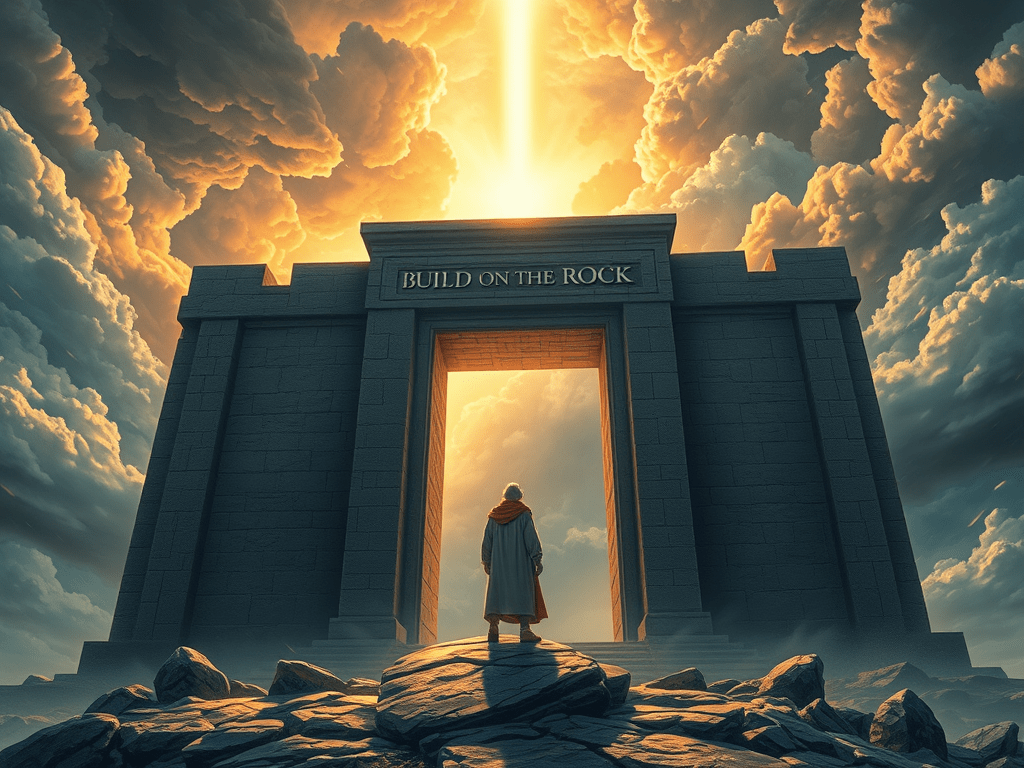
  • Build on the Rock:

    Build on the Rock:

    A Hero’s Journey of Real Spiritual Transformation

    Thursday, December 4th — Advent Reflection

    Readings: Isaiah 26:1–6 • Psalm 118 • Matthew 7:21,24–27
    Liturgical Color: Violet (Advent)

    Advent is a season of waiting, watching, and rebuilding the inner life. The readings for today speak with a single voice: your soul must be founded on the Rock, because storms will come. Not just external troubles, but the storms inside the human heart—fear, temptation, pride, confusion, and despair.

    Isaiah, the Psalmist, and Jesus Himself give us three images:
    a strong city, a sacred gate, and a house on solid rock.
    Together, they outline the path of every spiritual hero—from the prophets, to the saints, to ordinary men and women trying to follow God today.

    Let’s walk through the readings with Catholic wisdom, mythological insight, and psychological truth—so we can act on them, not just hear them.


    Isaiah: Open the Gates and Enter the Strong City

    Isaiah sees a vision of the soul as a strong city, built by God Himself:

    “We have a strong city… Open the gates! Let the upright nation come in… Trust in the Lord forever, for the Lord is the everlasting Rock.”

    The imagery is rich and precise:

    • The city is the human soul
    • The walls and ramparts are the virtues that protect us
    • The gates are the choices of the will

    Only those who trust in the Lord, who keep their minds “steadfast,” can enter.

    In mythic language, this moment is the hero approaching the threshold.
    Every great story has this scene:

    • Odysseus at the gates of the underworld
    • Aeneas at the temple doors
    • Frodo at the borders of Mordor
    • Christ at the entrance of the tomb

    But Scripture adds something deeper:
    The strength of the city is not your own willpower. God Himself is the foundation.
    The hero does not face chaos alone. The hero faces chaos with God.


    Psalm 118: The Gate of Holiness

    The Psalm continues the same theme:

    “Open to me the gates of holiness… This is the Lord’s own gate where the just may enter.”

    The pilgrim approaches the Temple and knocks. The question from inside is implied:
    Who may enter?

    The answer is not:

    • “I am strong.”
    • “I am important.”
    • “I have influence.”

    The answer is:
    “The Lord is my refuge.”

    Psychology says the same:
    When your core identity rests on anything unstable—success, emotions, reputation, strength—your inner world collapses when those things shift.
    But when identity rests on God, the soul stands firm.


    Jesus: Build Your House on the Rock

    In the Gospel, Jesus gives the image most people know:
    Two builders. Two foundations. Two futures.

    But He adds a detail that cuts straight to the heart:

    Both men hear His words. Only one acts.

    This is the decisive moment of the Hero’s Journey—when knowing is no longer enough.
    The hero must obey.
    The hero must choose.
    The hero must cross the threshold into action.

    Jesus says plainly:

    “Everyone who listens to these words of mine and acts on them will be like the wise man who built his house on rock.”

    Storms hit both houses.
    Faith does not guarantee ease.
    Faith guarantees endurance.


    The Psychology: Two Builders, Two Brains

    There’s a psychological layer here too.

    The house on rock

    represents a life governed by the higher faculties:

    • Reason
    • Conscience
    • Long-term vision
    • Stability
    • Sacrifice
    • Grace-supported will

    The house on sand

    represents a life governed by the lower systems:

    • Impulse
    • Emotion without discipline
    • Ego and appearance
    • Social pressure
    • Immediate pleasure

    Neuroscience confirms what Scripture teaches:
    When stress comes, the “lower” regions dominate unless the higher faculties are formed and anchored.

    Storms—suffering, fear, temptation, failure—expose the foundation of the soul.


    Mythic Parallels: Every Hero Faces the Storm

    Every ancient story knows this truth:

    • Gilgamesh meets the flood
    • Jonah meets the tempest
    • Odysseus meets the sea
    • Aeneas meets the burning city
    • Christ meets the Cross

    Heroes are not defined by the absence of storms, but by the strength of their foundation.

    Myths point to it.
    Psychology explains it.
    Catholic faith reveals it:
    The foundation is Christ Himself.


    Catholic Exegesis: The Rock Has a Name

    The Church Fathers are unanimous:

    • Christ is the Rock (1 Cor 10:4)
    • His teaching is the Rock
    • The Church is the Rock
    • Grace that strengthens the will is the Rock

    St. Augustine:
    “The house is faith; the foundation is Christ.”

    St. Gregory the Great:
    “To hear without acting is to build in the imagination.”

    St. Thomas Aquinas:
    “The foundation of the spiritual life is humility.”

    So the Rock is not self-help.
    The Rock is not moralism.
    The Rock is not positive thinking.

    The Rock is a Person.
    A relationship.
    A covenant.
    A surrender.


    How to Build on the Rock Today

    Here is the practical plan Jesus gives:

    1. Listen to His words

    Read Scripture.
    Study the faith.
    Let the Church teach you.

    2. Act on His words

    Do one concrete thing today:
    Forgive.
    Pray.
    Serve.
    Confess.
    Cut out a vice.
    Re-establish order.

    The hero’s gate is action.

    3. Trust God more than yourself

    Say:
    “Lord, I want Your will more than comfort.”

    4. Build habits that hold under pressure

    Virtue is spiritual architecture.
    The sacraments are reinforcement beams.
    Prayer is the daily maintenance.

    5. When the storm comes, choose to stand

    Do not fear the wind.
    Do not panic at the rain.
    Do not believe the lie that you are alone.

    The storm is not your enemy.
    The storm reveals your foundation.


    The Call: Enter the Gate. Stand on the Rock.

    Advent invites you to rebuild your life on Christ.

    Isaiah says: Enter the city.
    The Psalm says: Come through the gate.
    Jesus says: Stand on the Rock.

    The message is simple and strong:

    Your life has a structure.
    Your soul has a destiny.
    Your choices build a house that will either stand or fall.

    So today, choose to act.
    Choose to trust.
    Choose to build.
    Choose the Rock.

    And when the rains fall and the floods rise and the winds tear at everything—
    you will stand.
    And your endurance will give glory to God.

    Developed with assistance from ChatGPT-5

  • The Stone That Became a Mountain

    The Stone That Became a Mountain

    A Reflection for Tuesday, November 25, 2025 Based on Daniel 2:31-45; Daniel 3:57-61; and Luke 21:5-11

    (Originally delivered as a 12-minute talk – now expanded for anyone who wants to sit with it longer)

    I’ve never met King Nebuchadnezzar, but some nights I wake up in a cold sweat feeling exactly like him.

    You know the dream: a dazzling statue rises in front of you—head of gold, chest of silver, belly of bronze, legs of iron, and feet made of iron mixed with crumbling clay. It is magnificent, terrifying, and (you are secretly proud) it looks a lot like the empire you’ve spent your whole life building. Then, out of nowhere, a stone “untouched by human hand” rockets across the void, smashes the feet, and the entire thing explodes into powder. The wind scatters the dust, and the stone keeps growing until it becomes a mountain that fills the whole earth.

    Daniel, barely more than a teenager and a foreign prisoner, looks the most powerful man on the planet in the eye and says: “That stone is God’s Kingdom. Everything you trust will be ground to chaff. Only the Kingdom will last forever.”

    Two and a half millennia later, that dream still haunts us because it is no longer just about Babylon. It is about the statues we keep erecting inside our own skulls.

    Your Brain Is the Statue

    Neuroscience has accidentally given us one of the best commentaries on Daniel 2 ever written.

    • The golden head = the prefrontal cortex: language, long-term planning, morality, the part of you that wants to build something glorious and eternal.
    • The silver arms and chest = the limbic system: love, belonging, tribal identity, emotion.
    • The bronze belly = the older reward circuits: pleasure, ambition, appetite, status.
    • The iron legs = the brainstem and motor strips: raw survival, dominance, fight-or-flight.
    • The feet of iron and clay = the fragile, perpetually uneasy handshake between our ancient reptile brain and our fragile modern consciousness. Strong enough to run a civilization, brittle enough to shatter the first time life hits it wrong.

    Every war, every addiction, every mid-life crisis, every doom-scrolling spiral begins when the lower floors start dictating terms to the upper ones.

    The Universal Story

    Joseph Campbell spent his life showing that every culture tells the same story:

    Ordinary world → Call to adventure → Refusal → Mentor appears → Crossing the threshold → Ordeal and death → Seizing the treasure → Return to give it away.

    Translate the characters:

    Daniel is the mentor who will not bow.

    Jesus is the Stone cut without hands—the true Hero who descends into the realm of death and rises again.

    And you and I? We are the ones being summoned out of the collapsing statue into the growing mountain.

    When the Temple Comes Down

    In today’s Gospel people are gawking at the Jerusalem Temple—literally the most impressive religious building the ancient world had ever seen. Jesus looks at them and says, in effect, “Enjoy the view while it lasts. Not one stone will be left on another.”

    He is not being cruel. He is being honest. Every human temple, every human empire, every human self built only with human hands will one day stand on feet of clay.

    But notice what he says next: “When you hear of wars and insurrections, do not be terrified… Nation will rise against nation… There will be great earthquakes…” These are not the end. They are the birth pangs.

    In mythology, the false world has to shatter before the real story can begin.

    In psychology, the ego has to crack open before genuine integration can happen.

    In salvation history, the Stone has to strike.

    The Catholic Reading in One Sentence

    The Stone is Christ.

    The Mountain is the Church, born from the rock struck on Calvary and from the side of Christ on the Cross.

    And the dream is being fulfilled right now, every time a human soul lets the Kingdom smash its idols and fill its emptiness.

    So What Do We Actually Do?

    Four concrete, life-changing steps you can start this week:

    1. Name Your Statue
      Tonight, before you go to bed, ask: What is the gold-headed thing I trust more than God? Career? Reputation? Political ideology? My phone? My body? My children’s success? Write it down. That’s your personal Nebuchadnezzar dream.
    2. Let the Stone Strike
      Take that piece of paper (or just the knowledge of it) to confession, to adoration, to the foot of the crucifix. Ask Jesus to touch the feet of clay. It will probably feel like everything is falling apart. Good. That’s the sound of the Kingdom arriving.
    3. One Line, Ten Minutes, Every Morning
      Before you open any app, sit in silence and let one phrase from today’s readings strike you and grow:
      “A stone untouched by human hand…”
      Repeat it slowly, like a breath prayer. Let it smash the noisy empires in your mind. Ten minutes. That’s all. But do it daily and watch what kind of mountain starts growing inside you.
    4. Live the Return
      The hero never keeps the elixir for himself. Bring the peace you find in that silence to your family, your cubicle, your parish council, the grocery checkout line. The world is starving for people who have let the Stone win.

    The Dream Is Still True

    We are living in the age of the feet of clay.

    Globally: superpowers and tech empires that look invincible but are already cracking.

    Personally: hearts that are part iron, part mud, strong enough to function, brittle enough to break.

    But the Gospel acclamation today is shouting at us across two thousand years:

    “Stand erect, hold your heads high, because your liberation is near at hand!”

    The statue is already trembling.

    The Stone has already left the mountain.

    The only question left is whether we will cling to the collapsing colossus or open our hands and let the Kingdom break us open—so that, through us, it can fill the whole earth.

    Come, Lord Jesus.

    Strike the feet.

    Grow the mountain.

    Make Your home in us.

    And then send us back out to a world that desperately needs living stones.

    Amen.

    Feel free to share this post, print it, read it aloud to your family, or just sit with it in the quiet. The dream is still coming true—and you’re in it.

  • Jesus: The Perfection of Man

    How Christ embodies the fullness of love, virtue, and unity with God

    When Christians speak of Jesus as the “Son of Man,” it’s not just a title—it’s a truth about who He is for all humanity. Jesus does not merely show us what it means to be human; He is humanity perfected. He reveals in Himself what man was always meant to be, and in doing so, He calls each of us to become fully alive in Him.

    1. The Perfection of Love
    Love is the greatest commandment and the highest calling of humanity. In Jesus, we see love without limit—love that heals, forgives, sacrifices, and redeems. His compassion for the poor, His mercy toward sinners, and His willingness to lay down His life for the undeserving all reveal a love that is not sentimental but costly. This love is not merely an emotion but a total self-giving that fulfills the law and the prophets.

    2. The Perfection of Virtue
    The word “virtue” originally meant “manliness” or “strength of character.” In Jesus, every virtue is present in its fullness—courage, justice, temperance, prudence, humility, fortitude. He is bold before the powerful, gentle with the brokenhearted, and unwavering in the face of temptation. His life shows that true manhood is not domination or pride, but the disciplined strength to serve, protect, and do what is right even when it costs everything.

    3. The Perfection of the Image of God
    Humanity was created in the image and likeness of God, yet sin has distorted that image. Jesus is the perfect and uncorrupted image of the Father. He reflects God’s nature perfectly in His thoughts, words, and actions. To look at Christ is to see what man was meant to be—fully aligned with God’s will, radiating truth, beauty, and goodness.

    4. The Perfection of Unity with the Holy Spirit
    From His conception, Jesus was filled with the Holy Spirit. In His baptism, ministry, miracles, and prayer, we see a life completely guided by the Spirit of God. This unity was not partial or occasional—it was constant. His words carried divine authority because they were Spirit-led. His works carried divine power because they were Spirit-filled. In Jesus, humanity is in perfect communion with the Spirit, showing us what it means to walk with God in every moment.

    5. The Invitation to Follow
    If Jesus is the perfection of man, then following Him is not simply a religious act—it is the path to becoming fully human ourselves. He does not remain a distant ideal; He offers His Spirit so that we can share in His life. We are called not just to admire Him, but to be transformed into His likeness.

    In Christ, we see not only the perfection of man, but the perfection of our destiny. To follow Him is to walk toward the fullness of love, virtue, unity, and divine image for which we were created.

    If this reflection stirred something in you, don’t keep it to yourself. Share your thoughts in the comments below—let’s start a conversation on what true humanity looks like in Christ. If you found this post helpful, click “like,” subscribe for more reflections, and share it with someone who needs to be reminded of who they were made to be.

    Written with assistance from ChatGPT–5

     Jesus perfection of man, Jesus perfect love, Jesus perfect virtue, Jesus unity with God, perfection in Christ, Christian manhood, Jesus and the Holy Spirit, Christ as model man

  • Habit or Hero? Rethinking Routine, Discipline, and the Fight for Freedom

    Six Big Questions That Could Change How You Live

    In a world that rewards productivity, habits are often seen as heroic. They keep us on track, save mental energy, and offer the appearance of consistency. But what if they also carry a hidden danger — the risk of becoming hollow, mindless, or even harmful when left unchecked?

    This post explores the difference between habit and discipline, not in abstract terms, but through six practical, real-world questions. Each one digs deeper into the tension between automation and intentionality — and offers a path toward living with more freedom, reflection, and meaning.


    1. When Habit Isn’t Heroic: The Danger of Automated Virtue

    Q: I understand that habits are mental patterns that help us act with less effort. But I often think of them as rigid — as if they can trap us into doing what’s familiar, rather than what’s truly right. Isn’t that the difference between someone acting freely — like a hero — and someone following a rigid script — like a tyrant or a fascist?

    A: That’s a great question. Habits do save energy, but when they become rigid, they can stop us from seeing what’s truly right. The hero can step outside of familiar patterns to act with love and truth. The fascist cannot. He obeys the pattern, even when it causes harm. Discipline is the difference. Discipline is the conscious choice to do what’s right — even when it’s hard. That’s what gives us moral freedom.


    2. From Intent to Habit: When Regular Acts of Giving Lose Their Meaning

    Q: My church offers automatic giving. Once you set it up, it runs every week without further effort. Is that still virtuous? Or does it lose something when there’s no intentional act behind it anymore?

    A: Great observation. Setting up automated giving is efficient and shows commitment, but over time, it can lose its soul. You might stop reflecting on why you give, or miss opportunities for meaningful generosity. The action is still good, but the heart behind it may fade. Consider building a small ritual into your week to reconnect with the purpose behind your gift.


    3. When Systems Stall: What Quality Binders Teach Us About Habit and Discipline

    Q: I worked at a manufacturing plant that got ISO 9000 certified. We ended up with binders on a shelf, not real change. Why do systems like that go stale?

    A: You’re describing a system that kept the form but lost the soul. Habit and structure can mask decline if they’re not evaluated. Discipline, by contrast, is flexible and rooted in purpose. When habit outlives discipline, the system becomes self-referential. We need habits to support discipline — not replace it.


    4. Cultivating Habits: The Art of Balancing Routine and Reflection

    Q: So, should we build habits, but keep checking if they still serve the right purpose?

    A: Exactly. Habits are tools, but you’re the craftsman. They give structure, but you need discipline to stay responsive and awake. Think of it like a garden: habits are the plants, discipline is the gardener’s eye. You prune, adapt, and adjust. Structure and freedom are not enemies — they’re partners.


    5. When Habit Masquerades as Discipline

    Q: It bugs me when people treat habit as if it’s automatically virtuous. Isn’t there a difference?

    A: Yes, and it’s crucial. Habit is staying in motion. Discipline is staying intentional. Going to the gym while half-asleep isn’t discipline. It’s coasting. And when people equate habit with virtue, they resist change. They think questioning the habit means questioning their integrity. That’s how inertia can masquerade as moral strength.


    6. Helping Others Distinguish Between Habit and Discipline

    Q: How do we help people see the difference more clearly?

    A: Use real-life examples. Invite reflection. Share visual metaphors like: “Habit is cruise control; discipline is when you take the wheel.” Most of all, model it. Let others see you adjust your own habits when they no longer serve. That’s how we awaken others: not by criticizing, but by demonstrating.


    Conclusion: A Call to Wakefulness

    Habits are powerful. But without discipline, they can become lifeless routines that trap rather than free us. The hero is not the one who obeys the pattern without question. The hero is the one who stays awake.

    Ask yourself: Are your habits serving your purpose, or just preserving your comfort? If you pause long enough to notice the difference, you’re already on the path to freedom.

    Generated with assistance from OpenAI’s ChatGPT (2025).