They are experiencing Christianity as joy and hope, having thus become lovers of Christ.

Tag: truth

  • 8 Questions on the Road to Christ

    From seeking the truth to being seized by Christ

    On my journey of reflection, I came across a simple yet profound set of questions often used to guide a person from unbelief to faith. These eight steps move from basic honesty with oneself to the heart of Christianity:

    1. Are you being honest with yourself?
    2. Do you seek the truth?
    3. Is there some kind of God? (atheism vs. theism) — 5/6 of the world believes in some kind of god.
    4. Is it one God or many? (monotheism vs. polytheism) — about half of the world believes in one God.
    5. Is all God, or is He present but separate? (pantheism vs. Creator).
    6. Is God morally good, or is He indifferent to good and evil?
    7. Did God simply wind up the world, or is He present in history?
    8. Is God one person or three? Is Jesus His Son? One-third of the world is Christian.

    Each of these questions acts as a step on the “road to Christ.” They push us to examine what we believe, and why. Yet, even after answering all eight in favor of Christianity, there is still a deeper question that cannot be ignored.

    Joseph Cardinal Ratzinger (later Pope Benedict XVI) expressed it this way:

    Have you experienced an event or person which gives life a new horizon, and a decisive direction? Do you experience it as joy and hope? Are you inwardly seized by Christianity, and have you become a lover of Christ?

    That final question makes all the difference. It cuts to the heart: how many who call themselves “christian” (with a small c) have truly become Christian (with a capital C) in this deeper sense?

    The journey is not only about intellectual assent but about encounter, transformation, and love. Without that, the “road to Christ” remains unfinished.
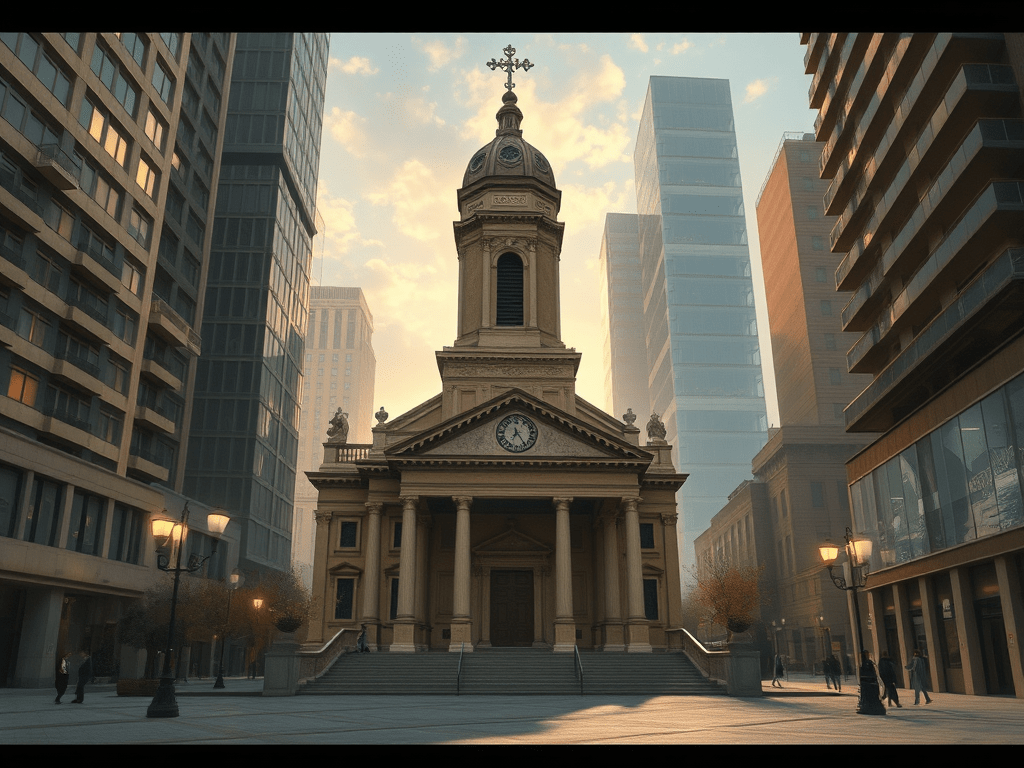
  • Wrestling With Ideas:

    Wrestling With Ideas:

    The Church, Orthodoxy, and the Spirit of the Age

    The Catholic Church has always carried a dual responsibility: to guard the deposit of faith and to protect the faithful from error. This task, though divinely entrusted, is carried out by human beings. And like every human institution, the Church is not immune to the influence of surrounding cultures, philosophies, and political theories.

    That tension is felt most keenly when the Church seems to “experiment” with new ways of speaking, teaching, or practicing the faith. At times, these efforts are seen as an attempt to incorporate temporal or even ideological ideas — the kind that history shows do not last. The question, then, is how to distinguish between legitimate development and dangerous dilution.

    One way modern thought often frames progress is through the lens of “thesis–antithesis–synthesis.” First articulated by Hegel and later adapted by Marx, this model suggests that truth advances by the clash of opposing ideas, resolved in a new synthesis. While this might apply in politics, economics, or philosophy, it becomes dangerous when applied to divine revelation.

    God’s truth is not simply another “thesis” waiting to be refined by the latest cultural antithesis. It is the anchor. To treat it otherwise risks diluting eternal truth with passing ideologies.

    Yet history also shows that false ideas, however seductive, tend to collapse under their own weight. They rise, attract attention, and then falter. In their wake, the Church often emerges with a clearer understanding of why such ideas fail. The cost, however, is real: confusion among the faithful, weakened trust, and even generations turning away.

    And still, God allows this wrestling. He permits both the Church and individuals to struggle with competing voices. In the end, truth endures. Consider St. Faustina, St. Bernadette, and St Juan Diego with Our Lady of Guadalupe. Each faced skepticism or outright rejection from Church leaders of their time. Yet their authentic messages bore fruit, purified by trial, and confirmed by their endurance.

    Perhaps this is the deeper lesson: God uses even tension, error, and conflict as a refining fire. What is temporal passes away; what is eternal remains. And in that promise we find hope — for the gates of hell shall not prevail.

    For Catholics today, the task is not to despair when the Church seems to flirt with every new “synthesis.” The task is to hold fast to Christ, to the tradition handed down, and to the lived witness of the saints. Orthodoxy is not fragile; it does not need to reinvent itself in each generation. It needs only to be lived, courageously and faithfully, in every age.

    Developed with assistance from ChatGPT-5