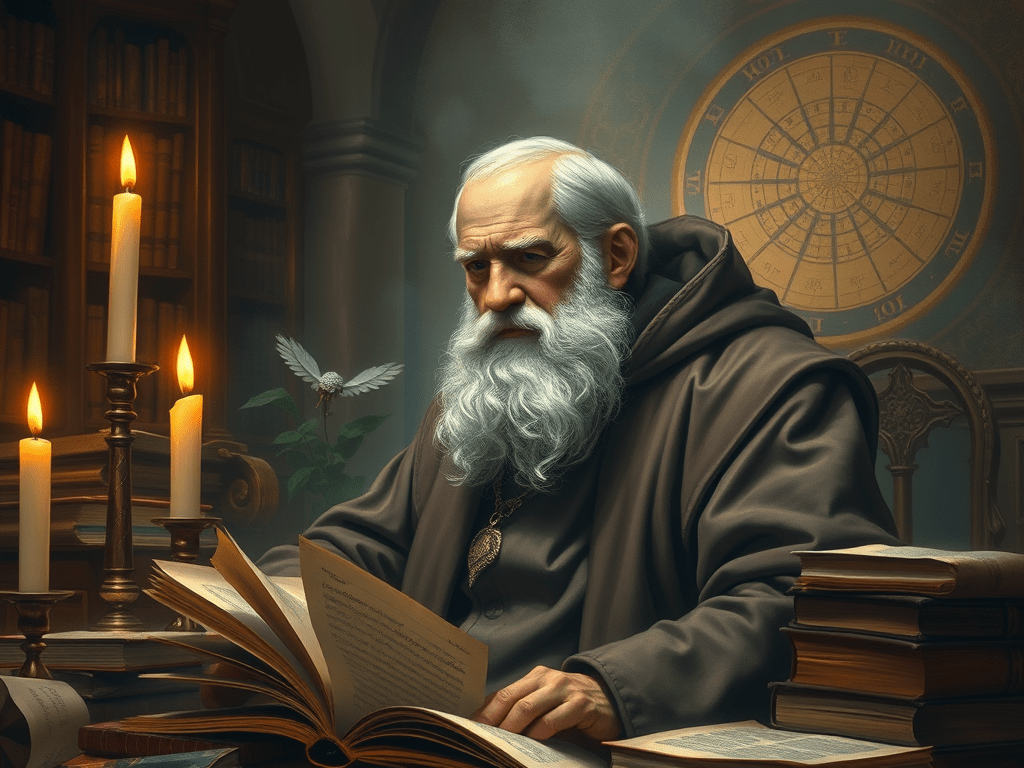
The Saint Who Proved Faith and Reason Belong Together
Today the Church celebrates the feast of St. Albert the Great—a man whose brilliance was so vast that his contemporaries simply called him Magnus, “the Great.” It is rare for history to give such a title to anyone, and even rarer for the Church to agree. But with Albert, both the scholars and the saints found themselves saying the same thing: this man is in a category of his own.
If you’ve ever wondered what the harmony of faith and science looks like in a single human life, St. Albert is your answer.
Who Was St. Albert the Great?
- Born: c. 1200 in Lauingen, Germany
- Died: November 15, 1280 in Cologne
- Feast Day: November 15
- Religious Order: Dominican (Order of Preachers)
- Titles: Doctor Universalis (Universal Doctor), Doctor of the Church, Patron Saint of Scientists
Albert was, without exaggeration, one of the greatest minds of the Middle Ages. He mastered philosophy, theology, natural science, and nearly every field of knowledge his world had to offer. And yet, his reputation for humility was as great as his intellect.
What Made Him So Extraordinary?
1. A Master of Philosophy and Theology
Albert is best known as the man who brought Aristotle to the Christian West.
He wrote massive commentaries on nearly all of Aristotle’s works—physics, metaphysics, ethics, politics, biology, psychology—and in doing so, he shaped the intellectual foundation of Europe.
But Albert did something even more important:
He showed that faith and reason are not enemies, but allies.
This insight became the cornerstone of Christian philosophy and inspired his most famous student, St. Thomas Aquinas, to build the great synthesis of faith and reason that still shapes Catholic thought today.
2. A Pioneer of Early Science
Albert is sometimes called a “proto-scientist,” but in truth he was already practicing something very close to the scientific method.
He observed, measured, classified, and experimented.
He wrote groundbreaking studies on:
- botany
- zoology
- mineralogy
- astronomy
- geography
- even early chemistry (then called alchemy)
He personally described plants and animals with surprising accuracy, noted the narcotic effects of certain herbs, and even acknowledged that the Earth is a sphere—centuries before it became common knowledge.
And while legends say he discovered the philosopher’s stone, Albert himself spent much of his time exposing fraudulent alchemists. He defended only what could be real, tested, and true.
3. Friar, Teacher, Bishop, and Tireless Preacher
Albert entered the Dominican Order around 1223, embracing a life of poverty, preaching, and study.
He taught all across Germany and in Paris, where he became the mentor of the young Thomas Aquinas. He served briefly—and reluctantly—as Bishop of Regensburg, but soon returned to the classroom, where he felt his vocation lay.
His life was marked by prayer, gentleness, charity, and deep humility.
Why Was He Made a Saint?
St. Albert was canonized in 1931—remarkably late, considering he had been venerated for centuries. His canonization was equipollent, meaning the Church formally recognized a devotion that already existed.
He became a Doctor of the Church the same year.
He is honored because of:
- his extraordinary holiness, lived quietly and consistently;
- his intellectual contributions, which strengthened and defended the faith;
- his integration of faith and science, preventing a divide that could have shattered Christian culture;
- the many miracles attributed to him during and after his life.
In 1931 he was declared the Patron Saint of Scientists, and today remains a model for all who seek the truth through both prayer and study.
Fun Facts & Medieval Legends
- Albert once defended the young Thomas Aquinas—mocked as “the Dumb Ox”—saying:
“You call him a dumb ox? His bellowing will one day echo throughout the world.”
The prophecy came true. - Medieval stories claimed Albert built a talking automaton—an early “robot.”
While almost certainly legend, it shows how people saw him as a kind of scientific wizard. - He defended the right of women to study philosophy and theology—centuries ahead of his time.
A Saint for Our Age
St. Albert the Great stands as a powerful answer to a modern question:
Can a person love God wholeheartedly and still pursue science, reason, and the natural world?
Albert’s life gives a clear, resounding yes.
He reminds us that all truth comes from God, and therefore no truth—whether scientific or spiritual—can contradict Him. He is the Church’s great bridge between the worlds of faith and knowledge, contemplation and investigation, theology and the natural sciences.
On his feast day, we are invited to rediscover that same unity in our own lives.
St. Albert the Great, pray for us.
 Seized by Christ