They are experiencing Christianity as joy and hope, having thus become lovers of Christ.

Tag: jesus

  • 10 REASONS TO SEEK JESUS

    1. Jesus Christ is the perfection of man, because He is the perfection of love. If we wish to be the best we can be, we must aspire to be like Christ. However, we will not be able to achieve this on our own.
    2. When we invite Christ into our lives, He becomes present in and through us. Thus, while we are hopeless sinners, we become carriers of the perfection of man. In fact, there is no place for pride, because all the good we do comes from Him. We cannot take credit for it.
    3. Through His grace we overcome sin, suffering, and death. Our past sins and any future faults have already been paid for by the price of His death and resurrection. Most new sins can be avoided by keeping our eyes fixed on Jesus.The torture of suffering is replaced by loving sacrifice for Christ, our purpose. Suffering only exists in the areas of self that we still cling to. In those areas where we have died to ourselves and surrendered to Him, death no longer has its sting. For many saints this has been simply a step through a veil.
    4. We have the eyes and heart of Christ. We see how much Christ loves everyone around us, and we see where they have been wounded.
    5. Everything we have—skill, effort, motivation, and knowledge—is worthless if it is not in the service of love, of Christ.
    6. We live in true joy, peace, and love. If we are doing His work—the work we were created for—it will be the greatest adventure we could ever have (with the best ending).
    7. We are washed in His love. We appreciate that Jesus loved us so much that He died for our sins. And He who died for us will never abandon us. We can know that when we speak, He hears us. He is always waiting for us in the stillness of our hearts. We gain the understanding that whatever happens to us is His blessing for us. It is the best thing that could happen.                                                                    
    8. Letting Him live through us, we can be better spouses, parents, children, employees, bosses, business owners, salespeople, customers, coworkers, students, teachers, friends, and citizens. By showing respect, being willing to put others first, with honesty, diligence, patience, perseverance, love, mercy, and loyalty, we gain the ideal character in all these areas.
    9. By keeping our eyes fixed on Christ, we can sacrifice to help overcome sin and suffering in the world around us. We can turn the other cheek instead of seeking revenge. Instead of adding to chaos, we can be a source of healing. Christianity has been the origin of showing respect and dignity to all humanity, as well as to animals and the environment. These have been the foundations for most of civilization’s progress since Christ. In areas where Christianity has been eliminated, such as under communist regimes, it is clear what the reign of evil brings.

    …As for the miseries and sins he heard of every day in the world, he was far from reproaching those people. On the contrary, he was surprised there were not more, considering the malice of which sinners were capable. For his part, he prayed for them, but knowing that God can remedy the harm they caused whenever He wishes, he himself did not trouble himself further.

     —Brother Lawrence in Christ

    1. We can help others come to know the love of Christ. It will take a billion martyrs to overcome the evil done in Christ’s name. It will take many more living martyrs to bring Christ to all the hopeless people in this world. If Christianity is a personal encounter with Christ, the Christ people meet must be presented through us.

    If You Really Knew Jesus, Then You Would Really Love Jesus

    Share your thoughts in the comments below—let’s start a conversation on what true humanity looks like in Christ. If you found this post helpful, click “like,” subscribe for more reflections, and share it with someone who needs to be reminded of who they were made to be.

  • A Word If Spoken

    I’ve carried this meditation for a while.

    I believe that for every person, there is a word—a message—that, if spoken, would cause them to freely and joyfully choose faith and to live for Christ.

    Everyone I’ve ever known who serves Christ with sincerity has heard this word. Maybe not in the same form, not the same message or tone, but they’ve received a word that reached the core of their heart. Something called them—not by force, but with the unmistakable pull of truth and love.

    And because I believe Jesus came that all might be saved, I also believe such a word exists for every person. A message capable of lighting up the heart.

    The only problem?
    I don’t know what that word is.


    The Work-Around

    So here’s what I try instead.

    I tell people: I know there’s a word that, if you heard it, would make you want to seek God with everything in you. I don’t know the word itself. But I’m asking you to assume that maybe it has not yet been spoken to you. 

    And if that’s true, then the most logical response is to begin seeking. Listening. Asking.

    Because if you can believe that at some point the door will be opened, … now it’s just a matter of stepping through.


    What This Says About Grace and Free Will

    This meditation walks a fine line between two deep truths of the faith:

    • That God desires all to be saved (1 Timothy 2:4),
    • And that faith comes by hearing (Romans 10:17).

    Why This Matters to Me

    This belief gives me two things:

    • Hope: That no one is beyond the reach of grace.
    • Humility: That I don’t have to be the one to say the perfect thing. I just have to point toward the Word, however I can.

    In some cases, I believe people are simply too “high up”—too successful, too secure, too self-assured—to look up. They haven’t been brought low enough to feel the need for God. But if they become curious now,… perhaps it will prevent that fall. Or prepare them for it.

    How About You?

    Have you ever had a moment where something clicked—a word, a thought, a memory—that stirred something deeper in you?

    Or maybe you’re still waiting for your word to be spoken?I’d love to hear your reflections, questions, or stories.

    You can leave a comment below. I’d love to hear your reflections, questions, or stories.

    Written with assistance from ChatGPT

  •  Why Does Pope Benedict Connect New Testament Love with Old Testament Commandments?

    Understanding the continuity of love in salvation history through the lens of Deus Caritas Est

    In Deus Caritas Est, Pope Benedict XVI teaches that Christian love isn’t something radically new—it grows from the soil of Israel’s covenant. By connecting the New Testament emphasis on love with Old Testament commandments, he roots Christian charity in the very heart of divine revelation. His point is not to discard the old, but to show how Christ fulfills it with new depth and clarity.

    Continuity of the Covenant

    From the beginning of his encyclical, Pope Benedict makes this continuity clear:

    “The Christian faith, while retaining the core of Israel’s faith, gives it new depth and breadth.” (Deus Caritas Est §1)

    He quotes the great Shema of Israel:

    “Hear, O Israel: The Lord our God is one Lord; and you shall love the Lord your God with all your heart…” (Deuteronomy 6:4–5)

    Love of God, then, was never absent from the faith of Israel—it was central. What Jesus brings is not a break from the past, but its true fulfillment.

    Jesus Fulfills the Law in Love

    Jesus joins this vertical command to another, found in Leviticus:

    “You shall love your neighbor as yourself.” (Leviticus 19:18)

    In the Gospel of Mark, He unites the two into one supreme law of love:

    “There is no other commandment greater than these.” (Mark 12:29–31)

    Pope Benedict highlights this to show that Jesus didn’t abolish the commandments, but revealed their full meaning. Love, properly understood, is the essence of the Law.

    From Obligation to Response

    Why do we love? Because “God has first loved us.” (1 John 4:10)
    This shifts everything. Love is no longer a heavy demand—it’s a response. Benedict writes that when love begins in God’s gift, the “command” to love is transformed into an invitation to relationship.

    Thus, keeping the commandments becomes a matter not of fear or duty, but of joy. Love of God leads naturally to love of neighbor.

    A Two-Fold Orientation: Vertical and Horizontal

    By presenting these two commands as one, Jesus shows that Christian love must always move in two directions:

    • Vertical – Toward God in worship and devotion
    • Horizontal – Toward neighbor in service and charity

    Pope Benedict stresses that these cannot be separated. True love of God leads to care for others, and real love for others flows from communion with God.

  • If Love Is the Main Christian Message, Why Does the Church Seem So Strict at Times?

    Understanding how Church discipline flows from love, not contradiction

    This question gets to the heart of a common struggle: If Christianity is centered on love, why does the Church often feel like a place of rules, restrictions, and prohibitions?

    Pope Benedict XVI anticipated this very question in Deus Caritas Est, where he asks bluntly:

    “Doesn’t the Church, with all her commandments and prohibitions, turn to bitterness the most precious thing in life?”

    The answer, as Benedict explains, is not to dismiss the rules—but to reconnect them with love. When love is forgotten, rules can feel cold or burdensome. But when love is central, even the strictness of the Church is revealed to be a form of protection and guidance.

    1. Benedict’s Challenge: Love Must Ground the Rules

    Rules lose their meaning when disconnected from love. That’s why Benedict insists the Church must re-anchor every commandment in God’s love.

    Christian morality, then, is not a burdensome legal code—it is a path of grateful response to the One who loved us first. It flows from relationship, not performance.

    2. Rules as Protective Boundaries, Not Arbitrary Limits

    Church teachings are not random restrictions. They are moral guardrails, meant to preserve human dignity and protect the possibility of real love.

    Safeguarding dignity: Certain behaviors wound ourselves and others. Catholic teaching identifies and warns against them to prevent harm.
    Map to freedom: The Church teaches that true freedom is not doing whatever we want, but doing what is good. Love needs discipline in order to grow.

    3. Loving Discipline from a Spiritual Parent

    The Church sees herself as both mother and teacher. Just as a parent sets boundaries for their child’s safety and growth, so too the Church offers moral discipline for our spiritual development.

    Spiritual fatherhood and motherhood: Rules shape conscience and virtue. They help form people capable of real, sacrificial love—not just fleeting emotion.

    4. Historical Roots: Guarding the Faith

    From the early Church to the present, moral clarity has been essential:

    Councils and canons fought heresy and spiritual confusion.
    Medieval moral theology gave believers a practical roadmap to holiness.
    Today, Pope Benedict invites us to rediscover that path—not as cold rules, but as love in action.

    The goal is not legalism. The goal is love that is wise, ordered, and enduring.


    Follow-up Question:

    Can you think of a Church teaching or rule that felt restrictive at first, but later you saw how it protected or deepened your experience of God’s love?

  •  Why John 3:16 Still Matters

    (and How to Hear It Anew)

    Q4: “Why does John 3:16 matter so much—haven’t we heard it so often that it loses meaning?”

    Answer:

    John 3:16 may be the most familiar verse in all of Scripture, but that familiarity can dull its impact. When we pause to truly reflect on what it says, we uncover the entire Gospel in one line—a line that reveals who God is, what He does, and how we are called to respond.

    1. The Gospel in One Sentence

    • God’s Initiative:
      The verse doesn’t begin with our effort. It begins with God’s love. “God so loved the world…” means He made the first move. His love is not reactive—it’s freely given.
    • The Gift of His Son:
      Love isn’t just a feeling here—it’s action. God gave His only Son. That’s not poetry; it’s the painful reality of the Cross, where divine love bore real suffering to save us.
    • Belief That Brings Life:
      Believing in Jesus means entrusting ourselves to Him. The result? Not just avoidance of perishing, but the gift of eternal life—a transformed life starting now.

    This is why the early Church, the Reformers, and modern evangelists have all held this verse so dearly. It’s a compact version of the entire Christian message.

    2. The Danger of Over-Familiarity

    • We Hear Without Listening:
      We’ve seen John 3:16 on signs, T-shirts, and bumper stickers. It becomes background noise—true, but unengaging.
    • We Lose the Weight of It:
      The words are simple, but their meaning is not. This verse speaks of cosmic love and costly redemption—things we shouldn’t glide past.
    • It No Longer Moves Us:
      Familiarity can harden the heart. But the Word of God isn’t meant to be skimmed. It’s meant to pierce, comfort, and renew.

    3. Ways to Hear It Anew

    • Reimagine the Scene:
      Imagine being at the foot of the Cross or standing before the empty tomb. What does it mean for God to give His Son there?
    • Personalize It:
      Insert your name into the verse: “For God so loved [Your Name]…” That’s not self-centered—it’s the point. God’s love is deeply personal.
    • Use Lectio Divina:
      Slowly read John 3:16 four times, focusing each time on a different word or phrase—like “loved,” “gave,” or “eternal.” What stirs in your spirit?
    • Share It Anew:
      Try telling a friend why John 3:16 matters to you today. Giving voice to Scripture helps break the dullness of repetition.

    4. Biblical and Historical Echoes

    • Early Church:
      Used John 3:16 as a summary creed for new Christians, especially at baptisms.
    • Reformation Era:
      Luther and Calvin frequently returned to this verse to emphasize grace and faith, countering legalism and works-based salvation.
    • Modern Witness:
      This verse still appears in hymns, testimonies, and public evangelism—not because it’s cliché, but because it’s central.

    Discussion Prompt:
    When you hear John 3:16 today, which word or phrase jumps out at you? Why? How might focusing on just that one part reshape how you see God’s love for you?

    Composed and edited with assistance from ChatGPT

    Related Posts:

    “Deus Caritas Est” Summary Sections 1 thru 8

    What Does It Mean to Truly Meet Jesus?

    Why Does Christianity Feel Like It’s All About Rules?

    How Do I Know If I’ve Truly Encountered God’s Love?

  • What Does It Mean to Truly Meet Jesus?

    Exploring the Transformative Journey from Knowing About Jesus to Experiencing a Personal Relationship with Him

    Understanding the Difference

    In today’s digital age, information about Jesus is readily accessible. Many are familiar with His teachings, miracles, and life events. However, there’s a profound difference between knowing about Jesus and truly meeting Him.

    Intellectual Knowledge vs. Personal Relationship

    • Intellectual Knowledge: Involves understanding facts about Jesus—His birth, teachings, and crucifixion. It’s akin to reading a biography.
    • Personal Relationship: Entails a heartfelt connection, where one experiences Jesus as a living presence in daily life. It’s like conversing with a close friend, sharing joys, fears, and aspirations.

    The Dynamics of a Personal Encounter

    Mutual Communication

    A genuine relationship with Jesus is interactive. Through prayer, we speak to Him; through Scripture and inner promptings, He speaks to us. This two-way communication fosters a deeper bond.

    Transformative Impact

    Meeting Jesus isn’t a passive experience. It reshapes our desires, priorities, and actions. Just as spending time with a compassionate friend can inspire kindness, encountering Jesus motivates us to embody His love and teachings.

    Tangible Presence

    For many, Jesus’ presence is felt tangibly—during worship, in the sacraments, or amidst life’s challenges. These moments affirm that He is not just a historical figure but an active participant in our lives.

    Historical Perspectives on Personal Encounters

    • Early Christians: Testified to the risen Christ appearing to them, emphasizing a direct and personal experience.
    • Desert Fathers (4th Century): Sought solitude to deepen their relationship with Christ, often referring to Him as their constant companion.
    • Medieval Mystics: Figures like St. Julian of Norwich described vivid visions of Christ, emphasizing personal devotion over mere doctrinal understanding.
    • Modern Movements: Emphasize that every believer can experience a personal relationship with Jesus, not just theologians or clergy.

    Reflect and Share

    Have you ever felt Jesus’ presence in a profound way? Perhaps during a quiet moment, in prayer, or amidst a challenging situation? Reflect on that experience and consider sharing it with others.

    With Editing Assistance from ChatGPT

  • Unpacking the Prodigal Son Story: A Mythical Hero’s Journey

    The Prodigal Son is one of the most beloved parables from Christian tradition, but when examined through the lens of the mythical hero’s journey, it reveals a deeper, universal narrative of transformation, redemption, and reconciliation. This timeless tale offers a rich exploration of personal growth, rebellion, and the cyclical nature of life. In this post, we’ll delve into how the Prodigal Son mirrors the structure of the mythical hero’s journey and what we can learn from his story.

    1. The Call to Adventure: A Desire for Freedom

    In mythological narratives, the hero often begins their journey with a call to adventure — a desire to explore the unknown. The Prodigal Son’s request for his inheritance marks his own “call” to freedom. He wants to leave behind the familiarity of his home and step into a world where he can forge his own path. This moment reflects the universal human desire to break free from constraints and seek independence, much like a hero departing from their original world to pursue a personal quest.

    2. Crossing the Threshold: Venturing into the Unknown

    The son leaves his father’s house and enters the “distant country,” symbolizing the crossing of the threshold into the unknown. It is here that he begins to indulge in a life of excess, squandering his inheritance. This chaotic journey mirrors the hero’s descent into the “wild” or underworld, where they encounter temptations and distractions that often lead them astray. In mythology, heroes face these temptations as part of their transformation, and the Prodigal Son is no different. His descent represents the dangers of excess and unchecked desires.

    3. The Abyss: Confronting the Crisis

    Every hero must face a crisis — the abyss — a moment of profound despair and self-reflection. For the Prodigal Son, this moment occurs when famine strikes and he finds himself feeding pigs, longing for their food. This marks his lowest point, symbolizing a metaphorical “death” — the hero’s confrontation with their mistakes and the consequences of their actions. The “famine” represents life’s harsh realities and the price one pays for straying too far from balance and wisdom.

    4. The Return: Transformation and Rebirth

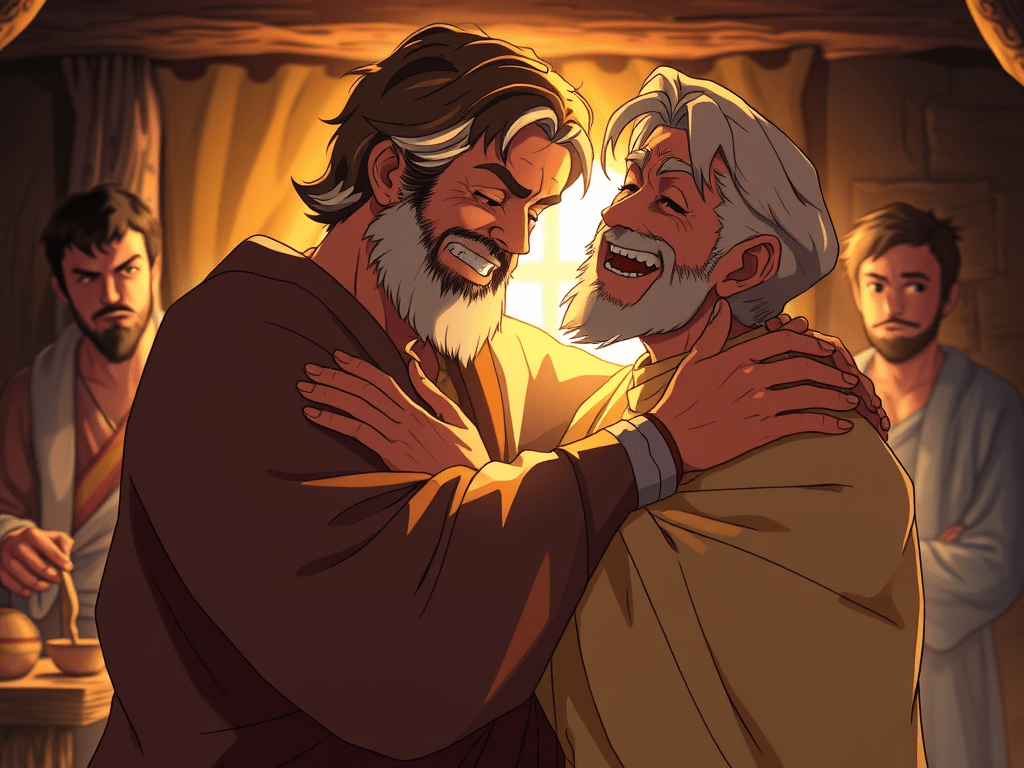
    In many myths, the hero returns home after their trials, but they are forever changed. Similarly, the Prodigal Son’s decision to return home represents a moment of transformation. His journey back is one of repentance and self-awareness, symbolizing a rebirth. When he arrives, his father greets him with open arms, demonstrating that redemption and reconciliation are possible, even after great mistakes.

    5. The Hero’s Reward: Celebration and Integration

    After the son’s return, he is celebrated by his father, who restores him to his rightful place. This is the reward phase of the hero’s journey, where the hero integrates the wisdom they’ve gained into their previous life. For the Prodigal Son, this celebration includes gifts such as a robe, ring, and sandals — signs of his full reintegration into the family. In myth, the hero often returns with newfound wisdom, and the Prodigal Son’s return symbolizes the potential for growth and healing, no matter how lost or estranged one might feel.

    6. The Shadow: Conflict with the Elder Brother

    In many myths, the hero’s return disrupts the status quo, often sparking tension with those who remained behind. The elder brother’s resentment toward the Prodigal Son reflects this mythical conflict. The elder son represents the “shadow” — a figure resistant to change, loyal to the old ways, and unwilling to embrace transformation. His anger symbolizes the internal and external conflicts that arise when old paradigms are challenged, and growth or redemption occurs.

    7. Rebirth: Death and Resurrection

    The narrative concludes with a powerful statement by the father: “This son of mine was dead and is alive again; he was lost and is found.” This moment echoes the cyclical nature of death and resurrection that is central to many mythic stories. The Prodigal Son’s “death” represents his metaphorical fall, and his return symbolizes a form of resurrection — a fresh start rooted in humility and wisdom. The cycle of life, death, and rebirth is essential to the hero’s journey, illustrating that transformation often requires loss and renewal.

    8. The Theme of Repentance and Redemption

    At its core, the Prodigal Son story embodies the theme of repentance and redemption. In many myths, the hero returns after making mistakes, and their journey is celebrated because they have learned from their trials. The father’s willingness to forgive, rather than punish, the Prodigal Son challenges the notion that heroism is about perfection. Sometimes, the hero is celebrated not for their unwavering goodness but for their capacity to learn from their errors and return transformed.

    Conclusion: Lessons from the Prodigal Son

    The Prodigal Son is more than just a biblical tale — it is a powerful reflection of the hero’s journey. Through his story, we learn about transformation, the importance of self-awareness, and the possibility of redemption, no matter how far we’ve strayed. By examining the Prodigal Son through the lens of mythology, we can see that the challenges of life — the mistakes, the temptations, the crises — are all part of the journey toward self-discovery and reconciliation.

    Whether you’re exploring the parable for personal reflection or analyzing it from a mythical perspective, the Prodigal Son’s journey offers timeless wisdom. Embrace your journey, accept the lessons that come with both failure and triumph, and remember that redemption is always within reach.

    Written in collaboration with ChatGPT (OpenAI, 2025).

  • The Parable of the Prodigal Son: A Preference for the Repentant Son Over the Loyal Brother

    The Parable of the Prodigal Son: A Preference for the Repentant Son Over the Loyal Brother

    The Parable of the Prodigal Son is one of the most well-known biblical stories. While often interpreted as a lesson on forgiveness, there’s a deeper, subversive message embedded in the narrative. The story emphasizes the redemption of the repentant son over the loyalty of the older brother, challenging us to reflect on the nature of grace, transformation, and true faith.

    Let’s break down why this story shows more favor to the repentant son than the dutiful older brother.

    1. The Repentant Son’s Journey

    The Prodigal Son embarks on a journey of transformation. He leaves home, squanders his inheritance, and experiences deep suffering. But the key moment in the story is when he “comes to his senses,” realizing that his life has gone astray. Returning home isn’t just about apologizing—it’s about a profound change of heart.

    His journey isn’t just physical; it’s deeply moral and spiritual. Without experiencing loss and humility, the son wouldn’t have gained the wisdom necessary to understand what truly matters. His repentance is not merely saying “sorry”; it’s taking full responsibility and seeking reconciliation.

    2. The Older Brother’s Stagnation

    In contrast, the older brother represents the opposite of transformation. He has remained “loyal” and “dutiful,” yet he lacks the deeper compassion and self-awareness that the younger son gains through his fall. His loyalty is tied to a transactional understanding of his relationship with his father. He believes that following the rules entitles him to rewards.

    However, when he sees his brother return, he becomes bitter and resentful. His jealousy reveals his inability to comprehend the true nature of forgiveness and grace. While he believes that loyalty should be rewarded, he struggles to accept the father’s generosity toward the repentant son. This exposes the flaw in his view of faithfulness: it’s not just about staying loyal; it’s about embracing grace, forgiveness, and love.

    3. The Father’s Preference for the Repentant Son

    The father’s actions in the story speak volumes. He doesn’t just forgive the younger son—he goes out of his way to restore him to his rightful place in the family. The father’s joy and celebration of the son’s return show that he values transformation over mere loyalty. To him, the younger son’s repentance signifies a deeper, more meaningful change.

    The older brother, on the other hand, cannot understand why his brother is being celebrated. His view of loyalty lacks grace, focusing solely on merit. The father’s actions reveal a profound truth: that genuine transformation and repentance are more valuable than blind obedience or duty.

    4. The Parable’s Subversive Message

    What makes the Prodigal Son so powerful is how it subverts conventional expectations. The older brother, who has done everything right, is not the one the father celebrates. Instead, it is the one who has made mistakes, strayed, and then returned with genuine repentance.

    This aligns with a deeper spiritual principle often emphasized in Christian teachings: God values repentance and the willingness to transform oneself over mere outward adherence to rules or social norms. The story challenges the idea that it’s enough to simply “do your duty” or “stay loyal.” True faith requires openness to growth, change, and grace.

    5. The Call to Radical Grace

    The parable points to a radical message: true grace and forgiveness are not about rewarding those who follow the rules but about welcoming the lost, the broken, and the repentant. The father’s unconditional love for the Prodigal Son serves as a model of divine love—extending forgiveness even to those who have fallen farthest, as long as they return with a sincere heart.

    This challenges conventional ideas of justice based on merit and points to a more inclusive form of love. The older brother’s sense of entitlement contrasts sharply with the father’s generosity, showing that grace operates outside systems of merit and deservingness.

    6. The Lesson for the Faithful

    There’s a deeper challenge here for the “faithful” or “loyal” figures in the story, such as the older brother (who represents the “righteous” or those who follow the rules). The story teaches that loyalty and obedience don’t automatically entitle you to special treatment. Instead, the lesson is about embracing the joy of redemption and the value of grace.

    The older son’s bitterness reveals a misunderstanding of true loyalty. Loyalty isn’t about comparison or competition; it’s about love, compassion, and the willingness to rejoice in the redemption of others. The parable emphasizes that doing the right thing is important, but it must be coupled with a generous, forgiving heart.

    Conclusion: The Preference for the Repentant Son

    The Prodigal Son’s story clearly favors the repentant son over the older brother. It places a higher value on transformation, humility, and the willingness to embrace grace over mere fidelity or rigid adherence to rules. The father’s response teaches us a profound lesson about the nature of divine love and forgiveness, encouraging us to look beyond our assumptions about justice, loyalty, and merit.

    The older brother’s jealousy and anger reflect the common human tendency to measure worth based on performance. But the parable calls us to embrace a more radical, compassionate vision—a vision where even the most flawed and broken can be redeemed, and their return is celebrated, not condemned.

    Yes, the story of the Prodigal Son does show a preference for the repentant son—and in doing so, it calls attention to the importance of grace over judgment and transformation over stagnation.

    Written in collaboration with ChatGPT (OpenAI, 2025).

  • Building a Welcoming Parish: A Call to Action for the Knights

    How Knights of Columbus Can Strengthen Parish Community Through Outreach

    A strong parish is more than just a place of worship—it’s a spiritual home. Yet too often, new parishioners go unnoticed, never truly connecting with the faith community. As Knights of Columbus, we have a unique opportunity to change this by creating a more welcoming and engaged parish environment.

    The Problem: A Disconnected Parish

    Currently, our parish’s welcoming process is limited. Once new members are added to the collection envelope mailing list, there is little follow-up. Even our parish business director rarely sees their faces. Many new parishioners attend Mass but struggle to feel like they truly belong.

    As Knights, we are called to serve. By taking an active role in welcoming others, we can foster a sense of belonging and deepen the faith experience for all.

    A Vision for Parish Connection

    Imagine if every parishioner were part of a small group—similar to our Lenten study groups—but based on neighborhoods. New members would automatically be connected to a group near them, ensuring they find fellowship from the start. As groups grow, they would naturally divide, maintaining strong, personal connections.

    While the Church cannot share personal information without permission, there are still many ways we, as Knights, can integrate new members into the community.

    What We Can Do as Knights

    1. Be More Intentional in Greeting Others

    • Welcome parishioners at the church doors before and after Mass.
    • Engage in conversations at the donuts and coffee area after Mass.
    • Ask, “How long have you been part of the parish?” If they are new, introduce them to others.

    2. Help New Parishioners Connect

    • If someone has been a parishioner for over a year, ask if they’d be willing to help welcome and get to know new members.
    • Gather basic location information (such as neighborhood) to connect parishioners with nearby Catholic neighbors.
    • Encourage active members to invite newcomers into existing groups or ministries.

    3. Introduce New Members to Others

    • If a parishioner has been in the church for less than a year, personally introduce them to several people at the same Mass.
    • Make an effort to engage with them regularly—it takes about eight interactions with the between a person and the new parishioner over several months before he/she feels truly connected.
    • Learn about their work, hobbies, and background to foster genuine relationships.
    • When the time is right, ask if they’d like to meet other parishioners from their neighborhood and help facilitate those introductions.

    Next Steps

    • Identify Knights willing to take an active role in greeting and introducing parishioners.
    • Develop a simple system to track and connect new members to others in their area.
    • Work alongside parish leadership to enhance the overall welcoming strategy.

    Conclusion: A Parish Where Everyone Belongs

    By taking these small but meaningful steps, the Knights of Columbus can be the driving force behind a more connected and engaged parish. Welcoming new members is not just an act of kindness—it is an act of evangelization that strengthens the entire Church. When people feel seen, heard, and valued, they are more likely to deepen their faith and become active members of the community.

    Let’s step forward in our mission as Knights and make our parish a true spiritual home for all.

    Written in collaboration with ChatGPT (OpenAI, 2025).

  • The Christian’s Heroic Journey: Ancient Myths and the Call to Faith

    The Christian’s Heroic Journey: Ancient Myths and the Call to Faith

    The Forgotten Heroic Role of Every Christian: Reclaiming the Lost Heroism of Faith

    Throughout history, myths and ancient stories have conveyed profound spiritual truths, shaping civilizations and guiding individuals through the complexities of life. However, in modern times, these narratives have been largely forgotten or dismissed as mere fiction. Within the Christian tradition, this loss has led to a misunderstanding of the faith, where holiness is often seen as passive or reserved for a select few saints. In reality, the Christian life itself is meant to be a heroic journey, one that every believer is called to undertake. The saints were not meant to be distant, unattainable figures, but models of the struggle that every Christian must engage in.

    This misunderstanding has resulted in a faith that is often reduced to adherence to doctrine and ritual, rather than a transformative path of meaning and purpose. The Catholic faith is not simply a system of moral rules, but a call to spiritual adventure, deeply embedded in the human experience and reflected in the structure of ancient myths. To reclaim this understanding, we must look to the archetypal patterns found in these stories, patterns that point us to the true heroic journey—the journey toward God.

    The Cost of Staying Passive: Apathy: The Slow Death of the Soul

    Many Christians feel disconnected from God, not because He is distant, but because they have settled for a passive faith. Ask yourself: Are you truly satisfied with where you are? A faith that lacks challenge quickly becomes stagnant, leading to frustration and even despair. Every great story—both in Scripture and in life—shows that growth only happens through struggle. The cost of remaining passive is not peace, but spiritual decay.

    The Rewards of the Heroic Path: Faith as the Ultimate Adventure

    Faith is not meant to be mere obligation—it is an adventure. What if the life you dream of is waiting for you on the other side of this journey? The saints were not born different from us; they were ordinary people who decided to engage fully with their faith. By stepping into the unknown and trusting God, they found a fulfillment that nothing else could provide. Transformation is not just about reaching heaven—it is about living fully now.

    The Illusion of Comfort: False Security: Trading Purpose for Passivity

    Many avoid effort because they believe they are choosing comfort. But are you really comfortable? Or are you just avoiding difficulty while quietly suffering from lack of purpose? The world offers distractions, but these distractions cannot replace true meaning. Choosing the path of faith may seem harder at first, but it brings a real and lasting fulfillment that worldly comfort can never provide.

    Myths, Meaning, and the Spiritual Path: Ancient Stories as Roadmaps to God

    As Jordan Peterson explains in Maps of Meaning, myths serve as psychological and spiritual maps that help individuals navigate the chaos of existence. These narratives depict the struggle between order and chaos, good and evil, suffering and redemption. In many ways, these themes mirror the Christian story. The hero of myth is often one who steps out of comfort and into the unknown, faces trials, undergoes transformation, and returns with newfound wisdom. This journey is reflected in the life of Christ, who enters into human suffering, conquers sin and death, and calls His followers to do the same.

    Unlike secular myths that leave the hero’s victory as an open-ended possibility, the Christian story presents the final and true archetype in Christ. He is the fulfillment of all previous heroic patterns, and His life serves as the ultimate guide for believers. Yet, His journey is not merely to be admired from a distance—it is to be lived out by every Christian. Baptism initiates this journey, and the sacramental life provides the structure and means for transformation. Each believer is called to carry the cross, to descend into suffering and darkness, and to emerge renewed in grace, ultimately becoming co-heirs with Christ in the Kingdom.

    The Call to Something Greater: Hearing the Call: Will You Answer?

    God does not call the qualified—He qualifies the called. Throughout Scripture, we see how He chose reluctant, flawed individuals and led them to greatness. Consider Moses, who doubted his ability, or Peter, who denied Christ—yet both became leaders of the faith. What if God is calling you now, but you are too afraid or too distracted to hear? Every hero must first answer the call, and ignoring it does not make it disappear.

    The Risk of Missing Out: The Regret of an Unlived Faith

    If you refuse the call, life will still happen to you—but you will not be shaping it. Many fear failure, but the real danger is regret. The worst thing is not making mistakes; the worst thing is looking back and realizing you never truly lived out your faith. If you do not step forward, you risk never experiencing the depth and richness that a life fully committed to God can bring.

    The Institutional Church and Its Role in Preserving the Heroic Path: The Church: A Fortress or a Battlefield?

    The Catholic Church, in its role as the guardian of truth, has historically been cautious of movements that threaten to distort or dilute doctrine. While this caution is necessary, it has also contributed to a perception of faith as static rather than dynamic. The institutional structure of the Church should not be seen as an obstacle to personal transformation but as the very framework within which the heroic journey unfolds. Tradition, doctrine, and sacramental life do not stifle spiritual adventure; they provide the path and safeguards necessary for true growth.

    The challenge for modern Catholics is to reclaim this heroic calling within the proper structure of the faith. The saints were not passive figures who merely followed rules; they were spiritual warriors who embraced the struggle and emerged transformed. Every Christian is meant to do the same. The hero’s journey is not an optional path—it is the essence of Christian life. To live the faith fully is to embrace the adventure of holiness, to fight against sin and despair, and to participate in the divine narrative that leads to ultimate redemption.

    In reclaiming this understanding, the faithful will not only deepen their own spiritual lives but also revitalize the Church itself. The world does not need passive adherents to a religious system—it needs heroes willing to live out the truth, fully engaged in the battle for meaning, virtue, and ultimate salvation.

    Written in collaboration with ChatGPT (OpenAI, 2025).