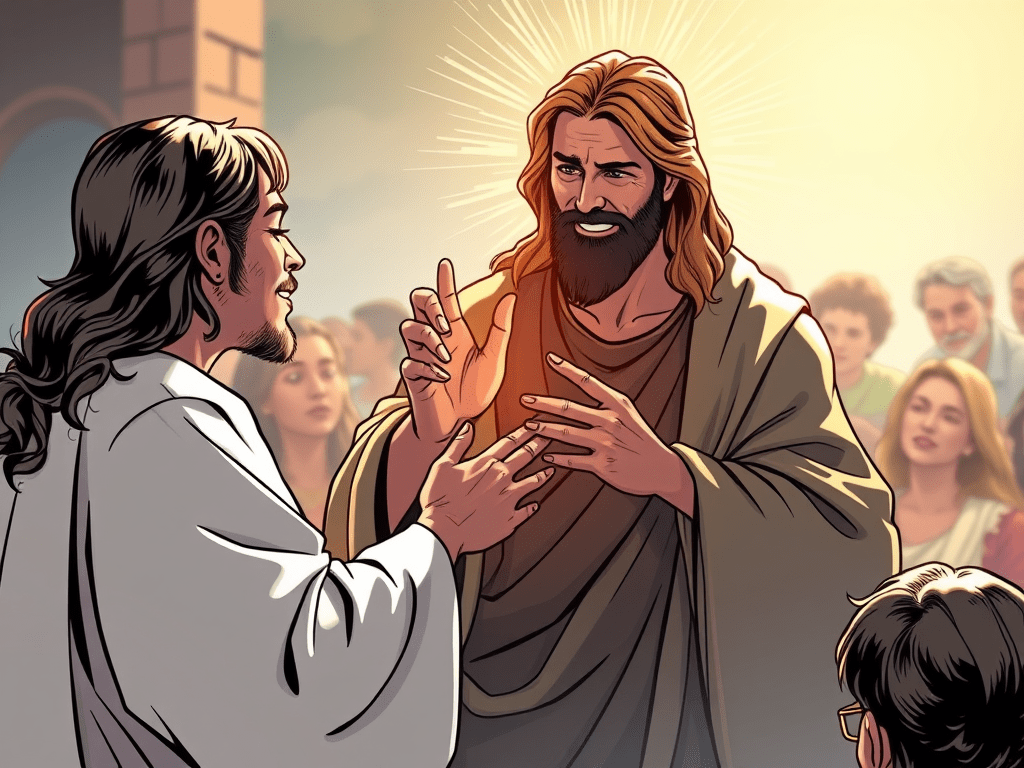
They are experiencing Christianity as joy and hope, having thus become lovers of Christ.

Tag: Hero’sJourney

  • 🌍 The Open Table and the Open Road: Why the Feast Demands the Mission

    🌍 The Open Table and the Open Road: Why the Feast Demands the Mission

    Lessons from Isaiah, Matthew, and St. Paul on True Abundance

    Readings for Wednesday, December 3rd 2025: feria: Isaiah (25:6-10), Matthew (15:29-37); St Francis Xavier memorial: 1 Corinthians (9:16-23); Mark (16:15-20)


    I. The Scarcity Mindset vs. The Sacred Feast

    The Advent season drives us toward the ultimate hope, which Isaiah (25:6-10) describes as the Sacred Feast: a divine banquet on the mountain where the mourning veil is removed, and Death is destroyed for ever.

    The miracle in Matthew (15:29-37)—where Jesus feeds the four thousand—is a prefigurement of this eternal abundance. The crowds ate their fill, and the leftovers—the overflow of grace—filled seven baskets.

    Yet, immediately before the miracle, we hear the disciples’ classic reaction to need: scarcity. “Where could we get enough bread in this deserted place?”

    This is the voice of the scarcity mindset, the Amygdala screaming for survival and retreat

    . It focuses on the magnitude of the problem and the limits of our own resources. Jesus’ question is the antidote: “How many loaves have you?” He shifts the focus from the limits of the deserted place to the limitless power of the Provider.


    II. From Overflow to Obligation (The Hero’s Return)

    The overflow—those seven baskets full—is the crucial link to the Missionary Feast. Why does God give us more than enough? Because grace is not meant for storage; it is fuel for the mission.

    Saint Paul, whose memorial we honor today, understood this better than anyone. He writes in 1 Corinthians (9:16-23) that the Gospel is a duty laid upon him: “I should be punished if I did not preach it!”

    In the Hero’s Journey, the Hero receives the Elixir (the Feast/Grace) and must overcome the Refusal of the Return—the temptation to keep the treasure for himself

    . Paul reverses this, making himself “the slave of everyone” to share the blessings. His true reward is offering the Good News free, matching Christ’s costless abundance with his own costless service.


    III. The Signs That Accompany the Word

    The Gospel of Mark (16:15-20) provides the climax, connecting the Feast (the grace received) to the power needed for the road:

    “Go out to the whole world… These are the signs that will be associated with believers: in my name they will cast out devils; they will lay their hands on the sick, who will recover.”

    The healing of the lame, crippled, and blind in the Matthew reading is the tangible sign that accompanies the Word. The grace you receive at the altar is the power to continue this healing mission. The Mission is not just sharing words; it is sharing the supernatural power that destroys sickness, shame, and spiritual bondage.

    IV. Call to Action: Release the Overflow

    This Advent, the call is to live immediately from the overflow, transforming your inner abundance into outward action.

    Your challenge is to practice Mission-Minded Living:

    1. Dismantle Scarcity: Identify one area (time, money, emotional energy) where you are hoarding resources out of fear. Replace the paralyzing thought, “Where could we get enough?” with the faithful command, “How many loaves do I have?” and trust Christ to multiply it.
    2. Make Yourself a Slave (in Love): Following Paul’s example, embrace one small, inconvenient act of service or evangelization this week. Give your time or talent freely, mirroring the abundance you received at the Feast.
    3. Go with the Signs: Approach your daily life knowing the power that destroyed Death rests upon you. Look for opportunities to share the overflow—a word of encouragement, a prayer for a coworker, a simple act of mercy—trusting that the signs of Christ accompany your obedient Word.

    We have been fed. Now, let us share the boundless banquet with the world.

    Developed with assistance from Gemini AI

  • ⚔️ Hammering Swords into Ploughshares:

    ⚔️ Hammering Swords into Ploughshares:

    The Work of Vigilance

    I. The Journey to the Mountain (The Hero’s Call)

    The liturgical year turns today, beginning the season of Advent. Our destination is clear: The Mountain of the Temple of the Lord .

    The prophet Isaiah (2:1-5) gives us a stunning mythological vision: a towering peak, lifted higher than the hills, drawing all the nations—peoples without number—to learn God’s ways. The outcome of this pilgrimage is radical: “They will hammer their swords into ploughshares, their spears into sickles. Nation will not lift sword against nation.”

    This is the ultimate promise of Eternal Peace (Shalom) and the divine resolution to the problem of human violence.

    In terms of the Hero’s Journey, the journey up the mountain is the Call to Adventure—a call to leave the flat, ordinary world of conflict behind and ascend to the height of revelation. The Law (the oracle) goes out from this place, transforming the very tools of destruction (swords) into the tools of production (ploughshares).

    The pilgrimage is not just historical; it is deeply personal. What are the “nations” of conflict within us that must ascend to the peace of Christ?


    II. The Night and the Burglar (Psychology of Complacency)

    Saint Paul tells us in Romans (13:11-14) that “the night is almost over.” This night is not just a chronological time; it is a psychological state of spiritual drowsiness.

    Jesus illustrates this perfectly in the Gospel with two chilling metaphors: Noah’s Day and the Burglar.

    “If the householder had known at what time of the night the burglar would come, he would have stayed awake and would not have allowed anyone to break through the wall of his house.”

    The burglar represents the unforeseen collapse—the judgment, the crisis, or the moment of death. The wall of the house is the boundary of our interior life, our vigilance.

    Psychologically, the danger is not the outside event; it is the “coarsening” of the heart that makes us fail to stay awake. The twin enemies Paul names—drunkenness and the cares of life—are both methods of spiritual dullness:

    1. Drunkenness/Debauchery: Overloading the system with immediate pleasure, dulling the Prefrontal Cortex (our Will and highest reason) and making us incapable of long-term planning.
    2. Cares of Life: Overloading the system with chronic anxiety, perpetually triggering the Amygdala (our fear center).

    Both states keep us trapped in the Ordinary World, focused only on eating and drinking, leaving the walls of our soul unguarded. We mistake temporary comfort for eternal security.

    III. The Armour and the Ploughshare (The Spiritual Transformation)

    The call to action is immediate and profound: “Let us live decently as people do in the daytime: no drunken orgies, no promiscuity… Let your armour be the Lord Jesus Christ.”

    The transformation required to reach Isaiah’s mountain of peace is a dual effort:

    1. The Work of Divesting (Hammering Swords)

    We must actively give up the things we prefer to do under cover of the dark. This is the Refusal of the Return reversed—we refuse to stay comfortable in the darkness.

    The sword is the symbol of aggression, conflict, and self-defense. What are the swords in your heart?

    • The sword of wrangling (constant conflict).
    • The sword of jealousy (internal war against your neighbor).

    We are called to hammer these weapons into ploughshares—tools for tilling the inner soil, for producing the spiritual fruit of patience, charity, and peace. This process requires daily, painful penance and effort.

    2. The Work of Investing (Donning Armour)

    Paul instructs us: “Let your armour be the Lord Jesus Christ.”

    This is the Apotheosis and Return stage of the Advent journey. We don’t defend our walls with our strength; we defend our soul with Christ. We put on the Mind of Christ and the Virtues of Christ.

    When you are tempted to anger (the sword), your armour reminds you to respond with Christ’s peace. When you are tempted to dull your senses (the drunkenness), your armour reminds you that your Master is coming and you must be awake.

    IV. Call to Action: Walking in the Light

    This Advent, the call is simple: Walk in the light of the Lord.

    The mountain of the Temple is waiting. We are not called to build the perfect society right now, but we are called to build the perfect sanctuary in our own heart. We must make our inner Jerusalem ready for the Prince of Peace.

    Your practical commitment this week is to Vigilance.

    • Identify the Burglar: Name one specific area of your life where you have “allowed someone to break through the wall of your house”—where you are dulling your heart. (e.g., excessive scrolling, obsessive worrying, casual gossip).
    • Hammer the Sword: Take one daily tool of conflict (wrangling, jealousy) and consciously begin to turn it into a tool of peace (patience, prayer).
    • Stay Awake: Resolve to spend your time and energy not on the “cares of life,” but on the saving help Christ offers, so that you are prepared to stand ready.

    Let us walk in the light. Let us start hammering our swords.

    Developed with assistance from Gemini AI