They are experiencing Christianity as joy and hope, having thus become lovers of Christ.

Tag: Hero’s Journey

  • The Geometry of Grace:

    The Geometry of Grace:

    Why the Yoke is Actually Light

    We’ve all heard the cynical refrain: “Misfortune falls on the good and the bad alike.” We treat life like a chaotic lottery where lightning strikes the saint and the sinner with equal indifference.

    But is that actually true?

    If we look through the lenses of Catholic Exegesis, Neurobiology, and the Hero’s Journey, we discover a startling reality: Grace isn’t just a theological “extra.” It is a fundamental shift in how a human being interacts with reality.

    1. The Suburbs of Heaven

    C.S. Lewis famously suggested that for those who say “Yes” to God, this life is the beginning of Heaven; for those who say “No,” it is the beginning of Hell.

    This isn’t just a poetic thought. It is a description of an internal ecosystem. The Book of Wisdom tells us that those who do good fare well. When you live a life of grace, you are no longer rowing against the current of the universe. You are aligned with the Creator’s design. This alignment creates a “protective shield”—not by magic, but by a radical reordering of your life.

    2. The Biological Advantage of Peace

    Let’s look at the “structure of the brain.” A life of sin—gluttony, drunkenness, aggressive driving, or constant domestic strife—keeps the brain in a state of chronic Amygdala Hijack. This is the “fight or flight” center. When it’s overactive, your body is flooded with cortisol, your immune system weakens, and your peripheral vision literally narrows. You become more “prone to injury” and “susceptible to accidents” because your brain is too cluttered to pay attention.

    A “Real Christian,” however, operates from the Prefrontal Cortex—the seat of peace and discernment. By practicing chastity, fasting, and a clean conscience, you are essentially “fine-tuning” your biological machine.

    • Better Sleep: Because your conscience is clear.
    • Less Sickness: Because your stress levels are lower and your habits are more responsible.
    • Fewer Accidents: Because you are “less in a hurry” and more aware of the people around you.

    3. The Hero’s Risk and the Martyr’s Paradox

    Now, there is one place where the “Safety of Grace” seems to fail: Sacrifice. In the classic Hero’s Journey, the protagonist eventually leaves the “Safe Zone” to face the dragon for the sake of the village. For the Christian, this is the call to be a Martyr or a servant. We are much more willing to take an injury for others.

    But even here, the experience is different. As Brother Lawrence noted, God does not permit a soul totally abandoned to Him to suffer for “any appreciable length of time” without Divine support. When the world sees a catastrophe, the Christian sees a rebirth.

    4. A Different Dimension of Suffering

    When trials do come—and they will—the “Real Christian” isn’t living in the same dimension as the worldling. For those living only for this world, a trial is “sheer hell” because it threatens their only treasure.

    For the person in Grace, suffering is Sacred Alchemy. Following the thought of St. John Paul II, we see that suffering:

    1. Consumes Evil: It burns away the parts of our ego that we haven’t yet surrendered.
    2. Acts as Penance: It helps us understand the true cost of sin—our own and others’.
    3. Opens a Door: It is the “New Jerusalem” mindset, asking not “Why is this happening to me?” but “What is God trying to show me?”

    The Call to Action: Die to the Hurry

    Spiritual transformation isn’t a theory; it’s a practice. If you want to experience this “Light Yoke,” start with the Great Simplification. * Clean your conscience: Go to Confession and clear the mental clutter.

    • Audit your pace: Intentionally move slower this week. Watch how your “luck” changes when you are no longer in a frantic hurry.
    • Fix your eyes: When the next trial hits, ask God for the strength to see it as a “door” rather than a “wall.”

    Edited with assistance from Gemini

  • 💜 The Call to Humility: Rewiring the Rebellious Heart

    💜 The Call to Humility: Rewiring the Rebellious Heart

    Readings for 16 DEC 2025: Zephaniah 3:1-2, 9-13; Psalm 33; Matthew 21:28-32

    I. Introduction: The Rebellious City

    We are deep in the heart of Advent, a season colored Violet—the color of royalty, but also of penance and preparation. The scriptures today issue a stark, powerful challenge, starting with the prophet Zephaniah:

    “Trouble is coming to the rebellious, the defiled, the tyrannical city! She would never listen to the call, would never learn the lesson…” (Zephaniah 3:1-2)

    When we hear the word “city,” our modern mind goes to bricks and mortar. But in the prophetic tradition, the city—Jerusalem—is often a profound metaphor for the human soul. Zephaniah is describing not just a physical place, but the rebellious, unintegrated heart—the ego that refuses counsel, trusts only itself, and never draws near to God.

    This “tyrannical city” is the part of our consciousness that seeks to be King Belshazzar, building its own reality based on pride and self-will.

    II. The Psychological Crisis: Refusal and Tyranny

    The First Reading lays bare the psychological state of the rebellious heart:

    • “She would never listen to the call.”
    • “She has never trusted in the Lord.”
    • “She never drew near to her God.”

    This is the Refusal of the Call in the language of the Hero’s Journey. Joseph Campbell taught that all great myths begin when the hero is called to leave their comfortable, known world, and initially says No. The rebellious heart is stuck in this refusal.

    Psychologically, this refusal is driven by the Limbic System. This ancient, instinctual part of the brain seeks comfort, security, and the avoidance of all risk. To trust God, to draw near to God, means surrendering control, which the Limbic System perceives as an existential threat. This fear of surrender makes the heart tyrannical—it must control everything because it fears everything.

    III. The Gospel’s Two Sons: Action vs. Attitude

    Jesus clarifies this battle between the tyrannical heart and true conversion with the parable of the two sons:

    • The First Son: Said “No,” but afterwards thought better of it and went.
    • The Second Son: Said “Certainly, sir,” but did not go.

    The chief priests and elders, comfortable in their certainty and piety, represent the Second Son. They had the right attitude (the right words, the right liturgy), but their tyrannical, rebellious heart (Zephaniah’s city) remained unchanged.

    The tax collectors and prostitutes represent the First Son. They started in the “tyrannical city” of self-will and sin, but in their moment of brokenness, they experienced the crucial psychological step: thinking better of it—a deliberate act of the will leading to action.

    Jesus’s verdict is stunning: “Tax collectors and prostitutes are making their way into the kingdom of God before you.” They embarked on the Hero’s Journey (repentance and action) while the pious were still stuck in the tyranny of their own self-righteous refusal.

    IV. The Great Transformation: Clean Lips and Humility

    The good news, the Advent promise, is that God does not abandon the tyrannical city. Zephaniah promises a profound transformation:

    “Yes, I will then give the peoples lips that are clean, so that all may invoke the name of the Lord and serve him under the same yoke.” (Zephaniah 3:9)

    The “clean lips” are the sign of the transformed heart. Psychologically, this is the victory of the Prefrontal Cortex (PFC)—the seat of reason, moral choice, and long-term vision—over the tyrannical Limbic System.

    • The Limbic heart speaks lies and boasts (Zephaniah 3:13: the perjured tongue).
    • The PFC, aligned with God’s will, brings clean lips—it brings truth, humility, and the ability to invoke the Lord’s name.

    This transformation is completed by two essential virtues:

    1. The Removal of Pride: “I will remove your proud boasters from your midst; and you will cease to strut on my holy mountain.” (Zephaniah 3:11)
    2. The Installation of Humility: “In your midst I will leave a humble and lowly people, and those who are left in Israel will seek refuge in the name of the Lord.” (Zephaniah 3:12)

    The spiritual journey is the systematic dismantling of the tyrannical ego and the installation of humility, where the PFC chooses the love of God over the fear of the self.

    V. Call to Action: The Poor Man’s Call

    This Advent, the call is clear: Stop being the Second Son. Stop being the tyrannical city.

    The Responsorial Psalm gives us the path to conversion: “This poor man called; the Lord heard him.”

    The “poor man” is the humble and lowly person Zephaniah promised. He is the person who has surrendered the tyranny of the ego. The Lord hears him because he is close to the “broken-hearted” and those whose “spirit is crushed.”

    Real spiritual transformation today requires two acts of the will:

    1. Stop Strutting: What are you still doing for show? What is the “proud boasting” that keeps you from trusting God? The work of penance is the work of removing pride.
    2. Start Doing: Do not remain in the Refusal phase. Be the first son. That means taking action that requires surrender. That means choosing the hard “Go and work in the vineyard” over the easy “Certainly, sir.”

    The Lord is coming. Let us choose to dismantle the rebellious city in our hearts, surrender the tyranny of fear, and allow the promised “humble and lowly people” to seek refuge in His name.

    Amen.

    Developed with assistance from Gemini AI

  • The Man Who Lived a Myth (And Was Real)

    The Man Who Lived a Myth (And Was Real)

    If someone told you this story as fiction, you’d roll your eyes and say, “Come on, nobody’s life is that tidy.”

    A boy is born into one of France’s ancient noble families, bloodline reaching back to the Crusades, family motto: Jamais arrière—“Never back.”

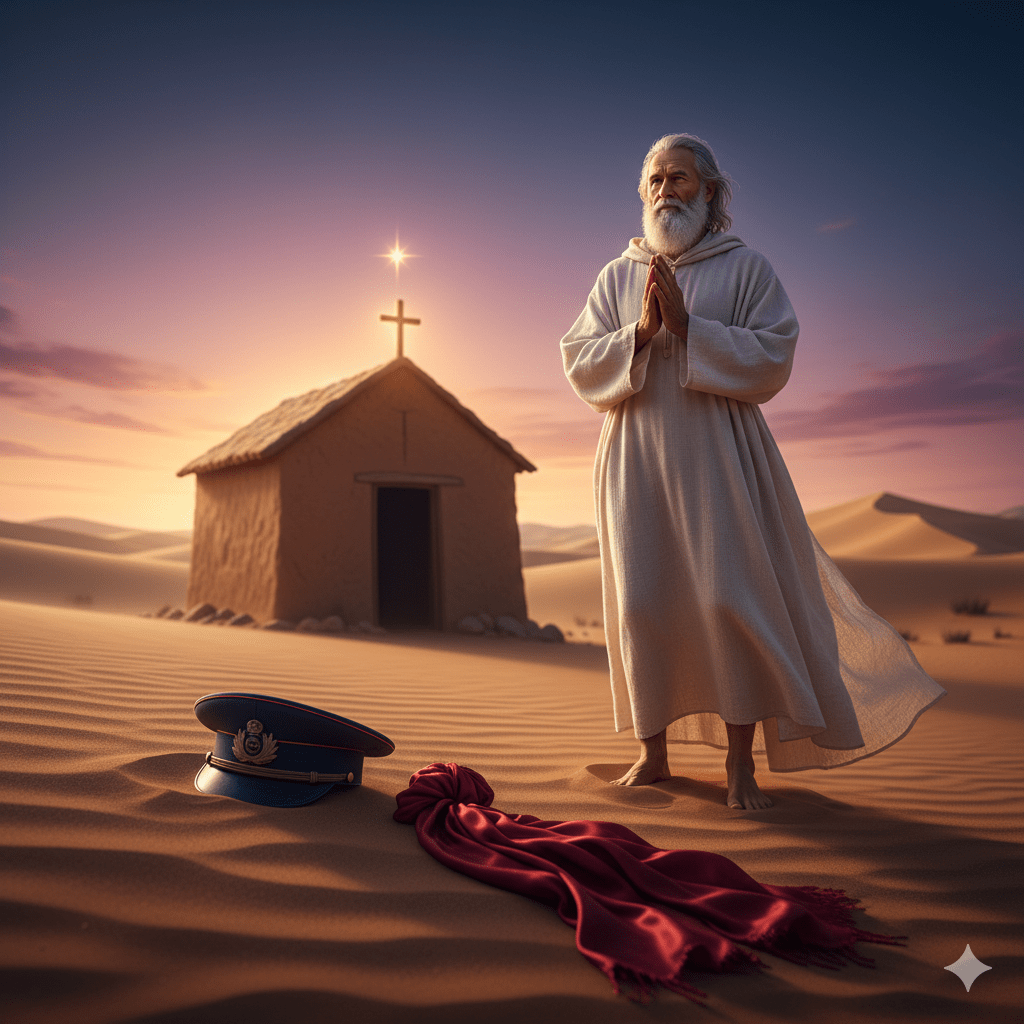
    He loses his parents at six, inherits a fortune, and promptly becomes the most spoiled, lazy, and debauched young officer in the French cavalry: expelled from school, famous for orgies and gourmet dinners in the Algerian desert while on duty.

    At twenty-eight, something cracks open inside him. He walks into a Paris church and tells a priest, “I don’t believe in God, but teach me about Him anyway.”

    He gives everything away, joins the strictest monastery he can find, decides even that isn’t poor enough, and leaves.

    He disappears into the Sahara to live closer to the poorest of the poor (the Tuareg nomads whom his own army regards as enemies).

    He builds a tiny hermitage of mud bricks, learns their language, compiles the first real Tuareg-French dictionary while half-starving at 9,000 feet on a frozen plateau.

    He begs to be ordained a priest only so he can celebrate Mass alone in the desert, telling God, “I want to live where no one knows You, so that You are not alone there.”

    On the night of 1 December 1916, bandits come to kidnap him for ransom. A fifteen-year-old boy guarding him panics at the sound of approaching French camel troops and shoots the hermit through the head.

    He dies instantly, face in the sand, apparently a failure: no converts, no community, no one to carry on his vision.

    He is buried in a ditch.

    A century later, in 2022, the Catholic Church declares him a saint.

    Nineteen religious orders and lay communities (Little Brothers of Jesus, Little Sisters of Jesus, and many others) now live all over the world according to the rule he wrote for a brotherhood that never existed while he was alive.

    From prodigal son to desert hermit to forgotten martyr to spiritual father of thousands: his life follows the ancient hero’s journey so perfectly that it feels invented.

    Except it isn’t.

    Every detail is documented, photographed, witnessed.

    Charles de Foucauld (1858–1916) lived a legend, then died in obscurity, and only then did the legend begin to walk on its own.

    Sometimes reality is allowed to be more beautiful than myth.

    Feel free to share.

    (If you want a one-sentence version for social media:

    “Rich playboy → atheist officer → Trappist monk → Sahara hermit → murdered by a scared teenager → canonized saint whose spiritual children now circle the globe. Charles de Foucauld didn’t just live a myth. He lived the whole myth, and it was true.”)

    Further reading
    • Charles de Foucauld’s own letters and spiritual writings are collected in Charles de Foucauld: Essential Writings (Orbis Books, 1999)
    • The best single biography in English remains Jean-Jacques Antier, Charles de Foucauld (Ignatius Press)
    • Pope Francis on Charles: Gaudete et Exsultate §§66–68 (free at vatican.va)
    • Pope Leo XIV’s recent references appear in Dilexi Te (2025), §§42–45

    This reflection was shaped in conversation with Grok (xAI), December 2025.

  • Build on the Rock:

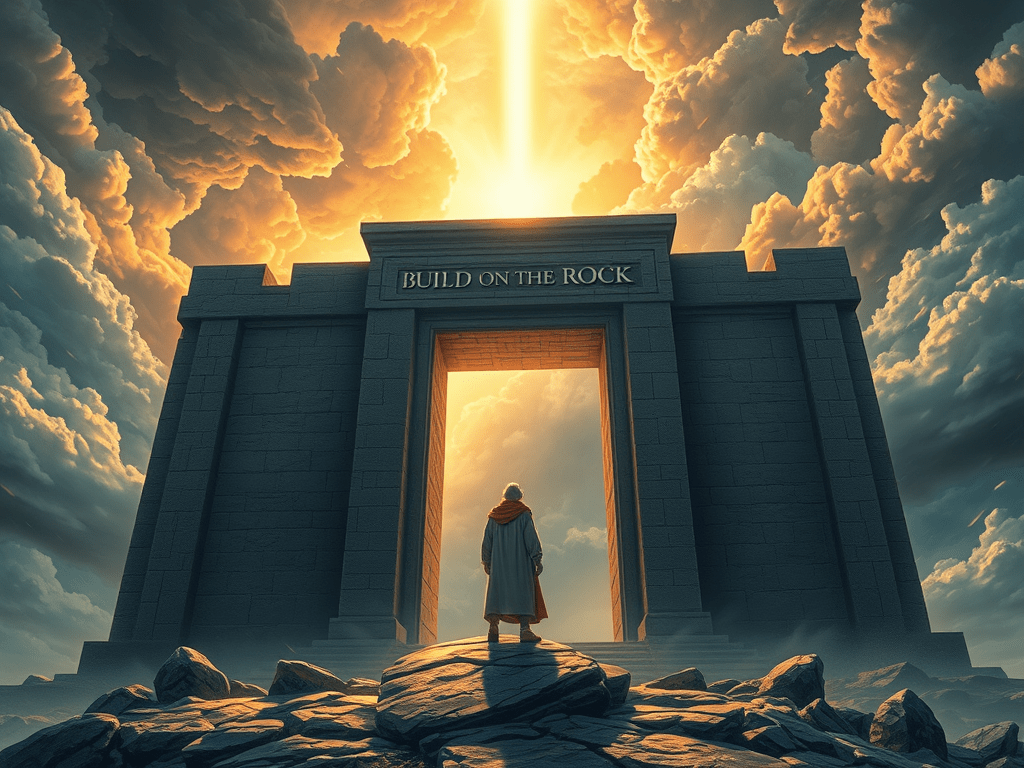
    Build on the Rock:

    A Hero’s Journey of Real Spiritual Transformation

    Thursday, December 4th — Advent Reflection

    Readings: Isaiah 26:1–6 • Psalm 118 • Matthew 7:21,24–27
    Liturgical Color: Violet (Advent)

    Advent is a season of waiting, watching, and rebuilding the inner life. The readings for today speak with a single voice: your soul must be founded on the Rock, because storms will come. Not just external troubles, but the storms inside the human heart—fear, temptation, pride, confusion, and despair.

    Isaiah, the Psalmist, and Jesus Himself give us three images:
    a strong city, a sacred gate, and a house on solid rock.
    Together, they outline the path of every spiritual hero—from the prophets, to the saints, to ordinary men and women trying to follow God today.

    Let’s walk through the readings with Catholic wisdom, mythological insight, and psychological truth—so we can act on them, not just hear them.


    Isaiah: Open the Gates and Enter the Strong City

    Isaiah sees a vision of the soul as a strong city, built by God Himself:

    “We have a strong city… Open the gates! Let the upright nation come in… Trust in the Lord forever, for the Lord is the everlasting Rock.”

    The imagery is rich and precise:

    • The city is the human soul
    • The walls and ramparts are the virtues that protect us
    • The gates are the choices of the will

    Only those who trust in the Lord, who keep their minds “steadfast,” can enter.

    In mythic language, this moment is the hero approaching the threshold.
    Every great story has this scene:

    • Odysseus at the gates of the underworld
    • Aeneas at the temple doors
    • Frodo at the borders of Mordor
    • Christ at the entrance of the tomb

    But Scripture adds something deeper:
    The strength of the city is not your own willpower. God Himself is the foundation.
    The hero does not face chaos alone. The hero faces chaos with God.


    Psalm 118: The Gate of Holiness

    The Psalm continues the same theme:

    “Open to me the gates of holiness… This is the Lord’s own gate where the just may enter.”

    The pilgrim approaches the Temple and knocks. The question from inside is implied:
    Who may enter?

    The answer is not:

    • “I am strong.”
    • “I am important.”
    • “I have influence.”

    The answer is:
    “The Lord is my refuge.”

    Psychology says the same:
    When your core identity rests on anything unstable—success, emotions, reputation, strength—your inner world collapses when those things shift.
    But when identity rests on God, the soul stands firm.


    Jesus: Build Your House on the Rock

    In the Gospel, Jesus gives the image most people know:
    Two builders. Two foundations. Two futures.

    But He adds a detail that cuts straight to the heart:

    Both men hear His words. Only one acts.

    This is the decisive moment of the Hero’s Journey—when knowing is no longer enough.
    The hero must obey.
    The hero must choose.
    The hero must cross the threshold into action.

    Jesus says plainly:

    “Everyone who listens to these words of mine and acts on them will be like the wise man who built his house on rock.”

    Storms hit both houses.
    Faith does not guarantee ease.
    Faith guarantees endurance.


    The Psychology: Two Builders, Two Brains

    There’s a psychological layer here too.

    The house on rock

    represents a life governed by the higher faculties:

    • Reason
    • Conscience
    • Long-term vision
    • Stability
    • Sacrifice
    • Grace-supported will

    The house on sand

    represents a life governed by the lower systems:

    • Impulse
    • Emotion without discipline
    • Ego and appearance
    • Social pressure
    • Immediate pleasure

    Neuroscience confirms what Scripture teaches:
    When stress comes, the “lower” regions dominate unless the higher faculties are formed and anchored.

    Storms—suffering, fear, temptation, failure—expose the foundation of the soul.


    Mythic Parallels: Every Hero Faces the Storm

    Every ancient story knows this truth:

    • Gilgamesh meets the flood
    • Jonah meets the tempest
    • Odysseus meets the sea
    • Aeneas meets the burning city
    • Christ meets the Cross

    Heroes are not defined by the absence of storms, but by the strength of their foundation.

    Myths point to it.
    Psychology explains it.
    Catholic faith reveals it:
    The foundation is Christ Himself.


    Catholic Exegesis: The Rock Has a Name

    The Church Fathers are unanimous:

    • Christ is the Rock (1 Cor 10:4)
    • His teaching is the Rock
    • The Church is the Rock
    • Grace that strengthens the will is the Rock

    St. Augustine:
    “The house is faith; the foundation is Christ.”

    St. Gregory the Great:
    “To hear without acting is to build in the imagination.”

    St. Thomas Aquinas:
    “The foundation of the spiritual life is humility.”

    So the Rock is not self-help.
    The Rock is not moralism.
    The Rock is not positive thinking.

    The Rock is a Person.
    A relationship.
    A covenant.
    A surrender.


    How to Build on the Rock Today

    Here is the practical plan Jesus gives:

    1. Listen to His words

    Read Scripture.
    Study the faith.
    Let the Church teach you.

    2. Act on His words

    Do one concrete thing today:
    Forgive.
    Pray.
    Serve.
    Confess.
    Cut out a vice.
    Re-establish order.

    The hero’s gate is action.

    3. Trust God more than yourself

    Say:
    “Lord, I want Your will more than comfort.”

    4. Build habits that hold under pressure

    Virtue is spiritual architecture.
    The sacraments are reinforcement beams.
    Prayer is the daily maintenance.

    5. When the storm comes, choose to stand

    Do not fear the wind.
    Do not panic at the rain.
    Do not believe the lie that you are alone.

    The storm is not your enemy.
    The storm reveals your foundation.


    The Call: Enter the Gate. Stand on the Rock.

    Advent invites you to rebuild your life on Christ.

    Isaiah says: Enter the city.
    The Psalm says: Come through the gate.
    Jesus says: Stand on the Rock.

    The message is simple and strong:

    Your life has a structure.
    Your soul has a destiny.
    Your choices build a house that will either stand or fall.

    So today, choose to act.
    Choose to trust.
    Choose to build.
    Choose the Rock.

    And when the rains fall and the floods rise and the winds tear at everything—
    you will stand.
    And your endurance will give glory to God.

    Developed with assistance from ChatGPT-5

  • ⚖️ Weighed and Found Wanting: The Fatal Mistake of Hubris

    ⚖️ Weighed and Found Wanting: The Fatal Mistake of Hubris

    Why Your Greatest Gifts Can Become Your Greatest Danger

    The story of King Belshazzar is the story of every person who has ever looked at their talents, their success, or their good fortune and thought, “This is mine. I earned it. I control it.”

    It’s the story of Hubris—that fatal, self-centered mistake that comes before the fall. Our readings today (Daniel 5 and Luke 21) show us the anatomy of this spiritual disease and reveal the only cure: active, enduring faithfulness.


    1. The Party and the Problem: The Banality of Blasphemy

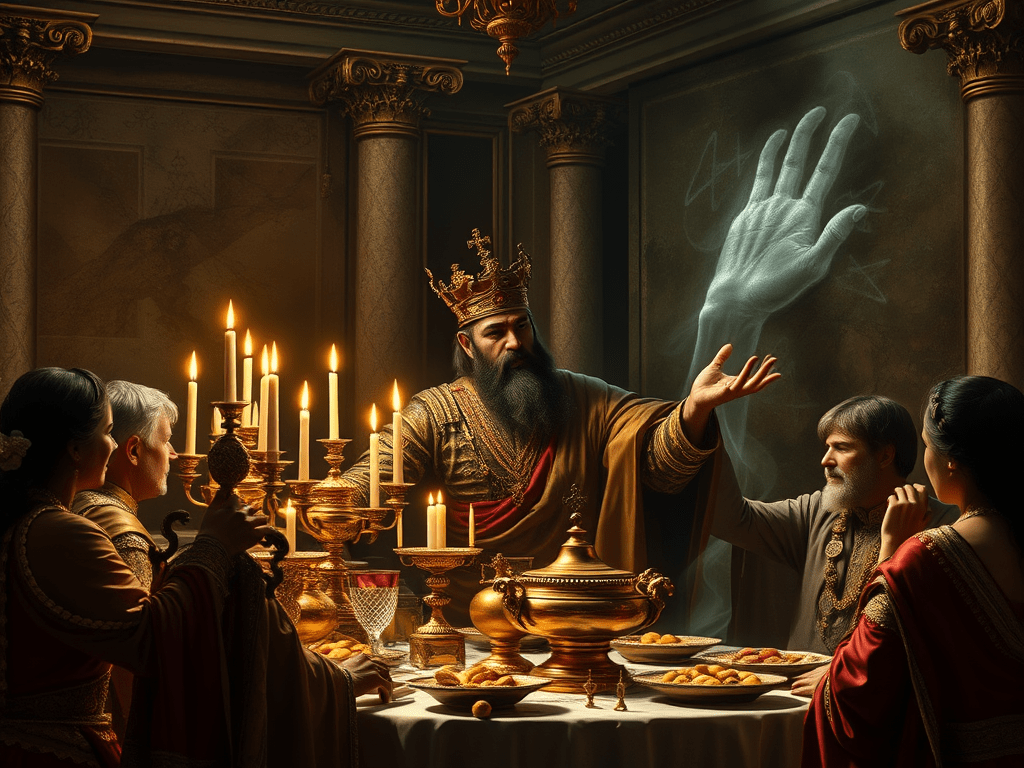
    King Belshazzar, in our first reading, throws a magnificent, drunken banquet. His act of blasphemy is not a simple mistake; it’s a defiant spectacle. He demands the holy gold and silver vessels looted from the Temple in Jerusalem be brought out and used for a pagan party.

    This is the spiritual state of radical entitlement. Belshazzar treats the holy (gifts from God) as merely a trophy for his own ego.

    The Psychology of Entitlement

    This is what happens when the Adversary’s whisper takes root: it convinces us that our talents, our wealth, and our relationships are entirely our own doing, meant solely for self-gratification.

    But at the height of his pride, the visible world breaks down: “Suddenly the fingers of a human hand appeared, and began to write on the plaster of the palace wall.”

    The writing is the ultimate accounting of a life lived without reference to the sacred:

    • Mene: Your power has been measured and ended.
    • Tekel: You have been weighed in the balance and found wanting.
    • Parsin: Your kingdom has been divided and lost.

    Belshazzar failed because he refused to glorify the God who held his breath and all his fortunes in his hands. His life, measured against the standard of the sacred, collapsed.


    2. The Hero’s Forge: The Necessity of Endurance

    If Belshazzar’s downfall is the consequence of Hubris and Pride, the Gospel (Luke 21) provides the antidote: Endurance and Trust.

    Jesus tells His disciples not of palaces, but of persecution, betrayal, and even death. This is the moment in the Hero’s Journey where the hero is stripped bare, entering the chaotic belly of the whale where all external support is lost.

    In the face of this absolute chaos, Jesus gives two counter-intuitive commands:

    1. Don’t Prepare Your Defence: Jesus commands us to relinquish the primal urge to control the narrative. Our brain, our ego, wants to be prepared, to argue, to win the court case. But He says, “I myself shall give you an eloquence and a wisdom…” We are called to suppress our own iron strength and rely on the Holy Spirit’s divine wisdom.
    2. Endure: The ultimate secret to salvation is revealed: “Your endurance will win you your lives.” Endurance is not passive survival. It is the active, faithful confrontation with suffering—a sustained posture of obedience that forges character and secures the soul.

    3. The Call to Live with Consecration

    We are called to move past the judgment of the decadent palace and into the endurance of the faithful disciple.

    A. Examine Your Holy Vessels

    Where are you taking the consecrated gifts God gave you—your time, your talents, your intelligence, your relationships—and treating them as merely trophies for your own consumption?

    • Do you use your intelligence to build yourself up, rather than to serve the Truth?
    • Do you treat your days off simply as hours for personal indulgence, rather than a chance to glorify God and love others?

    All we have is a consecrated vessel, a gift from God. The shift begins when we recognize this truth and use our gifts for their intended, holy purpose.

    B. Stay Awake in the Chaos

    The Gospel Acclamation instructs us: “Stay awake, praying at all times for the strength to stand with confidence before the Son of Man.”

    The courage to endure is won in the small battles:

    • In the willingness to suffer a slight and not seek immediate revenge.
    • In the resolve to remain faithful to your commitments when they become boring.
    • In the continuous choice to seek God’s wisdom instead of relying on your own prepared script.

    Do not be afraid of the chaos. It is merely the process by which God measures our foundations. Let us stand with confidence, relying not on our own power, but on the wisdom and eloquence of Christ, so that when our lives are weighed, we may be found faithful.


    Discussion Prompt:

    What is one “holy vessel” (a gift, talent, or resource) in your life that you have been treating like a “trophy” for your own pride or indulgence? What is one concrete action you can take this week to reconsecrate it to God’s purpose?

    Share your commitment below.

    Developed with assistance from Gemini AI, ChatGPT-5 and GROK 4.1

  • The Stone That Became a Mountain

    The Stone That Became a Mountain

    A Reflection for Tuesday, November 25, 2025 Based on Daniel 2:31-45; Daniel 3:57-61; and Luke 21:5-11

    (Originally delivered as a 12-minute talk – now expanded for anyone who wants to sit with it longer)

    I’ve never met King Nebuchadnezzar, but some nights I wake up in a cold sweat feeling exactly like him.

    You know the dream: a dazzling statue rises in front of you—head of gold, chest of silver, belly of bronze, legs of iron, and feet made of iron mixed with crumbling clay. It is magnificent, terrifying, and (you are secretly proud) it looks a lot like the empire you’ve spent your whole life building. Then, out of nowhere, a stone “untouched by human hand” rockets across the void, smashes the feet, and the entire thing explodes into powder. The wind scatters the dust, and the stone keeps growing until it becomes a mountain that fills the whole earth.

    Daniel, barely more than a teenager and a foreign prisoner, looks the most powerful man on the planet in the eye and says: “That stone is God’s Kingdom. Everything you trust will be ground to chaff. Only the Kingdom will last forever.”

    Two and a half millennia later, that dream still haunts us because it is no longer just about Babylon. It is about the statues we keep erecting inside our own skulls.

    Your Brain Is the Statue

    Neuroscience has accidentally given us one of the best commentaries on Daniel 2 ever written.

    • The golden head = the prefrontal cortex: language, long-term planning, morality, the part of you that wants to build something glorious and eternal.
    • The silver arms and chest = the limbic system: love, belonging, tribal identity, emotion.
    • The bronze belly = the older reward circuits: pleasure, ambition, appetite, status.
    • The iron legs = the brainstem and motor strips: raw survival, dominance, fight-or-flight.
    • The feet of iron and clay = the fragile, perpetually uneasy handshake between our ancient reptile brain and our fragile modern consciousness. Strong enough to run a civilization, brittle enough to shatter the first time life hits it wrong.

    Every war, every addiction, every mid-life crisis, every doom-scrolling spiral begins when the lower floors start dictating terms to the upper ones.

    The Universal Story

    Joseph Campbell spent his life showing that every culture tells the same story:

    Ordinary world → Call to adventure → Refusal → Mentor appears → Crossing the threshold → Ordeal and death → Seizing the treasure → Return to give it away.

    Translate the characters:

    Daniel is the mentor who will not bow.

    Jesus is the Stone cut without hands—the true Hero who descends into the realm of death and rises again.

    And you and I? We are the ones being summoned out of the collapsing statue into the growing mountain.

    When the Temple Comes Down

    In today’s Gospel people are gawking at the Jerusalem Temple—literally the most impressive religious building the ancient world had ever seen. Jesus looks at them and says, in effect, “Enjoy the view while it lasts. Not one stone will be left on another.”

    He is not being cruel. He is being honest. Every human temple, every human empire, every human self built only with human hands will one day stand on feet of clay.

    But notice what he says next: “When you hear of wars and insurrections, do not be terrified… Nation will rise against nation… There will be great earthquakes…” These are not the end. They are the birth pangs.

    In mythology, the false world has to shatter before the real story can begin.

    In psychology, the ego has to crack open before genuine integration can happen.

    In salvation history, the Stone has to strike.

    The Catholic Reading in One Sentence

    The Stone is Christ.

    The Mountain is the Church, born from the rock struck on Calvary and from the side of Christ on the Cross.

    And the dream is being fulfilled right now, every time a human soul lets the Kingdom smash its idols and fill its emptiness.

    So What Do We Actually Do?

    Four concrete, life-changing steps you can start this week:

    1. Name Your Statue
      Tonight, before you go to bed, ask: What is the gold-headed thing I trust more than God? Career? Reputation? Political ideology? My phone? My body? My children’s success? Write it down. That’s your personal Nebuchadnezzar dream.
    2. Let the Stone Strike
      Take that piece of paper (or just the knowledge of it) to confession, to adoration, to the foot of the crucifix. Ask Jesus to touch the feet of clay. It will probably feel like everything is falling apart. Good. That’s the sound of the Kingdom arriving.
    3. One Line, Ten Minutes, Every Morning
      Before you open any app, sit in silence and let one phrase from today’s readings strike you and grow:
      “A stone untouched by human hand…”
      Repeat it slowly, like a breath prayer. Let it smash the noisy empires in your mind. Ten minutes. That’s all. But do it daily and watch what kind of mountain starts growing inside you.
    4. Live the Return
      The hero never keeps the elixir for himself. Bring the peace you find in that silence to your family, your cubicle, your parish council, the grocery checkout line. The world is starving for people who have let the Stone win.

    The Dream Is Still True

    We are living in the age of the feet of clay.

    Globally: superpowers and tech empires that look invincible but are already cracking.

    Personally: hearts that are part iron, part mud, strong enough to function, brittle enough to break.

    But the Gospel acclamation today is shouting at us across two thousand years:

    “Stand erect, hold your heads high, because your liberation is near at hand!”

    The statue is already trembling.

    The Stone has already left the mountain.

    The only question left is whether we will cling to the collapsing colossus or open our hands and let the Kingdom break us open—so that, through us, it can fill the whole earth.

    Come, Lord Jesus.

    Strike the feet.

    Grow the mountain.

    Make Your home in us.

    And then send us back out to a world that desperately needs living stones.

    Amen.

    Feel free to share this post, print it, read it aloud to your family, or just sit with it in the quiet. The dream is still coming true—and you’re in it.

  • Discovering Your Heroic Vocation

    Recognizing the call that sets your life on a meaningful adventure

    Introduction: The Call to Adventure

    Every life has a calling. Not every vocation leads to priesthood or consecrated life. C.S. Lewis reminds us that there are infinitely many good vocations, each as different from one another as good is from evil. Some callings are familiar: raising a family, serving the poor, leading a community, or creating art that inspires. Others are unique, waiting quietly for a person to step forward.

    In the language of the Hero’s Journey, the first step of any adventure is the call. It may come as restlessness, a sense of purpose, or an invitation to serve. Recognizing this call is the beginning of a life fully aligned with God and with your gifts.


    The Heroic Vocational Questions

    To help discern your calling, consider these reflective questions. They are not a checklist, but a framework for discovery:

    1. Where do I feel most alive when serving or creating?
    2. What challenges stir courage in me rather than fear?
    3. Which relationships or mentors draw out the best in me?
    4. What activity makes me lose track of time while benefiting others?
    5. What do I keep returning to, even when it’s difficult or uncomfortable?
    6. How would I want my life to be remembered if I gave it fully to this path?
    7. What sacrifice would I be willing to make for the good that matters most to me?
    8. How does this calling connect with the greater good, the community, or God’s plan?

    These questions guide a person toward self-knowledge, courage, and clarity—the essential tools for responding to any vocation.


    Reflection and Discernment

    Answering these questions requires honest reflection, prayer, and openness to God’s guidance. It may take weeks or months to see patterns or clarity emerge. Journaling, talking with a trusted mentor, or spending time in prayerful solitude can help you hear the call more clearly.

    Remember: vocation is a process, not a single answer. Your understanding of your calling may grow or shift over time. The key is to remain attentive to the stirrings in your heart and to align your life with God’s will.


    Practical Next Steps

    Once you have a sense of your calling, take practical steps to test and nurture it:

    • Volunteer or intern in areas related to your perceived vocation.
    • Seek out mentors or communities that live out what you feel drawn to.
    • Learn actively: read, train, or practice skills that support your calling.
    • Experiment with small projects or commitments to see how they resonate.

    These steps allow your calling to reveal itself in action, confirming whether it truly aligns with your gifts and God’s plan.


    Conclusion

    Every vocation is heroic in its own way. Whether it is priesthood, marriage, art, leadership, or service, answering your call is stepping into a life of purpose, courage, and joy.

    Start by paying attention to the stirrings in your heart. Ask the reflective questions, test your path, and trust God’s guidance. Your heroic journey begins with the first step: saying yes to the call.

    Developed with assistance from ChatGPT-5

  • Take Up Your Cross:

    The Hero’s Anthem of Discipleship

    At Mass today, the congregation sang a hymn that almost reads like a hero’s anthem:

    “Take up thy cross,” the Savior said,
    “if thou wouldst my disciple be;
    deny thyself, the world forsake,
    and humbly follow after Me.”

    “Take up thy cross, let not its weight
    fill thy weak spirit with alarm;
    His strength shall bear thy spirit up,
    and brace thy heart, and nerve thine arm.”

    “Take up thy cross, nor heed the shame,
    nor let thy foolish pride rebel;
    thy Lord for thee the cross endured,
    to save thy soul from death and hell.”

    “Take up thy cross, and follow Christ,
    nor think till death to lay it down;
    for only they who bear the cross
    may hope to wear the glorious crown.”

    At first glance, it is a call to discipleship, a reminder to endure suffering, and a promise of eternal reward. But the hymn also mirrors the archetypal Hero’s Journey:

    • The Call to Adventure: The Savior invites each disciple to leave comfort behind, deny selfish desires, and step into a path of transformation.
    • Supernatural Aid: Divine strength sustains the believer, just as mythic heroes receive guidance and power from mentors or gods.
    • The Road of Trials: Enduring shame, temptation, and inner resistance is the crucible that refines courage, humility, and faith.
    • The Ultimate Boon: The crown at the journey’s end is victory over death and union with God—eternal life as the hero’s reward.
    • Return to the World: Though the cross is carried daily, the disciple’s journey inspires others, becoming a witness of hope and courage in the ordinary world.

    In essence, the hymn frames discipleship as a heroic quest. Each cross we bear is both trial and triumph, each act of faith a step along the path of transformation. It reminds us that true heroism is not the absence of suffering, but the courage to endure, the humility to trust, and the hope that, in the end, life’s ultimate reward is already glimpsed in faith.

    The lyrics are by: Everest, Charles William, M.A

    Written with assistance from ChatGPT-5

  • Humility Means Staying Close to the Ground

    Lessons from Jiu Jitsu, Scripture, and the Hero’s Descent

    We often think of humility as weakness, but it is really a strength. In a talk I heard today, the speaker said humility means being close to the ground. He used the example of Jiu Jitsu, a martial art strongest when practiced low to the floor.

    That picture opened other connections for me. Jordan Peterson has said that human beings were originally tree creatures — we stayed off the ground because it was unsafe. In myth, the “deep” often represents chaos — the water where danger and the unknown dwell.

    The hero, however, is the one willing to descend. He steps down into the unknown, into danger, into the deep, to face the dragon and gain something new. Humility is not about weakness; it is the stance of someone willing to learn.

    The adversary, in contrast, is proud. He refuses to bow, refuses to learn, and stays aloof from the ground.

    Where is God asking you to “stay close to the ground,” to take the low and humble place so you can learn what you need?

    Developed with assistance from ChatGPT-5

  • Understanding the Adversary

    A Heroic Approach to Trauma and Transformation

    Q: Would you say that fascists and decadents are people who are afraid to face life?

    Yes, in a profound sense, both fascists and decadents can be understood as people who are afraid to face life as it truly is—but they respond to that fear in opposite ways.

    Fascists often fear the chaos, ambiguity, and moral uncertainty of life. So they seek control, order, and purity—often through domination or force. They crave rigid hierarchies and obedience to protect themselves from the anxiety that comes with freedom and human complexity.

    Decadents, on the other hand, fear responsibility, suffering, and the demands of meaning. So they escape into pleasure, distraction, or irony. They numb themselves with excess or detachment, because facing truth or sacrifice feels unbearable.

    Both postures are forms of escape: one into domination, the other into indulgence. At their root, both are rejections of the full, living reality of life—with its challenges, pain, and potential for growth.

    Q: Both conditions are considered forms of the adversary. Is there a relationship between trauma and the adversary?

    Yes—there is a deep connection. Trauma often gives the adversary a foothold in a person’s life.

    Trauma wounds the soul. It creates confusion, fear, and a desperate longing for safety or escape. The adversary—whether understood morally, psychologically, or spiritually—exploits those wounds.

    For the fascist, trauma may have created a fear of chaos or betrayal. The adversary promises strength through control.

    For the decadent, trauma may have caused despair or numbness. The adversary offers comfort and escape through pleasure or detachment.

    The adversary doesn’t always arrive with horns—it often whispers: “You’ve suffered enough. Just give up. Just take control. Just hide.” And trauma makes that whisper sound true.

    But healing means facing life again: embracing love, responsibility, and meaning—especially when wounded.

    Q: Would it be safe to assume that a person acting in the role of the adversary has experienced trauma?

    Yes, it’s a very safe and often accurate assumption. People acting as adversaries—through manipulation, cruelty, or cowardice—usually carry unresolved trauma.

    Most people aren’t born villains. They’re wounded. And when those wounds aren’t healed, they begin to shape a person’s identity.

    That trauma might come from:

    • Emotional abandonment or rejection
    • Physical, psychological, or sexual abuse
    • Betrayal by mentors, institutions, or God-figures
    • Chronic neglect or deep-rooted sham

    To cope, they adopt masks: control, cynicism, seduction, mockery, coldness. But over time, the mask becomes the person—and sometimes, a monster.

    This isn’t to excuse evil. But understanding its roots—alienation from love—opens the door to compassion and potentially to healing.

    Q: Most people say to avoid adversarial people. But if the adversary is in all of us, doesn’t that mean they need help?

    Absolutely. This is a crucial insight.

    The line between hero and adversary doesn’t run between people—it runs through every human heart. As Solzhenitsyn said, “The line dividing good and evil cuts through the heart of every human being.”

    So when someone acts like an adversary, two things are true:

    1. They are in pain, acting from a wound or fear.
    2. They mirror something that could emerge in you—or has, under pressure.

    This realization doesn’t make you naive. It makes you wise. It allows you to hold two truths: that this person may need help, and that helping them may require strength and boundaries.

    Rather than just avoiding them, you can ask:

    • What pain might this behavior be covering up?
    • Have I ever acted like this? Why?
    • Can I speak truth with compassion?

    Boundaries are still important. But so is hope—for them and for yourself.

    Q: So how does someone help an adversarial person?

    Helping an adversarial person isn’t easy. But it begins with a new lens—a heroic lens. Here’s a grounded path:

    1. Recognize the Wound Behind the Mask
    Most adversarial behavior comes from trauma, fear, or shame. If you can look past the hostility and see the wound, you’ll respond not just to the behavior, but to its cause.

    2. Don’t Mirror the Conflict
    Adversarial people thrive on chaos. If you react emotionally, you play their game. Stay calm, clear, and firm. That breaks the cycle.

    3. Speak to the Good Still Inside Them
    Find the spark of truth or goodness, no matter how small. Call it out. Say:

    • “I don’t think you meant it that way.”
    • “I know you care about getting this right, even if we disagree.”
      This isn’t flattery—it’s truth with grace.

    4. Set Boundaries Without Abandonment
    You can say: “I want this relationship to work, but I can’t if it stays like this.”
    That protects you and offers them a path back.

    5. Pray for Them (and Yourself)
    You won’t always change them. But you can offer them up to God. Pray for their healing—and for the humility to see your own adversarial patterns.

    Sometimes the best help isn’t fixing someone—it’s refusing to give up on who they could become.


    Final Reflection

    The adversary isn’t just someone “out there.” It’s a possibility in every heart. Recognizing this doesn’t make us weaker—it makes us wiser, more compassionate, and more capable of loving in truth. To face the adversary in others is part of the heroic path. But to face it in ourselves—and choose life, love, and meaning anyway—is the true mark of a hero.

    Q&A With ChatGPT