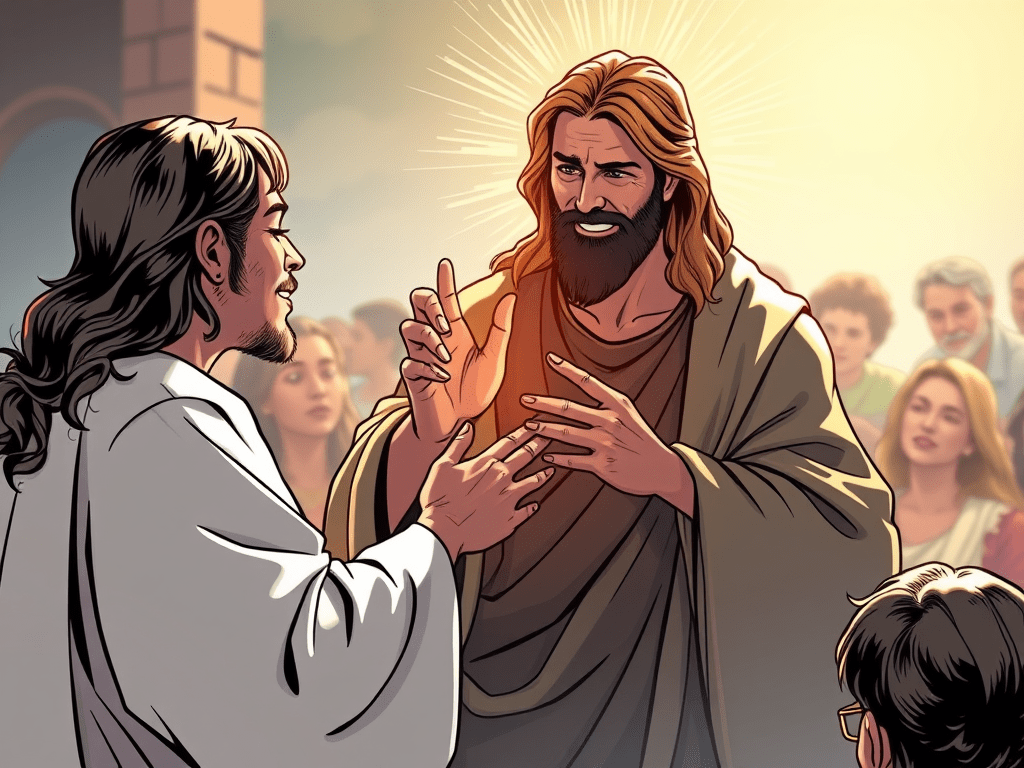
They are experiencing Christianity as joy and hope, having thus become lovers of Christ.

Tag: Discipleship

  • 🌍 The Open Table and the Open Road: Why the Feast Demands the Mission

    🌍 The Open Table and the Open Road: Why the Feast Demands the Mission

    Lessons from Isaiah, Matthew, and St. Paul on True Abundance

    Readings for Wednesday, December 3rd 2025: feria: Isaiah (25:6-10), Matthew (15:29-37); St Francis Xavier memorial: 1 Corinthians (9:16-23); Mark (16:15-20)


    I. The Scarcity Mindset vs. The Sacred Feast

    The Advent season drives us toward the ultimate hope, which Isaiah (25:6-10) describes as the Sacred Feast: a divine banquet on the mountain where the mourning veil is removed, and Death is destroyed for ever.

    The miracle in Matthew (15:29-37)—where Jesus feeds the four thousand—is a prefigurement of this eternal abundance. The crowds ate their fill, and the leftovers—the overflow of grace—filled seven baskets.

    Yet, immediately before the miracle, we hear the disciples’ classic reaction to need: scarcity. “Where could we get enough bread in this deserted place?”

    This is the voice of the scarcity mindset, the Amygdala screaming for survival and retreat

    . It focuses on the magnitude of the problem and the limits of our own resources. Jesus’ question is the antidote: “How many loaves have you?” He shifts the focus from the limits of the deserted place to the limitless power of the Provider.


    II. From Overflow to Obligation (The Hero’s Return)

    The overflow—those seven baskets full—is the crucial link to the Missionary Feast. Why does God give us more than enough? Because grace is not meant for storage; it is fuel for the mission.

    Saint Paul, whose memorial we honor today, understood this better than anyone. He writes in 1 Corinthians (9:16-23) that the Gospel is a duty laid upon him: “I should be punished if I did not preach it!”

    In the Hero’s Journey, the Hero receives the Elixir (the Feast/Grace) and must overcome the Refusal of the Return—the temptation to keep the treasure for himself

    . Paul reverses this, making himself “the slave of everyone” to share the blessings. His true reward is offering the Good News free, matching Christ’s costless abundance with his own costless service.


    III. The Signs That Accompany the Word

    The Gospel of Mark (16:15-20) provides the climax, connecting the Feast (the grace received) to the power needed for the road:

    “Go out to the whole world… These are the signs that will be associated with believers: in my name they will cast out devils; they will lay their hands on the sick, who will recover.”

    The healing of the lame, crippled, and blind in the Matthew reading is the tangible sign that accompanies the Word. The grace you receive at the altar is the power to continue this healing mission. The Mission is not just sharing words; it is sharing the supernatural power that destroys sickness, shame, and spiritual bondage.

    IV. Call to Action: Release the Overflow

    This Advent, the call is to live immediately from the overflow, transforming your inner abundance into outward action.

    Your challenge is to practice Mission-Minded Living:

    1. Dismantle Scarcity: Identify one area (time, money, emotional energy) where you are hoarding resources out of fear. Replace the paralyzing thought, “Where could we get enough?” with the faithful command, “How many loaves do I have?” and trust Christ to multiply it.
    2. Make Yourself a Slave (in Love): Following Paul’s example, embrace one small, inconvenient act of service or evangelization this week. Give your time or talent freely, mirroring the abundance you received at the Feast.
    3. Go with the Signs: Approach your daily life knowing the power that destroyed Death rests upon you. Look for opportunities to share the overflow—a word of encouragement, a prayer for a coworker, a simple act of mercy—trusting that the signs of Christ accompany your obedient Word.

    We have been fed. Now, let us share the boundless banquet with the world.

    Developed with assistance from Gemini AI

  • From Donuts to Discipleship: Where My Men’s Group Fits In

    Every Friday at 5:30 in the morning, I gather with several dozen men for That Man is You. It’s not glamorous—we stumble in half-awake, grab coffee and a donut, swap a few jokes, and slowly warm up.

    By 6:00 AM, we’re watching a video on faith, culture, or manhood. Afterward, we break into smaller groups to talk about it—sometimes about the content, sometimes about what’s weighing on our lives. A deacon moderates, keeping us centered on prayer and truth. By 7:00 AM, we’re out the door and off to work.

    On paper, that’s one hour a week. But in reality, it’s much more: it’s an anchor of brotherhood in my week.

    Where It Fits in the “Layered Parish” Model

    I’ve been working on a way to think about relationships in parish life, something I call the Layered Model of Community:

    • Core Sphere (2–5 people): Deep friendship, accountability, prayer partners.
    • Support Sphere (10–15 people): Steady brotherhood and shared life.
    • Community Sphere (50+ people): Wider fellowship—banquets, service projects, parish socials.
    • Mission Sphere (150–500+): The parish or diocese gathered in worship and witness.

    So where does That Man is You land?

    👉 Support Sphere.
    It’s a classic example: small groups of 10–12 men, weekly rhythm, spiritual content, moderated discussion. More than banter, but not intimate enough for every man to share his deepest struggles.

    How It Could Go Deeper

    What makes the Support Sphere strong is that it feeds men consistently. But transformation happens when the Core Sphere grows inside it.

    That could look like:

    • Two or three guys from the group grabbing coffee mid-week.
    • Starting a prayer partnership with one or two men.
    • Checking in outside the meeting—life, struggles, victories.

    In other words: using the Support Sphere as fertile ground for the Core Sphere to take root.

    The Bigger Picture

    That Man is You also stretches upward:

    • As a program, it’s a Community Sphere, connecting dozens of men at the parish level.
    • And it plugs into the Mission Sphere, part of a nationwide movement helping men step up in faith.

    But it’s in those smaller connections—finding your two or three brothers—that the deepest growth happens.

    Because as good as coffee, donuts, and teaching videos are, every man ultimately needs a band of brothers who know him by name and walk with him through life.

    Developed with assistance from ChatGPT-5

  • A Framework for Layered Relationships in Parish Life

    Most people want deeper community, but they’re already stretched thin. That’s why so many parish groups stall: they ask for more time without offering more meaning. The key is layering relationships so that each level has a purpose, fits modern life, and feeds the others.

    Here’s a practical model that any parish can adopt.


    1. Core Sphere (2–5 people)

    Purpose: Deep accountability, spiritual friendship, honest talk.
    Time: 30–60 minutes weekly.
    Content: Confide struggles, pray for one another, encourage growth.
    Example: Two men who meet for prayer once a week, or a group of 3–5 who connect after a parish project to check in about life and faith.

    👉 This is where the real transformation happens. Think of it as spiritual oxygen—you can’t live without it.


    2. Support Sphere (10–15 people)

    Purpose: A steady circle of brothers (or sisters) who share life together.
    Time: 1–2 hours monthly.
    Content: Shared meals, faith discussions, service projects, study, or retreats.
    Example: A small parish fraternity, or a sub-group of men who choose to meet outside of regular meetings.

    👉 This group makes sure no one drifts off alone.


    3. Community Sphere (50+ people)

    Purpose: Broader fellowship and a sense of shared mission.
    Time: A few hours per month, often tied to service or parish-wide gatherings.
    Content: Banquets, festivals, fish fries, service drives, seasonal events.
    Example: The men’s group, the Knights council, or a parish ministry cluster.

    👉 This is the visible life of the parish—but without Spheres 1 & 2, it risks staying shallow.


    4. Mission Sphere (150–500+)

    Purpose: The whole parish or diocese united in worship and mission.
    Time: Weekly Mass, feast days, diocesan events.
    Content: Preaching, sacraments, communal witness.
    Example: The parish gathered at Sunday liturgy, or the wider diocese.

    👉 This is where faith becomes public—but it must be fed by the smaller circles above.


    Why This Works

    • Realistic: Nobody can give 30 minutes a week to 150 people. But they can give 30–60 minutes to a handful, and a few hours to others on rotation.
    • Scalable: The parish doesn’t need to invent new structures—it just needs to layer what already exists.
    • Purpose-driven: Each sphere has a clear reason to exist, not just “another meeting.”

    Practical Action Plan

    • Start with Core Spheres
      • Encourage prayer partnerships or triads.
      • Make it normal for men to check in about life—not just tasks.
    • Form Support Spheres
      • Identify natural clusters (5–10 who already get along).
      • Invite them to gather monthly for a meal + prayer or reflection.
    • Strengthen the Community Sphere
      • Keep projects and banquets, but tie them back to smaller groups.
      • Example: after a service project, small teams pray or debrief together.
    • Integrate with the Mission Sphere
      • Root everything in the Eucharist and parish mission.
      • Celebrate parish-wide what the smaller groups are doing, so it all feels connected.

    ✨ In other words:

    • Mission Sphere = parish identity.
    • Community Sphere = belonging.
    • Support Sphere = brotherhood.
    • Core Sphere = deep friendship.

    Each level feeds the next. Together, they make “walking with every man” not only possible—but natural.

    Developed with assistance from ChatGPT-5

  • Beyond Bread Alone:

    The Forgotten Works of Mercy

    In the first blog, we saw how the corporal works of mercy have become part of the very fabric of Western society. Food banks, hospitals, charities, and even government programs echo Christ’s command to feed, clothe, and shelter those in need. That is a powerful legacy of Christianity.

    But mercy is not only about the body. It is also about the soul.

    The Church has always taught about the spiritual works of mercy:

    • Instruct the ignorant
    • Counsel the doubtful
    • Admonish the sinner
    • Bear wrongs patiently
    • Forgive offenses willingly
    • Comfort the afflicted
    • Pray for the living and the dead

    Unlike their corporal counterparts, these spiritual works are not easily institutionalized. A government cannot legislate forgiveness. A nonprofit cannot substitute for patient endurance. No program can replace prayer.

    And yet, it may be precisely these works that our world needs most today.

    In many places, hunger for truth is deeper than hunger for bread. Loneliness wounds more people than sickness. A culture of anger and resentment cries out for forgiveness and patience. In a world full of noise, people are starving for real counsel, comfort, and prayer.

    The danger is that Christians become content with mercy limited to the material. We may feed bodies but leave souls untouched. We may shelter people but never welcome them into communion with Christ. True mercy must be both corporal and spiritual — not either/or but both/and.

    Jesus Himself reminds us: “Man does not live by bread alone, but by every word that comes from the mouth of God” (Mt 4:4). To give bread without the Word is to give half a meal.

    So here is the challenge: if society is already carrying forward the physical dimension of mercy (often thanks to its Christian roots), then perhaps the unique responsibility of Christians today is to restore the spiritual works of mercy to their rightful place.

    This is not about abandoning corporal works — far from it. It is about remembering that real love, Christian love, reaches deeper than the body. It touches the heart, the soul, the eternal destiny of the person in front of us.

    In the next blog, we will look at practical ways to integrate both: how Christians can care for bodies and souls, ensuring that mercy is whole and holy.

    Developed with assistance from ChatGPT-5

  • Take Up Your Cross:

    The Hero’s Anthem of Discipleship

    At Mass today, the congregation sang a hymn that almost reads like a hero’s anthem:

    “Take up thy cross,” the Savior said,
    “if thou wouldst my disciple be;
    deny thyself, the world forsake,
    and humbly follow after Me.”

    “Take up thy cross, let not its weight
    fill thy weak spirit with alarm;
    His strength shall bear thy spirit up,
    and brace thy heart, and nerve thine arm.”

    “Take up thy cross, nor heed the shame,
    nor let thy foolish pride rebel;
    thy Lord for thee the cross endured,
    to save thy soul from death and hell.”

    “Take up thy cross, and follow Christ,
    nor think till death to lay it down;
    for only they who bear the cross
    may hope to wear the glorious crown.”

    At first glance, it is a call to discipleship, a reminder to endure suffering, and a promise of eternal reward. But the hymn also mirrors the archetypal Hero’s Journey:

    • The Call to Adventure: The Savior invites each disciple to leave comfort behind, deny selfish desires, and step into a path of transformation.
    • Supernatural Aid: Divine strength sustains the believer, just as mythic heroes receive guidance and power from mentors or gods.
    • The Road of Trials: Enduring shame, temptation, and inner resistance is the crucible that refines courage, humility, and faith.
    • The Ultimate Boon: The crown at the journey’s end is victory over death and union with God—eternal life as the hero’s reward.
    • Return to the World: Though the cross is carried daily, the disciple’s journey inspires others, becoming a witness of hope and courage in the ordinary world.

    In essence, the hymn frames discipleship as a heroic quest. Each cross we bear is both trial and triumph, each act of faith a step along the path of transformation. It reminds us that true heroism is not the absence of suffering, but the courage to endure, the humility to trust, and the hope that, in the end, life’s ultimate reward is already glimpsed in faith.

    The lyrics are by: Everest, Charles William, M.A

    Written with assistance from ChatGPT-5