They are experiencing Christianity as joy and hope, having thus become lovers of Christ.

Tag: discernment

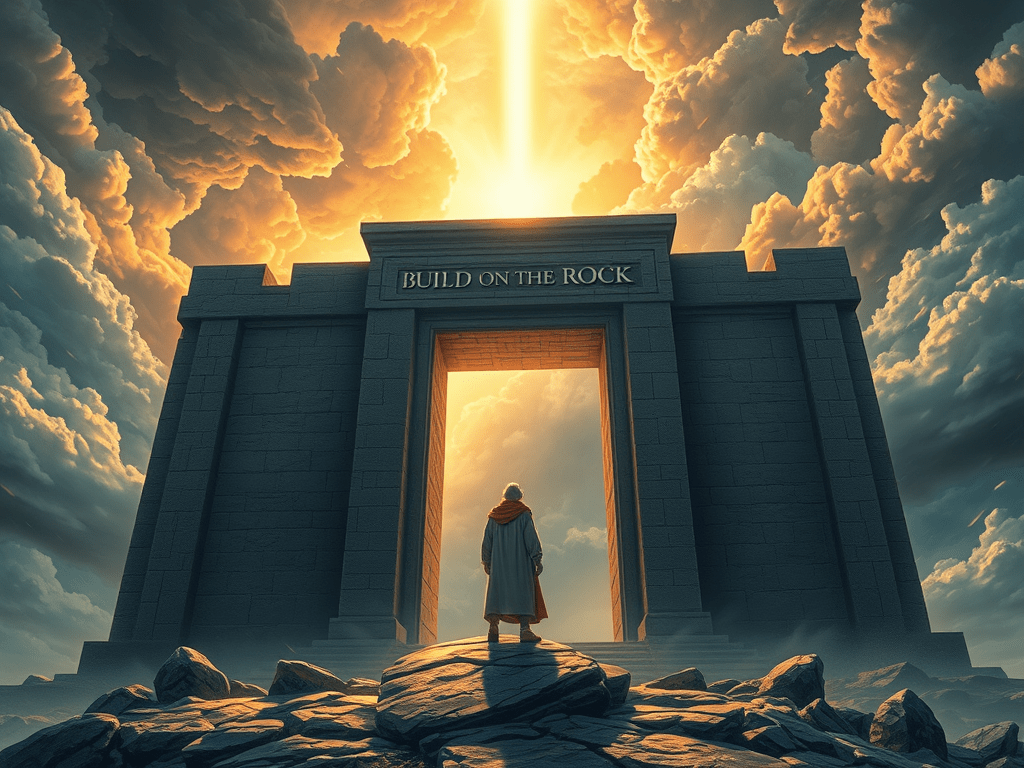
  • Build on the Rock:

    Build on the Rock:

    A Hero’s Journey of Real Spiritual Transformation

    Thursday, December 4th — Advent Reflection

    Readings: Isaiah 26:1–6 • Psalm 118 • Matthew 7:21,24–27
    Liturgical Color: Violet (Advent)

    Advent is a season of waiting, watching, and rebuilding the inner life. The readings for today speak with a single voice: your soul must be founded on the Rock, because storms will come. Not just external troubles, but the storms inside the human heart—fear, temptation, pride, confusion, and despair.

    Isaiah, the Psalmist, and Jesus Himself give us three images:
    a strong city, a sacred gate, and a house on solid rock.
    Together, they outline the path of every spiritual hero—from the prophets, to the saints, to ordinary men and women trying to follow God today.

    Let’s walk through the readings with Catholic wisdom, mythological insight, and psychological truth—so we can act on them, not just hear them.


    Isaiah: Open the Gates and Enter the Strong City

    Isaiah sees a vision of the soul as a strong city, built by God Himself:

    “We have a strong city… Open the gates! Let the upright nation come in… Trust in the Lord forever, for the Lord is the everlasting Rock.”

    The imagery is rich and precise:

    • The city is the human soul
    • The walls and ramparts are the virtues that protect us
    • The gates are the choices of the will

    Only those who trust in the Lord, who keep their minds “steadfast,” can enter.

    In mythic language, this moment is the hero approaching the threshold.
    Every great story has this scene:

    • Odysseus at the gates of the underworld
    • Aeneas at the temple doors
    • Frodo at the borders of Mordor
    • Christ at the entrance of the tomb

    But Scripture adds something deeper:
    The strength of the city is not your own willpower. God Himself is the foundation.
    The hero does not face chaos alone. The hero faces chaos with God.


    Psalm 118: The Gate of Holiness

    The Psalm continues the same theme:

    “Open to me the gates of holiness… This is the Lord’s own gate where the just may enter.”

    The pilgrim approaches the Temple and knocks. The question from inside is implied:
    Who may enter?

    The answer is not:

    • “I am strong.”
    • “I am important.”
    • “I have influence.”

    The answer is:
    “The Lord is my refuge.”

    Psychology says the same:
    When your core identity rests on anything unstable—success, emotions, reputation, strength—your inner world collapses when those things shift.
    But when identity rests on God, the soul stands firm.


    Jesus: Build Your House on the Rock

    In the Gospel, Jesus gives the image most people know:
    Two builders. Two foundations. Two futures.

    But He adds a detail that cuts straight to the heart:

    Both men hear His words. Only one acts.

    This is the decisive moment of the Hero’s Journey—when knowing is no longer enough.
    The hero must obey.
    The hero must choose.
    The hero must cross the threshold into action.

    Jesus says plainly:

    “Everyone who listens to these words of mine and acts on them will be like the wise man who built his house on rock.”

    Storms hit both houses.
    Faith does not guarantee ease.
    Faith guarantees endurance.


    The Psychology: Two Builders, Two Brains

    There’s a psychological layer here too.

    The house on rock

    represents a life governed by the higher faculties:

    • Reason
    • Conscience
    • Long-term vision
    • Stability
    • Sacrifice
    • Grace-supported will

    The house on sand

    represents a life governed by the lower systems:

    • Impulse
    • Emotion without discipline
    • Ego and appearance
    • Social pressure
    • Immediate pleasure

    Neuroscience confirms what Scripture teaches:
    When stress comes, the “lower” regions dominate unless the higher faculties are formed and anchored.

    Storms—suffering, fear, temptation, failure—expose the foundation of the soul.


    Mythic Parallels: Every Hero Faces the Storm

    Every ancient story knows this truth:

    • Gilgamesh meets the flood
    • Jonah meets the tempest
    • Odysseus meets the sea
    • Aeneas meets the burning city
    • Christ meets the Cross

    Heroes are not defined by the absence of storms, but by the strength of their foundation.

    Myths point to it.
    Psychology explains it.
    Catholic faith reveals it:
    The foundation is Christ Himself.


    Catholic Exegesis: The Rock Has a Name

    The Church Fathers are unanimous:

    • Christ is the Rock (1 Cor 10:4)
    • His teaching is the Rock
    • The Church is the Rock
    • Grace that strengthens the will is the Rock

    St. Augustine:
    “The house is faith; the foundation is Christ.”

    St. Gregory the Great:
    “To hear without acting is to build in the imagination.”

    St. Thomas Aquinas:
    “The foundation of the spiritual life is humility.”

    So the Rock is not self-help.
    The Rock is not moralism.
    The Rock is not positive thinking.

    The Rock is a Person.
    A relationship.
    A covenant.
    A surrender.


    How to Build on the Rock Today

    Here is the practical plan Jesus gives:

    1. Listen to His words

    Read Scripture.
    Study the faith.
    Let the Church teach you.

    2. Act on His words

    Do one concrete thing today:
    Forgive.
    Pray.
    Serve.
    Confess.
    Cut out a vice.
    Re-establish order.

    The hero’s gate is action.

    3. Trust God more than yourself

    Say:
    “Lord, I want Your will more than comfort.”

    4. Build habits that hold under pressure

    Virtue is spiritual architecture.
    The sacraments are reinforcement beams.
    Prayer is the daily maintenance.

    5. When the storm comes, choose to stand

    Do not fear the wind.
    Do not panic at the rain.
    Do not believe the lie that you are alone.

    The storm is not your enemy.
    The storm reveals your foundation.


    The Call: Enter the Gate. Stand on the Rock.

    Advent invites you to rebuild your life on Christ.

    Isaiah says: Enter the city.
    The Psalm says: Come through the gate.
    Jesus says: Stand on the Rock.

    The message is simple and strong:

    Your life has a structure.
    Your soul has a destiny.
    Your choices build a house that will either stand or fall.

    So today, choose to act.
    Choose to trust.
    Choose to build.
    Choose the Rock.

    And when the rains fall and the floods rise and the winds tear at everything—
    you will stand.
    And your endurance will give glory to God.

    Developed with assistance from ChatGPT-5

  • Discovering Your Heroic Vocation

    Recognizing the call that sets your life on a meaningful adventure

    Introduction: The Call to Adventure

    Every life has a calling. Not every vocation leads to priesthood or consecrated life. C.S. Lewis reminds us that there are infinitely many good vocations, each as different from one another as good is from evil. Some callings are familiar: raising a family, serving the poor, leading a community, or creating art that inspires. Others are unique, waiting quietly for a person to step forward.

    In the language of the Hero’s Journey, the first step of any adventure is the call. It may come as restlessness, a sense of purpose, or an invitation to serve. Recognizing this call is the beginning of a life fully aligned with God and with your gifts.


    The Heroic Vocational Questions

    To help discern your calling, consider these reflective questions. They are not a checklist, but a framework for discovery:

    1. Where do I feel most alive when serving or creating?
    2. What challenges stir courage in me rather than fear?
    3. Which relationships or mentors draw out the best in me?
    4. What activity makes me lose track of time while benefiting others?
    5. What do I keep returning to, even when it’s difficult or uncomfortable?
    6. How would I want my life to be remembered if I gave it fully to this path?
    7. What sacrifice would I be willing to make for the good that matters most to me?
    8. How does this calling connect with the greater good, the community, or God’s plan?

    These questions guide a person toward self-knowledge, courage, and clarity—the essential tools for responding to any vocation.


    Reflection and Discernment

    Answering these questions requires honest reflection, prayer, and openness to God’s guidance. It may take weeks or months to see patterns or clarity emerge. Journaling, talking with a trusted mentor, or spending time in prayerful solitude can help you hear the call more clearly.

    Remember: vocation is a process, not a single answer. Your understanding of your calling may grow or shift over time. The key is to remain attentive to the stirrings in your heart and to align your life with God’s will.


    Practical Next Steps

    Once you have a sense of your calling, take practical steps to test and nurture it:

    • Volunteer or intern in areas related to your perceived vocation.
    • Seek out mentors or communities that live out what you feel drawn to.
    • Learn actively: read, train, or practice skills that support your calling.
    • Experiment with small projects or commitments to see how they resonate.

    These steps allow your calling to reveal itself in action, confirming whether it truly aligns with your gifts and God’s plan.


    Conclusion

    Every vocation is heroic in its own way. Whether it is priesthood, marriage, art, leadership, or service, answering your call is stepping into a life of purpose, courage, and joy.

    Start by paying attention to the stirrings in your heart. Ask the reflective questions, test your path, and trust God’s guidance. Your heroic journey begins with the first step: saying yes to the call.

    Developed with assistance from ChatGPT-5

  • Seven Questions from Catholic to Consecrated Vocation

    From possibility to discernment — a practical guide for those considering priesthood or consecrated life

    Introduction: From Coin Toss to Questions

    In our last reflection, we looked at priestly vocations through the lens of statistics. With one diocesan priest for every 3,000 Catholic men, vocations today can seem almost miraculous — like flipping twelve coins and getting heads every time.

    But what if we replaced those twelve coins with seven questions? Questions that, if answered honestly and faithfully, could help a man discern whether he is called to a consecrated vocation. This approach moves from mere probability to spiritual discernment, from abstract numbers to personal reflection.


    The Seven Questions from Catholic to Consecrated Vocation

    1. Grace

    • Are you being honest with yourself?
    • Are you committed to putting God’s will first?
    • Do you trust God’s providence for your future?
    • Are you aware that those who give all for Christ will bear much fruit and be rewarded with joy and peace?

    2. Vocation Fit

    • Is there an organization or charism that complements your perceived vocation or interests?
    • Could you see yourself participating fully and happily in that community?

    3. Trust

    • Are you comfortable that the group is faithful to Church teaching, transparent, and well-governed?
    • Can you entrust your future obedience to this group with confidence?

    4. Celibacy

    • Are you willing to accept celibacy as a sign of trust and commitment to God?
    • Do you recognize the benefits of consecrated celibacy over marriage within this vocation?
    • Could your vocation be fulfilled outside a celibate life?
    • Would marriage prevent you from living this vocation fully?
    • Do you believe that, by God’s grace, a person can sacrifice personal benefit for God’s plan?

    5. Service

    • Do you understand the importance of the presence of consecrated religious for the well-being of families, the Church, and the salvation of souls?
    • Is the vocational need significant enough to justify the sacrifices required?
    • Are you aware that Christ is present in each person you will serve?

    6. Compatibility

    • Will consecration to this group allow you to achieve your broader vocation?
    • Will the group allow flexibility as your vocation evolves with your faith?

    7. Timing

    • Do you believe God is calling you now, or might the call come at a later time?

    Reflection

    Most of the stumbling blocks I’ve observed are not about rules or regulations, but trust in God. Many men hesitate to surrender personal freedom — especially sexuality — because they do not truly know God or experience His providence in their lives.

    In reality, this is the same reason many do not fully live as Christians in the first place. Cardinal Ratzinger phrased it poignantly:

    Have you experienced an event or person which gives life a new horizon, and a decisive direction? Do you experience it as joy and hope? Are you inwardly seized by Christianity, and have you become a lover of Christ?

    Vocations grow from a foundation of encounter with Christ. Without that, no set of questions, rules, or statistics can bear fruit.


    Conclusion

    By replacing the coin tosses with these seven questions, we can move from seeing vocations as statistical miracles to seeing them as discernible possibilities. But the first and most important step is always the same: knowing Christ and trusting Him with your life.

    Developed with assistance from ChatGPT-5