They are experiencing Christianity as joy and hope, having thus become lovers of Christ.

Tag: daniel

  • The Fall of the Tyrant: The Timeless Myth of Belshazzar’s Feast

    The Fall of the Tyrant: The Timeless Myth of Belshazzar’s Feast

    The Timeless Myth of Belshazzar’s Feast

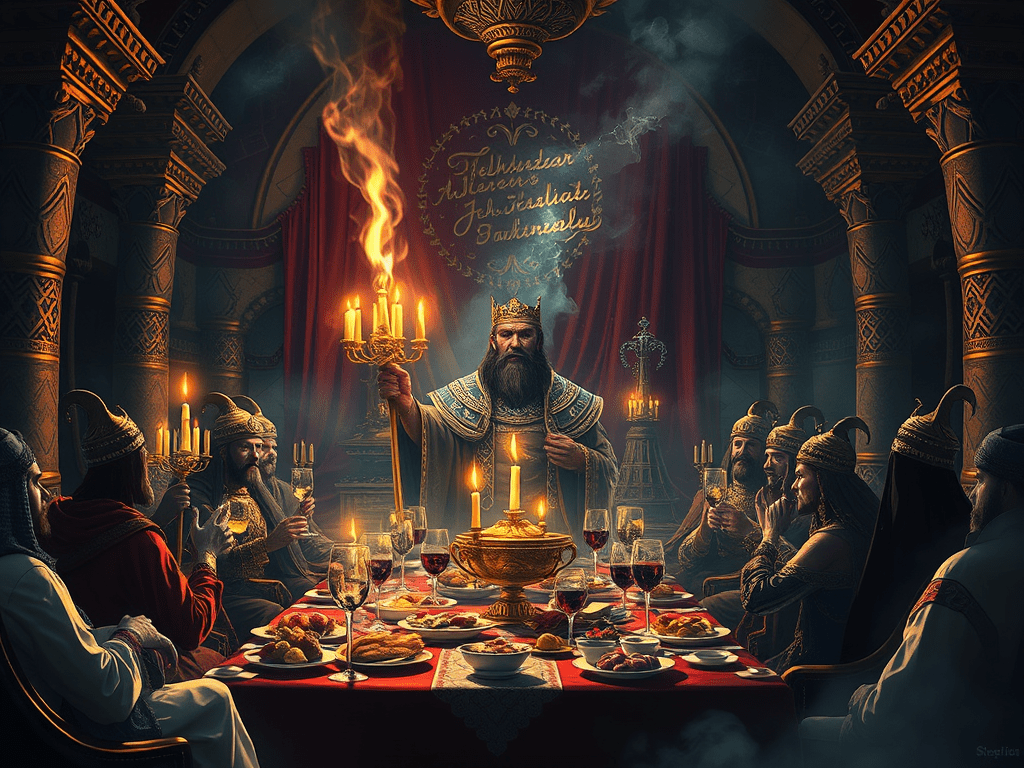
    In the Book of Daniel, chapter 5, we find one of the most dramatic stories in ancient scripture: Belshazzar’s Feast. A lavish banquet turns into a night of terror when a disembodied hand appears and writes mysterious words on the wall. The kingdom falls that very night. But beyond the historical account, this is a profound mythological tale about the inevitable collapse of any power built on arrogance, intoxication, and sacrilege.

    1. Hubris and Sacrilege: The Banquet as Ritual Defiance

    Babylon, in mythic terms, stands as the ultimate “anti-Temple”—a symbol of worldly power that rejects divine order. The banquet isn’t mere excess; it’s a deliberate act of defiance. King Belshazzar commands the sacred vessels looted from the Jerusalem Temple to be brought out. His guests drink wine from them while praising their gods of gold, silver, bronze, iron, wood, and stone.

    This profanation is the core sacrilege: these vessels once held the divine presence. Using them to toast idols is hubris incarnate—the mortal claiming superiority over the sacred. It’s the height of arrogance, performed at the peak of empire.

    2. The Omen: The Hand That Shatters Illusion

    Suddenly, a hand appears, writing on the wall—illuminated, ironically, by the light of the stolen Temple lampstand. The sacred light exposes the profane doom.

    Belshazzar’s reaction is visceral: his face pales, his limbs go slack, his knees knock together. This physical paralysis mirrors his moral collapse—the moment the tyrant’s illusion of invincible power crumbles before a higher force.

    3. The Hero-Interpreter: Daniel’s Uncompromising Stand

    The wise men fail, but Daniel—the exile who refuses to defile himself—is summoned. He deciphers the writing: “Mene, Mene, Tekel, Parsin.”

    Before delivering the verdict, Daniel refuses the king’s rewards: purple robes, gold chains, high office. “Keep your gifts,” he says. His authority comes not from Babylon’s system but from allegiance to the divine. He is untouchable, the true hero bridging chaos and cosmic truth.

    4. The Cosmic Verdict: Weighed on the Scales of Justice

    The words form a threefold judgment:

    • Mene: God has numbered your days; your reign is finite and ended.
    • Tekel: You have been weighed on the scales and found wanting—your character, deeds, and rule insufficient.
    • Parsin: Your kingdom is divided and given to the Medes and Persians.

    That night, Belshazzar is slain, and Babylon falls. The scales of cosmic justice tip irrevocably.

    Echoes in the Cycle of History

    This myth resonates with the ancient observation of civilizational cycles: “Hard times create strong men, strong men create good times, good times create weak men, and weak men create hard times.”

    Belshazzar’s story zooms in on the dangerous transition—good times breeding moral weakness, arrogance, and forgetfulness of limits, inviting sudden collapse. It’s a warning echoed in Greek tragedies (hubris-nemesis), Roman histories, and modern reflections on empires.

    In an age where powers rise and boast at their zenith, the writing on the wall remains a timeless reminder: all human empires are weighed, and those built on sacrilege and pride will be found wanting.

    Content developed with assistance of Gemini AI.

    Blog edited with assistance of Grok AI

  • The Stone That Became a Mountain

    The Stone That Became a Mountain

    A Reflection for Tuesday, November 25, 2025 Based on Daniel 2:31-45; Daniel 3:57-61; and Luke 21:5-11

    (Originally delivered as a 12-minute talk – now expanded for anyone who wants to sit with it longer)

    I’ve never met King Nebuchadnezzar, but some nights I wake up in a cold sweat feeling exactly like him.

    You know the dream: a dazzling statue rises in front of you—head of gold, chest of silver, belly of bronze, legs of iron, and feet made of iron mixed with crumbling clay. It is magnificent, terrifying, and (you are secretly proud) it looks a lot like the empire you’ve spent your whole life building. Then, out of nowhere, a stone “untouched by human hand” rockets across the void, smashes the feet, and the entire thing explodes into powder. The wind scatters the dust, and the stone keeps growing until it becomes a mountain that fills the whole earth.

    Daniel, barely more than a teenager and a foreign prisoner, looks the most powerful man on the planet in the eye and says: “That stone is God’s Kingdom. Everything you trust will be ground to chaff. Only the Kingdom will last forever.”

    Two and a half millennia later, that dream still haunts us because it is no longer just about Babylon. It is about the statues we keep erecting inside our own skulls.

    Your Brain Is the Statue

    Neuroscience has accidentally given us one of the best commentaries on Daniel 2 ever written.

    • The golden head = the prefrontal cortex: language, long-term planning, morality, the part of you that wants to build something glorious and eternal.
    • The silver arms and chest = the limbic system: love, belonging, tribal identity, emotion.
    • The bronze belly = the older reward circuits: pleasure, ambition, appetite, status.
    • The iron legs = the brainstem and motor strips: raw survival, dominance, fight-or-flight.
    • The feet of iron and clay = the fragile, perpetually uneasy handshake between our ancient reptile brain and our fragile modern consciousness. Strong enough to run a civilization, brittle enough to shatter the first time life hits it wrong.

    Every war, every addiction, every mid-life crisis, every doom-scrolling spiral begins when the lower floors start dictating terms to the upper ones.

    The Universal Story

    Joseph Campbell spent his life showing that every culture tells the same story:

    Ordinary world → Call to adventure → Refusal → Mentor appears → Crossing the threshold → Ordeal and death → Seizing the treasure → Return to give it away.

    Translate the characters:

    Daniel is the mentor who will not bow.

    Jesus is the Stone cut without hands—the true Hero who descends into the realm of death and rises again.

    And you and I? We are the ones being summoned out of the collapsing statue into the growing mountain.

    When the Temple Comes Down

    In today’s Gospel people are gawking at the Jerusalem Temple—literally the most impressive religious building the ancient world had ever seen. Jesus looks at them and says, in effect, “Enjoy the view while it lasts. Not one stone will be left on another.”

    He is not being cruel. He is being honest. Every human temple, every human empire, every human self built only with human hands will one day stand on feet of clay.

    But notice what he says next: “When you hear of wars and insurrections, do not be terrified… Nation will rise against nation… There will be great earthquakes…” These are not the end. They are the birth pangs.

    In mythology, the false world has to shatter before the real story can begin.

    In psychology, the ego has to crack open before genuine integration can happen.

    In salvation history, the Stone has to strike.

    The Catholic Reading in One Sentence

    The Stone is Christ.

    The Mountain is the Church, born from the rock struck on Calvary and from the side of Christ on the Cross.

    And the dream is being fulfilled right now, every time a human soul lets the Kingdom smash its idols and fill its emptiness.

    So What Do We Actually Do?

    Four concrete, life-changing steps you can start this week:

    1. Name Your Statue
      Tonight, before you go to bed, ask: What is the gold-headed thing I trust more than God? Career? Reputation? Political ideology? My phone? My body? My children’s success? Write it down. That’s your personal Nebuchadnezzar dream.
    2. Let the Stone Strike
      Take that piece of paper (or just the knowledge of it) to confession, to adoration, to the foot of the crucifix. Ask Jesus to touch the feet of clay. It will probably feel like everything is falling apart. Good. That’s the sound of the Kingdom arriving.
    3. One Line, Ten Minutes, Every Morning
      Before you open any app, sit in silence and let one phrase from today’s readings strike you and grow:
      “A stone untouched by human hand…”
      Repeat it slowly, like a breath prayer. Let it smash the noisy empires in your mind. Ten minutes. That’s all. But do it daily and watch what kind of mountain starts growing inside you.
    4. Live the Return
      The hero never keeps the elixir for himself. Bring the peace you find in that silence to your family, your cubicle, your parish council, the grocery checkout line. The world is starving for people who have let the Stone win.

    The Dream Is Still True

    We are living in the age of the feet of clay.

    Globally: superpowers and tech empires that look invincible but are already cracking.

    Personally: hearts that are part iron, part mud, strong enough to function, brittle enough to break.

    But the Gospel acclamation today is shouting at us across two thousand years:

    “Stand erect, hold your heads high, because your liberation is near at hand!”

    The statue is already trembling.

    The Stone has already left the mountain.

    The only question left is whether we will cling to the collapsing colossus or open our hands and let the Kingdom break us open—so that, through us, it can fill the whole earth.

    Come, Lord Jesus.

    Strike the feet.

    Grow the mountain.

    Make Your home in us.

    And then send us back out to a world that desperately needs living stones.

    Amen.

    Feel free to share this post, print it, read it aloud to your family, or just sit with it in the quiet. The dream is still coming true—and you’re in it.