They are experiencing Christianity as joy and hope, having thus become lovers of Christ.

Tag: christianity

  • The Geometry of Grace:

    The Geometry of Grace:

    Why the Yoke is Actually Light

    We’ve all heard the cynical refrain: “Misfortune falls on the good and the bad alike.” We treat life like a chaotic lottery where lightning strikes the saint and the sinner with equal indifference.

    But is that actually true?

    If we look through the lenses of Catholic Exegesis, Neurobiology, and the Hero’s Journey, we discover a startling reality: Grace isn’t just a theological “extra.” It is a fundamental shift in how a human being interacts with reality.

    1. The Suburbs of Heaven

    C.S. Lewis famously suggested that for those who say “Yes” to God, this life is the beginning of Heaven; for those who say “No,” it is the beginning of Hell.

    This isn’t just a poetic thought. It is a description of an internal ecosystem. The Book of Wisdom tells us that those who do good fare well. When you live a life of grace, you are no longer rowing against the current of the universe. You are aligned with the Creator’s design. This alignment creates a “protective shield”—not by magic, but by a radical reordering of your life.

    2. The Biological Advantage of Peace

    Let’s look at the “structure of the brain.” A life of sin—gluttony, drunkenness, aggressive driving, or constant domestic strife—keeps the brain in a state of chronic Amygdala Hijack. This is the “fight or flight” center. When it’s overactive, your body is flooded with cortisol, your immune system weakens, and your peripheral vision literally narrows. You become more “prone to injury” and “susceptible to accidents” because your brain is too cluttered to pay attention.

    A “Real Christian,” however, operates from the Prefrontal Cortex—the seat of peace and discernment. By practicing chastity, fasting, and a clean conscience, you are essentially “fine-tuning” your biological machine.

    • Better Sleep: Because your conscience is clear.
    • Less Sickness: Because your stress levels are lower and your habits are more responsible.
    • Fewer Accidents: Because you are “less in a hurry” and more aware of the people around you.

    3. The Hero’s Risk and the Martyr’s Paradox

    Now, there is one place where the “Safety of Grace” seems to fail: Sacrifice. In the classic Hero’s Journey, the protagonist eventually leaves the “Safe Zone” to face the dragon for the sake of the village. For the Christian, this is the call to be a Martyr or a servant. We are much more willing to take an injury for others.

    But even here, the experience is different. As Brother Lawrence noted, God does not permit a soul totally abandoned to Him to suffer for “any appreciable length of time” without Divine support. When the world sees a catastrophe, the Christian sees a rebirth.

    4. A Different Dimension of Suffering

    When trials do come—and they will—the “Real Christian” isn’t living in the same dimension as the worldling. For those living only for this world, a trial is “sheer hell” because it threatens their only treasure.

    For the person in Grace, suffering is Sacred Alchemy. Following the thought of St. John Paul II, we see that suffering:

    1. Consumes Evil: It burns away the parts of our ego that we haven’t yet surrendered.
    2. Acts as Penance: It helps us understand the true cost of sin—our own and others’.
    3. Opens a Door: It is the “New Jerusalem” mindset, asking not “Why is this happening to me?” but “What is God trying to show me?”

    The Call to Action: Die to the Hurry

    Spiritual transformation isn’t a theory; it’s a practice. If you want to experience this “Light Yoke,” start with the Great Simplification. * Clean your conscience: Go to Confession and clear the mental clutter.

    • Audit your pace: Intentionally move slower this week. Watch how your “luck” changes when you are no longer in a frantic hurry.
    • Fix your eyes: When the next trial hits, ask God for the strength to see it as a “door” rather than a “wall.”

    Edited with assistance from Gemini

  • 🌍 The Open Table and the Open Road: Why the Feast Demands the Mission

    🌍 The Open Table and the Open Road: Why the Feast Demands the Mission

    Lessons from Isaiah, Matthew, and St. Paul on True Abundance

    Readings for Wednesday, December 3rd 2025: feria: Isaiah (25:6-10), Matthew (15:29-37); St Francis Xavier memorial: 1 Corinthians (9:16-23); Mark (16:15-20)


    I. The Scarcity Mindset vs. The Sacred Feast

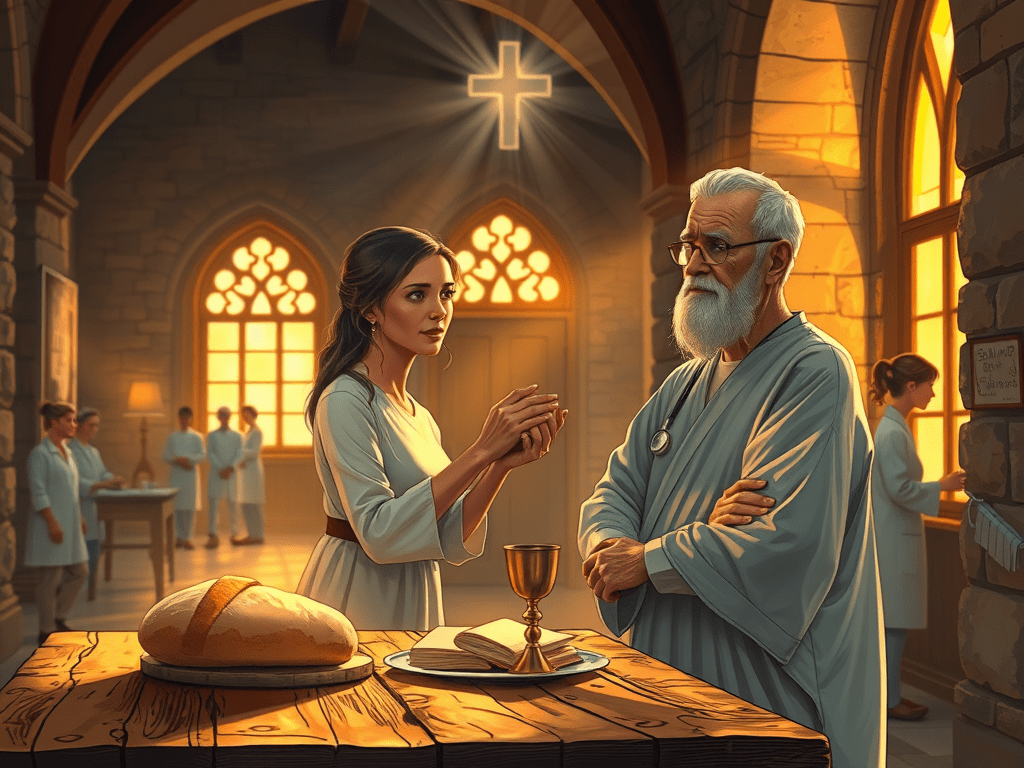
    The Advent season drives us toward the ultimate hope, which Isaiah (25:6-10) describes as the Sacred Feast: a divine banquet on the mountain where the mourning veil is removed, and Death is destroyed for ever.

    The miracle in Matthew (15:29-37)—where Jesus feeds the four thousand—is a prefigurement of this eternal abundance. The crowds ate their fill, and the leftovers—the overflow of grace—filled seven baskets.

    Yet, immediately before the miracle, we hear the disciples’ classic reaction to need: scarcity. “Where could we get enough bread in this deserted place?”

    This is the voice of the scarcity mindset, the Amygdala screaming for survival and retreat

    . It focuses on the magnitude of the problem and the limits of our own resources. Jesus’ question is the antidote: “How many loaves have you?” He shifts the focus from the limits of the deserted place to the limitless power of the Provider.


    II. From Overflow to Obligation (The Hero’s Return)

    The overflow—those seven baskets full—is the crucial link to the Missionary Feast. Why does God give us more than enough? Because grace is not meant for storage; it is fuel for the mission.

    Saint Paul, whose memorial we honor today, understood this better than anyone. He writes in 1 Corinthians (9:16-23) that the Gospel is a duty laid upon him: “I should be punished if I did not preach it!”

    In the Hero’s Journey, the Hero receives the Elixir (the Feast/Grace) and must overcome the Refusal of the Return—the temptation to keep the treasure for himself

    . Paul reverses this, making himself “the slave of everyone” to share the blessings. His true reward is offering the Good News free, matching Christ’s costless abundance with his own costless service.


    III. The Signs That Accompany the Word

    The Gospel of Mark (16:15-20) provides the climax, connecting the Feast (the grace received) to the power needed for the road:

    “Go out to the whole world… These are the signs that will be associated with believers: in my name they will cast out devils; they will lay their hands on the sick, who will recover.”

    The healing of the lame, crippled, and blind in the Matthew reading is the tangible sign that accompanies the Word. The grace you receive at the altar is the power to continue this healing mission. The Mission is not just sharing words; it is sharing the supernatural power that destroys sickness, shame, and spiritual bondage.

    IV. Call to Action: Release the Overflow

    This Advent, the call is to live immediately from the overflow, transforming your inner abundance into outward action.

    Your challenge is to practice Mission-Minded Living:

    1. Dismantle Scarcity: Identify one area (time, money, emotional energy) where you are hoarding resources out of fear. Replace the paralyzing thought, “Where could we get enough?” with the faithful command, “How many loaves do I have?” and trust Christ to multiply it.
    2. Make Yourself a Slave (in Love): Following Paul’s example, embrace one small, inconvenient act of service or evangelization this week. Give your time or talent freely, mirroring the abundance you received at the Feast.
    3. Go with the Signs: Approach your daily life knowing the power that destroyed Death rests upon you. Look for opportunities to share the overflow—a word of encouragement, a prayer for a coworker, a simple act of mercy—trusting that the signs of Christ accompany your obedient Word.

    We have been fed. Now, let us share the boundless banquet with the world.

    Developed with assistance from Gemini AI

  • ⚔️ Hammering Swords into Ploughshares:

    ⚔️ Hammering Swords into Ploughshares:

    The Work of Vigilance

    I. The Journey to the Mountain (The Hero’s Call)

    The liturgical year turns today, beginning the season of Advent. Our destination is clear: The Mountain of the Temple of the Lord .

    The prophet Isaiah (2:1-5) gives us a stunning mythological vision: a towering peak, lifted higher than the hills, drawing all the nations—peoples without number—to learn God’s ways. The outcome of this pilgrimage is radical: “They will hammer their swords into ploughshares, their spears into sickles. Nation will not lift sword against nation.”

    This is the ultimate promise of Eternal Peace (Shalom) and the divine resolution to the problem of human violence.

    In terms of the Hero’s Journey, the journey up the mountain is the Call to Adventure—a call to leave the flat, ordinary world of conflict behind and ascend to the height of revelation. The Law (the oracle) goes out from this place, transforming the very tools of destruction (swords) into the tools of production (ploughshares).

    The pilgrimage is not just historical; it is deeply personal. What are the “nations” of conflict within us that must ascend to the peace of Christ?


    II. The Night and the Burglar (Psychology of Complacency)

    Saint Paul tells us in Romans (13:11-14) that “the night is almost over.” This night is not just a chronological time; it is a psychological state of spiritual drowsiness.

    Jesus illustrates this perfectly in the Gospel with two chilling metaphors: Noah’s Day and the Burglar.

    “If the householder had known at what time of the night the burglar would come, he would have stayed awake and would not have allowed anyone to break through the wall of his house.”

    The burglar represents the unforeseen collapse—the judgment, the crisis, or the moment of death. The wall of the house is the boundary of our interior life, our vigilance.

    Psychologically, the danger is not the outside event; it is the “coarsening” of the heart that makes us fail to stay awake. The twin enemies Paul names—drunkenness and the cares of life—are both methods of spiritual dullness:

    1. Drunkenness/Debauchery: Overloading the system with immediate pleasure, dulling the Prefrontal Cortex (our Will and highest reason) and making us incapable of long-term planning.
    2. Cares of Life: Overloading the system with chronic anxiety, perpetually triggering the Amygdala (our fear center).

    Both states keep us trapped in the Ordinary World, focused only on eating and drinking, leaving the walls of our soul unguarded. We mistake temporary comfort for eternal security.

    III. The Armour and the Ploughshare (The Spiritual Transformation)

    The call to action is immediate and profound: “Let us live decently as people do in the daytime: no drunken orgies, no promiscuity… Let your armour be the Lord Jesus Christ.”

    The transformation required to reach Isaiah’s mountain of peace is a dual effort:

    1. The Work of Divesting (Hammering Swords)

    We must actively give up the things we prefer to do under cover of the dark. This is the Refusal of the Return reversed—we refuse to stay comfortable in the darkness.

    The sword is the symbol of aggression, conflict, and self-defense. What are the swords in your heart?

    • The sword of wrangling (constant conflict).
    • The sword of jealousy (internal war against your neighbor).

    We are called to hammer these weapons into ploughshares—tools for tilling the inner soil, for producing the spiritual fruit of patience, charity, and peace. This process requires daily, painful penance and effort.

    2. The Work of Investing (Donning Armour)

    Paul instructs us: “Let your armour be the Lord Jesus Christ.”

    This is the Apotheosis and Return stage of the Advent journey. We don’t defend our walls with our strength; we defend our soul with Christ. We put on the Mind of Christ and the Virtues of Christ.

    When you are tempted to anger (the sword), your armour reminds you to respond with Christ’s peace. When you are tempted to dull your senses (the drunkenness), your armour reminds you that your Master is coming and you must be awake.

    IV. Call to Action: Walking in the Light

    This Advent, the call is simple: Walk in the light of the Lord.

    The mountain of the Temple is waiting. We are not called to build the perfect society right now, but we are called to build the perfect sanctuary in our own heart. We must make our inner Jerusalem ready for the Prince of Peace.

    Your practical commitment this week is to Vigilance.

    • Identify the Burglar: Name one specific area of your life where you have “allowed someone to break through the wall of your house”—where you are dulling your heart. (e.g., excessive scrolling, obsessive worrying, casual gossip).
    • Hammer the Sword: Take one daily tool of conflict (wrangling, jealousy) and consciously begin to turn it into a tool of peace (patience, prayer).
    • Stay Awake: Resolve to spend your time and energy not on the “cares of life,” but on the saving help Christ offers, so that you are prepared to stand ready.

    Let us walk in the light. Let us start hammering our swords.

    Developed with assistance from Gemini AI

  • “Wake Up and Walk in the Light: Advent and the Great Human Awakening”

    “Wake Up and Walk in the Light: Advent and the Great Human Awakening”

    A 10–15 minute Advent reflection

    Isaiah 2:1-5; Psalm 121(122):1-2,4-5,6-9; Romans 13:11-14; Matthew 24:37-44

    Today is the First Sunday of Advent—the beginning of the Church’s year.
    And the very first word the Church gives us is: Wake up.

    Not “be cozy.”
    Not “ease into the holidays.”
    But Wake up.
    Be alert. Open your eyes.
    Something is coming.
    Someone is coming.

    And the way Scripture tells the story today, this awakening is not optional.
    It is the difference between remaining asleep in the old world—or stepping into the new creation God desires for us.


    1. Isaiah’s Mountain: The Call of the Hero at Dawn

    The prophet Isaiah begins with a vision of the “days to come.”
    He sees Mount Zion—the Temple mountain—lifted above all other mountains.
    Nations stream toward it.
    People without number ascend the hill saying:

    “Come, let us go up to the mountain of the Lord… that he may teach us his ways.”

    This is the biblical version of the call to adventure—the moment in every great myth when humans are summoned upward, summoned out of the ordinary world and toward a divine encounter.

    The mountain is a universal symbol in myth:

    • Mount Olympus for the Greeks
    • Mount Meru in Hindu cosmology
    • Sinai for Moses
    • Tabor for Christ

    The mountain always represents the highest meaning, the place where heaven and earth meet, where God reveals Himself, and where human beings are changed.

    Isaiah’s point is clear:
    Humanity’s future is not down in the valley of violence, distraction, and conflict.
    Our future is an ascent.
    A pilgrimage.
    A transformation.

    Psychologically, this ascent points to the integration of the self—the movement from fragmentation to unity, from instinct-driven living (the lower brain layers) toward a life governed by truth, conscience, and grace (the highest faculties).

    Isaiah describes the result of this ascent:

    “They shall beat their swords into ploughshares.”

    This is transformation—not by force, but by teaching, by truth, by hearing God.
    The weapons of self-destruction become the tools of cultivation.
    What once harmed now heals.

    This is what happens when a person climbs the mountain of the Lord.


    2. “I Rejoiced When I Heard Them Say”: The Joy of a Heart That Is Waking Up

    The psalm today echoes the upward movement:

    “I rejoiced when I heard them say: ‘Let us go to God’s house.’”

    This is the joy of someone who has heard the call.
    Someone whose feet are already on the path.
    Someone who has realized:
    My home is not here. My destiny is above.

    Psychologically, this is the movement from numbness to desire.
    From apathy to longing.
    From spiritual sleep to spiritual hunger.

    St. Augustine described it as the “weight of love” lifting the soul upward.

    Every Hero’s Journey begins—not with skill or strength—but with desire, the dawning awareness that “There must be more.”

    Advent awakens that desire.


    3. St. Paul: “Wake Up Now” — The Battle Between Night and Day

    Then St. Paul tells us plainly:

    “You know the time.
    The night is almost over.
    The day is at hand.
    Wake up now.”

    Paul speaks here like a drill sergeant of the soul.
    He knows we like comfort.
    We like the dark because our weaknesses hide there.
    But Paul says:

    “Give up the things done under cover of darkness…
    and put on the armor of light.”

    This is spiritual psychology at its sharpest.

    The “night” represents:

    • impulsivity
    • old habits
    • addictions
    • self-deception
    • sin we have learned to tolerate

    The “day” represents:

    • clarity
    • responsibility
    • moral courage
    • virtue
    • the renewing power of Jesus Christ

    Paul says:
    Do not wait until you feel ready. Light never begins with readiness.
    It begins with decision.

    Mythologically, this is the moment when the hero must leave home.
    Leave comfort.
    Leave childishness.
    The doorway to the adventure is dawn—and dawn always interrupts our sleep.


    4. Jesus in the Gospel: The Flood Comes to the Spiritually Asleep

    Now Christ speaks the hardest words of the day:

    “As in the days of Noah, so will it be at the coming of the Son of Man.”

    People were living as if nothing mattered:

    • eating
    • drinking
    • marrying
    • working

    None of these are evil.
    The problem is not the activities—it is the unconsciousness with which people lived.

    They were asleep inside their own lives.

    The Flood did not simply wash away bodies—it washed away illusions.
    It revealed who was awake and who was not.

    Then Jesus gives His teaching with startling urgency:

    “Stay awake…
    Stand ready…
    The Son of Man is coming at an hour you do not expect.”

    This is not meant to frighten us—it is meant to awaken us.

    Jesus is not warning about the end of the world;
    He is warning about the end of your illusions.
    The end of self-deception.
    The end of sleepwalking through life.

    In psychological terms, Jesus is calling us to conscious living—to a life where we no longer hide behind distraction, addiction, work, or noise.


    5. The Hero’s Journey of Advent

    Advent is the beginning of the Church’s New Year, but it is also the beginning of your own Hero’s Journey.

    The pattern is always the same:

    1. The Call — “Come, let us go up to the mountain of the Lord.”
    2. The Awakening — “I rejoiced when I heard them say…”
    3. The Separation — “The night is almost over… put on the armor of light.”
    4. The Testing — “Stay awake, for you do not know the hour…”
    5. The Transformation — Christ born in the soul, illuminating everything.
    6. The Return — A transformed life that brings peace and grace to others.

    Mythologies echo this pattern because they echo the deepest truth of the human spirit:
    We were made for ascent.
    We were made for God.


    6. A Call to Action: How to Begin Your Advent Awakening

    Here is the practical challenge of the Gospel:

    1. Identify where you are asleep.

    Where have you allowed routine, distraction, or sin to dull your conscience?
    What parts of your life run on autopilot?

    2. Begin one concrete act of awakening.

    • Set a real prayer time.
    • Go to Confession.
    • Fast from a comfort that keeps you numb.
    • Read Scripture daily.
    • Reconcile with someone.

    3. Put on the armor of light.

    Don’t wait to “feel holy.”
    Act first.
    The feelings follow.

    4. Live today as if the Lord is near—because He is.

    Advent is not pretend.
    It is training.
    It is rehearsal for the real coming of Christ—
    in death,
    in judgment,
    in the Eucharist,
    in grace,
    in the quiet call of conscience.

    5. Make this Advent your turning point.

    Advent is not about nostalgia.
    It is about awakening.

    Christ does not want to catch you off guard.
    He wants to find you alive.


    7. Conclusion: Walk in the Light of the Lord

    Isaiah ends his vision with a simple command:

    “O house of Jacob, come—
    let us walk in the light of the Lord.”

    This is the entire Gospel in one sentence.

    Walk.
    Move.
    Begin.
    Awaken.
    Step toward the mountain.
    Let the Lord teach you His ways.
    Let His light pierce your darkness.
    Let Christ become your armor.

    And when the Son of Man comes—today, tomorrow, or at the end of your life—may He find you wide awake, standing ready, rejoicing to enter the house of the Lord.

    Amen.

    Developed with assistance from ChatGPT-5

  • When the Lions Roar:

    When the Lions Roar:

    A Story Older Than Babylon

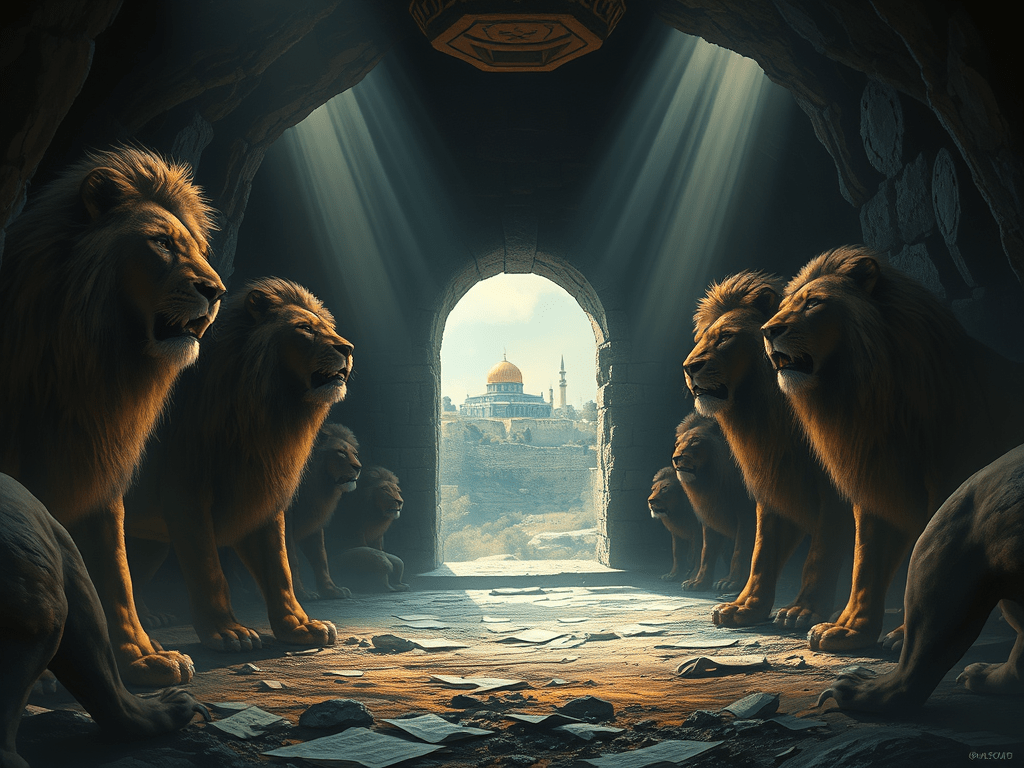
    I used to think the story of Daniel in the lions’ den was a children’s tale—flannelgraph heroes, cartoon lions, happy ending. Then I grew up and discovered the lions have grown up too. They have new names now: anxiety, pornography, rage, cancer, divorce papers, a child who no longer speaks your name, a culture that laughs at prayer. The den is real. The stone over the mouth of the pit is heavy. And the decree, signed by a thousand invisible kings, still cannot be revoked.

    But the Church, in her ancient wisdom, keeps putting this reading in front of us right when we need it most. And every time she does, she is telling us the oldest and truest story humanity has ever been told.

    Joseph Campbell spent his life mapping it. Hollywood makes billions retelling it. Jesus lived it perfectly. It has a name: the Hero’s Journey. And right now, whether you asked for it or not, you are on it.

    Stage 1: The World Out of Balance

    Every adventure begins with a wound in reality.

    In Babylon it was an idolatrous decree: “For thirty days, no one may pray to any god or human except the king.” The ego had crowned itself God.

    In today’s Gospel, Jesus speaks of Jerusalem surrounded by armies, the holy city trampled, cosmic powers shaken. The sacred center collapses.

    Sound familiar?

    Our world signs the same decree every day: “Thou shalt not pray. Thou shalt not be still. Thou shalt scroll, produce, perform, numb, repeat.”

    We feel the armies at the gates. We hear the lions pacing.

    Stage 2: The Belly of the Whale

    Then comes the moment every hero dreads: the night-sea journey, the descent into the place where human power ends.

    A stone is rolled over the mouth of the pit. Darkness. Silence. The smell of wild beasts.

    Modern neuroscience has a clinical name for it: the moment the amygdala hijacks the brain and the prefrontal cortex—the part that plans, hopes, prays—goes offline. Fight, flight, freeze. The lions roar.

    And yet Daniel prays. Three times a day, even in the den.

    Contemplative prayer, researchers now tell us, does something wild: it thickens the very prefrontal regions that fear tries to shut down. Faith literally rewires courage into the brain.

    Stage 3: The Supernatural Aid

    In the deepest dark, a Presence arrives.

    “My God sent his angel and shut the lions’ jaws.”

    The same angel who will calm a storm on Galilee.

    The same Presence who will breathe on trembling apostles: “Peace be with you.”

    Grace does not always remove the trial. Grace enters it. The lions are still there. But they fast today.

    Stage 4: The Return with the Boon

    Morning comes. The stone is still sealed, yet Daniel walks out without a scratch.

    King Darius—pagan, powerful, sleepless with anguish—writes to every nation under heaven:

    “The God of Daniel is the living God… He saves and rescues… Let all tremble and fear before Him.”

    The hero never returns for applause. The hero returns carrying a gift the world is dying for: living proof that something is stronger than death.

    The Gospel’s Astonishing Twist

    Re-read Luke 21 with this story in your bones and you will never hear it the same way again.

    Jesus is not predicting doom for doom’s sake. He is describing the identical pattern:

    • Armies at the gates
    • Cosmic distress, people “dying of fear”
    • And then: “They will see the Son of Man coming… When these things begin to take place, stand erect and lift up your heads, because your liberation is drawing near.”

    Stand erect.

    That is not a survival tip. That is resurrection posture.

    Your Den, Your Angel, Your Witness

    You are in the den right now.

    The lions have your scent. The stone is heavy.

    But the same God who sent His angel to a Jewish exile in Babylon has not changed His strategy.

    So here is the only spiritual formation plan that has ever worked:

    Tonight, set a timer for three minutes.

    Get on your knees (or sit if the body protests).

    Name the lions out loud. Speak the fear.

    Then pray one Our Father slower than you have ever prayed it in your life.

    Feel the amygdala roar. Keep praying anyway.

    That is the precise moment the angel shuts the lions’ mouths.

    Do it tomorrow. And the next day. Thirty days if necessary.

    Because the spiritual life is not a technique to feel better.

    It is a death and resurrection that rewires your brain, reorders your desires, and turns you into a walking sign that the God of Daniel still “saves, sets free, and works signs and wonders in heaven and on earth.”

    When the culture collapses, when the diagnosis comes, when the child walks away, when the sun and moon go dark—do not cower.

    Stand erect. Lift up your head.

    The world is waiting for someone who has come out of the den unharmed to tell them the terrifying, glorious truth:

    There is a living God.

    And He is stronger than the lions.

    Your liberation is drawing near.

    And through you, someone else’s just might be too.

    Developed with assistance from Grok AI

  • ⚖️ Weighed and Found Wanting: The Fatal Mistake of Hubris

    ⚖️ Weighed and Found Wanting: The Fatal Mistake of Hubris

    Why Your Greatest Gifts Can Become Your Greatest Danger

    The story of King Belshazzar is the story of every person who has ever looked at their talents, their success, or their good fortune and thought, “This is mine. I earned it. I control it.”

    It’s the story of Hubris—that fatal, self-centered mistake that comes before the fall. Our readings today (Daniel 5 and Luke 21) show us the anatomy of this spiritual disease and reveal the only cure: active, enduring faithfulness.


    1. The Party and the Problem: The Banality of Blasphemy

    King Belshazzar, in our first reading, throws a magnificent, drunken banquet. His act of blasphemy is not a simple mistake; it’s a defiant spectacle. He demands the holy gold and silver vessels looted from the Temple in Jerusalem be brought out and used for a pagan party.

    This is the spiritual state of radical entitlement. Belshazzar treats the holy (gifts from God) as merely a trophy for his own ego.

    The Psychology of Entitlement

    This is what happens when the Adversary’s whisper takes root: it convinces us that our talents, our wealth, and our relationships are entirely our own doing, meant solely for self-gratification.

    But at the height of his pride, the visible world breaks down: “Suddenly the fingers of a human hand appeared, and began to write on the plaster of the palace wall.”

    The writing is the ultimate accounting of a life lived without reference to the sacred:

    • Mene: Your power has been measured and ended.
    • Tekel: You have been weighed in the balance and found wanting.
    • Parsin: Your kingdom has been divided and lost.

    Belshazzar failed because he refused to glorify the God who held his breath and all his fortunes in his hands. His life, measured against the standard of the sacred, collapsed.


    2. The Hero’s Forge: The Necessity of Endurance

    If Belshazzar’s downfall is the consequence of Hubris and Pride, the Gospel (Luke 21) provides the antidote: Endurance and Trust.

    Jesus tells His disciples not of palaces, but of persecution, betrayal, and even death. This is the moment in the Hero’s Journey where the hero is stripped bare, entering the chaotic belly of the whale where all external support is lost.

    In the face of this absolute chaos, Jesus gives two counter-intuitive commands:

    1. Don’t Prepare Your Defence: Jesus commands us to relinquish the primal urge to control the narrative. Our brain, our ego, wants to be prepared, to argue, to win the court case. But He says, “I myself shall give you an eloquence and a wisdom…” We are called to suppress our own iron strength and rely on the Holy Spirit’s divine wisdom.
    2. Endure: The ultimate secret to salvation is revealed: “Your endurance will win you your lives.” Endurance is not passive survival. It is the active, faithful confrontation with suffering—a sustained posture of obedience that forges character and secures the soul.

    3. The Call to Live with Consecration

    We are called to move past the judgment of the decadent palace and into the endurance of the faithful disciple.

    A. Examine Your Holy Vessels

    Where are you taking the consecrated gifts God gave you—your time, your talents, your intelligence, your relationships—and treating them as merely trophies for your own consumption?

    • Do you use your intelligence to build yourself up, rather than to serve the Truth?
    • Do you treat your days off simply as hours for personal indulgence, rather than a chance to glorify God and love others?

    All we have is a consecrated vessel, a gift from God. The shift begins when we recognize this truth and use our gifts for their intended, holy purpose.

    B. Stay Awake in the Chaos

    The Gospel Acclamation instructs us: “Stay awake, praying at all times for the strength to stand with confidence before the Son of Man.”

    The courage to endure is won in the small battles:

    • In the willingness to suffer a slight and not seek immediate revenge.
    • In the resolve to remain faithful to your commitments when they become boring.
    • In the continuous choice to seek God’s wisdom instead of relying on your own prepared script.

    Do not be afraid of the chaos. It is merely the process by which God measures our foundations. Let us stand with confidence, relying not on our own power, but on the wisdom and eloquence of Christ, so that when our lives are weighed, we may be found faithful.


    Discussion Prompt:

    What is one “holy vessel” (a gift, talent, or resource) in your life that you have been treating like a “trophy” for your own pride or indulgence? What is one concrete action you can take this week to reconsecrate it to God’s purpose?

    Share your commitment below.

    Developed with assistance from Gemini AI, ChatGPT-5 and GROK 4.1

  • St. Albert the Great:

    St. Albert the Great:

    The Saint Who Proved Faith and Reason Belong Together

    Today the Church celebrates the feast of St. Albert the Great—a man whose brilliance was so vast that his contemporaries simply called him Magnus, “the Great.” It is rare for history to give such a title to anyone, and even rarer for the Church to agree. But with Albert, both the scholars and the saints found themselves saying the same thing: this man is in a category of his own.

    If you’ve ever wondered what the harmony of faith and science looks like in a single human life, St. Albert is your answer.


    Who Was St. Albert the Great?

    • Born: c. 1200 in Lauingen, Germany
    • Died: November 15, 1280 in Cologne
    • Feast Day: November 15
    • Religious Order: Dominican (Order of Preachers)
    • Titles: Doctor Universalis (Universal Doctor), Doctor of the Church, Patron Saint of Scientists

    Albert was, without exaggeration, one of the greatest minds of the Middle Ages. He mastered philosophy, theology, natural science, and nearly every field of knowledge his world had to offer. And yet, his reputation for humility was as great as his intellect.


    What Made Him So Extraordinary?

    1. A Master of Philosophy and Theology

    Albert is best known as the man who brought Aristotle to the Christian West.
    He wrote massive commentaries on nearly all of Aristotle’s works—physics, metaphysics, ethics, politics, biology, psychology—and in doing so, he shaped the intellectual foundation of Europe.

    But Albert did something even more important:

    He showed that faith and reason are not enemies, but allies.

    This insight became the cornerstone of Christian philosophy and inspired his most famous student, St. Thomas Aquinas, to build the great synthesis of faith and reason that still shapes Catholic thought today.


    2. A Pioneer of Early Science

    Albert is sometimes called a “proto-scientist,” but in truth he was already practicing something very close to the scientific method.

    He observed, measured, classified, and experimented.

    He wrote groundbreaking studies on:

    • botany
    • zoology
    • mineralogy
    • astronomy
    • geography
    • even early chemistry (then called alchemy)

    He personally described plants and animals with surprising accuracy, noted the narcotic effects of certain herbs, and even acknowledged that the Earth is a sphere—centuries before it became common knowledge.

    And while legends say he discovered the philosopher’s stone, Albert himself spent much of his time exposing fraudulent alchemists. He defended only what could be real, tested, and true.


    3. Friar, Teacher, Bishop, and Tireless Preacher

    Albert entered the Dominican Order around 1223, embracing a life of poverty, preaching, and study.

    He taught all across Germany and in Paris, where he became the mentor of the young Thomas Aquinas. He served briefly—and reluctantly—as Bishop of Regensburg, but soon returned to the classroom, where he felt his vocation lay.

    His life was marked by prayer, gentleness, charity, and deep humility.


    Why Was He Made a Saint?

    St. Albert was canonized in 1931—remarkably late, considering he had been venerated for centuries. His canonization was equipollent, meaning the Church formally recognized a devotion that already existed.

    He became a Doctor of the Church the same year.

    He is honored because of:

    • his extraordinary holiness, lived quietly and consistently;
    • his intellectual contributions, which strengthened and defended the faith;
    • his integration of faith and science, preventing a divide that could have shattered Christian culture;
    • the many miracles attributed to him during and after his life.

    In 1931 he was declared the Patron Saint of Scientists, and today remains a model for all who seek the truth through both prayer and study.


    Fun Facts & Medieval Legends

    • Albert once defended the young Thomas Aquinas—mocked as “the Dumb Ox”—saying:
      “You call him a dumb ox? His bellowing will one day echo throughout the world.”
      The prophecy came true.
    • Medieval stories claimed Albert built a talking automaton—an early “robot.”
      While almost certainly legend, it shows how people saw him as a kind of scientific wizard.
    • He defended the right of women to study philosophy and theology—centuries ahead of his time.

    A Saint for Our Age

    St. Albert the Great stands as a powerful answer to a modern question:

    Can a person love God wholeheartedly and still pursue science, reason, and the natural world?

    Albert’s life gives a clear, resounding yes.

    He reminds us that all truth comes from God, and therefore no truth—whether scientific or spiritual—can contradict Him. He is the Church’s great bridge between the worlds of faith and knowledge, contemplation and investigation, theology and the natural sciences.

    On his feast day, we are invited to rediscover that same unity in our own lives.

    St. Albert the Great, pray for us.

  • From Donuts to Discipleship: Where My Men’s Group Fits In

    Every Friday at 5:30 in the morning, I gather with several dozen men for That Man is You. It’s not glamorous—we stumble in half-awake, grab coffee and a donut, swap a few jokes, and slowly warm up.

    By 6:00 AM, we’re watching a video on faith, culture, or manhood. Afterward, we break into smaller groups to talk about it—sometimes about the content, sometimes about what’s weighing on our lives. A deacon moderates, keeping us centered on prayer and truth. By 7:00 AM, we’re out the door and off to work.

    On paper, that’s one hour a week. But in reality, it’s much more: it’s an anchor of brotherhood in my week.

    Where It Fits in the “Layered Parish” Model

    I’ve been working on a way to think about relationships in parish life, something I call the Layered Model of Community:

    • Core Sphere (2–5 people): Deep friendship, accountability, prayer partners.
    • Support Sphere (10–15 people): Steady brotherhood and shared life.
    • Community Sphere (50+ people): Wider fellowship—banquets, service projects, parish socials.
    • Mission Sphere (150–500+): The parish or diocese gathered in worship and witness.

    So where does That Man is You land?

    👉 Support Sphere.
    It’s a classic example: small groups of 10–12 men, weekly rhythm, spiritual content, moderated discussion. More than banter, but not intimate enough for every man to share his deepest struggles.

    How It Could Go Deeper

    What makes the Support Sphere strong is that it feeds men consistently. But transformation happens when the Core Sphere grows inside it.

    That could look like:

    • Two or three guys from the group grabbing coffee mid-week.
    • Starting a prayer partnership with one or two men.
    • Checking in outside the meeting—life, struggles, victories.

    In other words: using the Support Sphere as fertile ground for the Core Sphere to take root.

    The Bigger Picture

    That Man is You also stretches upward:

    • As a program, it’s a Community Sphere, connecting dozens of men at the parish level.
    • And it plugs into the Mission Sphere, part of a nationwide movement helping men step up in faith.

    But it’s in those smaller connections—finding your two or three brothers—that the deepest growth happens.

    Because as good as coffee, donuts, and teaching videos are, every man ultimately needs a band of brothers who know him by name and walk with him through life.

    Developed with assistance from ChatGPT-5
  • Have We Outsourced the Works of Mercy?

    In the Gospels, Jesus gave His followers the command to live out the corporal works of mercy: feed the hungry, give drink to the thirsty, clothe the naked, welcome the stranger, visit the sick and the prisoner, and bury the dead. These simple, concrete acts of love are how Christians have always revealed Christ to the world.

    Over centuries, these works became so deeply woven into Western society that many people today hardly notice their Christian origin. Hospitals, food pantries, shelters, charities, and even government welfare programs all reflect the lasting influence of the Gospel. In many ways, the corporal works of mercy are part of the very fabric of our culture.

    That is good news. But it also raises an important question: have we outsourced mercy to institutions?

    Think about it. In modern society, there is almost always a program, charity, or government office ready to provide physical care. This is not bad — in fact, it is evidence of Christianity’s leavening effect on culture. Yet when mercy is reduced to only social services, something essential is lost.

    Christians are not called simply to hand off good works to others. We are called to bring Christ Himself into every act of mercy. Feeding the hungry is not complete without offering the Bread of Life. Giving shelter is not full without welcoming someone into genuine human community. Visiting the sick is not just about treatment but about hope and prayer.

    If we only address the body while leaving the soul untouched, mercy becomes incomplete. As one observer put it, some Catholic charities risk “feeding bellies while starving souls.”

    So, while society may continue the corporal works in their material form, Christians are still uniquely responsible for the deeper task: to ensure that mercy reaches both body and soul.

    This series will explore that balance — beginning with the works of mercy everyone knows, and moving toward the often-forgotten spiritual works of mercy. Together, they reveal a vision of Christian love that cannot be replaced by any program or policy.

    Developed with assistance from ChatGPT-5