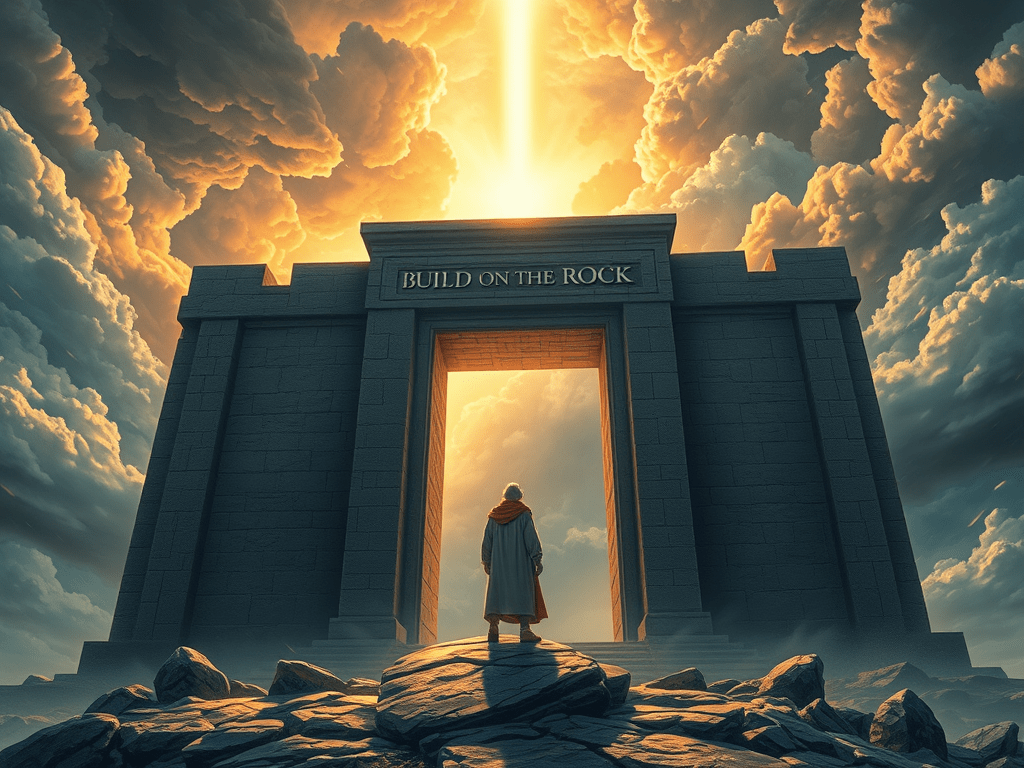
A Hero’s Journey of Real Spiritual Transformation
Thursday, December 4th — Advent Reflection
Readings: Isaiah 26:1–6 • Psalm 118 • Matthew 7:21,24–27
Liturgical Color: Violet (Advent)
Advent is a season of waiting, watching, and rebuilding the inner life. The readings for today speak with a single voice: your soul must be founded on the Rock, because storms will come. Not just external troubles, but the storms inside the human heart—fear, temptation, pride, confusion, and despair.
Isaiah, the Psalmist, and Jesus Himself give us three images:
a strong city, a sacred gate, and a house on solid rock.
Together, they outline the path of every spiritual hero—from the prophets, to the saints, to ordinary men and women trying to follow God today.
Let’s walk through the readings with Catholic wisdom, mythological insight, and psychological truth—so we can act on them, not just hear them.
Isaiah: Open the Gates and Enter the Strong City
Isaiah sees a vision of the soul as a strong city, built by God Himself:
“We have a strong city… Open the gates! Let the upright nation come in… Trust in the Lord forever, for the Lord is the everlasting Rock.”
The imagery is rich and precise:
- The city is the human soul
- The walls and ramparts are the virtues that protect us
- The gates are the choices of the will
Only those who trust in the Lord, who keep their minds “steadfast,” can enter.
In mythic language, this moment is the hero approaching the threshold.
Every great story has this scene:
- Odysseus at the gates of the underworld
- Aeneas at the temple doors
- Frodo at the borders of Mordor
- Christ at the entrance of the tomb
But Scripture adds something deeper:
The strength of the city is not your own willpower. God Himself is the foundation.
The hero does not face chaos alone. The hero faces chaos with God.
Psalm 118: The Gate of Holiness
The Psalm continues the same theme:
“Open to me the gates of holiness… This is the Lord’s own gate where the just may enter.”
The pilgrim approaches the Temple and knocks. The question from inside is implied:
Who may enter?
The answer is not:
- “I am strong.”
- “I am important.”
- “I have influence.”
The answer is:
“The Lord is my refuge.”
Psychology says the same:
When your core identity rests on anything unstable—success, emotions, reputation, strength—your inner world collapses when those things shift.
But when identity rests on God, the soul stands firm.
Jesus: Build Your House on the Rock
In the Gospel, Jesus gives the image most people know:
Two builders. Two foundations. Two futures.
But He adds a detail that cuts straight to the heart:
Both men hear His words. Only one acts.
This is the decisive moment of the Hero’s Journey—when knowing is no longer enough.
The hero must obey.
The hero must choose.
The hero must cross the threshold into action.
Jesus says plainly:
“Everyone who listens to these words of mine and acts on them will be like the wise man who built his house on rock.”
Storms hit both houses.
Faith does not guarantee ease.
Faith guarantees endurance.
The Psychology: Two Builders, Two Brains
There’s a psychological layer here too.
The house on rock
represents a life governed by the higher faculties:
- Reason
- Conscience
- Long-term vision
- Stability
- Sacrifice
- Grace-supported will
The house on sand
represents a life governed by the lower systems:
- Impulse
- Emotion without discipline
- Ego and appearance
- Social pressure
- Immediate pleasure
Neuroscience confirms what Scripture teaches:
When stress comes, the “lower” regions dominate unless the higher faculties are formed and anchored.
Storms—suffering, fear, temptation, failure—expose the foundation of the soul.
Mythic Parallels: Every Hero Faces the Storm
Every ancient story knows this truth:
- Gilgamesh meets the flood
- Jonah meets the tempest
- Odysseus meets the sea
- Aeneas meets the burning city
- Christ meets the Cross
Heroes are not defined by the absence of storms, but by the strength of their foundation.
Myths point to it.
Psychology explains it.
Catholic faith reveals it:
The foundation is Christ Himself.
Catholic Exegesis: The Rock Has a Name
The Church Fathers are unanimous:
- Christ is the Rock (1 Cor 10:4)
- His teaching is the Rock
- The Church is the Rock
- Grace that strengthens the will is the Rock
St. Augustine:
“The house is faith; the foundation is Christ.”
St. Gregory the Great:
“To hear without acting is to build in the imagination.”
St. Thomas Aquinas:
“The foundation of the spiritual life is humility.”
So the Rock is not self-help.
The Rock is not moralism.
The Rock is not positive thinking.
The Rock is a Person.
A relationship.
A covenant.
A surrender.
How to Build on the Rock Today
Here is the practical plan Jesus gives:
1. Listen to His words
Read Scripture.
Study the faith.
Let the Church teach you.
2. Act on His words
Do one concrete thing today:
Forgive.
Pray.
Serve.
Confess.
Cut out a vice.
Re-establish order.
The hero’s gate is action.
3. Trust God more than yourself
Say:
“Lord, I want Your will more than comfort.”
4. Build habits that hold under pressure
Virtue is spiritual architecture.
The sacraments are reinforcement beams.
Prayer is the daily maintenance.
5. When the storm comes, choose to stand
Do not fear the wind.
Do not panic at the rain.
Do not believe the lie that you are alone.
The storm is not your enemy.
The storm reveals your foundation.
The Call: Enter the Gate. Stand on the Rock.
Advent invites you to rebuild your life on Christ.
Isaiah says: Enter the city.
The Psalm says: Come through the gate.
Jesus says: Stand on the Rock.
The message is simple and strong:
Your life has a structure.
Your soul has a destiny.
Your choices build a house that will either stand or fall.
So today, choose to act.
Choose to trust.
Choose to build.
Choose the Rock.
And when the rains fall and the floods rise and the winds tear at everything—
you will stand.
And your endurance will give glory to God.
Developed with assistance from ChatGPT-5
 Seized by Christ