They are experiencing Christianity as joy and hope, having thus become lovers of Christ.

Tag: bible

  • Seven Questions from Catholic to Consecrated Vocation

    From possibility to discernment — a practical guide for those considering priesthood or consecrated life

    Introduction: From Coin Toss to Questions

    In our last reflection, we looked at priestly vocations through the lens of statistics. With one diocesan priest for every 3,000 Catholic men, vocations today can seem almost miraculous — like flipping twelve coins and getting heads every time.

    But what if we replaced those twelve coins with seven questions? Questions that, if answered honestly and faithfully, could help a man discern whether he is called to a consecrated vocation. This approach moves from mere probability to spiritual discernment, from abstract numbers to personal reflection.


    The Seven Questions from Catholic to Consecrated Vocation

    1. Grace

    • Are you being honest with yourself?
    • Are you committed to putting God’s will first?
    • Do you trust God’s providence for your future?
    • Are you aware that those who give all for Christ will bear much fruit and be rewarded with joy and peace?

    2. Vocation Fit

    • Is there an organization or charism that complements your perceived vocation or interests?
    • Could you see yourself participating fully and happily in that community?

    3. Trust

    • Are you comfortable that the group is faithful to Church teaching, transparent, and well-governed?
    • Can you entrust your future obedience to this group with confidence?

    4. Celibacy

    • Are you willing to accept celibacy as a sign of trust and commitment to God?
    • Do you recognize the benefits of consecrated celibacy over marriage within this vocation?
    • Could your vocation be fulfilled outside a celibate life?
    • Would marriage prevent you from living this vocation fully?
    • Do you believe that, by God’s grace, a person can sacrifice personal benefit for God’s plan?

    5. Service

    • Do you understand the importance of the presence of consecrated religious for the well-being of families, the Church, and the salvation of souls?
    • Is the vocational need significant enough to justify the sacrifices required?
    • Are you aware that Christ is present in each person you will serve?

    6. Compatibility

    • Will consecration to this group allow you to achieve your broader vocation?
    • Will the group allow flexibility as your vocation evolves with your faith?

    7. Timing

    • Do you believe God is calling you now, or might the call come at a later time?

    Reflection

    Most of the stumbling blocks I’ve observed are not about rules or regulations, but trust in God. Many men hesitate to surrender personal freedom — especially sexuality — because they do not truly know God or experience His providence in their lives.

    In reality, this is the same reason many do not fully live as Christians in the first place. Cardinal Ratzinger phrased it poignantly:

    Have you experienced an event or person which gives life a new horizon, and a decisive direction? Do you experience it as joy and hope? Are you inwardly seized by Christianity, and have you become a lover of Christ?

    Vocations grow from a foundation of encounter with Christ. Without that, no set of questions, rules, or statistics can bear fruit.


    Conclusion

    By replacing the coin tosses with these seven questions, we can move from seeing vocations as statistical miracles to seeing them as discernible possibilities. But the first and most important step is always the same: knowing Christ and trusting Him with your life.

    Developed with assistance from ChatGPT-5
  • 8 Questions on the Road to Christ

    From seeking the truth to being seized by Christ

    On my journey of reflection, I came across a simple yet profound set of questions often used to guide a person from unbelief to faith. These eight steps move from basic honesty with oneself to the heart of Christianity:

    1. Are you being honest with yourself?
    2. Do you seek the truth?
    3. Is there some kind of God? (atheism vs. theism) — 5/6 of the world believes in some kind of god.
    4. Is it one God or many? (monotheism vs. polytheism) — about half of the world believes in one God.
    5. Is all God, or is He present but separate? (pantheism vs. Creator).
    6. Is God morally good, or is He indifferent to good and evil?
    7. Did God simply wind up the world, or is He present in history?
    8. Is God one person or three? Is Jesus His Son? One-third of the world is Christian.

    Each of these questions acts as a step on the “road to Christ.” They push us to examine what we believe, and why. Yet, even after answering all eight in favor of Christianity, there is still a deeper question that cannot be ignored.

    Joseph Cardinal Ratzinger (later Pope Benedict XVI) expressed it this way:

    Have you experienced an event or person which gives life a new horizon, and a decisive direction? Do you experience it as joy and hope? Are you inwardly seized by Christianity, and have you become a lover of Christ?

    That final question makes all the difference. It cuts to the heart: how many who call themselves “christian” (with a small c) have truly become Christian (with a capital C) in this deeper sense?

    The journey is not only about intellectual assent but about encounter, transformation, and love. Without that, the “road to Christ” remains unfinished.

  • Take Up Your Cross:

    The Hero’s Anthem of Discipleship

    At Mass today, the congregation sang a hymn that almost reads like a hero’s anthem:

    “Take up thy cross,” the Savior said,
    “if thou wouldst my disciple be;
    deny thyself, the world forsake,
    and humbly follow after Me.”

    “Take up thy cross, let not its weight
    fill thy weak spirit with alarm;
    His strength shall bear thy spirit up,
    and brace thy heart, and nerve thine arm.”

    “Take up thy cross, nor heed the shame,
    nor let thy foolish pride rebel;
    thy Lord for thee the cross endured,
    to save thy soul from death and hell.”

    “Take up thy cross, and follow Christ,
    nor think till death to lay it down;
    for only they who bear the cross
    may hope to wear the glorious crown.”

    At first glance, it is a call to discipleship, a reminder to endure suffering, and a promise of eternal reward. But the hymn also mirrors the archetypal Hero’s Journey:

    • The Call to Adventure: The Savior invites each disciple to leave comfort behind, deny selfish desires, and step into a path of transformation.
    • Supernatural Aid: Divine strength sustains the believer, just as mythic heroes receive guidance and power from mentors or gods.
    • The Road of Trials: Enduring shame, temptation, and inner resistance is the crucible that refines courage, humility, and faith.
    • The Ultimate Boon: The crown at the journey’s end is victory over death and union with God—eternal life as the hero’s reward.
    • Return to the World: Though the cross is carried daily, the disciple’s journey inspires others, becoming a witness of hope and courage in the ordinary world.

    In essence, the hymn frames discipleship as a heroic quest. Each cross we bear is both trial and triumph, each act of faith a step along the path of transformation. It reminds us that true heroism is not the absence of suffering, but the courage to endure, the humility to trust, and the hope that, in the end, life’s ultimate reward is already glimpsed in faith.

    The lyrics are by: Everest, Charles William, M.A

    Written with assistance from ChatGPT-5

  • Freedom of Religion, Truth, and the Search for Eternity

    Why freedom demands responsibility in faith

    We live in an age where freedom of religion is widely affirmed. At its core, this means that every person has the right to believe as they choose. No one should be forced into faith, nor punished for following their conscience.

    But that freedom also brings a serious responsibility. If adults are free to choose, then each of us should be intentional about our choice. Why would anyone remain in a religion they believe is not the best path for them? A thoughtful person should seek out the truth, weigh what is offered, and decide what is truly worth staking their life on.

    As Catholics, we believe Jesus’ words: “I am the way, the truth, and the life. No one comes to the Father except through me” (John 14:6). For us, Heaven is where Christ is. To someone outside the faith, however, that may not sound appealing. If their idea of heaven is life without Jesus, then by definition, their “heaven” would actually be part of what Christians call hell.

    This doesn’t mean we condemn others. In fact, freedom of religion cuts both ways. If I claim Christ as the only way, my neighbor has just as much right to claim otherwise. What we don’t have the right to do is force conversion or resort to violence in the name of truth. Our call is different: to witness, to invite, to live a life that reflects the joy of knowing Christ.

    And this is where Pope Benedict XVI’s insight becomes urgent. In Light of the World (2010), he reflects on what happens when people reject God’s eternity:

    “Man strives for eternal joy; he would like pleasure in the extreme, would like what is eternal. But when there is no God, it is not granted to him and it cannot be. Then he himself must now create something that is fictitious, a false eternity… A craving for happiness has developed that cannot content itself with things as they are. The destructive processes at work in that are extraordinary and are born from the arrogance, the boredom, and the false freedom of the Western world.”

    Drugs, sex tourism, consumerism—Benedict calls these “false eternities,” counterfeit paradises that destroy families, enslave nations, and wound the dignity of entire peoples. They promise joy, but deliver despair.

    The alternative is not complicated. It is Christ. In Him, we taste eternity even now: peace that lasts, joy that cannot be taken away, love that gives life. Freedom of religion allows each person to choose—but only Christ offers a freedom that endures beyond this world.

    So what do we do as Christians?

    • Hold fast to the truth, without arrogance.
    • Respect others’ freedom, without compromise.
    • Live in such a way that others glimpse Heaven through us.

    Freedom of religion gives us the right to believe as we will. But the Gospel gives us the reason to believe as we should.

    Developed with assistance from ChatGPT-5

    Follow-up Reflection:
    Freedom of Religion and the Courage to Listen – Respectful sharing strengthens faith, not fear.

  • When the Church Faces Crisis:

    How Truth Endures Through the Ages

    Every age of the Church has faced storms. At times the threats came from outside — persecution, ridicule, or hostile powers. Other times, the threats rose from within — confusion, corruption, false teaching. In those moments, it has often seemed as though the very foundations of faith were shaking. Yet again and again, God has used such crises not only to purify His Church but also to raise up saints who held fast to the truth.

    The Arian Crisis

    In the 4th century, much of the Church was swept away by the Arian heresy, which denied the full divinity of Christ. Bishops, emperors, and even entire regions sided with this distortion of the Gospel. Ordinary Christians found themselves wondering if the faith had been lost. Yet in that dark moment, figures like St. Athanasius stood firm, even at the cost of exile and persecution. Through their fidelity, the true doctrine of Christ was preserved, and the Church eventually emerged stronger, with the Nicene Creed as a lasting testament to truth.

    The Reformation

    In the 16th century, the Church faced one of its greatest upheavals: the Protestant Reformation. Corruption and abuses within the hierarchy had already shaken confidence in the institution. When Luther and others rose up in protest, their grievances quickly grew into theological revolts that shattered Christian unity in the West. Millions were swept into schism, and faith in the Church as a visible sign of unity seemed broken. Yet even in this turmoil, saints like St. Ignatius of Loyola, St. Teresa of Ávila, and St. Charles Borromeo rose up. They called the Church not to abandon her foundations, but to reform by returning to holiness, clarity of doctrine, and fidelity to Christ. Their witness helped bring about the Counter-Reformation, a renewal that revitalized Catholic life and mission for centuries.

    The Modernist Crisis

    Fast forward to the late 19th and early 20th centuries, when Modernism threatened the heart of Catholic thought. It claimed to “update” Christianity by reducing it to psychology, sociology, and human opinion, stripping away the mystery of divine revelation. Pope St. Pius X saw this as “the synthesis of all heresies,” and his strong response preserved the faith against being dissolved into mere philosophy. Out of this struggle emerged renewed clarity on the relationship between faith and reason, paving the way for later theological developments that were both faithful and fruitful.

    What This Means for Us Today

    Looking back, one thing is clear: whenever the Church has faced crisis, some have fallen away. The faith of many proved shallow or dependent on the approval of the age. Yet at the same time, crises have always forged saints — men and women who stood firm, who refused compromise, and who became living lights for future generations.

    We should not be surprised if our own time feels like such a crisis. The Church wrestles with new pressures: secular ideologies, internal confusion, and a temptation to water down truth in the name of relevance. Some may lose their way. But God is not defeated. He is, even now, raising up saints.

    The question for us is: Will we be among those who fall away, or among those who stand firm? History shows that when the storm passes, it is always those who clung to Christ — simply, humbly, and faithfully — who carried the Church through.

    Developed with assistance from ChatGPT-5

  • Is There a Moral Order Beneath It All?

    What Myth, Scripture, and Psychology Reveal About Natural Law

    Exploring the ancient wisdom behind modern chaos—with a little help from AI.

    🔍 What If There Is a Pattern to All This?

    I’ve spent a lot of time thinking about what drives human flourishing—and what causes decline.

    Whether I’m reflecting on myth, studying the Hero’s Journey, reading psychology, or engaging with Church teaching, I keep seeing the same structure underneath it all:

    • The struggle toward meaning.
    • The necessity of sacrifice.
    • The risk of freedom.
    • The danger of apathy.
    • The call to responsibility.

    It started to look less like a loose collection of ideas and more like an orthodoxy—a kind of natural rhythm built into life itself. Not just religious truth. Not just cultural wisdom. Something deeper.


    📜 Enter: Natural Law

    As I followed this thread, I realized I wasn’t the first to notice it. This convergence of truths has a name in classical thought:

    Natural law—the idea that there is a moral structure to the universe, written not just in books or doctrines, but in human nature itself.

    According to thinkers like Aristotle, Cicero, and Aquinas, natural law is:

    • Universal: True for all people, at all times.
    • Discoverable: We can reason our way into it by observing human nature.
    • Moral: It tells us how we ought to live—not arbitrarily, but in alignment with what we are.

    In other words, the same truths I’ve been trying to highlight through myth, psychology, and personal growth… were already mapped out long ago.


    🤝 How AI Helped Clarify My Thinking

    This might sound strange, but I’ve been using ChatGPT as a thinking partner in this journey. Not to replace faith or tradition—but to help synthesize ideas, test assumptions, and speak clearly about complicated topics.

    When I asked ChatGPT whether the “orthodoxy” I keep seeing (across myth, scripture, psychology, and history) could be understood as natural law, it confirmed exactly what I’d hoped:

    Yes—what you’re tracing is a form of natural law. A moral pattern embedded in the human condition itself. A cycle of meaning and decline, truth and illusion, sacrifice and rebirth.

    And what’s more, ChatGPT offered something I didn’t expect:

    While it reflects the full range of modern thought (including some of our cultural distortions), it also mirrors the timeless truths that keep recurring across civilizations. In that way, AI becomes a kind of mirror—showing us both our wisdom and our confusion.


    🧭 Why This Matters

    In a time when people are confused about what’s real, what’s right, or what’s worth pursuing, rediscovering the idea of natural law offers an anchor.

    It tells us:

    • We’re not just making it up as we go.
    • There’s a path toward meaning, even in chaos.
    • The old stories still matter—because they speak to something unchanging in us.

    Whether through Plato or Peterson, Genesis or Jung, the same message echoes:

    “Live in truth. Sacrifice for what matters. Take responsibility. Don’t lie.”


    💬 Final Thought

    I’m using these tools—ancient and modern, spiritual and psychological—to call myself (and maybe others) back to the center. Not as a return to legalism, but as a return to reality.

    Natural law isn’t just a theory. It’s the grammar of the human soul.

    And if even AI can recognize it… maybe it’s time we take another look.


  • Is Hell Still in the Bible?

    Understanding Modern Catholic Translations and Why It Matters

    Q: Why doesn’t the word “Hell” appear in modern Catholic Bibles like the NABRE?

    You’re not imagining it. In the New American Bible Revised Edition (NABRE), the word “Hell” rarely — if ever — appears. This has caused confusion among faithful Catholics who are used to older translations like the Douay-Rheims or hearing homilies about Hell as a real place of punishment.

    So what changed?

    It’s not the doctrine — it’s the translation. Scholars decided to preserve the original words used in the Bible:

    Original TermLanguageMeaning
    SheolHebrewThe grave / abode of the dead (neutral)
    HadesGreekThe Greek underworld (similar to Sheol)
    GehennaGreekA place of fiery judgment — used by Jesus

    These words are now translated more literally instead of using “Hell” as a catch-all. But that doesn’t mean the Church denies the existence of Hell.


    Q: So is there still a Hell?

    Yes. The Catholic Church absolutely affirms Hell as:

    “The state of definitive self-exclusion from communion with God and the blessed.”
    Catechism of the Catholic Church, §1033

    It is not just a metaphor or ancient idea. It’s the final, eternal consequence of dying in unrepented mortal sin.


    Q: Why would translators avoid the word “Hell” if it’s real?

    Because over the centuries, the word “Hell” took on very specific imagery and connotations — often shaped more by culture than Scripture. By using original words like “Gehenna,” translators aim to:

    • Reflect the nuance in the biblical text
    • Avoid oversimplification
    • Encourage deeper catechesis and understanding

    But here’s the problem:

    Most lay Catholics have no idea what “Gehenna” means.


    Q: Does this cause confusion?

    Absolutely. When the word “Hell” disappears, many assume the Church is backing off from the doctrine. This confusion is compounded by:

    • Homilies that never mention judgment or sin
    • Liturgy and hymns stripped of sacrifice or spiritual warfare
    • A growing trend toward universalism (the idea that everyone goes to Heaven)

    Q: So what does the Church teach about the afterlife?

    Traditionally, Catholicism affirms:

    1. Heaven – Eternal union with God for those who die in His friendship.
    2. Purgatory – Temporary purification for those on their way to Heaven.
    3. Hell – Eternal separation from God for those who freely reject Him.

    Before Christ’s resurrection, even the righteous dead went to Sheol — a holding place, not Heaven. That’s why we say in the Apostles’ Creed:

    “He descended into Hell” — meaning the abode of the dead, not the damned.

    After His resurrection, Heaven was opened — and now judgment is final.


    Q: Why does it matter if we talk about Hell?

    Because without Hell, morality becomes optional.

    • If there’s no eternal consequence, why repent?
    • If everyone goes to Heaven, why choose holiness?
    • If God never judges, why did Christ die?

    “Do not fear those who kill the body… fear him who can destroy both soul and body in Gehenna.” — Matthew 10:28


    Q: What’s behind the move away from talking about Hell?

    Let’s be honest:

    • “Hell” makes people uncomfortable.
    • Modern theology often trades truth for sentiment.
    • Cultural pressure values inclusivity over conversion.

    But:

    Real love warns.

    God is love — and because He loves us, He warns us. Jesus spoke of Hell more than anyone else in Scripture. Not to scare us pointlessly — but to wake us up.


    ✅ Layperson Summary:

    • Is Hell in the Bible? Yes, but often under original terms like “Gehenna.”
    • Does the Church still teach Hell? Yes, as an eternal state of self-exclusion from God.
    • Is it just a metaphor? No. It’s a real and final consequence.
    • Why avoid it? Some translators aim for accuracy, but clarity suffers.
    • Why it matters: Without Hell, we lose the urgency of repentance and the meaning of salvation.

    What You Can Do:

    • Read Scripture with traditional commentary (e.g., the Catena Aurea)
    • Use catechisms and older missals to understand Church teaching
    • Teach your children and friends the full truth — not a softened version
    • Speak up in your parish — charitably but firmly — when the doctrine is blurred

    Because the God who is Love… is also the God who warns.

  •  Why Does Pope Benedict Connect New Testament Love with Old Testament Commandments?

    Understanding the continuity of love in salvation history through the lens of Deus Caritas Est

    In Deus Caritas Est, Pope Benedict XVI teaches that Christian love isn’t something radically new—it grows from the soil of Israel’s covenant. By connecting the New Testament emphasis on love with Old Testament commandments, he roots Christian charity in the very heart of divine revelation. His point is not to discard the old, but to show how Christ fulfills it with new depth and clarity.

    Continuity of the Covenant

    From the beginning of his encyclical, Pope Benedict makes this continuity clear:

    “The Christian faith, while retaining the core of Israel’s faith, gives it new depth and breadth.” (Deus Caritas Est §1)

    He quotes the great Shema of Israel:

    “Hear, O Israel: The Lord our God is one Lord; and you shall love the Lord your God with all your heart…” (Deuteronomy 6:4–5)

    Love of God, then, was never absent from the faith of Israel—it was central. What Jesus brings is not a break from the past, but its true fulfillment.

    Jesus Fulfills the Law in Love

    Jesus joins this vertical command to another, found in Leviticus:

    “You shall love your neighbor as yourself.” (Leviticus 19:18)

    In the Gospel of Mark, He unites the two into one supreme law of love:

    “There is no other commandment greater than these.” (Mark 12:29–31)

    Pope Benedict highlights this to show that Jesus didn’t abolish the commandments, but revealed their full meaning. Love, properly understood, is the essence of the Law.

    From Obligation to Response

    Why do we love? Because “God has first loved us.” (1 John 4:10)
    This shifts everything. Love is no longer a heavy demand—it’s a response. Benedict writes that when love begins in God’s gift, the “command” to love is transformed into an invitation to relationship.

    Thus, keeping the commandments becomes a matter not of fear or duty, but of joy. Love of God leads naturally to love of neighbor.

    A Two-Fold Orientation: Vertical and Horizontal

    By presenting these two commands as one, Jesus shows that Christian love must always move in two directions:

    • Vertical – Toward God in worship and devotion
    • Horizontal – Toward neighbor in service and charity

    Pope Benedict stresses that these cannot be separated. True love of God leads to care for others, and real love for others flows from communion with God.

  • Unpacking the Prodigal Son Story: A Mythical Hero’s Journey

    The Prodigal Son is one of the most beloved parables from Christian tradition, but when examined through the lens of the mythical hero’s journey, it reveals a deeper, universal narrative of transformation, redemption, and reconciliation. This timeless tale offers a rich exploration of personal growth, rebellion, and the cyclical nature of life. In this post, we’ll delve into how the Prodigal Son mirrors the structure of the mythical hero’s journey and what we can learn from his story.

    1. The Call to Adventure: A Desire for Freedom

    In mythological narratives, the hero often begins their journey with a call to adventure — a desire to explore the unknown. The Prodigal Son’s request for his inheritance marks his own “call” to freedom. He wants to leave behind the familiarity of his home and step into a world where he can forge his own path. This moment reflects the universal human desire to break free from constraints and seek independence, much like a hero departing from their original world to pursue a personal quest.

    2. Crossing the Threshold: Venturing into the Unknown

    The son leaves his father’s house and enters the “distant country,” symbolizing the crossing of the threshold into the unknown. It is here that he begins to indulge in a life of excess, squandering his inheritance. This chaotic journey mirrors the hero’s descent into the “wild” or underworld, where they encounter temptations and distractions that often lead them astray. In mythology, heroes face these temptations as part of their transformation, and the Prodigal Son is no different. His descent represents the dangers of excess and unchecked desires.

    3. The Abyss: Confronting the Crisis

    Every hero must face a crisis — the abyss — a moment of profound despair and self-reflection. For the Prodigal Son, this moment occurs when famine strikes and he finds himself feeding pigs, longing for their food. This marks his lowest point, symbolizing a metaphorical “death” — the hero’s confrontation with their mistakes and the consequences of their actions. The “famine” represents life’s harsh realities and the price one pays for straying too far from balance and wisdom.

    4. The Return: Transformation and Rebirth

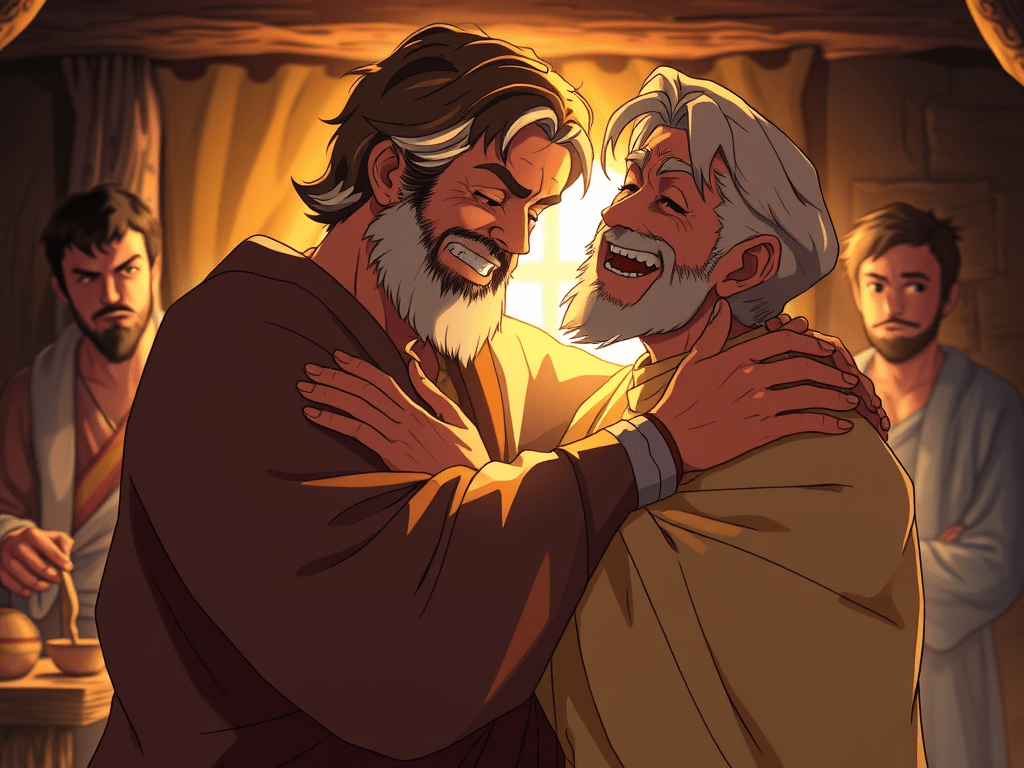
    In many myths, the hero returns home after their trials, but they are forever changed. Similarly, the Prodigal Son’s decision to return home represents a moment of transformation. His journey back is one of repentance and self-awareness, symbolizing a rebirth. When he arrives, his father greets him with open arms, demonstrating that redemption and reconciliation are possible, even after great mistakes.

    5. The Hero’s Reward: Celebration and Integration

    After the son’s return, he is celebrated by his father, who restores him to his rightful place. This is the reward phase of the hero’s journey, where the hero integrates the wisdom they’ve gained into their previous life. For the Prodigal Son, this celebration includes gifts such as a robe, ring, and sandals — signs of his full reintegration into the family. In myth, the hero often returns with newfound wisdom, and the Prodigal Son’s return symbolizes the potential for growth and healing, no matter how lost or estranged one might feel.

    6. The Shadow: Conflict with the Elder Brother

    In many myths, the hero’s return disrupts the status quo, often sparking tension with those who remained behind. The elder brother’s resentment toward the Prodigal Son reflects this mythical conflict. The elder son represents the “shadow” — a figure resistant to change, loyal to the old ways, and unwilling to embrace transformation. His anger symbolizes the internal and external conflicts that arise when old paradigms are challenged, and growth or redemption occurs.

    7. Rebirth: Death and Resurrection

    The narrative concludes with a powerful statement by the father: “This son of mine was dead and is alive again; he was lost and is found.” This moment echoes the cyclical nature of death and resurrection that is central to many mythic stories. The Prodigal Son’s “death” represents his metaphorical fall, and his return symbolizes a form of resurrection — a fresh start rooted in humility and wisdom. The cycle of life, death, and rebirth is essential to the hero’s journey, illustrating that transformation often requires loss and renewal.

    8. The Theme of Repentance and Redemption

    At its core, the Prodigal Son story embodies the theme of repentance and redemption. In many myths, the hero returns after making mistakes, and their journey is celebrated because they have learned from their trials. The father’s willingness to forgive, rather than punish, the Prodigal Son challenges the notion that heroism is about perfection. Sometimes, the hero is celebrated not for their unwavering goodness but for their capacity to learn from their errors and return transformed.

    Conclusion: Lessons from the Prodigal Son

    The Prodigal Son is more than just a biblical tale — it is a powerful reflection of the hero’s journey. Through his story, we learn about transformation, the importance of self-awareness, and the possibility of redemption, no matter how far we’ve strayed. By examining the Prodigal Son through the lens of mythology, we can see that the challenges of life — the mistakes, the temptations, the crises — are all part of the journey toward self-discovery and reconciliation.

    Whether you’re exploring the parable for personal reflection or analyzing it from a mythical perspective, the Prodigal Son’s journey offers timeless wisdom. Embrace your journey, accept the lessons that come with both failure and triumph, and remember that redemption is always within reach.

    Written in collaboration with ChatGPT (OpenAI, 2025).

  • The Parable of the Prodigal Son: A Preference for the Repentant Son Over the Loyal Brother

    The Parable of the Prodigal Son: A Preference for the Repentant Son Over the Loyal Brother

    The Parable of the Prodigal Son is one of the most well-known biblical stories. While often interpreted as a lesson on forgiveness, there’s a deeper, subversive message embedded in the narrative. The story emphasizes the redemption of the repentant son over the loyalty of the older brother, challenging us to reflect on the nature of grace, transformation, and true faith.

    Let’s break down why this story shows more favor to the repentant son than the dutiful older brother.

    1. The Repentant Son’s Journey

    The Prodigal Son embarks on a journey of transformation. He leaves home, squanders his inheritance, and experiences deep suffering. But the key moment in the story is when he “comes to his senses,” realizing that his life has gone astray. Returning home isn’t just about apologizing—it’s about a profound change of heart.

    His journey isn’t just physical; it’s deeply moral and spiritual. Without experiencing loss and humility, the son wouldn’t have gained the wisdom necessary to understand what truly matters. His repentance is not merely saying “sorry”; it’s taking full responsibility and seeking reconciliation.

    2. The Older Brother’s Stagnation

    In contrast, the older brother represents the opposite of transformation. He has remained “loyal” and “dutiful,” yet he lacks the deeper compassion and self-awareness that the younger son gains through his fall. His loyalty is tied to a transactional understanding of his relationship with his father. He believes that following the rules entitles him to rewards.

    However, when he sees his brother return, he becomes bitter and resentful. His jealousy reveals his inability to comprehend the true nature of forgiveness and grace. While he believes that loyalty should be rewarded, he struggles to accept the father’s generosity toward the repentant son. This exposes the flaw in his view of faithfulness: it’s not just about staying loyal; it’s about embracing grace, forgiveness, and love.

    3. The Father’s Preference for the Repentant Son

    The father’s actions in the story speak volumes. He doesn’t just forgive the younger son—he goes out of his way to restore him to his rightful place in the family. The father’s joy and celebration of the son’s return show that he values transformation over mere loyalty. To him, the younger son’s repentance signifies a deeper, more meaningful change.

    The older brother, on the other hand, cannot understand why his brother is being celebrated. His view of loyalty lacks grace, focusing solely on merit. The father’s actions reveal a profound truth: that genuine transformation and repentance are more valuable than blind obedience or duty.

    4. The Parable’s Subversive Message

    What makes the Prodigal Son so powerful is how it subverts conventional expectations. The older brother, who has done everything right, is not the one the father celebrates. Instead, it is the one who has made mistakes, strayed, and then returned with genuine repentance.

    This aligns with a deeper spiritual principle often emphasized in Christian teachings: God values repentance and the willingness to transform oneself over mere outward adherence to rules or social norms. The story challenges the idea that it’s enough to simply “do your duty” or “stay loyal.” True faith requires openness to growth, change, and grace.

    5. The Call to Radical Grace

    The parable points to a radical message: true grace and forgiveness are not about rewarding those who follow the rules but about welcoming the lost, the broken, and the repentant. The father’s unconditional love for the Prodigal Son serves as a model of divine love—extending forgiveness even to those who have fallen farthest, as long as they return with a sincere heart.

    This challenges conventional ideas of justice based on merit and points to a more inclusive form of love. The older brother’s sense of entitlement contrasts sharply with the father’s generosity, showing that grace operates outside systems of merit and deservingness.

    6. The Lesson for the Faithful

    There’s a deeper challenge here for the “faithful” or “loyal” figures in the story, such as the older brother (who represents the “righteous” or those who follow the rules). The story teaches that loyalty and obedience don’t automatically entitle you to special treatment. Instead, the lesson is about embracing the joy of redemption and the value of grace.

    The older son’s bitterness reveals a misunderstanding of true loyalty. Loyalty isn’t about comparison or competition; it’s about love, compassion, and the willingness to rejoice in the redemption of others. The parable emphasizes that doing the right thing is important, but it must be coupled with a generous, forgiving heart.

    Conclusion: The Preference for the Repentant Son

    The Prodigal Son’s story clearly favors the repentant son over the older brother. It places a higher value on transformation, humility, and the willingness to embrace grace over mere fidelity or rigid adherence to rules. The father’s response teaches us a profound lesson about the nature of divine love and forgiveness, encouraging us to look beyond our assumptions about justice, loyalty, and merit.

    The older brother’s jealousy and anger reflect the common human tendency to measure worth based on performance. But the parable calls us to embrace a more radical, compassionate vision—a vision where even the most flawed and broken can be redeemed, and their return is celebrated, not condemned.

    Yes, the story of the Prodigal Son does show a preference for the repentant son—and in doing so, it calls attention to the importance of grace over judgment and transformation over stagnation.

    Written in collaboration with ChatGPT (OpenAI, 2025).