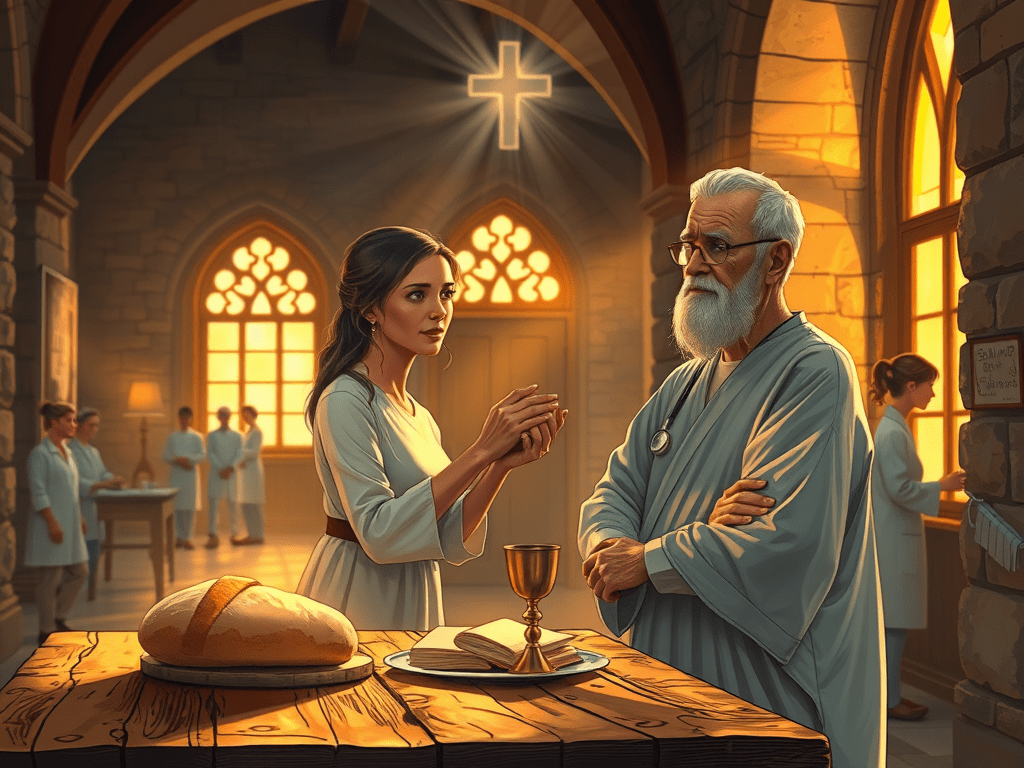
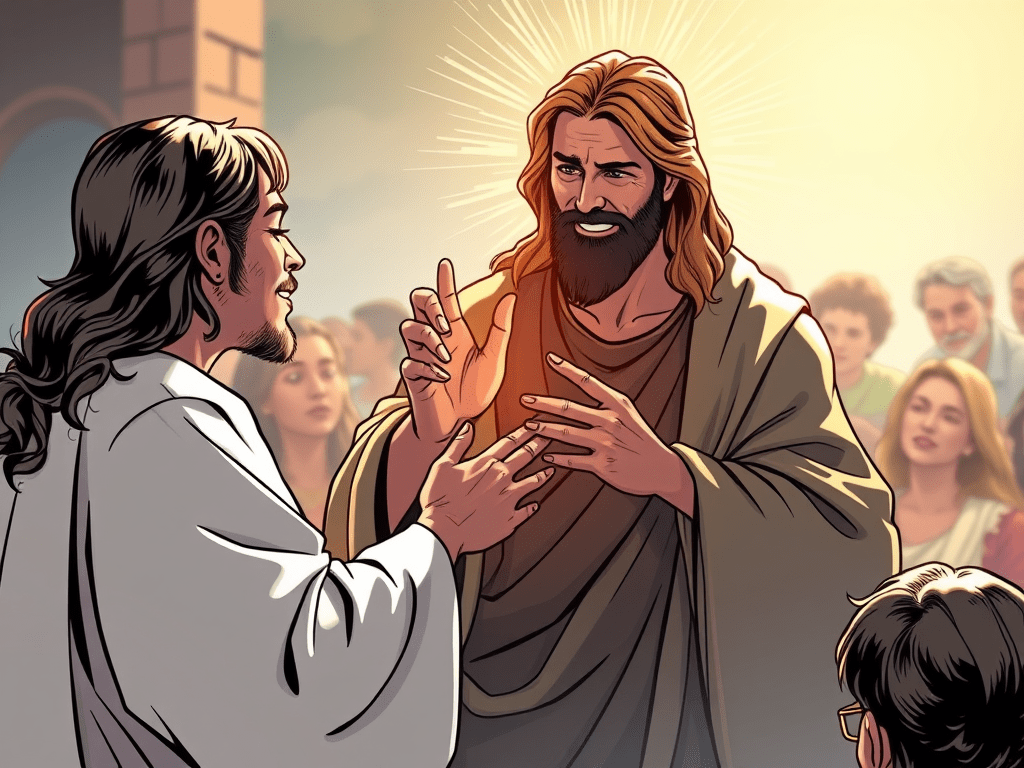
They are experiencing Christianity as joy and hope, having thus become lovers of Christ.

Tag: bible

  • The Crossroads of Life:

    The Crossroads of Life:

    Choosing Fire or Water

    Reflection on Readings for Sunday 15FEB20126

    (Sirach 15:16-21 & Psalm 119)

    In the Book of Sirach (also called Ecclesiasticus), we hear a stark, empowering truth: “If you wish, you can keep the commandments, to behave faithfully is within your power. He has set fire and water before you; put out your hand to whichever you prefer. Man has life and death before him; whichever a man likes better will be given him” (Sir 15:16-17). God never commands godlessness or permits sin without consequence (Sir 15:20-21). This isn’t determinism—it’s divine respect for free will, a cornerstone of Catholic teaching on human agency and grace.

    Psalm 119 echoes this call: “Blessed are they who follow the law of the Lord! … Open my eyes, that I may consider the wonders of your law. … Teach me, O Lord, the way of your statutes” (Ps 119:1-2, 17-18, 33).

    This moment mirrors the Hero’s Journey archetype, where the ordinary person stands at the threshold of adventure. Joseph Campbell’s monomyth begins with a call, often refused at first, but here Sirach presents the choice plainly: life (water, virtue) or death (fire, vice).

    Mythologically, it recalls Hercules at the crossroads. In ancient Greek tales, young Hercules meets two figures—Vice offering ease and pleasure, Virtue demanding toil for lasting glory. He chooses the harder path, forging his heroic legacy through labors. Similar choices appear in Norse lore, like Odin sacrificing an eye for wisdom at the World Tree.

    Psychologically, this engages the brain’s structure. The prefrontal cortex handles executive decisions, weighing long-term consequences and exercising self-control. The amygdala drives emotional impulses—fear, anger, desire—often urging the “fire” of quick gratification. Neuroplasticity shows that repeated virtuous choices strengthen prefrontal pathways, rewiring habits toward resilience and moral growth. Grace elevates this natural capacity, turning biology into a tool for holiness.

    Today, you stand at your own crossroads. Where are you reaching for fire instead of water? Begin with small, deliberate choices: forgive a grudge, resist a harmful impulse, seek God in prayer. Commit to a daily examen—review your day, note patterns, and choose life anew. The path of virtue isn’t easy, but it leads to true freedom and glory. What choice will you make right now?

    Developed with assistance of GROK AI

  • Celibacy in Protestantism:

    Celibacy in Protestantism:

    Myth, Reality, and the Hero’s Path to Vocation

    Celibacy isn’t just a Catholic thing—unmarried Protestant ministers exist and thrive, especially in Anglican, Lutheran, and some evangelical traditions. Unlike Catholicism, it’s not required, but it’s permitted and sometimes chosen as a deliberate vocation. Think of it as opting for a life that’s a “sign” of undivided devotion, much like the early church’s monastic roots.

    In liturgical churches, there’s still a theology of vocation that echoes monasticism: life as sacramental, where celibacy allows for deeper contemplation. Non-liturgical denominations, though, often expect ministers to marry, viewing it as proof of stability. This can overlook celibacy’s power as a calling in itself.

    Tie this to the Hero’s Journey, and it gets even more intriguing. Heroes rarely marry mid-quest; the journey demands solitude for transformation. Marriage, when it happens, follows as a reward or integration. Early marriage can short-circuit this, stabilizing a man before he’s initiated into his deeper self, potentially sparking crises later.

    Modern marriage trends add fuel: We’re marrying later, but men aren’t always maturing—they’re just extending adolescence. Women face biological clocks, and historical norms (men marrying after proving competence, with moderate age gaps) get labeled problematic today due to fears of imbalance. But the real crisis? Misaligned vocations. Not every man called deeply to God is meant for marriage, and rushing in before self-knowledge can undermine both.

    Liturgical traditions preserve this wisdom: Some must enter the “wilderness” first. Tozer embodied this tension—a married prophet whose calling strained his home. It’s a call to discern: Is your path active or contemplative? Married or single? Engaging with these questions can transform how we view singleness not as a deficit, but as a heroic choice.

    What’s your take on celibacy in ministry? Is it undervalued today?

    Developed with assistance from Grok and Gemini

  • 🧎‍♂️ Prayer Includes Speaking Up

    🧎‍♂️ Prayer Includes Speaking Up

    What Luke 11 Teaches Us About Letting Ourselves Be Known
    By Tom Neugebauer | Seized by Christ

    “Ask, and it will be given to you; seek, and you will find; knock, and the door will be opened to you.” — Luke 11:9

    When Jesus teaches His disciples to pray in Luke 11, He invites them into something bold and persistent. Not just polite, private asking—but heartfelt, repeated knocking. The kind of prayer that won’t stop because the need is real.

    But what if one of the most powerful ways to pray isn’t just between us and God?

    What if part of that asking, seeking, and knocking means being willing to say out loud—to others—what we truly need?


    🗣️ Real Prayer Isn’t Always Silent

    Sometimes, we imagine prayer as a secret between us and God. And it can be. But if we never speak our needs to others—friends, family, fellow Christians—we may be cutting off the very path God wants to use to help us.

    When we share our burdens with someone we trust:

    • We invite them to pray with clarity and compassion.
    • We open the door to God’s grace working through human love.
    • We allow ourselves to be known—and that’s part of intimacy with God too.

    🤲 Vulnerability Is Part of Prayer

    Sharing our needs isn’t weakness. It’s humility and faith. It says:

    “I trust God enough to ask. And I trust you enough to let you in.”

    Jesus didn’t just tell people, “I’m praying for you.” He listened to what they wanted: “What do you want me to do for you?” (Luke 18:41)

    He taught us to ask God for what we need—and to bring those needs into real relationship.


    🧩 The Answer Might Begin with the Asking

    When we name our longings to those around us, we:

    • Help others understand how to pray for us
    • Create space for real help to come—not out of pity, but partnership
    • Remind ourselves that prayer isn’t just about waiting—it’s about honest engagement

    Sometimes God doesn’t move because we haven’t knocked on the door that’s right next to us.


    💬 What If Prayer Looked Like This?

    • We talk to God about our real needs—and not just in vague terms
    • We share those needs with a friend, a small group, or someone we trust
    • We allow others to become part of the story—not by fixing us, but by knowing us
    • We recognize that being known can be its own kind of healing

    🙏 Let Yourself Be Heard

    Next time you’re struggling with something:

    • Don’t just whisper it to God
    • Say it to someone you love and trust
    • Let that be part of your prayer

    You never know—God may be ready to answer. He just needed you to knock on more than one door.


    🕊️ If this reflection stirred something in you—maybe about how you share your needs or pray for others—please consider liking, subscribing, and sharing a comment below.

    We grow in faith together, and your story, insight, or question could be the nudge someone else needs today.

    • authentic Christian prayer
    • sharing prayer intentions
    • Luke 11 prayer reflection
    • praying with others
    • intercessory prayer meaning
    • Catholic prayer and relationships
    • asking God and asking others
    • vulnerability in prayer
    • how to pray effectively

    persistent prayer in Luke

  • A.W. Tozer’s Hidden Struggle:

    A.W. Tozer’s Hidden Struggle:

    The Prophet’s Family and the Price of Divine Calling 

    A.W. Tozer is revered as a spiritual giant, but behind the sermons and books was a man whose calling exacted a heavy toll on his loved ones. Married with seven children (six sons and one daughter), Tozer lived with an intensity that mirrored a monk’s devotion. His interior life was all-consuming, focused on God above all else. But that focus created emotional distance, especially for his wife, Ada.

    After Tozer’s death, Ada remarried and reportedly said, “Aiden loved Jesus Christ, but Leonard Odam (her new husband) loves me.” Ouch. It’s a raw admission that highlights the tension: Tozer’s prophetic vocation—marked by radical devotion—clashed with the demands of marriage. He wasn’t absent for selfish reasons like career ambition or escapism; his “absence” was poured into prayer, writing, and ministry that has inspired millions.

    This raises a thorny question: Should some men with such a deep calling avoid marriage altogether, or at least delay it until they’ve wrestled with their spiritual identity? In Protestant circles, marriage is often seen as a badge of maturity, but Tozer’s story suggests otherwise. It’s a reminder that not every path to holiness fits neatly into family life.

    Drawing from the Hero’s Journey archetype (think Joseph Campbell), the hero often remains single during the quest—marriage comes after transformation, as a crowning achievement. Tozer’s life illustrates the risk of flipping that script: early marriage can stabilize a man before he’s faced his true call, leading to strain or midlife reckonings.

    Tozer wasn’t a neglectful husband by worldly standards—many men are “absent” due to jobs, poverty, or distractions. But his was a holy absence, aimed at eternal good. Still, the cost was real, and it challenges us: How do we balance divine pursuit with human relationships? If you’re navigating a similar tension, Tozer’s biography is a must-read. It’s not a cautionary tale of failure, but of the tragic beauty in following God at all costs.

    Share your thoughts: Have you seen calling clash with family in your life or others’?

    Developed with assistance from Grok and Gemini

  • The Holy Paradox: Why Choosing Christ Doesn’t Make You “Better”

    The Holy Paradox: Why Choosing Christ Doesn’t Make You “Better”

    Moving from the Ego’s “Us vs. Them” to the Radical Humility of the Father’s Eyes.

    The Subtle Poison of Religious Pride

    When we decide to give our lives to Christ, we cross a threshold. It feels like a victory—and in many ways, it is. But right behind that victory lurks a subtle, spiritual poison. We begin to look at the world through a lens of “us” and “them.” We start to wonder: Am I better than they are?

    The short, jarring answer is: No.

    In the economy of Grace, there is no “better.” There is only the called, the seeking, and the found.

    The Myth of the Self-Made Saint

    We like to think our “Yes” to God is a personal achievement. We treat it like a trophy we earned. But Catholic Exegesis and the history of the Saints tell a different story.

    It is God who provides the environment. It is God who provides the attitude. It is God who guides the choice. You didn’t invent the air you breathe; you simply finally decided to stop holding your breath. Even the initiative to seek Him is a grace He provided.

    Key Insight: All that is good in us comes from Him. All that is evil in us is simply that which has not yet died.

    Beyond the “Sheep and Goats” Mentality

    Our brains are wired to categorize, to judge, and to rank. But to live a life of grace is to override those biological shortcuts and adopt The Father’s Eyes.

    When we look at someone “trapped by sin” or “downtrodden,” we are seeing only the surface. We have no idea what is happening in the deep recesses of their heart. Consider these three truths:

    1. The Invisible Battle: That person may be fighting a psychological or spiritual slavery you cannot imagine.
    2. The Proximity of Grace: The “worse off” a person appears by our standards, the closer they may be to a total, explosive conversion.
    3. The Elder Brother Trap: Like the brother of the Prodigal Son, we can be “right” on the outside while being miles away from the Father’s heart on the inside.

    Suffering as Sacred Alchemy

    Transformation isn’t just about feeling good; it’s about dying to the self. St. John Paul II once wrote that there is a specific kind of suffering that “burns and consumes evil with the flame of love.” When we see someone struggling, we aren’t called to point a finger. We are called to step into the fire with them.

    Because we have been blessed with grace, we don’t have a higher status—we have a higher responsibility. We are called to suffer personally to help others overcome their shadows. This is the “Hero’s Journey” of the soul: descending into the mess of humanity to bring back the light.

    The Mirror: Fixing Our Eyes

    If you find yourself comparing your holiness to your neighbor’s, you have taken your eyes off the Prize.

    We still have enough of ourselves that needs redemption to keep us busy for several lifetimes. The goal isn’t to be “better” than the person in the pew next to you; it is to be more “dead to yourself” than you were yesterday.

    The Call to Action: Today, look at the person you are most tempted to judge. Instead of a “goat,” see a “lost sheep.” Instead of a “sinner,” see a “prodigal.” Ask for the grace to see them not as they are, but as the Father sees them.

    Developed with assistance from Gemini AI

  • 💜 The Call to Humility: Rewiring the Rebellious Heart

    💜 The Call to Humility: Rewiring the Rebellious Heart

    Readings for 16 DEC 2025: Zephaniah 3:1-2, 9-13; Psalm 33; Matthew 21:28-32

    I. Introduction: The Rebellious City

    We are deep in the heart of Advent, a season colored Violet—the color of royalty, but also of penance and preparation. The scriptures today issue a stark, powerful challenge, starting with the prophet Zephaniah:

    “Trouble is coming to the rebellious, the defiled, the tyrannical city! She would never listen to the call, would never learn the lesson…” (Zephaniah 3:1-2)

    When we hear the word “city,” our modern mind goes to bricks and mortar. But in the prophetic tradition, the city—Jerusalem—is often a profound metaphor for the human soul. Zephaniah is describing not just a physical place, but the rebellious, unintegrated heart—the ego that refuses counsel, trusts only itself, and never draws near to God.

    This “tyrannical city” is the part of our consciousness that seeks to be King Belshazzar, building its own reality based on pride and self-will.

    II. The Psychological Crisis: Refusal and Tyranny

    The First Reading lays bare the psychological state of the rebellious heart:

    • “She would never listen to the call.”
    • “She has never trusted in the Lord.”
    • “She never drew near to her God.”

    This is the Refusal of the Call in the language of the Hero’s Journey. Joseph Campbell taught that all great myths begin when the hero is called to leave their comfortable, known world, and initially says No. The rebellious heart is stuck in this refusal.

    Psychologically, this refusal is driven by the Limbic System. This ancient, instinctual part of the brain seeks comfort, security, and the avoidance of all risk. To trust God, to draw near to God, means surrendering control, which the Limbic System perceives as an existential threat. This fear of surrender makes the heart tyrannical—it must control everything because it fears everything.

    III. The Gospel’s Two Sons: Action vs. Attitude

    Jesus clarifies this battle between the tyrannical heart and true conversion with the parable of the two sons:

    • The First Son: Said “No,” but afterwards thought better of it and went.
    • The Second Son: Said “Certainly, sir,” but did not go.

    The chief priests and elders, comfortable in their certainty and piety, represent the Second Son. They had the right attitude (the right words, the right liturgy), but their tyrannical, rebellious heart (Zephaniah’s city) remained unchanged.

    The tax collectors and prostitutes represent the First Son. They started in the “tyrannical city” of self-will and sin, but in their moment of brokenness, they experienced the crucial psychological step: thinking better of it—a deliberate act of the will leading to action.

    Jesus’s verdict is stunning: “Tax collectors and prostitutes are making their way into the kingdom of God before you.” They embarked on the Hero’s Journey (repentance and action) while the pious were still stuck in the tyranny of their own self-righteous refusal.

    IV. The Great Transformation: Clean Lips and Humility

    The good news, the Advent promise, is that God does not abandon the tyrannical city. Zephaniah promises a profound transformation:

    “Yes, I will then give the peoples lips that are clean, so that all may invoke the name of the Lord and serve him under the same yoke.” (Zephaniah 3:9)

    The “clean lips” are the sign of the transformed heart. Psychologically, this is the victory of the Prefrontal Cortex (PFC)—the seat of reason, moral choice, and long-term vision—over the tyrannical Limbic System.

    • The Limbic heart speaks lies and boasts (Zephaniah 3:13: the perjured tongue).
    • The PFC, aligned with God’s will, brings clean lips—it brings truth, humility, and the ability to invoke the Lord’s name.

    This transformation is completed by two essential virtues:

    1. The Removal of Pride: “I will remove your proud boasters from your midst; and you will cease to strut on my holy mountain.” (Zephaniah 3:11)
    2. The Installation of Humility: “In your midst I will leave a humble and lowly people, and those who are left in Israel will seek refuge in the name of the Lord.” (Zephaniah 3:12)

    The spiritual journey is the systematic dismantling of the tyrannical ego and the installation of humility, where the PFC chooses the love of God over the fear of the self.

    V. Call to Action: The Poor Man’s Call

    This Advent, the call is clear: Stop being the Second Son. Stop being the tyrannical city.

    The Responsorial Psalm gives us the path to conversion: “This poor man called; the Lord heard him.”

    The “poor man” is the humble and lowly person Zephaniah promised. He is the person who has surrendered the tyranny of the ego. The Lord hears him because he is close to the “broken-hearted” and those whose “spirit is crushed.”

    Real spiritual transformation today requires two acts of the will:

    1. Stop Strutting: What are you still doing for show? What is the “proud boasting” that keeps you from trusting God? The work of penance is the work of removing pride.
    2. Start Doing: Do not remain in the Refusal phase. Be the first son. That means taking action that requires surrender. That means choosing the hard “Go and work in the vineyard” over the easy “Certainly, sir.”

    The Lord is coming. Let us choose to dismantle the rebellious city in our hearts, surrender the tyranny of fear, and allow the promised “humble and lowly people” to seek refuge in His name.

    Amen.

    Developed with assistance from Gemini AI

  • The Fall of the Tyrant: The Timeless Myth of Belshazzar’s Feast

    The Fall of the Tyrant: The Timeless Myth of Belshazzar’s Feast

    The Timeless Myth of Belshazzar’s Feast

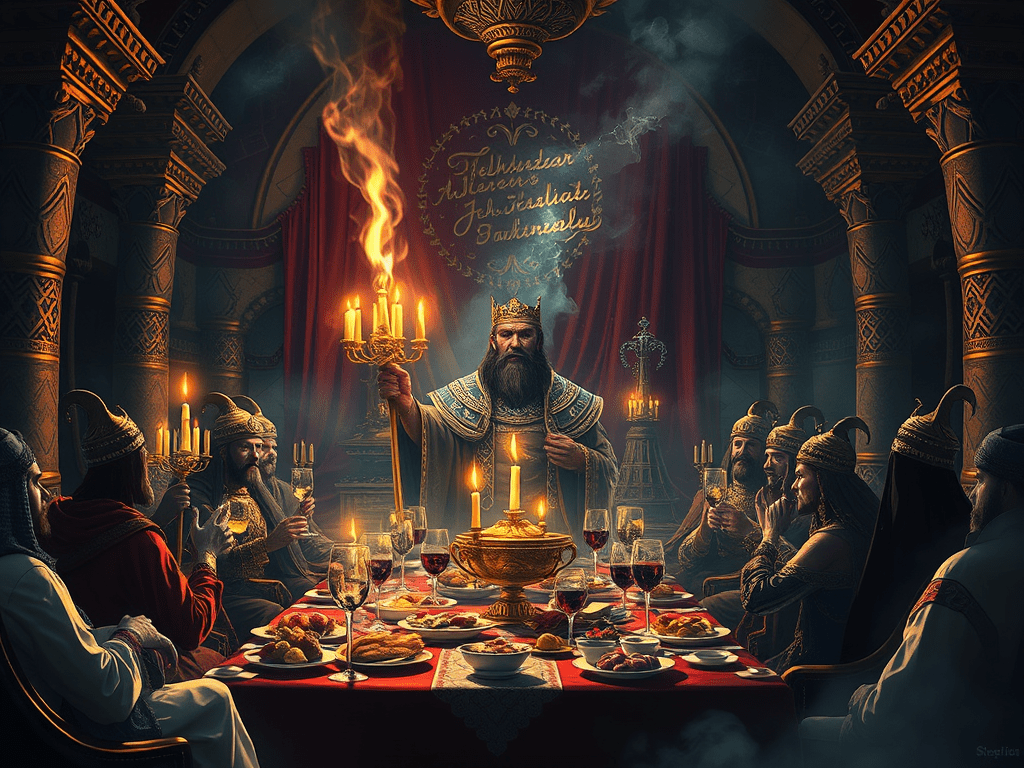
    In the Book of Daniel, chapter 5, we find one of the most dramatic stories in ancient scripture: Belshazzar’s Feast. A lavish banquet turns into a night of terror when a disembodied hand appears and writes mysterious words on the wall. The kingdom falls that very night. But beyond the historical account, this is a profound mythological tale about the inevitable collapse of any power built on arrogance, intoxication, and sacrilege.

    1. Hubris and Sacrilege: The Banquet as Ritual Defiance

    Babylon, in mythic terms, stands as the ultimate “anti-Temple”—a symbol of worldly power that rejects divine order. The banquet isn’t mere excess; it’s a deliberate act of defiance. King Belshazzar commands the sacred vessels looted from the Jerusalem Temple to be brought out. His guests drink wine from them while praising their gods of gold, silver, bronze, iron, wood, and stone.

    This profanation is the core sacrilege: these vessels once held the divine presence. Using them to toast idols is hubris incarnate—the mortal claiming superiority over the sacred. It’s the height of arrogance, performed at the peak of empire.

    2. The Omen: The Hand That Shatters Illusion

    Suddenly, a hand appears, writing on the wall—illuminated, ironically, by the light of the stolen Temple lampstand. The sacred light exposes the profane doom.

    Belshazzar’s reaction is visceral: his face pales, his limbs go slack, his knees knock together. This physical paralysis mirrors his moral collapse—the moment the tyrant’s illusion of invincible power crumbles before a higher force.

    3. The Hero-Interpreter: Daniel’s Uncompromising Stand

    The wise men fail, but Daniel—the exile who refuses to defile himself—is summoned. He deciphers the writing: “Mene, Mene, Tekel, Parsin.”

    Before delivering the verdict, Daniel refuses the king’s rewards: purple robes, gold chains, high office. “Keep your gifts,” he says. His authority comes not from Babylon’s system but from allegiance to the divine. He is untouchable, the true hero bridging chaos and cosmic truth.

    4. The Cosmic Verdict: Weighed on the Scales of Justice

    The words form a threefold judgment:

    • Mene: God has numbered your days; your reign is finite and ended.
    • Tekel: You have been weighed on the scales and found wanting—your character, deeds, and rule insufficient.
    • Parsin: Your kingdom is divided and given to the Medes and Persians.

    That night, Belshazzar is slain, and Babylon falls. The scales of cosmic justice tip irrevocably.

    Echoes in the Cycle of History

    This myth resonates with the ancient observation of civilizational cycles: “Hard times create strong men, strong men create good times, good times create weak men, and weak men create hard times.”

    Belshazzar’s story zooms in on the dangerous transition—good times breeding moral weakness, arrogance, and forgetfulness of limits, inviting sudden collapse. It’s a warning echoed in Greek tragedies (hubris-nemesis), Roman histories, and modern reflections on empires.

    In an age where powers rise and boast at their zenith, the writing on the wall remains a timeless reminder: all human empires are weighed, and those built on sacrilege and pride will be found wanting.

    Content developed with assistance of Gemini AI.

    Blog edited with assistance of Grok AI

  • 🕊️ The Holy Wisdom:

    🕊️ The Holy Wisdom:

    How to Live in the World Where the Wolf and the Lamb Lie Down

    I. The Shoot and the Sevenfold Spirit (The Mythological Order)

    The prophet Isaiah (11:1-10) gives us one of the most sublime visions of the Messianic Age. It begins with the Shoot from the stock of Jesse—the image of radical new life springing from seemingly dead roots. This is the ultimate Anointing, where the seven gifts of the Holy Spirit rest upon the Messiah: wisdom, insight, counsel, power, knowledge, and the fear of the Lord (with the fear of the Lord being his breath, emphasizing reverence).

    This Messianic rule immediately establishes a new cosmic order. It is an end to the primal chaos and conflict that has defined the world since the Fall.

    The imagery—the wolf lives with the lamb, the calf and lion feed together, the infant plays over the cobra’s hole—is pure Mythological Parallel. It evokes the Golden Age or Paradise Restored. . This is the reversal of the natural order of predation and fear. The country is not secured by armies, but by knowledge of the Lord.

    The key insight for us is that this peace is not merely external, but internal: it is the perfect integration of our own conflicting natures.


    II. The Internal Wolf and Lamb (Psychology of Integration)

    We all house the wolf and the lamb. We carry the panther (our wild, unchecked appetites) and the kid (our innocent, vulnerable soul).

    Psychologically, the division in Isaiah’s vision reflects the constant civil war within the human heart:

    • The Wolf/Lion: Represents the passions and the instinctual self—the power of the limbic system and the amygdala—that seek to consume, dominate, and survive at any cost.
    • The Lamb/Calf: Represents the vulnerable, gentle, and receptive spiritual self—the capacity for peace and trust.

    When we are disordered, the wolf preys upon the lamb. Our fear consumes our peace; our lust devours our innocence.

    The Messianic promise is that the Spirit of the Lord (which integrates the powers of wisdom and counsel with knowledge and fear) rests on the leader who reorders this inner landscape. The “little boy” who leads them is the pure Will, guided by Wisdom, that shepherds the powerful animal instincts without destroying them. The lion doesn’t disappear; it learns to eat straw like the ox.

    III. The Wisdom of Children (The Hero’s Revelation)

    How do we gain this integration? The Gospel provides the counterintuitive method.

    Luke 10:21-24 shows Jesus, filled with joy, praising the Father for “hiding these things from the learned and the clever and revealing them to mere children.”

    This is the great Inversion of Wisdom. It is the prerequisite for the Hero’s Revelation. The knowledge that brings true peace is not attained through academic complexity or ego-driven cleverness. It is revealed through humility and simplicity—the state of the “child.”

    • The “learned and the clever” rely on the strength of the Prefrontal Cortex for independent reasoning, often fueling the prideful “wolf” of the ego.
    • “Mere children” rely on trust and direct reception. They are open to the gift of the Spirit (the fear of the Lord—holy reverence) that unlocks true knowledge.

    Only through the eyes of a child can we see the chaos of our inner zoo and accept the reordering delivered by Christ’s Word. Only by becoming small and humble can the Spirit rest fully upon us.

    IV. Call to Action: Practicing the Reordering

    The goal of this Advent is to let the Spirit of the Lord settle upon us, creating that inner sanctuary where no creature does harm.

    Your call to spiritual transformation this week is to practice the Reordering of the Heart:

    1. Identify the Predator: Name the “wolf” in your heart. What is the one instinct (fear, anger, cynicism, lust) that consistently preys upon your peace (the “lamb”)?
    2. Invite the Shepherd: Don’t try to kill the wolf with brute force (that just creates more violence). Instead, invite the Spirit of the Lord into that conflict. When the urge to consume or strike arises, pause and ask for the Spirit of Counsel and Wisdom to lead that wild instinct, turning its energy toward a productive task (like the lion eating straw).
    3. Embrace the Child’s Vision: Seek to simplify your mind. Spend time in quiet prayer not trying to figure out God, but simply receiving Him. Like the Centurion we discussed, surrender the need to be clever. Only in the humility of the child is the fullness of the Lord’s knowledge revealed.

    Let us be the humble remnant, purified and ordered, on whom the Spirit rests, making our hearts glorious and ready for the King.

    Developed with assistance of Gemini AI

  • 🌍 The Open Table and the Open Road: Why the Feast Demands the Mission

    🌍 The Open Table and the Open Road: Why the Feast Demands the Mission

    Lessons from Isaiah, Matthew, and St. Paul on True Abundance

    Readings for Wednesday, December 3rd 2025: feria: Isaiah (25:6-10), Matthew (15:29-37); St Francis Xavier memorial: 1 Corinthians (9:16-23); Mark (16:15-20)


    I. The Scarcity Mindset vs. The Sacred Feast

    The Advent season drives us toward the ultimate hope, which Isaiah (25:6-10) describes as the Sacred Feast: a divine banquet on the mountain where the mourning veil is removed, and Death is destroyed for ever.

    The miracle in Matthew (15:29-37)—where Jesus feeds the four thousand—is a prefigurement of this eternal abundance. The crowds ate their fill, and the leftovers—the overflow of grace—filled seven baskets.

    Yet, immediately before the miracle, we hear the disciples’ classic reaction to need: scarcity. “Where could we get enough bread in this deserted place?”

    This is the voice of the scarcity mindset, the Amygdala screaming for survival and retreat

    . It focuses on the magnitude of the problem and the limits of our own resources. Jesus’ question is the antidote: “How many loaves have you?” He shifts the focus from the limits of the deserted place to the limitless power of the Provider.


    II. From Overflow to Obligation (The Hero’s Return)

    The overflow—those seven baskets full—is the crucial link to the Missionary Feast. Why does God give us more than enough? Because grace is not meant for storage; it is fuel for the mission.

    Saint Paul, whose memorial we honor today, understood this better than anyone. He writes in 1 Corinthians (9:16-23) that the Gospel is a duty laid upon him: “I should be punished if I did not preach it!”

    In the Hero’s Journey, the Hero receives the Elixir (the Feast/Grace) and must overcome the Refusal of the Return—the temptation to keep the treasure for himself

    . Paul reverses this, making himself “the slave of everyone” to share the blessings. His true reward is offering the Good News free, matching Christ’s costless abundance with his own costless service.


    III. The Signs That Accompany the Word

    The Gospel of Mark (16:15-20) provides the climax, connecting the Feast (the grace received) to the power needed for the road:

    “Go out to the whole world… These are the signs that will be associated with believers: in my name they will cast out devils; they will lay their hands on the sick, who will recover.”

    The healing of the lame, crippled, and blind in the Matthew reading is the tangible sign that accompanies the Word. The grace you receive at the altar is the power to continue this healing mission. The Mission is not just sharing words; it is sharing the supernatural power that destroys sickness, shame, and spiritual bondage.

    IV. Call to Action: Release the Overflow

    This Advent, the call is to live immediately from the overflow, transforming your inner abundance into outward action.

    Your challenge is to practice Mission-Minded Living:

    1. Dismantle Scarcity: Identify one area (time, money, emotional energy) where you are hoarding resources out of fear. Replace the paralyzing thought, “Where could we get enough?” with the faithful command, “How many loaves do I have?” and trust Christ to multiply it.
    2. Make Yourself a Slave (in Love): Following Paul’s example, embrace one small, inconvenient act of service or evangelization this week. Give your time or talent freely, mirroring the abundance you received at the Feast.
    3. Go with the Signs: Approach your daily life knowing the power that destroyed Death rests upon you. Look for opportunities to share the overflow—a word of encouragement, a prayer for a coworker, a simple act of mercy—trusting that the signs of Christ accompany your obedient Word.

    We have been fed. Now, let us share the boundless banquet with the world.

    Developed with assistance from Gemini AI