How to Live in the World Where the Wolf and the Lamb Lie Down
I. The Shoot and the Sevenfold Spirit (The Mythological Order)
The prophet Isaiah (11:1-10) gives us one of the most sublime visions of the Messianic Age. It begins with the Shoot from the stock of Jesse—the image of radical new life springing from seemingly dead roots. This is the ultimate Anointing, where the seven gifts of the Holy Spirit rest upon the Messiah: wisdom, insight, counsel, power, knowledge, and the fear of the Lord (with the fear of the Lord being his breath, emphasizing reverence).
This Messianic rule immediately establishes a new cosmic order. It is an end to the primal chaos and conflict that has defined the world since the Fall.
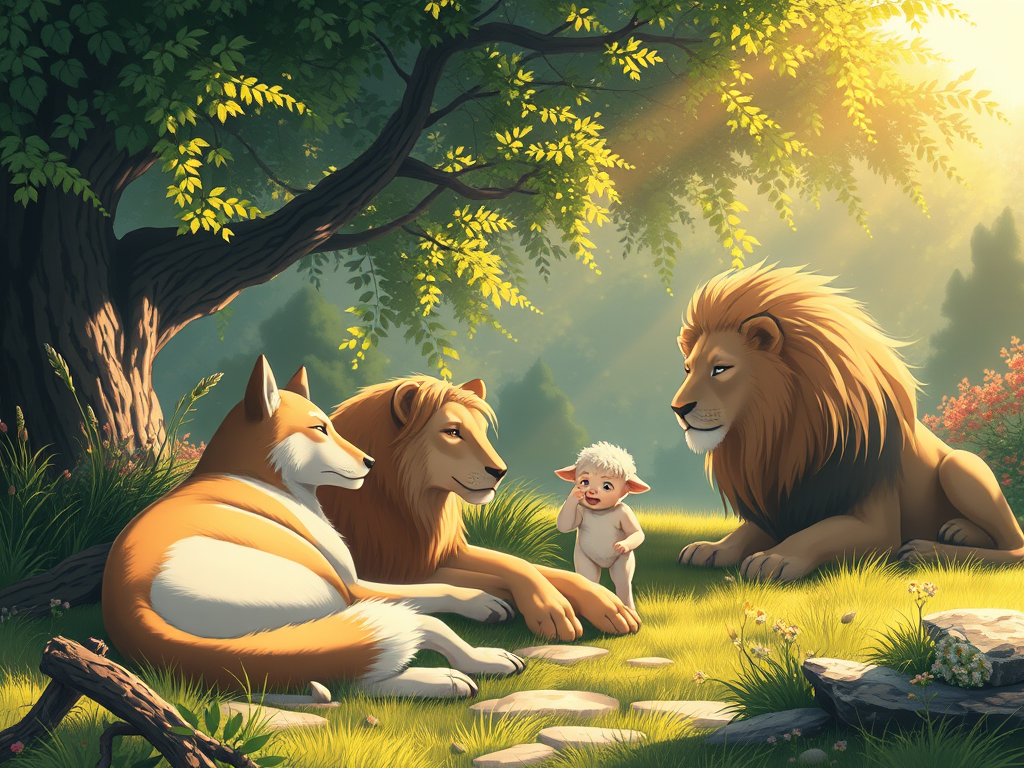
The imagery—the wolf lives with the lamb, the calf and lion feed together, the infant plays over the cobra’s hole—is pure Mythological Parallel. It evokes the Golden Age or Paradise Restored. . This is the reversal of the natural order of predation and fear. The country is not secured by armies, but by knowledge of the Lord.
The key insight for us is that this peace is not merely external, but internal: it is the perfect integration of our own conflicting natures.
II. The Internal Wolf and Lamb (Psychology of Integration)
We all house the wolf and the lamb. We carry the panther (our wild, unchecked appetites) and the kid (our innocent, vulnerable soul).
Psychologically, the division in Isaiah’s vision reflects the constant civil war within the human heart:
- The Wolf/Lion: Represents the passions and the instinctual self—the power of the limbic system and the amygdala—that seek to consume, dominate, and survive at any cost.
- The Lamb/Calf: Represents the vulnerable, gentle, and receptive spiritual self—the capacity for peace and trust.
When we are disordered, the wolf preys upon the lamb. Our fear consumes our peace; our lust devours our innocence.
The Messianic promise is that the Spirit of the Lord (which integrates the powers of wisdom and counsel with knowledge and fear) rests on the leader who reorders this inner landscape. The “little boy” who leads them is the pure Will, guided by Wisdom, that shepherds the powerful animal instincts without destroying them. The lion doesn’t disappear; it learns to eat straw like the ox.
III. The Wisdom of Children (The Hero’s Revelation)
How do we gain this integration? The Gospel provides the counterintuitive method.
Luke 10:21-24 shows Jesus, filled with joy, praising the Father for “hiding these things from the learned and the clever and revealing them to mere children.”
This is the great Inversion of Wisdom. It is the prerequisite for the Hero’s Revelation. The knowledge that brings true peace is not attained through academic complexity or ego-driven cleverness. It is revealed through humility and simplicity—the state of the “child.”
- The “learned and the clever” rely on the strength of the Prefrontal Cortex for independent reasoning, often fueling the prideful “wolf” of the ego.
- “Mere children” rely on trust and direct reception. They are open to the gift of the Spirit (the fear of the Lord—holy reverence) that unlocks true knowledge.
Only through the eyes of a child can we see the chaos of our inner zoo and accept the reordering delivered by Christ’s Word. Only by becoming small and humble can the Spirit rest fully upon us.
IV. Call to Action: Practicing the Reordering
The goal of this Advent is to let the Spirit of the Lord settle upon us, creating that inner sanctuary where no creature does harm.
Your call to spiritual transformation this week is to practice the Reordering of the Heart:
- Identify the Predator: Name the “wolf” in your heart. What is the one instinct (fear, anger, cynicism, lust) that consistently preys upon your peace (the “lamb”)?
- Invite the Shepherd: Don’t try to kill the wolf with brute force (that just creates more violence). Instead, invite the Spirit of the Lord into that conflict. When the urge to consume or strike arises, pause and ask for the Spirit of Counsel and Wisdom to lead that wild instinct, turning its energy toward a productive task (like the lion eating straw).
- Embrace the Child’s Vision: Seek to simplify your mind. Spend time in quiet prayer not trying to figure out God, but simply receiving Him. Like the Centurion we discussed, surrender the need to be clever. Only in the humility of the child is the fullness of the Lord’s knowledge revealed.
Let us be the humble remnant, purified and ordered, on whom the Spirit rests, making our hearts glorious and ready for the King.
Developed with assistance of Gemini AI
 Seized by Christ