They are experiencing Christianity as joy and hope, having thus become lovers of Christ.

Tag: advent

  • 💜 The Call to Humility: Rewiring the Rebellious Heart

    💜 The Call to Humility: Rewiring the Rebellious Heart

    Readings for 16 DEC 2025: Zephaniah 3:1-2, 9-13; Psalm 33; Matthew 21:28-32

    I. Introduction: The Rebellious City

    We are deep in the heart of Advent, a season colored Violet—the color of royalty, but also of penance and preparation. The scriptures today issue a stark, powerful challenge, starting with the prophet Zephaniah:

    “Trouble is coming to the rebellious, the defiled, the tyrannical city! She would never listen to the call, would never learn the lesson…” (Zephaniah 3:1-2)

    When we hear the word “city,” our modern mind goes to bricks and mortar. But in the prophetic tradition, the city—Jerusalem—is often a profound metaphor for the human soul. Zephaniah is describing not just a physical place, but the rebellious, unintegrated heart—the ego that refuses counsel, trusts only itself, and never draws near to God.

    This “tyrannical city” is the part of our consciousness that seeks to be King Belshazzar, building its own reality based on pride and self-will.

    II. The Psychological Crisis: Refusal and Tyranny

    The First Reading lays bare the psychological state of the rebellious heart:

    • “She would never listen to the call.”
    • “She has never trusted in the Lord.”
    • “She never drew near to her God.”

    This is the Refusal of the Call in the language of the Hero’s Journey. Joseph Campbell taught that all great myths begin when the hero is called to leave their comfortable, known world, and initially says No. The rebellious heart is stuck in this refusal.

    Psychologically, this refusal is driven by the Limbic System. This ancient, instinctual part of the brain seeks comfort, security, and the avoidance of all risk. To trust God, to draw near to God, means surrendering control, which the Limbic System perceives as an existential threat. This fear of surrender makes the heart tyrannical—it must control everything because it fears everything.

    III. The Gospel’s Two Sons: Action vs. Attitude

    Jesus clarifies this battle between the tyrannical heart and true conversion with the parable of the two sons:

    • The First Son: Said “No,” but afterwards thought better of it and went.
    • The Second Son: Said “Certainly, sir,” but did not go.

    The chief priests and elders, comfortable in their certainty and piety, represent the Second Son. They had the right attitude (the right words, the right liturgy), but their tyrannical, rebellious heart (Zephaniah’s city) remained unchanged.

    The tax collectors and prostitutes represent the First Son. They started in the “tyrannical city” of self-will and sin, but in their moment of brokenness, they experienced the crucial psychological step: thinking better of it—a deliberate act of the will leading to action.

    Jesus’s verdict is stunning: “Tax collectors and prostitutes are making their way into the kingdom of God before you.” They embarked on the Hero’s Journey (repentance and action) while the pious were still stuck in the tyranny of their own self-righteous refusal.

    IV. The Great Transformation: Clean Lips and Humility

    The good news, the Advent promise, is that God does not abandon the tyrannical city. Zephaniah promises a profound transformation:

    “Yes, I will then give the peoples lips that are clean, so that all may invoke the name of the Lord and serve him under the same yoke.” (Zephaniah 3:9)

    The “clean lips” are the sign of the transformed heart. Psychologically, this is the victory of the Prefrontal Cortex (PFC)—the seat of reason, moral choice, and long-term vision—over the tyrannical Limbic System.

    • The Limbic heart speaks lies and boasts (Zephaniah 3:13: the perjured tongue).
    • The PFC, aligned with God’s will, brings clean lips—it brings truth, humility, and the ability to invoke the Lord’s name.

    This transformation is completed by two essential virtues:

    1. The Removal of Pride: “I will remove your proud boasters from your midst; and you will cease to strut on my holy mountain.” (Zephaniah 3:11)
    2. The Installation of Humility: “In your midst I will leave a humble and lowly people, and those who are left in Israel will seek refuge in the name of the Lord.” (Zephaniah 3:12)

    The spiritual journey is the systematic dismantling of the tyrannical ego and the installation of humility, where the PFC chooses the love of God over the fear of the self.

    V. Call to Action: The Poor Man’s Call

    This Advent, the call is clear: Stop being the Second Son. Stop being the tyrannical city.

    The Responsorial Psalm gives us the path to conversion: “This poor man called; the Lord heard him.”

    The “poor man” is the humble and lowly person Zephaniah promised. He is the person who has surrendered the tyranny of the ego. The Lord hears him because he is close to the “broken-hearted” and those whose “spirit is crushed.”

    Real spiritual transformation today requires two acts of the will:

    1. Stop Strutting: What are you still doing for show? What is the “proud boasting” that keeps you from trusting God? The work of penance is the work of removing pride.
    2. Start Doing: Do not remain in the Refusal phase. Be the first son. That means taking action that requires surrender. That means choosing the hard “Go and work in the vineyard” over the easy “Certainly, sir.”

    The Lord is coming. Let us choose to dismantle the rebellious city in our hearts, surrender the tyranny of fear, and allow the promised “humble and lowly people” to seek refuge in His name.

    Amen.

    Developed with assistance from Gemini AI
  • Build on the Rock:

    Build on the Rock:

    A Hero’s Journey of Real Spiritual Transformation

    Thursday, December 4th — Advent Reflection

    Readings: Isaiah 26:1–6 • Psalm 118 • Matthew 7:21,24–27
    Liturgical Color: Violet (Advent)

    Advent is a season of waiting, watching, and rebuilding the inner life. The readings for today speak with a single voice: your soul must be founded on the Rock, because storms will come. Not just external troubles, but the storms inside the human heart—fear, temptation, pride, confusion, and despair.

    Isaiah, the Psalmist, and Jesus Himself give us three images:
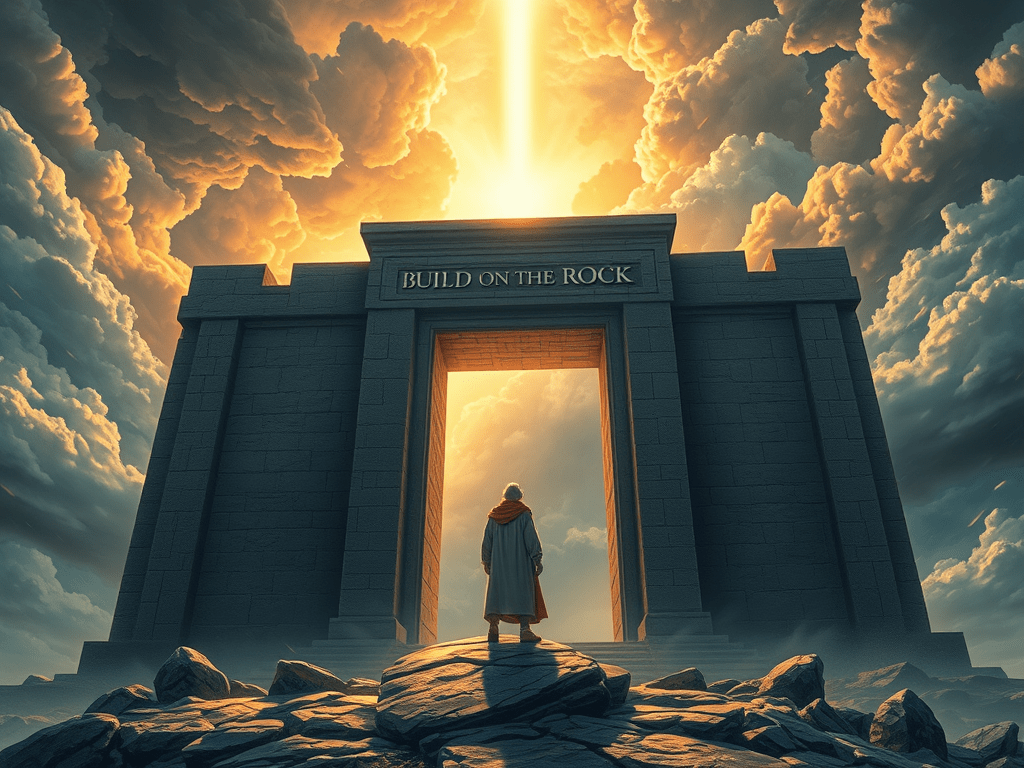
    a strong city, a sacred gate, and a house on solid rock.
    Together, they outline the path of every spiritual hero—from the prophets, to the saints, to ordinary men and women trying to follow God today.

    Let’s walk through the readings with Catholic wisdom, mythological insight, and psychological truth—so we can act on them, not just hear them.


    Isaiah: Open the Gates and Enter the Strong City

    Isaiah sees a vision of the soul as a strong city, built by God Himself:

    “We have a strong city… Open the gates! Let the upright nation come in… Trust in the Lord forever, for the Lord is the everlasting Rock.”

    The imagery is rich and precise:

    • The city is the human soul
    • The walls and ramparts are the virtues that protect us
    • The gates are the choices of the will

    Only those who trust in the Lord, who keep their minds “steadfast,” can enter.

    In mythic language, this moment is the hero approaching the threshold.
    Every great story has this scene:

    • Odysseus at the gates of the underworld
    • Aeneas at the temple doors
    • Frodo at the borders of Mordor
    • Christ at the entrance of the tomb

    But Scripture adds something deeper:
    The strength of the city is not your own willpower. God Himself is the foundation.
    The hero does not face chaos alone. The hero faces chaos with God.


    Psalm 118: The Gate of Holiness

    The Psalm continues the same theme:

    “Open to me the gates of holiness… This is the Lord’s own gate where the just may enter.”

    The pilgrim approaches the Temple and knocks. The question from inside is implied:
    Who may enter?

    The answer is not:

    • “I am strong.”
    • “I am important.”
    • “I have influence.”

    The answer is:
    “The Lord is my refuge.”

    Psychology says the same:
    When your core identity rests on anything unstable—success, emotions, reputation, strength—your inner world collapses when those things shift.
    But when identity rests on God, the soul stands firm.


    Jesus: Build Your House on the Rock

    In the Gospel, Jesus gives the image most people know:
    Two builders. Two foundations. Two futures.

    But He adds a detail that cuts straight to the heart:

    Both men hear His words. Only one acts.

    This is the decisive moment of the Hero’s Journey—when knowing is no longer enough.
    The hero must obey.
    The hero must choose.
    The hero must cross the threshold into action.

    Jesus says plainly:

    “Everyone who listens to these words of mine and acts on them will be like the wise man who built his house on rock.”

    Storms hit both houses.
    Faith does not guarantee ease.
    Faith guarantees endurance.


    The Psychology: Two Builders, Two Brains

    There’s a psychological layer here too.

    The house on rock

    represents a life governed by the higher faculties:

    • Reason
    • Conscience
    • Long-term vision
    • Stability
    • Sacrifice
    • Grace-supported will

    The house on sand

    represents a life governed by the lower systems:

    • Impulse
    • Emotion without discipline
    • Ego and appearance
    • Social pressure
    • Immediate pleasure

    Neuroscience confirms what Scripture teaches:
    When stress comes, the “lower” regions dominate unless the higher faculties are formed and anchored.

    Storms—suffering, fear, temptation, failure—expose the foundation of the soul.


    Mythic Parallels: Every Hero Faces the Storm

    Every ancient story knows this truth:

    • Gilgamesh meets the flood
    • Jonah meets the tempest
    • Odysseus meets the sea
    • Aeneas meets the burning city
    • Christ meets the Cross

    Heroes are not defined by the absence of storms, but by the strength of their foundation.

    Myths point to it.
    Psychology explains it.
    Catholic faith reveals it:
    The foundation is Christ Himself.


    Catholic Exegesis: The Rock Has a Name

    The Church Fathers are unanimous:

    • Christ is the Rock (1 Cor 10:4)
    • His teaching is the Rock
    • The Church is the Rock
    • Grace that strengthens the will is the Rock

    St. Augustine:
    “The house is faith; the foundation is Christ.”

    St. Gregory the Great:
    “To hear without acting is to build in the imagination.”

    St. Thomas Aquinas:
    “The foundation of the spiritual life is humility.”

    So the Rock is not self-help.
    The Rock is not moralism.
    The Rock is not positive thinking.

    The Rock is a Person.
    A relationship.
    A covenant.
    A surrender.


    How to Build on the Rock Today

    Here is the practical plan Jesus gives:

    1. Listen to His words

    Read Scripture.
    Study the faith.
    Let the Church teach you.

    2. Act on His words

    Do one concrete thing today:
    Forgive.
    Pray.
    Serve.
    Confess.
    Cut out a vice.
    Re-establish order.

    The hero’s gate is action.

    3. Trust God more than yourself

    Say:
    “Lord, I want Your will more than comfort.”

    4. Build habits that hold under pressure

    Virtue is spiritual architecture.
    The sacraments are reinforcement beams.
    Prayer is the daily maintenance.

    5. When the storm comes, choose to stand

    Do not fear the wind.
    Do not panic at the rain.
    Do not believe the lie that you are alone.

    The storm is not your enemy.
    The storm reveals your foundation.


    The Call: Enter the Gate. Stand on the Rock.

    Advent invites you to rebuild your life on Christ.

    Isaiah says: Enter the city.
    The Psalm says: Come through the gate.
    Jesus says: Stand on the Rock.

    The message is simple and strong:

    Your life has a structure.
    Your soul has a destiny.
    Your choices build a house that will either stand or fall.

    So today, choose to act.
    Choose to trust.
    Choose to build.
    Choose the Rock.

    And when the rains fall and the floods rise and the winds tear at everything—
    you will stand.
    And your endurance will give glory to God.

    Developed with assistance from ChatGPT-5

  • “Wake Up and Walk in the Light: Advent and the Great Human Awakening”

    “Wake Up and Walk in the Light: Advent and the Great Human Awakening”

    A 10–15 minute Advent reflection

    Isaiah 2:1-5; Psalm 121(122):1-2,4-5,6-9; Romans 13:11-14; Matthew 24:37-44

    Today is the First Sunday of Advent—the beginning of the Church’s year.
    And the very first word the Church gives us is: Wake up.

    Not “be cozy.”
    Not “ease into the holidays.”
    But Wake up.
    Be alert. Open your eyes.
    Something is coming.
    Someone is coming.

    And the way Scripture tells the story today, this awakening is not optional.
    It is the difference between remaining asleep in the old world—or stepping into the new creation God desires for us.


    1. Isaiah’s Mountain: The Call of the Hero at Dawn

    The prophet Isaiah begins with a vision of the “days to come.”
    He sees Mount Zion—the Temple mountain—lifted above all other mountains.
    Nations stream toward it.
    People without number ascend the hill saying:

    “Come, let us go up to the mountain of the Lord… that he may teach us his ways.”

    This is the biblical version of the call to adventure—the moment in every great myth when humans are summoned upward, summoned out of the ordinary world and toward a divine encounter.

    The mountain is a universal symbol in myth:

    • Mount Olympus for the Greeks
    • Mount Meru in Hindu cosmology
    • Sinai for Moses
    • Tabor for Christ

    The mountain always represents the highest meaning, the place where heaven and earth meet, where God reveals Himself, and where human beings are changed.

    Isaiah’s point is clear:
    Humanity’s future is not down in the valley of violence, distraction, and conflict.
    Our future is an ascent.
    A pilgrimage.
    A transformation.

    Psychologically, this ascent points to the integration of the self—the movement from fragmentation to unity, from instinct-driven living (the lower brain layers) toward a life governed by truth, conscience, and grace (the highest faculties).

    Isaiah describes the result of this ascent:

    “They shall beat their swords into ploughshares.”

    This is transformation—not by force, but by teaching, by truth, by hearing God.
    The weapons of self-destruction become the tools of cultivation.
    What once harmed now heals.

    This is what happens when a person climbs the mountain of the Lord.


    2. “I Rejoiced When I Heard Them Say”: The Joy of a Heart That Is Waking Up

    The psalm today echoes the upward movement:

    “I rejoiced when I heard them say: ‘Let us go to God’s house.’”

    This is the joy of someone who has heard the call.
    Someone whose feet are already on the path.
    Someone who has realized:
    My home is not here. My destiny is above.

    Psychologically, this is the movement from numbness to desire.
    From apathy to longing.
    From spiritual sleep to spiritual hunger.

    St. Augustine described it as the “weight of love” lifting the soul upward.

    Every Hero’s Journey begins—not with skill or strength—but with desire, the dawning awareness that “There must be more.”

    Advent awakens that desire.


    3. St. Paul: “Wake Up Now” — The Battle Between Night and Day

    Then St. Paul tells us plainly:

    “You know the time.
    The night is almost over.
    The day is at hand.
    Wake up now.”

    Paul speaks here like a drill sergeant of the soul.
    He knows we like comfort.
    We like the dark because our weaknesses hide there.
    But Paul says:

    “Give up the things done under cover of darkness…
    and put on the armor of light.”

    This is spiritual psychology at its sharpest.

    The “night” represents:

    • impulsivity
    • old habits
    • addictions
    • self-deception
    • sin we have learned to tolerate

    The “day” represents:

    • clarity
    • responsibility
    • moral courage
    • virtue
    • the renewing power of Jesus Christ

    Paul says:
    Do not wait until you feel ready. Light never begins with readiness.
    It begins with decision.

    Mythologically, this is the moment when the hero must leave home.
    Leave comfort.
    Leave childishness.
    The doorway to the adventure is dawn—and dawn always interrupts our sleep.


    4. Jesus in the Gospel: The Flood Comes to the Spiritually Asleep

    Now Christ speaks the hardest words of the day:

    “As in the days of Noah, so will it be at the coming of the Son of Man.”

    People were living as if nothing mattered:

    • eating
    • drinking
    • marrying
    • working

    None of these are evil.
    The problem is not the activities—it is the unconsciousness with which people lived.

    They were asleep inside their own lives.

    The Flood did not simply wash away bodies—it washed away illusions.
    It revealed who was awake and who was not.

    Then Jesus gives His teaching with startling urgency:

    “Stay awake…
    Stand ready…
    The Son of Man is coming at an hour you do not expect.”

    This is not meant to frighten us—it is meant to awaken us.

    Jesus is not warning about the end of the world;
    He is warning about the end of your illusions.
    The end of self-deception.
    The end of sleepwalking through life.

    In psychological terms, Jesus is calling us to conscious living—to a life where we no longer hide behind distraction, addiction, work, or noise.


    5. The Hero’s Journey of Advent

    Advent is the beginning of the Church’s New Year, but it is also the beginning of your own Hero’s Journey.

    The pattern is always the same:

    1. The Call — “Come, let us go up to the mountain of the Lord.”
    2. The Awakening — “I rejoiced when I heard them say…”
    3. The Separation — “The night is almost over… put on the armor of light.”
    4. The Testing — “Stay awake, for you do not know the hour…”
    5. The Transformation — Christ born in the soul, illuminating everything.
    6. The Return — A transformed life that brings peace and grace to others.

    Mythologies echo this pattern because they echo the deepest truth of the human spirit:
    We were made for ascent.
    We were made for God.


    6. A Call to Action: How to Begin Your Advent Awakening

    Here is the practical challenge of the Gospel:

    1. Identify where you are asleep.

    Where have you allowed routine, distraction, or sin to dull your conscience?
    What parts of your life run on autopilot?

    2. Begin one concrete act of awakening.

    • Set a real prayer time.
    • Go to Confession.
    • Fast from a comfort that keeps you numb.
    • Read Scripture daily.
    • Reconcile with someone.

    3. Put on the armor of light.

    Don’t wait to “feel holy.”
    Act first.
    The feelings follow.

    4. Live today as if the Lord is near—because He is.

    Advent is not pretend.
    It is training.
    It is rehearsal for the real coming of Christ—
    in death,
    in judgment,
    in the Eucharist,
    in grace,
    in the quiet call of conscience.

    5. Make this Advent your turning point.

    Advent is not about nostalgia.
    It is about awakening.

    Christ does not want to catch you off guard.
    He wants to find you alive.


    7. Conclusion: Walk in the Light of the Lord

    Isaiah ends his vision with a simple command:

    “O house of Jacob, come—
    let us walk in the light of the Lord.”

    This is the entire Gospel in one sentence.

    Walk.
    Move.
    Begin.
    Awaken.
    Step toward the mountain.
    Let the Lord teach you His ways.
    Let His light pierce your darkness.
    Let Christ become your armor.

    And when the Son of Man comes—today, tomorrow, or at the end of your life—may He find you wide awake, standing ready, rejoicing to enter the house of the Lord.

    Amen.

    Developed with assistance from ChatGPT-5