They are experiencing Christianity as joy and hope, having thus become lovers of Christ.

Category: Christian Purpose

  • A Call to Adventure: Finding Meaning Beyond Science

    In today’s world, it’s easy to get caught up in the quest for knowledge. Science explains how things work, but it doesn’t answer the deeper questions that stir our hearts: Why do we exist? What’s the purpose of life? These questions go beyond facts and data, and no matter how much we learn, they always seem to lead us back to one truth: there’s something more.

    Science can’t explain the deeper mysteries of the universe, nor can it help us understand what our lives truly mean. We may wonder if there’s a purpose to our existence or if we’re just drifting through an indifferent world. This is the call to adventure—the deeper yearning within us to explore what lies beyond the material world, to seek answers that resonate with our souls.

    Pope Paul VI once pointed out that our desire for spiritual fulfillment is a natural part of being human. We all feel the pull toward something greater than ourselves. The search for truth is a journey, a challenge, but one that ultimately leads to growth and transformation. For many, that truth is found in Jesus Christ, whose teachings of love, forgiveness, and redemption offer answers to our deepest questions.

    The journey to spiritual fulfillment isn’t easy, but like any great adventure, it’s about stepping out of our comfort zones and embracing the unknown. It’s not just about seeking answers—it’s about finding the right answer that brings purpose, peace, and connection to our lives.

    If you’ve ever wondered if there’s more to life, this is your invitation to begin the journey. The answers are out there, waiting to be discovered. Will you take the first step?

    Written in collaboration with ChatGPT (OpenAI, 2025).

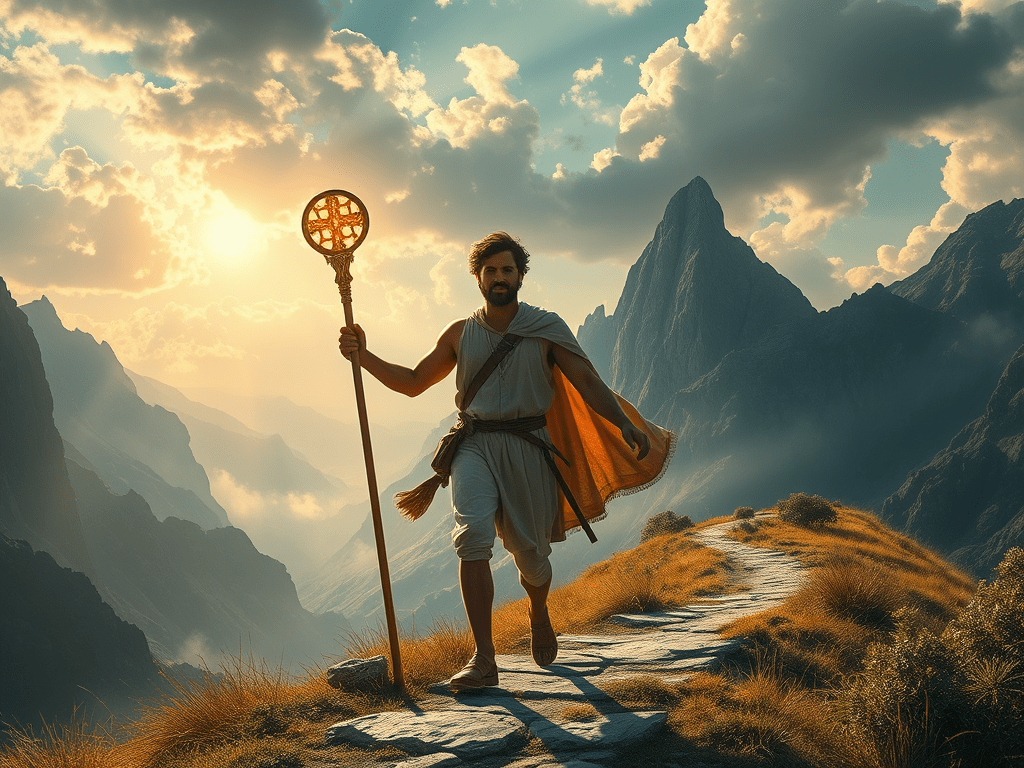
  • The Christian’s Heroic Journey: Ancient Myths and the Call to Faith

    The Christian’s Heroic Journey: Ancient Myths and the Call to Faith

    The Forgotten Heroic Role of Every Christian: Reclaiming the Lost Heroism of Faith

    Throughout history, myths and ancient stories have conveyed profound spiritual truths, shaping civilizations and guiding individuals through the complexities of life. However, in modern times, these narratives have been largely forgotten or dismissed as mere fiction. Within the Christian tradition, this loss has led to a misunderstanding of the faith, where holiness is often seen as passive or reserved for a select few saints. In reality, the Christian life itself is meant to be a heroic journey, one that every believer is called to undertake. The saints were not meant to be distant, unattainable figures, but models of the struggle that every Christian must engage in.

    This misunderstanding has resulted in a faith that is often reduced to adherence to doctrine and ritual, rather than a transformative path of meaning and purpose. The Catholic faith is not simply a system of moral rules, but a call to spiritual adventure, deeply embedded in the human experience and reflected in the structure of ancient myths. To reclaim this understanding, we must look to the archetypal patterns found in these stories, patterns that point us to the true heroic journey—the journey toward God.

    The Cost of Staying Passive: Apathy: The Slow Death of the Soul

    Many Christians feel disconnected from God, not because He is distant, but because they have settled for a passive faith. Ask yourself: Are you truly satisfied with where you are? A faith that lacks challenge quickly becomes stagnant, leading to frustration and even despair. Every great story—both in Scripture and in life—shows that growth only happens through struggle. The cost of remaining passive is not peace, but spiritual decay.

    The Rewards of the Heroic Path: Faith as the Ultimate Adventure

    Faith is not meant to be mere obligation—it is an adventure. What if the life you dream of is waiting for you on the other side of this journey? The saints were not born different from us; they were ordinary people who decided to engage fully with their faith. By stepping into the unknown and trusting God, they found a fulfillment that nothing else could provide. Transformation is not just about reaching heaven—it is about living fully now.

    The Illusion of Comfort: False Security: Trading Purpose for Passivity

    Many avoid effort because they believe they are choosing comfort. But are you really comfortable? Or are you just avoiding difficulty while quietly suffering from lack of purpose? The world offers distractions, but these distractions cannot replace true meaning. Choosing the path of faith may seem harder at first, but it brings a real and lasting fulfillment that worldly comfort can never provide.

    Myths, Meaning, and the Spiritual Path: Ancient Stories as Roadmaps to God

    As Jordan Peterson explains in Maps of Meaning, myths serve as psychological and spiritual maps that help individuals navigate the chaos of existence. These narratives depict the struggle between order and chaos, good and evil, suffering and redemption. In many ways, these themes mirror the Christian story. The hero of myth is often one who steps out of comfort and into the unknown, faces trials, undergoes transformation, and returns with newfound wisdom. This journey is reflected in the life of Christ, who enters into human suffering, conquers sin and death, and calls His followers to do the same.

    Unlike secular myths that leave the hero’s victory as an open-ended possibility, the Christian story presents the final and true archetype in Christ. He is the fulfillment of all previous heroic patterns, and His life serves as the ultimate guide for believers. Yet, His journey is not merely to be admired from a distance—it is to be lived out by every Christian. Baptism initiates this journey, and the sacramental life provides the structure and means for transformation. Each believer is called to carry the cross, to descend into suffering and darkness, and to emerge renewed in grace, ultimately becoming co-heirs with Christ in the Kingdom.

    The Call to Something Greater: Hearing the Call: Will You Answer?

    God does not call the qualified—He qualifies the called. Throughout Scripture, we see how He chose reluctant, flawed individuals and led them to greatness. Consider Moses, who doubted his ability, or Peter, who denied Christ—yet both became leaders of the faith. What if God is calling you now, but you are too afraid or too distracted to hear? Every hero must first answer the call, and ignoring it does not make it disappear.

    The Risk of Missing Out: The Regret of an Unlived Faith

    If you refuse the call, life will still happen to you—but you will not be shaping it. Many fear failure, but the real danger is regret. The worst thing is not making mistakes; the worst thing is looking back and realizing you never truly lived out your faith. If you do not step forward, you risk never experiencing the depth and richness that a life fully committed to God can bring.

    The Institutional Church and Its Role in Preserving the Heroic Path: The Church: A Fortress or a Battlefield?

    The Catholic Church, in its role as the guardian of truth, has historically been cautious of movements that threaten to distort or dilute doctrine. While this caution is necessary, it has also contributed to a perception of faith as static rather than dynamic. The institutional structure of the Church should not be seen as an obstacle to personal transformation but as the very framework within which the heroic journey unfolds. Tradition, doctrine, and sacramental life do not stifle spiritual adventure; they provide the path and safeguards necessary for true growth.

    The challenge for modern Catholics is to reclaim this heroic calling within the proper structure of the faith. The saints were not passive figures who merely followed rules; they were spiritual warriors who embraced the struggle and emerged transformed. Every Christian is meant to do the same. The hero’s journey is not an optional path—it is the essence of Christian life. To live the faith fully is to embrace the adventure of holiness, to fight against sin and despair, and to participate in the divine narrative that leads to ultimate redemption.

    In reclaiming this understanding, the faithful will not only deepen their own spiritual lives but also revitalize the Church itself. The world does not need passive adherents to a religious system—it needs heroes willing to live out the truth, fully engaged in the battle for meaning, virtue, and ultimate salvation.

    Written in collaboration with ChatGPT (OpenAI, 2025).
  • Microspheres Key to Church Renewal

    I am dedicated to helping to promote the Kingdom of God in my parish and in my diocese. My goal is to find a way to promote the faith such that by 2030, the Archdiocese would be 4 times its current size, and have 1 priest for every 100 men.

    Although my view really doesn’t  matter, I see nothing wrong with the Teaching of the Church, the Hierarchy, or the Magesterium. As far as I can see, the shortcoming is in the gap between the priests and the lay people.

    Although a parish may be the size of several brigades, it is as useless as a mob without some structure, network, and relationships.

    Unfortunately, most of the time, it seems that the only thing that separates Catholics from the rest of the world is that 1 hour on Sunday when they actually separate themselves from the rest of the world.

    If you know a tree by the fruit it produces, then you would have to say that most Catholics are unaware of the treasure that God is. They have been given a gold mine, but they act like it’s just yellow plastic.

    These days most people prefer interacting with media, rather than with other human beings, often even in their own families.

    I believe that the “Sense of Community” one has with his church or parish is directly related to the number of microsphere relationships (average of 30 minutes per week per person) he has within that church.

    Would it take a network of 5, 10, or even 20 microsphere relationships experienced as shared lives, shared service, and shared support to create that sense of community? This would create the kind of environment where Catholics could find God and respond to their vocations.

    If we could develop within the Church support groups for everyone, many of the problems that the Church now experiences would disappear.

    It was the communities of brotherhoods that allowed Civilization to survive the invasions of Europe that occurred 1000 years ago. Something of that kind will be required to survive the current assault on our faith.

    I do not believe it is necessarily the Church’s responsibility or even within their capability to bring about this change.

    Tom Neugebauer

    Seized by Christ

  • From Redemptor Hominis to a Synod on Subsidiarity

    In Redemptor Hominis, one of the first encyclicals of Pope John Paul VI, he made reference to the fact that every man is the way of the Church. This statement is to imply that Christ has entrusted to the Church the salvation of every man, so it is the duty of the Church to reach out to every man, and show them the way to Christ.

    In Gratissimus Sane, Pope John Paul II makes reference to the fact that every family is also the way of the Church.

    In addition, he said that the Family is the way that the way that the Church walks with every individual, because every person starts out as a member of a family that establishes their character, and makes them a unique person.

    However, in the last 50 years, the family has disintegrated, with more than 50 percent of marriages ending in divorce, and many children growing up without fathers. This actually creates more people with additional needs, and poorly formed character.

    100 years ago, before mobility was so common, more people lived with extended family, that provided the moral and spiritual support of an individual and of a family. It could to some extent pick up for broken family situations, but that is generally no longer the case.

    Even nuclear families are much smaller, so that is so much less the local support and council available.

    And it was typical for a family to have within it, an uncle or child or cousin that was consecrated to the priesthood. Or sisters or aunts that were consecrated. One of the most devastating effects of the reduction of the priesthood was the loss of their  moral and spiritual guidance of the family.

    With one priest for 4000 parishioners, substantially reduced family and reduced extended family, how can the Church realistically expect to walk with every family, much less every individual?

    Many years ago, I compared the organization of the military with the Catholic Church.

    In the military hierarchy, every group of 2 or 3 has a higher level to go to for support.

    Military                       # of Individuals            Catholic Church


    Region / Theater         1,000,000 +                       Diocese

    Army Group                    250,000                         (Deanery Group)

    Army                                   60,000 – 100,000        Deanery

    Corps                                   30,000 –   80,000        (Sub Deanery)

    Division                              10,000 –    20,000       (Parish Group)

    Brigade                                 2,000 –      5,000        Parish

    Batillion                                   300 –      1,000        (Priest Group)

    Company                                   70 –         250         (Deacon Group)

    Troop                                          25 –          60          (Small Community)

    Patrol                                            8 –          12          (Fire Patrol)

    Fire Team                                     4                          (Fire Team)

    Fire & Maneuver                         2                          (Prayer Partner)

    Soldier                                           1                          Parishioner

    I believe that the military has through many thousands of years developed the optimal efficient hierarchy structure, to provide support from the top, and successful execution from the bottom.

    For sake of reference, I added in parenthesis suggested groups where groups do not, or do not seem to exist in the Church.

    I am not suggesting that we imitate the Military, but I would like to suggest that we could do better than we are now.

    I have heard, for example, a deacon mention that there is discussion of housing priests in parish groups or subdeaneries so that they can have appropriate support and fellowship.

    I am focused on the lower levels from the deacon group and down. That is why I am working to assemble a “catechesis” related to providing support to the individual, the family, and to small communities. I’m not trying to make up anything. I am going to try to gather from the teaching from the Church. I will also make reference to articles that support it, that appear all the time in the media.

    On the other end, I am trying to inspire a Synod of Bishops to discuss Subsidiarity in general, and the sub-parish level in specific. Synods on Youth and Family  have established ongoing research of those topics. It would be worthwhile to define a starting point for developing a catechesis of Subsidiarity.

    I believe that it could, for example, lead to new projects for religious orders.

    I believe the current shape of the Church has everything to do with the resources available to work with. One can consider how many more resources would be available if the Church figures out how to walk with every man.

    Sometimes I think about the fact that if there are 7 Billion people in the world, and 1.16 B Catholics, then there are 5 persons in the world for each Catholic. That approaches a manageable group size, comparable to Christ and the 12 apostles. If only we knew how to carry that out, then we would really be able to have the Church walking with every man, in Love.

    Regards
    Tom Neugebauer
    Seized by Christ