They are experiencing Christianity as joy and hope, having thus become lovers of Christ.

Category: Scripture & Interpretation

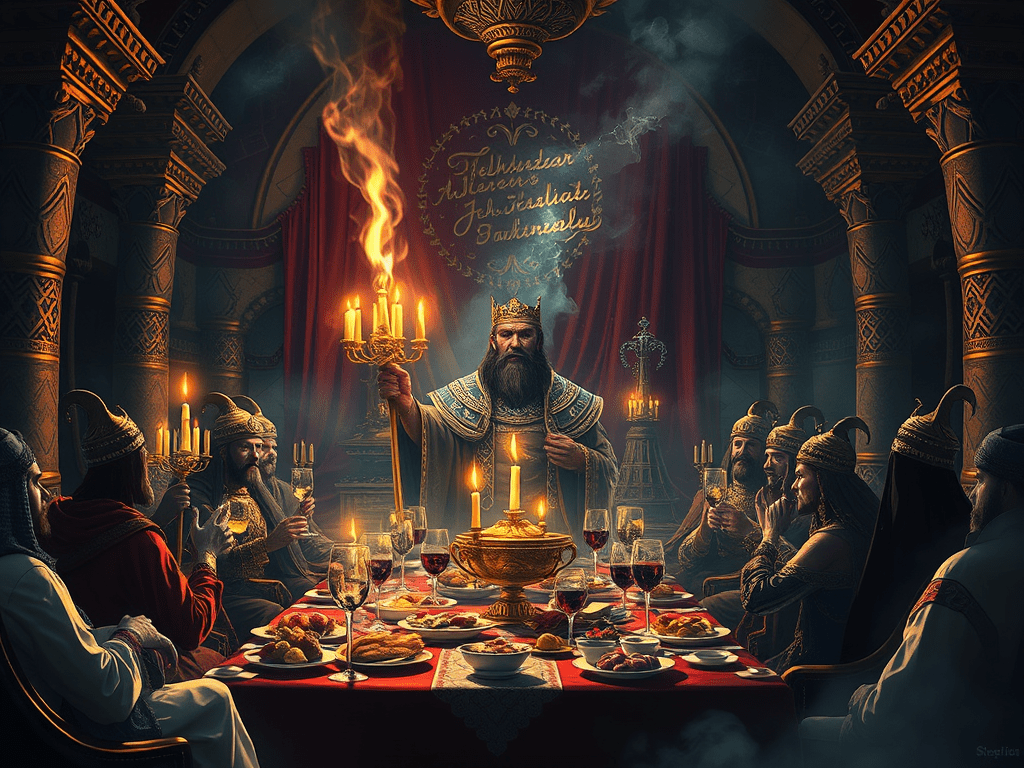
  • The Fall of the Tyrant: The Timeless Myth of Belshazzar’s Feast

    The Fall of the Tyrant: The Timeless Myth of Belshazzar’s Feast

    The Timeless Myth of Belshazzar’s Feast

    In the Book of Daniel, chapter 5, we find one of the most dramatic stories in ancient scripture: Belshazzar’s Feast. A lavish banquet turns into a night of terror when a disembodied hand appears and writes mysterious words on the wall. The kingdom falls that very night. But beyond the historical account, this is a profound mythological tale about the inevitable collapse of any power built on arrogance, intoxication, and sacrilege.

    1. Hubris and Sacrilege: The Banquet as Ritual Defiance

    Babylon, in mythic terms, stands as the ultimate “anti-Temple”—a symbol of worldly power that rejects divine order. The banquet isn’t mere excess; it’s a deliberate act of defiance. King Belshazzar commands the sacred vessels looted from the Jerusalem Temple to be brought out. His guests drink wine from them while praising their gods of gold, silver, bronze, iron, wood, and stone.

    This profanation is the core sacrilege: these vessels once held the divine presence. Using them to toast idols is hubris incarnate—the mortal claiming superiority over the sacred. It’s the height of arrogance, performed at the peak of empire.

    2. The Omen: The Hand That Shatters Illusion

    Suddenly, a hand appears, writing on the wall—illuminated, ironically, by the light of the stolen Temple lampstand. The sacred light exposes the profane doom.

    Belshazzar’s reaction is visceral: his face pales, his limbs go slack, his knees knock together. This physical paralysis mirrors his moral collapse—the moment the tyrant’s illusion of invincible power crumbles before a higher force.

    3. The Hero-Interpreter: Daniel’s Uncompromising Stand

    The wise men fail, but Daniel—the exile who refuses to defile himself—is summoned. He deciphers the writing: “Mene, Mene, Tekel, Parsin.”

    Before delivering the verdict, Daniel refuses the king’s rewards: purple robes, gold chains, high office. “Keep your gifts,” he says. His authority comes not from Babylon’s system but from allegiance to the divine. He is untouchable, the true hero bridging chaos and cosmic truth.

    4. The Cosmic Verdict: Weighed on the Scales of Justice

    The words form a threefold judgment:

    • Mene: God has numbered your days; your reign is finite and ended.
    • Tekel: You have been weighed on the scales and found wanting—your character, deeds, and rule insufficient.
    • Parsin: Your kingdom is divided and given to the Medes and Persians.

    That night, Belshazzar is slain, and Babylon falls. The scales of cosmic justice tip irrevocably.

    Echoes in the Cycle of History

    This myth resonates with the ancient observation of civilizational cycles: “Hard times create strong men, strong men create good times, good times create weak men, and weak men create hard times.”

    Belshazzar’s story zooms in on the dangerous transition—good times breeding moral weakness, arrogance, and forgetfulness of limits, inviting sudden collapse. It’s a warning echoed in Greek tragedies (hubris-nemesis), Roman histories, and modern reflections on empires.

    In an age where powers rise and boast at their zenith, the writing on the wall remains a timeless reminder: all human empires are weighed, and those built on sacrilege and pride will be found wanting.

    Content developed with assistance of Gemini AI.

    Blog edited with assistance of Grok AI

  • The Prefrontal Battle: How Your Brain is Wired for Heroism (Daniel 1 & Mark 12)

    The Prefrontal Battle: How Your Brain is Wired for Heroism (Daniel 1 & Mark 12)

    What if the greatest moral and spiritual battles we face aren’t huge, public crises, but small, private decisions made in a quiet moment? We often look for epic, cinematic faith, but the truth is that spiritual transformation is profoundly neurobiological. It happens inside the three pounds of tissue between your ears.

    Ancient scripture isn’t just about history or ritual; it provides a stunningly accurate blueprint for how our minds function—and malfunction. We see, time and again, moments where two distinct forces within us clash: the primal urge for comfort and the higher calling toward long-term destiny.

    These moments are not unique to ancient prophets or martyrs. They are the Prefrontal Battle that you fight every day. By exploring the quiet discipline of Daniel and the radical sacrifice of the poor widow, we can see that building a heroic life is literally a matter of rewiring your brain through small, consistent acts of will.

    I. The Neuroscience of Discipline

    Our minds are governed by a powerful dual system. Understanding it is the key to spiritual freedom.

    A. The Two Brain Systems

    1. The Limbic System (The Survivalist): This is the brain’s ancient core. It is preoccupied with safety, comfort, instant gratification, and immediate risk assessment. Its mantra is: Survival, Right Now. It is brilliant at keeping you alive, but terrible at achieving your highest potential, as it fears any change, discipline, or risk
    2. The Prefrontal Cortex (PFC) (The Hero): This is the most recently evolved part of the brain, located right behind your forehead. It is the seat of willpower, moral reasoning, long-term planning, and impulse control. The PFC is what allows you to choose a future reward over immediate comfort. Its function is to say “No” to the limbic system’s demands when they conflict with your highest values.

    B. The Case Study: Daniel’s Quiet Victory

    In the Book of Daniel, we encounter a young man exiled to Babylon—the ultimate environment designed for comfort, luxury, and spiritual assimilation. The king provided the Hebrew youth with a daily ration of rich food and wine from his own table. This was not a punishment; it was a profound privilege, a fast track to approval, safety, and integration into the highest social class.

    To the Limbic System (The Survivalist), this was a dream scenario: high-calorie food, social acceptance, and guaranteed protection. The impulse was clear: take the easy path.

    But Daniel’s response was a masterclass in Prefrontal Cortex control:

    Daniel resolved not to defile himself with the king’s food and wine (Daniel 1:8).

    This was a quiet but firm decision of the will. His choice was not about the quality of the food; it was about integrity—choosing his long-term covenant and identity over immediate comfort. He used his PFC to override the powerful, instinctive demands for ease and assimilation.

    He was not asked to fight a dragon or cross a sea; he was asked to choose vegetables and water over the king’s bounty. The mythological lesson here is that great destinies are formed through small, repeatable acts of discipline.

    C. The Scientific Principle: Holiness is Habit

    The story reveals the direct reward of this PFC control: After ten days, Daniel and his companions looked “healthier and better nourished” than those who ate the king’s food (Daniel 1:15).

    This result is a spiritual reality, but it is also a powerful metaphor for Neuroplasticity. Every time Daniel chose his higher value (his faith) over his primal urge (rich food), he reinforced a new neural pathway. Every decision strengthened his PFC control over his Limbic System.

    • Holiness is Habit: Spiritual growth is not about a one-time heroic feat, but about consistent, small decisions that literally rewire the brain. You strengthen what you repeatedly use. Choosing integrity over comfort, even in the smallest things, is the process of building the neurobiological architecture required for heroism.

    II. The Neuroscience of Sacrifice

    Now, we move from the discipline of refusal to the ultimate test of the PFC: Sacrifice.

    A. The Brain Hates Sacrifice

    The Limbic System views sacrifice as illogical and terrifying. Its primary directive is to hoard resources and minimize risk. The brain views giving away resources—especially those necessary for survival—as an existential threat. This fear is a powerful inhibitor of true faith and generosity.

    B. The Case Study: The Widow’s Radical Override

    Jesus was watching the wealthy drop large, impressive amounts of money into the temple treasury. These were acts of generosity, but they were measured and safe—they gave from their “abundance” (Mark 12:41-44). Their Limbic System remained perfectly comfortable.

    Then He saw her: a poor widow who put in only two small copper coins.

    Jesus declared that this smallest gift was the greatest one. Why? Because:

    “She, from her poverty, has put in all she had to live on.”

    This act is the ultimate PFC override. She overcame her most fundamental, primal survival instinct—the fear of hunger, homelessness, and death—and entrusted her future to God. She chose Trust (PFC) over Self-Preservation (Limbic System). She demonstrated that faith and love cannot be lived from a place of certainty.

    III. Conclusion: The Logic of Love

    The Prefrontal Battle is not an isolated spiritual struggle; it is the fundamental process by which we align ourselves with the highest reality.

    The highest principle that justifies the PFC’s battle is Love.

    • For Daniel, the PFC choice was motivated by Love for God’s Covenant (identity) over the love of comfort.
    • For the Widow, the PFC choice was motivated by radical Love and Trust in God over the love of self-preservation.

    The Limbic System calculates safety; it fears loss, and it hoards resources. But the highest function of human consciousness, driven by the PFC, is to pursue a value—a higher love—that transcends immediate survival.

    This is why ancient scripture, confirmed by modern neurobiology, teaches us that the path to transformation is paved with deliberate, courageous choices:

    • You cannot live a life of true faith or love from a place of safety and certainty.
    • Every time you choose a higher moral truth over your brain’s instinctual demand for comfort, you are literally rewiring your consciousness.

    The heroic journey starts not with a grand announcement, but with a quiet, firm decision of the will.

    The Question is: What is your PFC fighting for today?

    Ask yourself: What small discipline is God asking of you today? Is it refusing the “king’s rich food” (a destructive habit or easy lie), or is it surrendering your last “two coins” (a fear, a calculation, or a piece of control)? The power to choose is in your PFC, and the logic of that choice is always love.

    Developed with assistance from Gemini AI

  • “Wake Up and Walk in the Light: Advent and the Great Human Awakening”

    “Wake Up and Walk in the Light: Advent and the Great Human Awakening”

    A 10–15 minute Advent reflection

    Isaiah 2:1-5; Psalm 121(122):1-2,4-5,6-9; Romans 13:11-14; Matthew 24:37-44

    Today is the First Sunday of Advent—the beginning of the Church’s year.
    And the very first word the Church gives us is: Wake up.

    Not “be cozy.”
    Not “ease into the holidays.”
    But Wake up.
    Be alert. Open your eyes.
    Something is coming.
    Someone is coming.

    And the way Scripture tells the story today, this awakening is not optional.
    It is the difference between remaining asleep in the old world—or stepping into the new creation God desires for us.


    1. Isaiah’s Mountain: The Call of the Hero at Dawn

    The prophet Isaiah begins with a vision of the “days to come.”
    He sees Mount Zion—the Temple mountain—lifted above all other mountains.
    Nations stream toward it.
    People without number ascend the hill saying:

    “Come, let us go up to the mountain of the Lord… that he may teach us his ways.”

    This is the biblical version of the call to adventure—the moment in every great myth when humans are summoned upward, summoned out of the ordinary world and toward a divine encounter.

    The mountain is a universal symbol in myth:

    • Mount Olympus for the Greeks
    • Mount Meru in Hindu cosmology
    • Sinai for Moses
    • Tabor for Christ

    The mountain always represents the highest meaning, the place where heaven and earth meet, where God reveals Himself, and where human beings are changed.

    Isaiah’s point is clear:
    Humanity’s future is not down in the valley of violence, distraction, and conflict.
    Our future is an ascent.
    A pilgrimage.
    A transformation.

    Psychologically, this ascent points to the integration of the self—the movement from fragmentation to unity, from instinct-driven living (the lower brain layers) toward a life governed by truth, conscience, and grace (the highest faculties).

    Isaiah describes the result of this ascent:

    “They shall beat their swords into ploughshares.”

    This is transformation—not by force, but by teaching, by truth, by hearing God.
    The weapons of self-destruction become the tools of cultivation.
    What once harmed now heals.

    This is what happens when a person climbs the mountain of the Lord.


    2. “I Rejoiced When I Heard Them Say”: The Joy of a Heart That Is Waking Up

    The psalm today echoes the upward movement:

    “I rejoiced when I heard them say: ‘Let us go to God’s house.’”

    This is the joy of someone who has heard the call.
    Someone whose feet are already on the path.
    Someone who has realized:
    My home is not here. My destiny is above.

    Psychologically, this is the movement from numbness to desire.
    From apathy to longing.
    From spiritual sleep to spiritual hunger.

    St. Augustine described it as the “weight of love” lifting the soul upward.

    Every Hero’s Journey begins—not with skill or strength—but with desire, the dawning awareness that “There must be more.”

    Advent awakens that desire.


    3. St. Paul: “Wake Up Now” — The Battle Between Night and Day

    Then St. Paul tells us plainly:

    “You know the time.
    The night is almost over.
    The day is at hand.
    Wake up now.”

    Paul speaks here like a drill sergeant of the soul.
    He knows we like comfort.
    We like the dark because our weaknesses hide there.
    But Paul says:

    “Give up the things done under cover of darkness…
    and put on the armor of light.”

    This is spiritual psychology at its sharpest.

    The “night” represents:

    • impulsivity
    • old habits
    • addictions
    • self-deception
    • sin we have learned to tolerate

    The “day” represents:

    • clarity
    • responsibility
    • moral courage
    • virtue
    • the renewing power of Jesus Christ

    Paul says:
    Do not wait until you feel ready. Light never begins with readiness.
    It begins with decision.

    Mythologically, this is the moment when the hero must leave home.
    Leave comfort.
    Leave childishness.
    The doorway to the adventure is dawn—and dawn always interrupts our sleep.


    4. Jesus in the Gospel: The Flood Comes to the Spiritually Asleep

    Now Christ speaks the hardest words of the day:

    “As in the days of Noah, so will it be at the coming of the Son of Man.”

    People were living as if nothing mattered:

    • eating
    • drinking
    • marrying
    • working

    None of these are evil.
    The problem is not the activities—it is the unconsciousness with which people lived.

    They were asleep inside their own lives.

    The Flood did not simply wash away bodies—it washed away illusions.
    It revealed who was awake and who was not.

    Then Jesus gives His teaching with startling urgency:

    “Stay awake…
    Stand ready…
    The Son of Man is coming at an hour you do not expect.”

    This is not meant to frighten us—it is meant to awaken us.

    Jesus is not warning about the end of the world;
    He is warning about the end of your illusions.
    The end of self-deception.
    The end of sleepwalking through life.

    In psychological terms, Jesus is calling us to conscious living—to a life where we no longer hide behind distraction, addiction, work, or noise.


    5. The Hero’s Journey of Advent

    Advent is the beginning of the Church’s New Year, but it is also the beginning of your own Hero’s Journey.

    The pattern is always the same:

    1. The Call — “Come, let us go up to the mountain of the Lord.”
    2. The Awakening — “I rejoiced when I heard them say…”
    3. The Separation — “The night is almost over… put on the armor of light.”
    4. The Testing — “Stay awake, for you do not know the hour…”
    5. The Transformation — Christ born in the soul, illuminating everything.
    6. The Return — A transformed life that brings peace and grace to others.

    Mythologies echo this pattern because they echo the deepest truth of the human spirit:
    We were made for ascent.
    We were made for God.


    6. A Call to Action: How to Begin Your Advent Awakening

    Here is the practical challenge of the Gospel:

    1. Identify where you are asleep.

    Where have you allowed routine, distraction, or sin to dull your conscience?
    What parts of your life run on autopilot?

    2. Begin one concrete act of awakening.

    • Set a real prayer time.
    • Go to Confession.
    • Fast from a comfort that keeps you numb.
    • Read Scripture daily.
    • Reconcile with someone.

    3. Put on the armor of light.

    Don’t wait to “feel holy.”
    Act first.
    The feelings follow.

    4. Live today as if the Lord is near—because He is.

    Advent is not pretend.
    It is training.
    It is rehearsal for the real coming of Christ—
    in death,
    in judgment,
    in the Eucharist,
    in grace,
    in the quiet call of conscience.

    5. Make this Advent your turning point.

    Advent is not about nostalgia.
    It is about awakening.

    Christ does not want to catch you off guard.
    He wants to find you alive.


    7. Conclusion: Walk in the Light of the Lord

    Isaiah ends his vision with a simple command:

    “O house of Jacob, come—
    let us walk in the light of the Lord.”

    This is the entire Gospel in one sentence.

    Walk.
    Move.
    Begin.
    Awaken.
    Step toward the mountain.
    Let the Lord teach you His ways.
    Let His light pierce your darkness.
    Let Christ become your armor.

    And when the Son of Man comes—today, tomorrow, or at the end of your life—may He find you wide awake, standing ready, rejoicing to enter the house of the Lord.

    Amen.

    Developed with assistance from ChatGPT-5
  • The Stone That Became a Mountain

    The Stone That Became a Mountain

    A Reflection for Tuesday, November 25, 2025 Based on Daniel 2:31-45; Daniel 3:57-61; and Luke 21:5-11

    (Originally delivered as a 12-minute talk – now expanded for anyone who wants to sit with it longer)

    I’ve never met King Nebuchadnezzar, but some nights I wake up in a cold sweat feeling exactly like him.

    You know the dream: a dazzling statue rises in front of you—head of gold, chest of silver, belly of bronze, legs of iron, and feet made of iron mixed with crumbling clay. It is magnificent, terrifying, and (you are secretly proud) it looks a lot like the empire you’ve spent your whole life building. Then, out of nowhere, a stone “untouched by human hand” rockets across the void, smashes the feet, and the entire thing explodes into powder. The wind scatters the dust, and the stone keeps growing until it becomes a mountain that fills the whole earth.

    Daniel, barely more than a teenager and a foreign prisoner, looks the most powerful man on the planet in the eye and says: “That stone is God’s Kingdom. Everything you trust will be ground to chaff. Only the Kingdom will last forever.”

    Two and a half millennia later, that dream still haunts us because it is no longer just about Babylon. It is about the statues we keep erecting inside our own skulls.

    Your Brain Is the Statue

    Neuroscience has accidentally given us one of the best commentaries on Daniel 2 ever written.

    • The golden head = the prefrontal cortex: language, long-term planning, morality, the part of you that wants to build something glorious and eternal.
    • The silver arms and chest = the limbic system: love, belonging, tribal identity, emotion.
    • The bronze belly = the older reward circuits: pleasure, ambition, appetite, status.
    • The iron legs = the brainstem and motor strips: raw survival, dominance, fight-or-flight.
    • The feet of iron and clay = the fragile, perpetually uneasy handshake between our ancient reptile brain and our fragile modern consciousness. Strong enough to run a civilization, brittle enough to shatter the first time life hits it wrong.

    Every war, every addiction, every mid-life crisis, every doom-scrolling spiral begins when the lower floors start dictating terms to the upper ones.

    The Universal Story

    Joseph Campbell spent his life showing that every culture tells the same story:

    Ordinary world → Call to adventure → Refusal → Mentor appears → Crossing the threshold → Ordeal and death → Seizing the treasure → Return to give it away.

    Translate the characters:

    Daniel is the mentor who will not bow.

    Jesus is the Stone cut without hands—the true Hero who descends into the realm of death and rises again.

    And you and I? We are the ones being summoned out of the collapsing statue into the growing mountain.

    When the Temple Comes Down

    In today’s Gospel people are gawking at the Jerusalem Temple—literally the most impressive religious building the ancient world had ever seen. Jesus looks at them and says, in effect, “Enjoy the view while it lasts. Not one stone will be left on another.”

    He is not being cruel. He is being honest. Every human temple, every human empire, every human self built only with human hands will one day stand on feet of clay.

    But notice what he says next: “When you hear of wars and insurrections, do not be terrified… Nation will rise against nation… There will be great earthquakes…” These are not the end. They are the birth pangs.

    In mythology, the false world has to shatter before the real story can begin.

    In psychology, the ego has to crack open before genuine integration can happen.

    In salvation history, the Stone has to strike.

    The Catholic Reading in One Sentence

    The Stone is Christ.

    The Mountain is the Church, born from the rock struck on Calvary and from the side of Christ on the Cross.

    And the dream is being fulfilled right now, every time a human soul lets the Kingdom smash its idols and fill its emptiness.

    So What Do We Actually Do?

    Four concrete, life-changing steps you can start this week:

    1. Name Your Statue
      Tonight, before you go to bed, ask: What is the gold-headed thing I trust more than God? Career? Reputation? Political ideology? My phone? My body? My children’s success? Write it down. That’s your personal Nebuchadnezzar dream.
    2. Let the Stone Strike
      Take that piece of paper (or just the knowledge of it) to confession, to adoration, to the foot of the crucifix. Ask Jesus to touch the feet of clay. It will probably feel like everything is falling apart. Good. That’s the sound of the Kingdom arriving.
    3. One Line, Ten Minutes, Every Morning
      Before you open any app, sit in silence and let one phrase from today’s readings strike you and grow:
      “A stone untouched by human hand…”
      Repeat it slowly, like a breath prayer. Let it smash the noisy empires in your mind. Ten minutes. That’s all. But do it daily and watch what kind of mountain starts growing inside you.
    4. Live the Return
      The hero never keeps the elixir for himself. Bring the peace you find in that silence to your family, your cubicle, your parish council, the grocery checkout line. The world is starving for people who have let the Stone win.

    The Dream Is Still True

    We are living in the age of the feet of clay.

    Globally: superpowers and tech empires that look invincible but are already cracking.

    Personally: hearts that are part iron, part mud, strong enough to function, brittle enough to break.

    But the Gospel acclamation today is shouting at us across two thousand years:

    “Stand erect, hold your heads high, because your liberation is near at hand!”

    The statue is already trembling.

    The Stone has already left the mountain.

    The only question left is whether we will cling to the collapsing colossus or open our hands and let the Kingdom break us open—so that, through us, it can fill the whole earth.

    Come, Lord Jesus.

    Strike the feet.

    Grow the mountain.

    Make Your home in us.

    And then send us back out to a world that desperately needs living stones.

    Amen.

    Feel free to share this post, print it, read it aloud to your family, or just sit with it in the quiet. The dream is still coming true—and you’re in it.

  • Is Hell Still in the Bible?

    Understanding Modern Catholic Translations and Why It Matters

    Q: Why doesn’t the word “Hell” appear in modern Catholic Bibles like the NABRE?

    You’re not imagining it. In the New American Bible Revised Edition (NABRE), the word “Hell” rarely — if ever — appears. This has caused confusion among faithful Catholics who are used to older translations like the Douay-Rheims or hearing homilies about Hell as a real place of punishment.

    So what changed?

    It’s not the doctrine — it’s the translation. Scholars decided to preserve the original words used in the Bible:

    Original TermLanguageMeaning
    SheolHebrewThe grave / abode of the dead (neutral)
    HadesGreekThe Greek underworld (similar to Sheol)
    GehennaGreekA place of fiery judgment — used by Jesus

    These words are now translated more literally instead of using “Hell” as a catch-all. But that doesn’t mean the Church denies the existence of Hell.


    Q: So is there still a Hell?

    Yes. The Catholic Church absolutely affirms Hell as:

    “The state of definitive self-exclusion from communion with God and the blessed.”
    Catechism of the Catholic Church, §1033

    It is not just a metaphor or ancient idea. It’s the final, eternal consequence of dying in unrepented mortal sin.


    Q: Why would translators avoid the word “Hell” if it’s real?

    Because over the centuries, the word “Hell” took on very specific imagery and connotations — often shaped more by culture than Scripture. By using original words like “Gehenna,” translators aim to:

    • Reflect the nuance in the biblical text
    • Avoid oversimplification
    • Encourage deeper catechesis and understanding

    But here’s the problem:

    Most lay Catholics have no idea what “Gehenna” means.


    Q: Does this cause confusion?

    Absolutely. When the word “Hell” disappears, many assume the Church is backing off from the doctrine. This confusion is compounded by:

    • Homilies that never mention judgment or sin
    • Liturgy and hymns stripped of sacrifice or spiritual warfare
    • A growing trend toward universalism (the idea that everyone goes to Heaven)

    Q: So what does the Church teach about the afterlife?

    Traditionally, Catholicism affirms:

    1. Heaven – Eternal union with God for those who die in His friendship.
    2. Purgatory – Temporary purification for those on their way to Heaven.
    3. Hell – Eternal separation from God for those who freely reject Him.

    Before Christ’s resurrection, even the righteous dead went to Sheol — a holding place, not Heaven. That’s why we say in the Apostles’ Creed:

    “He descended into Hell” — meaning the abode of the dead, not the damned.

    After His resurrection, Heaven was opened — and now judgment is final.


    Q: Why does it matter if we talk about Hell?

    Because without Hell, morality becomes optional.

    • If there’s no eternal consequence, why repent?
    • If everyone goes to Heaven, why choose holiness?
    • If God never judges, why did Christ die?

    “Do not fear those who kill the body… fear him who can destroy both soul and body in Gehenna.” — Matthew 10:28


    Q: What’s behind the move away from talking about Hell?

    Let’s be honest:

    • “Hell” makes people uncomfortable.
    • Modern theology often trades truth for sentiment.
    • Cultural pressure values inclusivity over conversion.

    But:

    Real love warns.

    God is love — and because He loves us, He warns us. Jesus spoke of Hell more than anyone else in Scripture. Not to scare us pointlessly — but to wake us up.


    ✅ Layperson Summary:

    • Is Hell in the Bible? Yes, but often under original terms like “Gehenna.”
    • Does the Church still teach Hell? Yes, as an eternal state of self-exclusion from God.
    • Is it just a metaphor? No. It’s a real and final consequence.
    • Why avoid it? Some translators aim for accuracy, but clarity suffers.
    • Why it matters: Without Hell, we lose the urgency of repentance and the meaning of salvation.

    What You Can Do:

    • Read Scripture with traditional commentary (e.g., the Catena Aurea)
    • Use catechisms and older missals to understand Church teaching
    • Teach your children and friends the full truth — not a softened version
    • Speak up in your parish — charitably but firmly — when the doctrine is blurred

    Because the God who is Love… is also the God who warns.

  •  Why Does Pope Benedict Connect New Testament Love with Old Testament Commandments?

    Understanding the continuity of love in salvation history through the lens of Deus Caritas Est

    In Deus Caritas Est, Pope Benedict XVI teaches that Christian love isn’t something radically new—it grows from the soil of Israel’s covenant. By connecting the New Testament emphasis on love with Old Testament commandments, he roots Christian charity in the very heart of divine revelation. His point is not to discard the old, but to show how Christ fulfills it with new depth and clarity.

    Continuity of the Covenant

    From the beginning of his encyclical, Pope Benedict makes this continuity clear:

    “The Christian faith, while retaining the core of Israel’s faith, gives it new depth and breadth.” (Deus Caritas Est §1)

    He quotes the great Shema of Israel:

    “Hear, O Israel: The Lord our God is one Lord; and you shall love the Lord your God with all your heart…” (Deuteronomy 6:4–5)

    Love of God, then, was never absent from the faith of Israel—it was central. What Jesus brings is not a break from the past, but its true fulfillment.

    Jesus Fulfills the Law in Love

    Jesus joins this vertical command to another, found in Leviticus:

    “You shall love your neighbor as yourself.” (Leviticus 19:18)

    In the Gospel of Mark, He unites the two into one supreme law of love:

    “There is no other commandment greater than these.” (Mark 12:29–31)

    Pope Benedict highlights this to show that Jesus didn’t abolish the commandments, but revealed their full meaning. Love, properly understood, is the essence of the Law.

    From Obligation to Response

    Why do we love? Because “God has first loved us.” (1 John 4:10)
    This shifts everything. Love is no longer a heavy demand—it’s a response. Benedict writes that when love begins in God’s gift, the “command” to love is transformed into an invitation to relationship.

    Thus, keeping the commandments becomes a matter not of fear or duty, but of joy. Love of God leads naturally to love of neighbor.

    A Two-Fold Orientation: Vertical and Horizontal

    By presenting these two commands as one, Jesus shows that Christian love must always move in two directions:

    • Vertical – Toward God in worship and devotion
    • Horizontal – Toward neighbor in service and charity

    Pope Benedict stresses that these cannot be separated. True love of God leads to care for others, and real love for others flows from communion with God.

  •  Why John 3:16 Still Matters

    (and How to Hear It Anew)

    Q4: “Why does John 3:16 matter so much—haven’t we heard it so often that it loses meaning?”

    Answer:

    John 3:16 may be the most familiar verse in all of Scripture, but that familiarity can dull its impact. When we pause to truly reflect on what it says, we uncover the entire Gospel in one line—a line that reveals who God is, what He does, and how we are called to respond.

    1. The Gospel in One Sentence

    • God’s Initiative:
      The verse doesn’t begin with our effort. It begins with God’s love. “God so loved the world…” means He made the first move. His love is not reactive—it’s freely given.
    • The Gift of His Son:
      Love isn’t just a feeling here—it’s action. God gave His only Son. That’s not poetry; it’s the painful reality of the Cross, where divine love bore real suffering to save us.
    • Belief That Brings Life:
      Believing in Jesus means entrusting ourselves to Him. The result? Not just avoidance of perishing, but the gift of eternal life—a transformed life starting now.

    This is why the early Church, the Reformers, and modern evangelists have all held this verse so dearly. It’s a compact version of the entire Christian message.

    2. The Danger of Over-Familiarity

    • We Hear Without Listening:
      We’ve seen John 3:16 on signs, T-shirts, and bumper stickers. It becomes background noise—true, but unengaging.
    • We Lose the Weight of It:
      The words are simple, but their meaning is not. This verse speaks of cosmic love and costly redemption—things we shouldn’t glide past.
    • It No Longer Moves Us:
      Familiarity can harden the heart. But the Word of God isn’t meant to be skimmed. It’s meant to pierce, comfort, and renew.

    3. Ways to Hear It Anew

    • Reimagine the Scene:
      Imagine being at the foot of the Cross or standing before the empty tomb. What does it mean for God to give His Son there?
    • Personalize It:
      Insert your name into the verse: “For God so loved [Your Name]…” That’s not self-centered—it’s the point. God’s love is deeply personal.
    • Use Lectio Divina:
      Slowly read John 3:16 four times, focusing each time on a different word or phrase—like “loved,” “gave,” or “eternal.” What stirs in your spirit?
    • Share It Anew:
      Try telling a friend why John 3:16 matters to you today. Giving voice to Scripture helps break the dullness of repetition.

    4. Biblical and Historical Echoes

    • Early Church:
      Used John 3:16 as a summary creed for new Christians, especially at baptisms.
    • Reformation Era:
      Luther and Calvin frequently returned to this verse to emphasize grace and faith, countering legalism and works-based salvation.
    • Modern Witness:
      This verse still appears in hymns, testimonies, and public evangelism—not because it’s cliché, but because it’s central.

    Discussion Prompt:
    When you hear John 3:16 today, which word or phrase jumps out at you? Why? How might focusing on just that one part reshape how you see God’s love for you?

    Composed and edited with assistance from ChatGPT

    Related Posts:

    “Deus Caritas Est” Summary Sections 1 thru 8

    What Does It Mean to Truly Meet Jesus?

    Why Does Christianity Feel Like It’s All About Rules?

    How Do I Know If I’ve Truly Encountered God’s Love?

  • The Mythological Significance of Baptism

    How Christian Baptism Unites Us with the Hero’s Journey and the Cosmic Battle Between Order and Chaos

    Baptism Is a Myth Made Flesh

    Yes — Christian baptism is deeply mythological, in the truest and richest sense of the word.

    But let’s be clear: “mythological” here doesn’t mean false story. It means a symbolic narrative that expresses deep, eternal truths about human existence and the divine. In fact, in Jordan Peterson’s language:

    “Myth is a dramatic description of the patterns that govern our being.”

    Myths don’t compete with reality — they reveal it. And baptism is one of the clearest examples of that.


    Baptism as Myth-In-Action

    Baptism is not just a symbol — it’s a sacrament, which means it does what it signifies. But to grasp its full meaning, we need to see it through the mythological lens:

    1. Chaos and Creation

    • In Genesis, water represents chaos: the deep, the void, the unformed.
    • God brings life and order from it.
    • Baptism takes that chaotic symbol and makes it the very place of new creation — you are born again from the deep.

    2. Descent and Return (The Hero’s Journey)

    • Baptism imitates the classic pattern: death → descent → rebirth.
    • The baptized person “dies” with Christ and rises again in a new identity.
    • Like the mythic hero, the person descends into the unknown and returns transformed.

    3. The Great Battle and the New Kingdom

    • Christ’s baptism marks the beginning of His public mission — a battle against evil and a mission to restore the world.
    • Your baptism draws you into that same cosmic conflict: it ends your slavery to sin and brings you into the Kingdom of God.
    • In mythological terms, it is the transition from one world (chaos, tyranny, death) to another (order, truth, life).

    Why It Matters

    Baptism is not just an initiation rite. It is a real participation in the structure of meaning itself. It ties you personally to:

    • The universal drama of creation and chaos
    • The eternal role of the hero confronting the unknown
    • The sacrificial path of death and rebirth

    In a world where people are starved for meaning and afraid of the unknown, baptism reveals the ancient truth:

    You are meant to enter the chaos, confront it, and return renewed.

    Through baptism, you do that not alone, but through Christ — the True Hero, the Logos, who makes sense of the world.


    St. Paul Saw It Too

    When St. Paul writes:

    “Do you not know that all of us who have been baptized into Christ Jesus were baptized into his death?… so that we too might walk in newness of life” (Romans 6:3–4),

    he is thinking in mythological structure: a symbolic death and resurrection that becomes real in you.

    You are enrolled in the battle. You are joined to the Hero. You rise into the new world.


    Conclusion: Baptism as the Path of Meaning

    Christian baptism is mythic, sacramental, and real:

    • Mythic, because it speaks in the language of archetype and transformation
    • Sacramental, because it causes the very rebirth it symbolizes
    • Real, because it unites your personal story with the cosmic pattern of death and resurrection

    In a culture drowning in meaninglessness, baptism is the true Water of Life — and the gateway to becoming fully alive.

    Developed with assistance from ChatGPT

  • Why Does Christianity Feel Like It’s All About Rules?

    Why Does Christianity Feel Like It’s All About Rules?

    Rediscovering the Love at Its Core

    If Christianity Starts with Love, Why Does It Feel Like It’s All About Rules?

    You’ve probably heard it—or maybe thought it yourself: “If God is love, then why does being Christian feel like following a bunch of rules?”

    It’s a fair question. The Gospel begins with love—God’s love for us, poured out through Christ. But somehow, what many people experience instead is a system of dos and don’ts, loaded with guilt and fear.

    Why the disconnect?

    Let’s explore a few reasons why Christianity often feels rule-heavy—and how we can recover its heart.


    1. Rules Are Love’s Scaffolding

    Just like parents set up boundaries for their toddlers—don’t touch the stove, don’t run into traffic—God, through the Church, gives us moral guidelines not to restrict us, but to protect us.

    Rules aren’t the enemy of love. They’re how love gets a foothold in real life.

    When rightly understood, commandments and Church teachings are like guardrails on a winding road. They exist to help us flourish—not to limit joy, but to preserve it.


    2. We Learn the Law Before We Know the Love

    Most people start their spiritual life with a focus on behavior. It’s natural to want a checklist—especially when you’re unsure what’s right or wrong. “Just tell me what to do so I don’t mess up.”

    But the Christian life isn’t just about doing—it’s about being in relationship.

    Over time, what once felt like a burden can become a bridge. When the heart begins to grasp God’s love, obedience shifts from fear to freedom.


    3. Fear and Guilt Can Eclipse the Gospel

    Let’s be honest—fear is powerful. Fear of messing up. Fear of hell. Fear of not being good enough.

    Rules can offer the illusion of control: “If I do X, I’m safe.”

    But when guilt dominates a person’s experience of religion, the beauty of grace gets buried. Christianity becomes a tightrope walk instead of a relationship of trust.

    Love doesn’t ignore sin—it heals it. But when communities focus only on what not to do, they risk losing sight of what we’re invited into: life in abundance.


    4. History Hardened Some Lines

    Throughout history, the Church has had to respond to real threats—heresies, persecution, cultural confusion. In times of crisis, the tendency is to emphasize clarity and boundaries.

    But those necessary guardrails can become rigid over time, even after the original threat is gone. What started as protection can slowly replace affection.

    This isn’t new. Even in the early Church, the apostles had to strike a balance between truth and freedom (see Acts 15). It’s an age-old tension—and one we still navigate today.


    5. Recovering the Primacy of Love

    Rules without love become dry. But love without truth becomes hollow.

    The good news? Christianity was never meant to be about jumping through hoops. At its core is this breathtaking claim: “We love because He first loved us” (1 John 4:19).

    Every commandment makes sense only when framed as an invitation—not a burden to carry, but a path to joy. When we obey God not to earn His love, but because we’ve already received it, everything changes.


    A Quick Historical Glimpse

    • Old Testament – The law was part of the covenant: “You are My people; this is how we live in union.”
    • Jesus’ Teaching – He summarized all commandments into two: love God and love your neighbor (Matthew 22:37–40).
    • Early Church – Faced with cultural diversity and false teaching, rules were used to preserve unity—but sometimes drifted into legalism.
    • Reformers & Vatican II – The Reformers emphasized grace over works; Vatican II’s Lumen Gentium echoed Paul: “The greatest of these is love” (1 Corinthians 13:13).

    Final Thought & Discussion Prompt

    “Can you think of a commandment that once felt burdensome—but when seen as an invitation into God’s love, became a source of freedom and joy?”

    Let’s talk about it. Share your experience in the comments.

  • Unpacking the Prodigal Son Story: A Mythical Hero’s Journey

    The Prodigal Son is one of the most beloved parables from Christian tradition, but when examined through the lens of the mythical hero’s journey, it reveals a deeper, universal narrative of transformation, redemption, and reconciliation. This timeless tale offers a rich exploration of personal growth, rebellion, and the cyclical nature of life. In this post, we’ll delve into how the Prodigal Son mirrors the structure of the mythical hero’s journey and what we can learn from his story.

    1. The Call to Adventure: A Desire for Freedom

    In mythological narratives, the hero often begins their journey with a call to adventure — a desire to explore the unknown. The Prodigal Son’s request for his inheritance marks his own “call” to freedom. He wants to leave behind the familiarity of his home and step into a world where he can forge his own path. This moment reflects the universal human desire to break free from constraints and seek independence, much like a hero departing from their original world to pursue a personal quest.

    2. Crossing the Threshold: Venturing into the Unknown

    The son leaves his father’s house and enters the “distant country,” symbolizing the crossing of the threshold into the unknown. It is here that he begins to indulge in a life of excess, squandering his inheritance. This chaotic journey mirrors the hero’s descent into the “wild” or underworld, where they encounter temptations and distractions that often lead them astray. In mythology, heroes face these temptations as part of their transformation, and the Prodigal Son is no different. His descent represents the dangers of excess and unchecked desires.

    3. The Abyss: Confronting the Crisis

    Every hero must face a crisis — the abyss — a moment of profound despair and self-reflection. For the Prodigal Son, this moment occurs when famine strikes and he finds himself feeding pigs, longing for their food. This marks his lowest point, symbolizing a metaphorical “death” — the hero’s confrontation with their mistakes and the consequences of their actions. The “famine” represents life’s harsh realities and the price one pays for straying too far from balance and wisdom.

    4. The Return: Transformation and Rebirth

    In many myths, the hero returns home after their trials, but they are forever changed. Similarly, the Prodigal Son’s decision to return home represents a moment of transformation. His journey back is one of repentance and self-awareness, symbolizing a rebirth. When he arrives, his father greets him with open arms, demonstrating that redemption and reconciliation are possible, even after great mistakes.

    5. The Hero’s Reward: Celebration and Integration

    After the son’s return, he is celebrated by his father, who restores him to his rightful place. This is the reward phase of the hero’s journey, where the hero integrates the wisdom they’ve gained into their previous life. For the Prodigal Son, this celebration includes gifts such as a robe, ring, and sandals — signs of his full reintegration into the family. In myth, the hero often returns with newfound wisdom, and the Prodigal Son’s return symbolizes the potential for growth and healing, no matter how lost or estranged one might feel.

    6. The Shadow: Conflict with the Elder Brother

    In many myths, the hero’s return disrupts the status quo, often sparking tension with those who remained behind. The elder brother’s resentment toward the Prodigal Son reflects this mythical conflict. The elder son represents the “shadow” — a figure resistant to change, loyal to the old ways, and unwilling to embrace transformation. His anger symbolizes the internal and external conflicts that arise when old paradigms are challenged, and growth or redemption occurs.

    7. Rebirth: Death and Resurrection

    The narrative concludes with a powerful statement by the father: “This son of mine was dead and is alive again; he was lost and is found.” This moment echoes the cyclical nature of death and resurrection that is central to many mythic stories. The Prodigal Son’s “death” represents his metaphorical fall, and his return symbolizes a form of resurrection — a fresh start rooted in humility and wisdom. The cycle of life, death, and rebirth is essential to the hero’s journey, illustrating that transformation often requires loss and renewal.

    8. The Theme of Repentance and Redemption

    At its core, the Prodigal Son story embodies the theme of repentance and redemption. In many myths, the hero returns after making mistakes, and their journey is celebrated because they have learned from their trials. The father’s willingness to forgive, rather than punish, the Prodigal Son challenges the notion that heroism is about perfection. Sometimes, the hero is celebrated not for their unwavering goodness but for their capacity to learn from their errors and return transformed.

    Conclusion: Lessons from the Prodigal Son

    The Prodigal Son is more than just a biblical tale — it is a powerful reflection of the hero’s journey. Through his story, we learn about transformation, the importance of self-awareness, and the possibility of redemption, no matter how far we’ve strayed. By examining the Prodigal Son through the lens of mythology, we can see that the challenges of life — the mistakes, the temptations, the crises — are all part of the journey toward self-discovery and reconciliation.

    Whether you’re exploring the parable for personal reflection or analyzing it from a mythical perspective, the Prodigal Son’s journey offers timeless wisdom. Embrace your journey, accept the lessons that come with both failure and triumph, and remember that redemption is always within reach.

    Written in collaboration with ChatGPT (OpenAI, 2025).