They are experiencing Christianity as joy and hope, having thus become lovers of Christ.

Category: History & Decline

  • The Fall of the Tyrant: The Timeless Myth of Belshazzar’s Feast

    The Fall of the Tyrant: The Timeless Myth of Belshazzar’s Feast

    The Timeless Myth of Belshazzar’s Feast

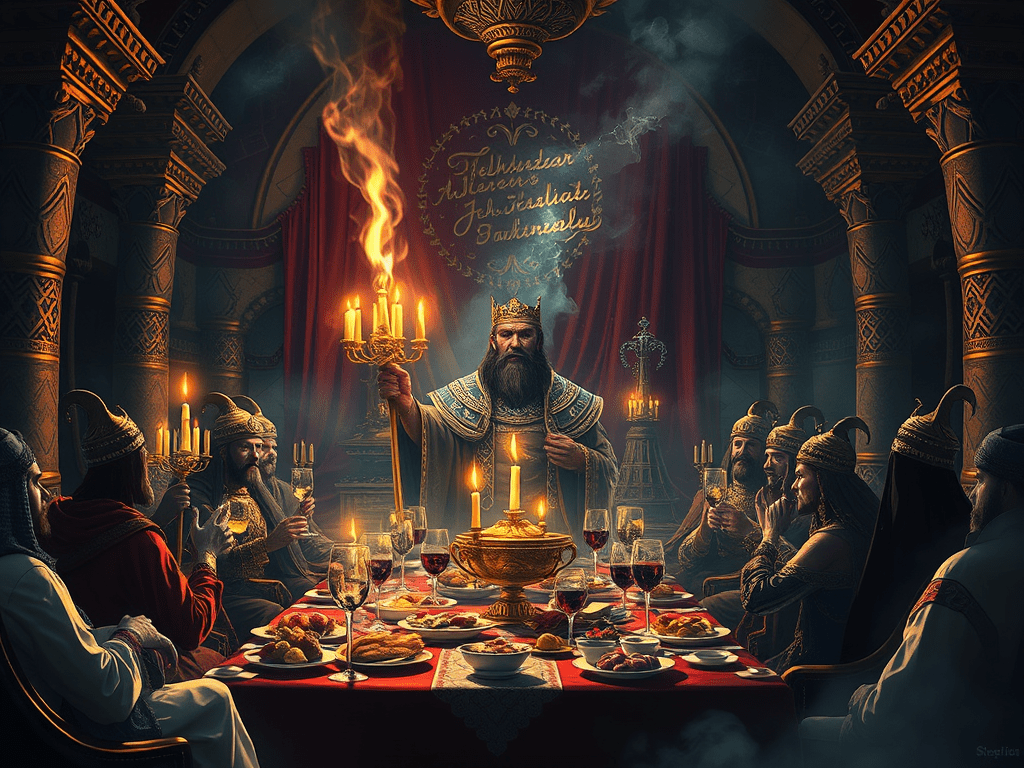
    In the Book of Daniel, chapter 5, we find one of the most dramatic stories in ancient scripture: Belshazzar’s Feast. A lavish banquet turns into a night of terror when a disembodied hand appears and writes mysterious words on the wall. The kingdom falls that very night. But beyond the historical account, this is a profound mythological tale about the inevitable collapse of any power built on arrogance, intoxication, and sacrilege.

    1. Hubris and Sacrilege: The Banquet as Ritual Defiance

    Babylon, in mythic terms, stands as the ultimate “anti-Temple”—a symbol of worldly power that rejects divine order. The banquet isn’t mere excess; it’s a deliberate act of defiance. King Belshazzar commands the sacred vessels looted from the Jerusalem Temple to be brought out. His guests drink wine from them while praising their gods of gold, silver, bronze, iron, wood, and stone.

    This profanation is the core sacrilege: these vessels once held the divine presence. Using them to toast idols is hubris incarnate—the mortal claiming superiority over the sacred. It’s the height of arrogance, performed at the peak of empire.

    2. The Omen: The Hand That Shatters Illusion

    Suddenly, a hand appears, writing on the wall—illuminated, ironically, by the light of the stolen Temple lampstand. The sacred light exposes the profane doom.

    Belshazzar’s reaction is visceral: his face pales, his limbs go slack, his knees knock together. This physical paralysis mirrors his moral collapse—the moment the tyrant’s illusion of invincible power crumbles before a higher force.

    3. The Hero-Interpreter: Daniel’s Uncompromising Stand

    The wise men fail, but Daniel—the exile who refuses to defile himself—is summoned. He deciphers the writing: “Mene, Mene, Tekel, Parsin.”

    Before delivering the verdict, Daniel refuses the king’s rewards: purple robes, gold chains, high office. “Keep your gifts,” he says. His authority comes not from Babylon’s system but from allegiance to the divine. He is untouchable, the true hero bridging chaos and cosmic truth.

    4. The Cosmic Verdict: Weighed on the Scales of Justice

    The words form a threefold judgment:

    • Mene: God has numbered your days; your reign is finite and ended.
    • Tekel: You have been weighed on the scales and found wanting—your character, deeds, and rule insufficient.
    • Parsin: Your kingdom is divided and given to the Medes and Persians.

    That night, Belshazzar is slain, and Babylon falls. The scales of cosmic justice tip irrevocably.

    Echoes in the Cycle of History

    This myth resonates with the ancient observation of civilizational cycles: “Hard times create strong men, strong men create good times, good times create weak men, and weak men create hard times.”

    Belshazzar’s story zooms in on the dangerous transition—good times breeding moral weakness, arrogance, and forgetfulness of limits, inviting sudden collapse. It’s a warning echoed in Greek tragedies (hubris-nemesis), Roman histories, and modern reflections on empires.

    In an age where powers rise and boast at their zenith, the writing on the wall remains a timeless reminder: all human empires are weighed, and those built on sacrilege and pride will be found wanting.

    Content developed with assistance of Gemini AI.

    Blog edited with assistance of Grok AI

  • 🎺 Trouble in River City

    Why America Needs a Hero’s Journey, Not Just a Marching Band

    How The Music Man, myth, and modern comfort expose our spiritual apathy—and what we can do about it

    What if America’s crisis isn’t scarcity—but too much abundance with too little meaning?

    There’s an old quote—often attributed to Alexander Tyler—that outlines the cycle of civilizations. It begins in bondage, rises through faith, courage, and liberty, peaks in abundance, and then falls through complacency, apathy, and dependence, finally returning to bondage. If that cycle rings true, we have to ask: Where is America right now?

    Most signs point to somewhere between abundance → complacency → apathy. And that’s why so few seem interested in growing in faith, taking on responsibility, or answering the call of purpose. We’re not hungry for transformation—because we don’t feel the need.

    But here’s the problem: bondage doesn’t always look like chains.

    Sometimes, it looks like endless entertainment. Like ultra-comfortable lives that make us restless, numb, and detached. In other words, like a pool hall in The Music Man.


    🎱 “Ya got trouble… right here in River City!”

    In Meredith Willson’s The Music Man, Professor Harold Hill warns the town of River City that their boys are sliding into ruin—through the game of pool. Of course, he’s a con man, using fear to sell band instruments. But there’s an ironic twist:

    He’s right.

    The pool hall becomes a symbol of a deeper drift. The boys aren’t just wasting time—they’re losing direction, virtue, and vitality. Hill’s proposal—form a boys’ band—is more than a scam. It accidentally becomes a call to purpose, discipline, and beauty.

    That’s myth in action. Even flawed messengers can stir people toward the Hero’s Journey.


    🧭 Apathy is a disguised form of bondage

    In myth, bondage is always the starting point. Think of Israel in Egypt, Odysseus stranded far from Ithaca, or Luke Skywalker stuck on a desert farm. There’s always something wrong, and the Hero must see it before he can leave it.

    But what if the enemy isn’t external?
    What if it’s spiritual numbness?
    What if our “Egypt” is a dopamine-soaked feed full of shallow pleasures?

    In that case, we’re in bondage—and we don’t even know it.

    That’s why abundance alone won’t save us. It’s not enough to be comfortable—we need to be called. Until people realize they’re stuck, they won’t rise. And that’s where myth, music, and moral imagination can crack open a soul.


    🎺 The Band Must Play

    In the end, The Music Man is a strange but beautiful parable.

    • The boys need something higher to aim at.
    • The town needs to remember what virtue looks like.
    • And even the con man finds redemption when he stops running and chooses to care.

    Today, we don’t need another hustle. We need a band—a higher aim, a moral discipline, and a song to march toward.

    The Hero’s Journey always begins in bondage. But only if we see it. Only if we hear the call.

    So let the music start.

    Written in collaboration with ChatGPT (OpenAI, 2025)

  • Why Civilizations Collapse:

    What Myths Teach Us About the Fall of Democracies

    The Tytler Cycle isn’t just political theory—it’s the story of the soul, told in every great myth.

    “A democracy cannot exist as a permanent form of government. It can only exist until the voters discover that they can vote themselves largesse from the public treasury…”
    —Attributed to Professor Alexander Tytler (1787)

    You’ve probably come across some version of the so-called Tytler Cycle. It claims that all democracies follow a predictable pattern: from freedom to abundance, to complacency, to dependence, and finally back into bondage.

    For some, it’s just a cynical take on politics. But looked at through the lens of myth and archetype, it becomes something much more profound:

    It’s not just the fall of a government.
    It’s the rise and fall of the soul.

    The Cycle Through Mythic Eyes

    Let’s walk through the Tytler Cycle as a moral and spiritual journey—one that appears in countless myths and scriptures across time.


    🔗 Bondage → Spiritual Faith
    This is the beginning of the hero’s story. In myth, this is Egypt before the Exodus, the desert before the call, the dungeon before the sword is drawn. It’s when people suffer under something oppressive—and realize they can’t save themselves.

    Mythic truth: Suffering awakens the soul to something higher.


    🔥 Spiritual Faith → Courage
    Faith gives birth to boldness. This is Moses facing Pharaoh. It’s Odysseus setting sail. It’s the moment someone stops asking “Why is this happening to me?” and starts asking “What must I do?”

    Mythic truth: Faith creates purpose. Purpose demands courage.


    🗽 Courage → Liberty
    Through sacrifice, real freedom is earned. The tyrant falls, the dragon dies, the sea is crossed. Liberty here is not comfort—it’s earned order. It is hard-won.

    Mythic truth: Freedom without cost is not freedom.


    💰 Liberty → Abundance
    With order in place, prosperity grows. Cities rise. Systems thrive. The people enjoy peace. But this stage is where many heroes (and nations) fall asleep.

    Mythic truth: Abundance is not the goal—it’s the test.


    😴 Abundance → Complacency → Apathy
    Now the real decay begins. Warriors become managers. Builders become consumers. The sacred becomes boring. The heroic is replaced with the comfortable.

    Mythic truth: Without struggle, the soul forgets its mission.


    🧷 Apathy → Dependence → Bondage
    In the final stages, people no longer protect what they’ve inherited. They vote for comfort over courage, safety over freedom. The tyrant returns—this time invited.

    Mythic truth: The abandonment of virtue always leads back to slavery.


    The Eternal Message

    This isn’t just about nations. It’s about you.

    We all live through this cycle in miniature.
    When we stop striving, stop sacrificing, and stop remembering the cost of freedom—we fall.
    When we trade meaning for comfort, truth for ease, or courage for conformity—we begin the long slide back into bondage.

    But here’s the good news, written into every myth:The cycle is not inevitable.
    It can be broken—if the hero awakens.

    Developed with assistance of ChatGPT

  • Black Bones in the Desert: What the Earth Remembers

    How ancient burial sites reveal lost landscapes and the quiet echoes of forgotten worlds

    There’s another story — one that pairs with the image of a skull worn through by the road. In Africa, researchers once came across an ancient cemetery where all the bones had turned black. At first, this baffled them. What kind of people leave behind black bones? Had they discovered some unknown species — perhaps a human ancestor lost to time?

    But then someone offered a simpler, more powerful explanation: bones turn black when soaked in water for long periods of time. These were not alien remains — they were fully human. The mystery wasn’t in the bones, but in the place. The desert in which they were found had once been a wet, fertile land, rich with life and water.

    This discovery reveals something extraordinary: the landscape had changed so completely that we had forgotten its past. What is now arid and desolate was once lush and alive. And all that remains of that former world is a trace in the bones.

    This is a different kind of legacy. It’s not the personal legacy of names or deeds, but the environmental legacy that links humanity to place. These blackened bones do not preserve identity, but they preserve context. They remind us that human history is entwined with ecological history — that the earth itself remembers what we forget.

    In that way, the story becomes deeply symbolic. What seemed alien was entirely human. And what seemed dead was once a place of abundance. The blackness of the bone was not a mark of difference, but a testimony to transformation.

    This is the kind of truth that doesn’t survive in monuments. It isn’t shouted in stone or carved in tablets. It seeps into sediment, stains the bones, and whispers from beneath the surface. It tells us: Something was here. Life was here. And now the world has changed.

    It reminds us that history is not only linear, but layered. And sometimes, only when erosion or excavation peels back those layers do we see what was hidden all along.

    Legacy, then, is not always a matter of being remembered. Sometimes it’s about leaving a trace — in the way we shaped the land, in the ecosystems we touched, in the soil and water and stone that once sustained our lives. We may not endure in memory, but our impact can endure in place.

    The bones do not speak in words. But they carry a message: that human life leaves behind more than names. It leaves behind evidence — clues about the kind of world we inhabited, and perhaps clues about the kind of world we left behind.

    What traces are you leaving behind — in your habits, your choices, and the environments you shape? What will the earth remember of your world?

  • Skull in the Dust:

    What Will Remain of Us?

    There’s a story I once heard: someone walking along a dirt road in Africa noticed a strange shape protruding from the path. It turned out to be the cross-section of a skull — not from a recent burial, but something ancient. Scientists later determined that it was roughly 5,000 years old. It had been buried for millennia, forgotten by history, and only revealed by the slow wearing-down of the road.

    It’s a striking image — a human life, reduced to bone, indistinguishable from the dust until chance erosion reveals it again. One person among untold millions, completely forgotten in name, story, and song. No monument, no footnote in a book — just a fragment of skull, sliced clean by time.

    But the image also invites a deeper reflection. What remains of a person when everything personal is erased? If no one remembers your name, were you part of anything that mattered?

    This is the question at the heart of human legacy.

    Jordan Peterson says that society is built on the backs of heroes — and that innovation builds on innovation forever. While some figures stand out in the narrative of history, many of the contributions that make civilization possible were anonymous. The tools, customs, stories, and rituals passed down through oral tradition or simple imitation — many of these came from people whose names we will never know.

    So it’s possible that the person whose skull was found contributed to something vital. Perhaps they preserved a hunting technique, crafted a tool, or passed on a story that taught their children caution or courage. Maybe their tribe developed a cooperative structure that influenced others. And perhaps that contribution set off a chain of developments that, hundreds or thousands of years later, became part of the infrastructure of modern life.

    What appears as complete erasure might actually be buried continuity — the quiet impact of anonymous lives shaping the foundations of civilization.

    The road that wore through the skull could also symbolize the road of history itself — a slow and relentless passage that wears away individuals but reveals deeper layers of inheritance. Each generation walks over the last, compressing it into the foundation of the next.

    This is both humbling and meaningful. On one hand, we will all be forgotten. On the other hand, our lives — even our suffering — may carry forward ripples that shape the world long after we’re gone. The systems we participate in, the children we raise, the words we share, the kindness we show — these things outlive us in ways we can’t always predict.

    We should not seek legacy in fame or monuments. We should seek to live in such a way that what we pass on — whether directly or indirectly — becomes a sturdy stone in the road of civilization. Even if no one ever knows it was ours.

    Have you ever considered that your quiet daily choices — even your pain — might form part of a foundation others will build on? What road are you paving?

    Developed with assistance from ChatGPT

  • Microspheres Key to Church Renewal

    I am dedicated to helping to promote the Kingdom of God in my parish and in my diocese. My goal is to find a way to promote the faith such that by 2030, the Archdiocese would be 4 times its current size, and have 1 priest for every 100 men.

    Although my view really doesn’t  matter, I see nothing wrong with the Teaching of the Church, the Hierarchy, or the Magesterium. As far as I can see, the shortcoming is in the gap between the priests and the lay people.

    Although a parish may be the size of several brigades, it is as useless as a mob without some structure, network, and relationships.

    Unfortunately, most of the time, it seems that the only thing that separates Catholics from the rest of the world is that 1 hour on Sunday when they actually separate themselves from the rest of the world.

    If you know a tree by the fruit it produces, then you would have to say that most Catholics are unaware of the treasure that God is. They have been given a gold mine, but they act like it’s just yellow plastic.

    These days most people prefer interacting with media, rather than with other human beings, often even in their own families.

    I believe that the “Sense of Community” one has with his church or parish is directly related to the number of microsphere relationships (average of 30 minutes per week per person) he has within that church.

    Would it take a network of 5, 10, or even 20 microsphere relationships experienced as shared lives, shared service, and shared support to create that sense of community? This would create the kind of environment where Catholics could find God and respond to their vocations.

    If we could develop within the Church support groups for everyone, many of the problems that the Church now experiences would disappear.

    It was the communities of brotherhoods that allowed Civilization to survive the invasions of Europe that occurred 1000 years ago. Something of that kind will be required to survive the current assault on our faith.

    I do not believe it is necessarily the Church’s responsibility or even within their capability to bring about this change.

    Tom Neugebauer

    Seized by Christ