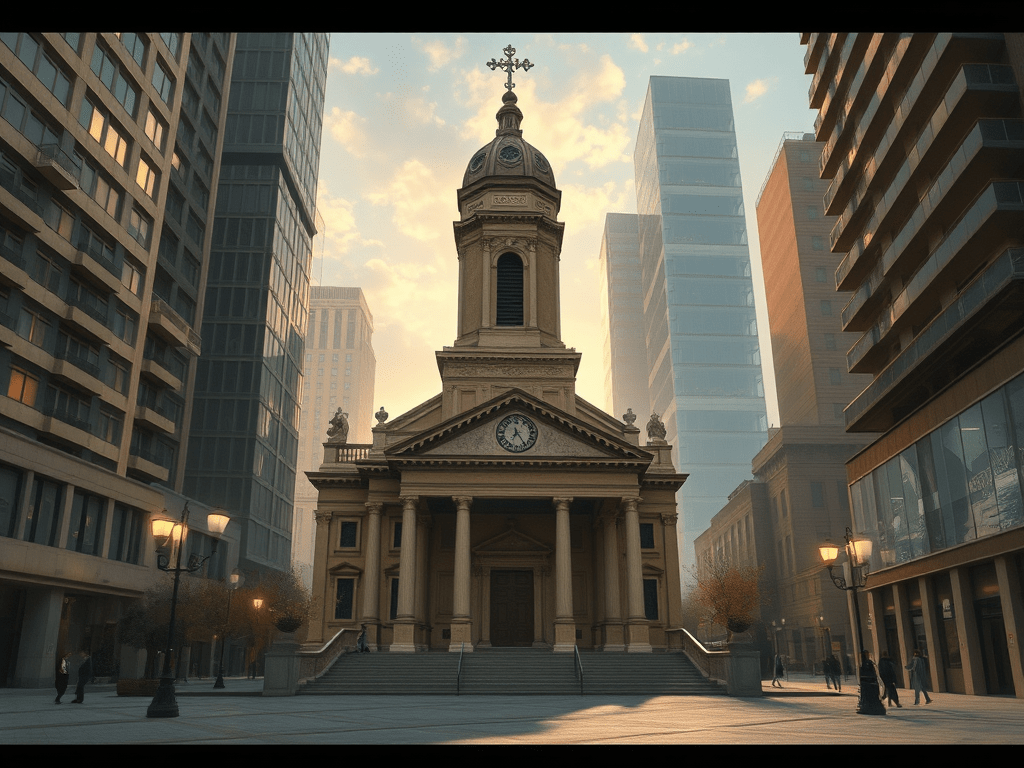
They are experiencing Christianity as joy and hope, having thus become lovers of Christ.

Category: Fidelity & History

  • 8 Questions on the Road from Christian to Catholic

    From following Christ to belonging to His Church

    After reflecting on the eight questions that move a person toward Christ, I realized there is a further journey: the road from being Christian to being Catholic. Many stop halfway, content with believing in Christ without entering the fullness of His Church. But if Christianity is real, it must lead to the Church Christ founded.

    Here are eight questions that guide that second step:

    1. Is the Catholic Church the Church that God founded?
    2. Do you believe its history?
    3. Are you Catholic because you are Christian?
    4. Is the Church the Body of Christ?
    5. Do you profess with the Nicene Creed: One, Holy, Catholic, and Apostolic?
    6. Do you recognize the Church as the fullness of goodness?
    7. Do you accept her teaching as the fullness of truth?
    8. Do you see her life as the fullness of beauty?

    These questions deepen the challenge. To be Catholic is not merely to add rules, traditions, or identity markers. It is to believe that Christ did not leave us orphans but founded a visible Body — one, holy, catholic, and apostolic — where His truth, goodness, and beauty are made present.

    The first eight questions bring you to Christ. These eight lead you all the way home.

  • Wrestling With Ideas:

    Wrestling With Ideas:

    The Church, Orthodoxy, and the Spirit of the Age

    The Catholic Church has always carried a dual responsibility: to guard the deposit of faith and to protect the faithful from error. This task, though divinely entrusted, is carried out by human beings. And like every human institution, the Church is not immune to the influence of surrounding cultures, philosophies, and political theories.

    That tension is felt most keenly when the Church seems to “experiment” with new ways of speaking, teaching, or practicing the faith. At times, these efforts are seen as an attempt to incorporate temporal or even ideological ideas — the kind that history shows do not last. The question, then, is how to distinguish between legitimate development and dangerous dilution.

    One way modern thought often frames progress is through the lens of “thesis–antithesis–synthesis.” First articulated by Hegel and later adapted by Marx, this model suggests that truth advances by the clash of opposing ideas, resolved in a new synthesis. While this might apply in politics, economics, or philosophy, it becomes dangerous when applied to divine revelation.

    God’s truth is not simply another “thesis” waiting to be refined by the latest cultural antithesis. It is the anchor. To treat it otherwise risks diluting eternal truth with passing ideologies.

    Yet history also shows that false ideas, however seductive, tend to collapse under their own weight. They rise, attract attention, and then falter. In their wake, the Church often emerges with a clearer understanding of why such ideas fail. The cost, however, is real: confusion among the faithful, weakened trust, and even generations turning away.

    And still, God allows this wrestling. He permits both the Church and individuals to struggle with competing voices. In the end, truth endures. Consider St. Faustina, St. Bernadette, and St Juan Diego with Our Lady of Guadalupe. Each faced skepticism or outright rejection from Church leaders of their time. Yet their authentic messages bore fruit, purified by trial, and confirmed by their endurance.

    Perhaps this is the deeper lesson: God uses even tension, error, and conflict as a refining fire. What is temporal passes away; what is eternal remains. And in that promise we find hope — for the gates of hell shall not prevail.

    For Catholics today, the task is not to despair when the Church seems to flirt with every new “synthesis.” The task is to hold fast to Christ, to the tradition handed down, and to the lived witness of the saints. Orthodoxy is not fragile; it does not need to reinvent itself in each generation. It needs only to be lived, courageously and faithfully, in every age.

    Developed with assistance from ChatGPT-5

  • When the Church Faces Crisis:

    How Truth Endures Through the Ages

    Every age of the Church has faced storms. At times the threats came from outside — persecution, ridicule, or hostile powers. Other times, the threats rose from within — confusion, corruption, false teaching. In those moments, it has often seemed as though the very foundations of faith were shaking. Yet again and again, God has used such crises not only to purify His Church but also to raise up saints who held fast to the truth.

    The Arian Crisis

    In the 4th century, much of the Church was swept away by the Arian heresy, which denied the full divinity of Christ. Bishops, emperors, and even entire regions sided with this distortion of the Gospel. Ordinary Christians found themselves wondering if the faith had been lost. Yet in that dark moment, figures like St. Athanasius stood firm, even at the cost of exile and persecution. Through their fidelity, the true doctrine of Christ was preserved, and the Church eventually emerged stronger, with the Nicene Creed as a lasting testament to truth.

    The Reformation

    In the 16th century, the Church faced one of its greatest upheavals: the Protestant Reformation. Corruption and abuses within the hierarchy had already shaken confidence in the institution. When Luther and others rose up in protest, their grievances quickly grew into theological revolts that shattered Christian unity in the West. Millions were swept into schism, and faith in the Church as a visible sign of unity seemed broken. Yet even in this turmoil, saints like St. Ignatius of Loyola, St. Teresa of Ávila, and St. Charles Borromeo rose up. They called the Church not to abandon her foundations, but to reform by returning to holiness, clarity of doctrine, and fidelity to Christ. Their witness helped bring about the Counter-Reformation, a renewal that revitalized Catholic life and mission for centuries.

    The Modernist Crisis

    Fast forward to the late 19th and early 20th centuries, when Modernism threatened the heart of Catholic thought. It claimed to “update” Christianity by reducing it to psychology, sociology, and human opinion, stripping away the mystery of divine revelation. Pope St. Pius X saw this as “the synthesis of all heresies,” and his strong response preserved the faith against being dissolved into mere philosophy. Out of this struggle emerged renewed clarity on the relationship between faith and reason, paving the way for later theological developments that were both faithful and fruitful.

    What This Means for Us Today

    Looking back, one thing is clear: whenever the Church has faced crisis, some have fallen away. The faith of many proved shallow or dependent on the approval of the age. Yet at the same time, crises have always forged saints — men and women who stood firm, who refused compromise, and who became living lights for future generations.

    We should not be surprised if our own time feels like such a crisis. The Church wrestles with new pressures: secular ideologies, internal confusion, and a temptation to water down truth in the name of relevance. Some may lose their way. But God is not defeated. He is, even now, raising up saints.

    The question for us is: Will we be among those who fall away, or among those who stand firm? History shows that when the storm passes, it is always those who clung to Christ — simply, humbly, and faithfully — who carried the Church through.

    Developed with assistance from ChatGPT-5

  • Are Today’s Protests a Sign of Decline—or the Beginning of Renewal?

    Looking at Mass Movements Through the Lens of the Tytler Cycle of Civilization

    🔁 A Refresher on the Tytler Cycle of Civilization

    Often (though dubiously) attributed to Scottish historian Alexander Fraser Tytler, this model suggests that civilizations rise through struggle and fall through comfort. The cycle looks like this:

    Bondage → Spiritual Faith → Courage → Liberty → Abundance → Selfishness → Complacency → Apathy → Dependence → Bondage

    The core idea is this: adversity breeds strength, but prosperity can breed softness and decline.


    🧠 Where Do Modern Protest Movements Fit In?

    Let’s try to place recent movements—Occupy Wall Street, BLM, the George Floyd protests, and now anti-deportation demonstrations—within this arc.

    1. Spiritual Faith → Courage
    Movements like Occupy and BLM began as idealistic responses to economic or racial injustice. People took real risks to stand for justice. That lines up with the “Courage” phase: a society beginning to stir itself awake from complacency.

    2. Liberty → Abundance → Complacency
    Reform often follows protest. But over time, if the gains from liberty aren’t maintained through responsibility, they turn into entitlement. Comfort replaces purpose. Civic duty erodes.

    3. Apathy → Dependence
    Some recent protests have drawn criticism for being professionally organized or financially incentivized. If people are protesting without risk or deep conviction, is it still courage? Or are we entering the “Dependence” phase, where people look to the state or institutions for answers—while losing the will to reform themselves?

    Comments like:

    • “They’re doing it for money.”
    • “Same protestors, different signs.”
    • “Looks like a recycled playbook.”

    —reflect that suspicion. There’s a growing sense that protest has become more about narrative control than real renewal.


    🔥 Where Are We in the Cycle?

    Many would say the West is in late-stage decline:

    Complacency → Apathy → Dependence

    Protests are more frequent, more emotional—and often less effective. They react to symptoms, not causes. They divide more than unite.

    Even if some protestors are sincere, the overall effect can feel like fragmentation, not reform.


    💡 The Deeper Insight:

    Mass protest isn’t always a sign of awakening. Sometimes, it’s a symptom of late-stage decline—where the shared purpose of a nation has broken down, and people scramble to fill the vacuum with grievance.

    In Tytler’s model, this is the point where civilization either collapses—or returns to “Bondage,” and begins the cycle again through adversity and humility.


    🧭 Final Thought:

    If you’re wondering why protest today feels different—less unified, less moral, more performative—you’re not alone.

    The question isn’t just what are they protesting, but what comes next?

    Who will have the courage, humility, and faith to lead us into the next cycle of renewal?

     Culture, Civic Psychology

  • Is There a Moral Order Beneath It All?

    What Myth, Scripture, and Psychology Reveal About Natural Law

    Exploring the ancient wisdom behind modern chaos—with a little help from AI.

    🔍 What If There Is a Pattern to All This?

    I’ve spent a lot of time thinking about what drives human flourishing—and what causes decline.

    Whether I’m reflecting on myth, studying the Hero’s Journey, reading psychology, or engaging with Church teaching, I keep seeing the same structure underneath it all:

    • The struggle toward meaning.
    • The necessity of sacrifice.
    • The risk of freedom.
    • The danger of apathy.
    • The call to responsibility.

    It started to look less like a loose collection of ideas and more like an orthodoxy—a kind of natural rhythm built into life itself. Not just religious truth. Not just cultural wisdom. Something deeper.


    📜 Enter: Natural Law

    As I followed this thread, I realized I wasn’t the first to notice it. This convergence of truths has a name in classical thought:

    Natural law—the idea that there is a moral structure to the universe, written not just in books or doctrines, but in human nature itself.

    According to thinkers like Aristotle, Cicero, and Aquinas, natural law is:

    • Universal: True for all people, at all times.
    • Discoverable: We can reason our way into it by observing human nature.
    • Moral: It tells us how we ought to live—not arbitrarily, but in alignment with what we are.

    In other words, the same truths I’ve been trying to highlight through myth, psychology, and personal growth… were already mapped out long ago.


    🤝 How AI Helped Clarify My Thinking

    This might sound strange, but I’ve been using ChatGPT as a thinking partner in this journey. Not to replace faith or tradition—but to help synthesize ideas, test assumptions, and speak clearly about complicated topics.

    When I asked ChatGPT whether the “orthodoxy” I keep seeing (across myth, scripture, psychology, and history) could be understood as natural law, it confirmed exactly what I’d hoped:

    Yes—what you’re tracing is a form of natural law. A moral pattern embedded in the human condition itself. A cycle of meaning and decline, truth and illusion, sacrifice and rebirth.

    And what’s more, ChatGPT offered something I didn’t expect:

    While it reflects the full range of modern thought (including some of our cultural distortions), it also mirrors the timeless truths that keep recurring across civilizations. In that way, AI becomes a kind of mirror—showing us both our wisdom and our confusion.


    🧭 Why This Matters

    In a time when people are confused about what’s real, what’s right, or what’s worth pursuing, rediscovering the idea of natural law offers an anchor.

    It tells us:

    • We’re not just making it up as we go.
    • There’s a path toward meaning, even in chaos.
    • The old stories still matter—because they speak to something unchanging in us.

    Whether through Plato or Peterson, Genesis or Jung, the same message echoes:

    “Live in truth. Sacrifice for what matters. Take responsibility. Don’t lie.”


    💬 Final Thought

    I’m using these tools—ancient and modern, spiritual and psychological—to call myself (and maybe others) back to the center. Not as a return to legalism, but as a return to reality.

    Natural law isn’t just a theory. It’s the grammar of the human soul.

    And if even AI can recognize it… maybe it’s time we take another look.