They are experiencing Christianity as joy and hope, having thus become lovers of Christ.

Category: Adversary / Trauma

  • 💜 The Call to Humility: Rewiring the Rebellious Heart

    💜 The Call to Humility: Rewiring the Rebellious Heart

    Readings for 16 DEC 2025: Zephaniah 3:1-2, 9-13; Psalm 33; Matthew 21:28-32

    I. Introduction: The Rebellious City

    We are deep in the heart of Advent, a season colored Violet—the color of royalty, but also of penance and preparation. The scriptures today issue a stark, powerful challenge, starting with the prophet Zephaniah:

    “Trouble is coming to the rebellious, the defiled, the tyrannical city! She would never listen to the call, would never learn the lesson…” (Zephaniah 3:1-2)

    When we hear the word “city,” our modern mind goes to bricks and mortar. But in the prophetic tradition, the city—Jerusalem—is often a profound metaphor for the human soul. Zephaniah is describing not just a physical place, but the rebellious, unintegrated heart—the ego that refuses counsel, trusts only itself, and never draws near to God.

    This “tyrannical city” is the part of our consciousness that seeks to be King Belshazzar, building its own reality based on pride and self-will.

    II. The Psychological Crisis: Refusal and Tyranny

    The First Reading lays bare the psychological state of the rebellious heart:

    • “She would never listen to the call.”
    • “She has never trusted in the Lord.”
    • “She never drew near to her God.”

    This is the Refusal of the Call in the language of the Hero’s Journey. Joseph Campbell taught that all great myths begin when the hero is called to leave their comfortable, known world, and initially says No. The rebellious heart is stuck in this refusal.

    Psychologically, this refusal is driven by the Limbic System. This ancient, instinctual part of the brain seeks comfort, security, and the avoidance of all risk. To trust God, to draw near to God, means surrendering control, which the Limbic System perceives as an existential threat. This fear of surrender makes the heart tyrannical—it must control everything because it fears everything.

    III. The Gospel’s Two Sons: Action vs. Attitude

    Jesus clarifies this battle between the tyrannical heart and true conversion with the parable of the two sons:

    • The First Son: Said “No,” but afterwards thought better of it and went.
    • The Second Son: Said “Certainly, sir,” but did not go.

    The chief priests and elders, comfortable in their certainty and piety, represent the Second Son. They had the right attitude (the right words, the right liturgy), but their tyrannical, rebellious heart (Zephaniah’s city) remained unchanged.

    The tax collectors and prostitutes represent the First Son. They started in the “tyrannical city” of self-will and sin, but in their moment of brokenness, they experienced the crucial psychological step: thinking better of it—a deliberate act of the will leading to action.

    Jesus’s verdict is stunning: “Tax collectors and prostitutes are making their way into the kingdom of God before you.” They embarked on the Hero’s Journey (repentance and action) while the pious were still stuck in the tyranny of their own self-righteous refusal.

    IV. The Great Transformation: Clean Lips and Humility

    The good news, the Advent promise, is that God does not abandon the tyrannical city. Zephaniah promises a profound transformation:

    “Yes, I will then give the peoples lips that are clean, so that all may invoke the name of the Lord and serve him under the same yoke.” (Zephaniah 3:9)

    The “clean lips” are the sign of the transformed heart. Psychologically, this is the victory of the Prefrontal Cortex (PFC)—the seat of reason, moral choice, and long-term vision—over the tyrannical Limbic System.

    • The Limbic heart speaks lies and boasts (Zephaniah 3:13: the perjured tongue).
    • The PFC, aligned with God’s will, brings clean lips—it brings truth, humility, and the ability to invoke the Lord’s name.

    This transformation is completed by two essential virtues:

    1. The Removal of Pride: “I will remove your proud boasters from your midst; and you will cease to strut on my holy mountain.” (Zephaniah 3:11)
    2. The Installation of Humility: “In your midst I will leave a humble and lowly people, and those who are left in Israel will seek refuge in the name of the Lord.” (Zephaniah 3:12)

    The spiritual journey is the systematic dismantling of the tyrannical ego and the installation of humility, where the PFC chooses the love of God over the fear of the self.

    V. Call to Action: The Poor Man’s Call

    This Advent, the call is clear: Stop being the Second Son. Stop being the tyrannical city.

    The Responsorial Psalm gives us the path to conversion: “This poor man called; the Lord heard him.”

    The “poor man” is the humble and lowly person Zephaniah promised. He is the person who has surrendered the tyranny of the ego. The Lord hears him because he is close to the “broken-hearted” and those whose “spirit is crushed.”

    Real spiritual transformation today requires two acts of the will:

    1. Stop Strutting: What are you still doing for show? What is the “proud boasting” that keeps you from trusting God? The work of penance is the work of removing pride.
    2. Start Doing: Do not remain in the Refusal phase. Be the first son. That means taking action that requires surrender. That means choosing the hard “Go and work in the vineyard” over the easy “Certainly, sir.”

    The Lord is coming. Let us choose to dismantle the rebellious city in our hearts, surrender the tyranny of fear, and allow the promised “humble and lowly people” to seek refuge in His name.

    Amen.

    Developed with assistance from Gemini AI

  • 🕊️ The Holy Wisdom:

    🕊️ The Holy Wisdom:

    How to Live in the World Where the Wolf and the Lamb Lie Down

    I. The Shoot and the Sevenfold Spirit (The Mythological Order)

    The prophet Isaiah (11:1-10) gives us one of the most sublime visions of the Messianic Age. It begins with the Shoot from the stock of Jesse—the image of radical new life springing from seemingly dead roots. This is the ultimate Anointing, where the seven gifts of the Holy Spirit rest upon the Messiah: wisdom, insight, counsel, power, knowledge, and the fear of the Lord (with the fear of the Lord being his breath, emphasizing reverence).

    This Messianic rule immediately establishes a new cosmic order. It is an end to the primal chaos and conflict that has defined the world since the Fall.

    The imagery—the wolf lives with the lamb, the calf and lion feed together, the infant plays over the cobra’s hole—is pure Mythological Parallel. It evokes the Golden Age or Paradise Restored. . This is the reversal of the natural order of predation and fear. The country is not secured by armies, but by knowledge of the Lord.

    The key insight for us is that this peace is not merely external, but internal: it is the perfect integration of our own conflicting natures.


    II. The Internal Wolf and Lamb (Psychology of Integration)

    We all house the wolf and the lamb. We carry the panther (our wild, unchecked appetites) and the kid (our innocent, vulnerable soul).

    Psychologically, the division in Isaiah’s vision reflects the constant civil war within the human heart:

    • The Wolf/Lion: Represents the passions and the instinctual self—the power of the limbic system and the amygdala—that seek to consume, dominate, and survive at any cost.
    • The Lamb/Calf: Represents the vulnerable, gentle, and receptive spiritual self—the capacity for peace and trust.

    When we are disordered, the wolf preys upon the lamb. Our fear consumes our peace; our lust devours our innocence.

    The Messianic promise is that the Spirit of the Lord (which integrates the powers of wisdom and counsel with knowledge and fear) rests on the leader who reorders this inner landscape. The “little boy” who leads them is the pure Will, guided by Wisdom, that shepherds the powerful animal instincts without destroying them. The lion doesn’t disappear; it learns to eat straw like the ox.

    III. The Wisdom of Children (The Hero’s Revelation)

    How do we gain this integration? The Gospel provides the counterintuitive method.

    Luke 10:21-24 shows Jesus, filled with joy, praising the Father for “hiding these things from the learned and the clever and revealing them to mere children.”

    This is the great Inversion of Wisdom. It is the prerequisite for the Hero’s Revelation. The knowledge that brings true peace is not attained through academic complexity or ego-driven cleverness. It is revealed through humility and simplicity—the state of the “child.”

    • The “learned and the clever” rely on the strength of the Prefrontal Cortex for independent reasoning, often fueling the prideful “wolf” of the ego.
    • “Mere children” rely on trust and direct reception. They are open to the gift of the Spirit (the fear of the Lord—holy reverence) that unlocks true knowledge.

    Only through the eyes of a child can we see the chaos of our inner zoo and accept the reordering delivered by Christ’s Word. Only by becoming small and humble can the Spirit rest fully upon us.

    IV. Call to Action: Practicing the Reordering

    The goal of this Advent is to let the Spirit of the Lord settle upon us, creating that inner sanctuary where no creature does harm.

    Your call to spiritual transformation this week is to practice the Reordering of the Heart:

    1. Identify the Predator: Name the “wolf” in your heart. What is the one instinct (fear, anger, cynicism, lust) that consistently preys upon your peace (the “lamb”)?
    2. Invite the Shepherd: Don’t try to kill the wolf with brute force (that just creates more violence). Instead, invite the Spirit of the Lord into that conflict. When the urge to consume or strike arises, pause and ask for the Spirit of Counsel and Wisdom to lead that wild instinct, turning its energy toward a productive task (like the lion eating straw).
    3. Embrace the Child’s Vision: Seek to simplify your mind. Spend time in quiet prayer not trying to figure out God, but simply receiving Him. Like the Centurion we discussed, surrender the need to be clever. Only in the humility of the child is the fullness of the Lord’s knowledge revealed.

    Let us be the humble remnant, purified and ordered, on whom the Spirit rests, making our hearts glorious and ready for the King.

    Developed with assistance of Gemini AI

  • ⚔️ Hammering Swords into Ploughshares:

    ⚔️ Hammering Swords into Ploughshares:

    The Work of Vigilance

    I. The Journey to the Mountain (The Hero’s Call)

    The liturgical year turns today, beginning the season of Advent. Our destination is clear: The Mountain of the Temple of the Lord .

    The prophet Isaiah (2:1-5) gives us a stunning mythological vision: a towering peak, lifted higher than the hills, drawing all the nations—peoples without number—to learn God’s ways. The outcome of this pilgrimage is radical: “They will hammer their swords into ploughshares, their spears into sickles. Nation will not lift sword against nation.”

    This is the ultimate promise of Eternal Peace (Shalom) and the divine resolution to the problem of human violence.

    In terms of the Hero’s Journey, the journey up the mountain is the Call to Adventure—a call to leave the flat, ordinary world of conflict behind and ascend to the height of revelation. The Law (the oracle) goes out from this place, transforming the very tools of destruction (swords) into the tools of production (ploughshares).

    The pilgrimage is not just historical; it is deeply personal. What are the “nations” of conflict within us that must ascend to the peace of Christ?


    II. The Night and the Burglar (Psychology of Complacency)

    Saint Paul tells us in Romans (13:11-14) that “the night is almost over.” This night is not just a chronological time; it is a psychological state of spiritual drowsiness.

    Jesus illustrates this perfectly in the Gospel with two chilling metaphors: Noah’s Day and the Burglar.

    “If the householder had known at what time of the night the burglar would come, he would have stayed awake and would not have allowed anyone to break through the wall of his house.”

    The burglar represents the unforeseen collapse—the judgment, the crisis, or the moment of death. The wall of the house is the boundary of our interior life, our vigilance.

    Psychologically, the danger is not the outside event; it is the “coarsening” of the heart that makes us fail to stay awake. The twin enemies Paul names—drunkenness and the cares of life—are both methods of spiritual dullness:

    1. Drunkenness/Debauchery: Overloading the system with immediate pleasure, dulling the Prefrontal Cortex (our Will and highest reason) and making us incapable of long-term planning.
    2. Cares of Life: Overloading the system with chronic anxiety, perpetually triggering the Amygdala (our fear center).

    Both states keep us trapped in the Ordinary World, focused only on eating and drinking, leaving the walls of our soul unguarded. We mistake temporary comfort for eternal security.

    III. The Armour and the Ploughshare (The Spiritual Transformation)

    The call to action is immediate and profound: “Let us live decently as people do in the daytime: no drunken orgies, no promiscuity… Let your armour be the Lord Jesus Christ.”

    The transformation required to reach Isaiah’s mountain of peace is a dual effort:

    1. The Work of Divesting (Hammering Swords)

    We must actively give up the things we prefer to do under cover of the dark. This is the Refusal of the Return reversed—we refuse to stay comfortable in the darkness.

    The sword is the symbol of aggression, conflict, and self-defense. What are the swords in your heart?

    • The sword of wrangling (constant conflict).
    • The sword of jealousy (internal war against your neighbor).

    We are called to hammer these weapons into ploughshares—tools for tilling the inner soil, for producing the spiritual fruit of patience, charity, and peace. This process requires daily, painful penance and effort.

    2. The Work of Investing (Donning Armour)

    Paul instructs us: “Let your armour be the Lord Jesus Christ.”

    This is the Apotheosis and Return stage of the Advent journey. We don’t defend our walls with our strength; we defend our soul with Christ. We put on the Mind of Christ and the Virtues of Christ.

    When you are tempted to anger (the sword), your armour reminds you to respond with Christ’s peace. When you are tempted to dull your senses (the drunkenness), your armour reminds you that your Master is coming and you must be awake.

    IV. Call to Action: Walking in the Light

    This Advent, the call is simple: Walk in the light of the Lord.

    The mountain of the Temple is waiting. We are not called to build the perfect society right now, but we are called to build the perfect sanctuary in our own heart. We must make our inner Jerusalem ready for the Prince of Peace.

    Your practical commitment this week is to Vigilance.

    • Identify the Burglar: Name one specific area of your life where you have “allowed someone to break through the wall of your house”—where you are dulling your heart. (e.g., excessive scrolling, obsessive worrying, casual gossip).
    • Hammer the Sword: Take one daily tool of conflict (wrangling, jealousy) and consciously begin to turn it into a tool of peace (patience, prayer).
    • Stay Awake: Resolve to spend your time and energy not on the “cares of life,” but on the saving help Christ offers, so that you are prepared to stand ready.

    Let us walk in the light. Let us start hammering our swords.

    Developed with assistance from Gemini AI
  • “Wake Up and Walk in the Light: Advent and the Great Human Awakening”

    “Wake Up and Walk in the Light: Advent and the Great Human Awakening”

    A 10–15 minute Advent reflection

    Isaiah 2:1-5; Psalm 121(122):1-2,4-5,6-9; Romans 13:11-14; Matthew 24:37-44

    Today is the First Sunday of Advent—the beginning of the Church’s year.
    And the very first word the Church gives us is: Wake up.

    Not “be cozy.”
    Not “ease into the holidays.”
    But Wake up.
    Be alert. Open your eyes.
    Something is coming.
    Someone is coming.

    And the way Scripture tells the story today, this awakening is not optional.
    It is the difference between remaining asleep in the old world—or stepping into the new creation God desires for us.


    1. Isaiah’s Mountain: The Call of the Hero at Dawn

    The prophet Isaiah begins with a vision of the “days to come.”
    He sees Mount Zion—the Temple mountain—lifted above all other mountains.
    Nations stream toward it.
    People without number ascend the hill saying:

    “Come, let us go up to the mountain of the Lord… that he may teach us his ways.”

    This is the biblical version of the call to adventure—the moment in every great myth when humans are summoned upward, summoned out of the ordinary world and toward a divine encounter.

    The mountain is a universal symbol in myth:

    • Mount Olympus for the Greeks
    • Mount Meru in Hindu cosmology
    • Sinai for Moses
    • Tabor for Christ

    The mountain always represents the highest meaning, the place where heaven and earth meet, where God reveals Himself, and where human beings are changed.

    Isaiah’s point is clear:
    Humanity’s future is not down in the valley of violence, distraction, and conflict.
    Our future is an ascent.
    A pilgrimage.
    A transformation.

    Psychologically, this ascent points to the integration of the self—the movement from fragmentation to unity, from instinct-driven living (the lower brain layers) toward a life governed by truth, conscience, and grace (the highest faculties).

    Isaiah describes the result of this ascent:

    “They shall beat their swords into ploughshares.”

    This is transformation—not by force, but by teaching, by truth, by hearing God.
    The weapons of self-destruction become the tools of cultivation.
    What once harmed now heals.

    This is what happens when a person climbs the mountain of the Lord.


    2. “I Rejoiced When I Heard Them Say”: The Joy of a Heart That Is Waking Up

    The psalm today echoes the upward movement:

    “I rejoiced when I heard them say: ‘Let us go to God’s house.’”

    This is the joy of someone who has heard the call.
    Someone whose feet are already on the path.
    Someone who has realized:
    My home is not here. My destiny is above.

    Psychologically, this is the movement from numbness to desire.
    From apathy to longing.
    From spiritual sleep to spiritual hunger.

    St. Augustine described it as the “weight of love” lifting the soul upward.

    Every Hero’s Journey begins—not with skill or strength—but with desire, the dawning awareness that “There must be more.”

    Advent awakens that desire.


    3. St. Paul: “Wake Up Now” — The Battle Between Night and Day

    Then St. Paul tells us plainly:

    “You know the time.
    The night is almost over.
    The day is at hand.
    Wake up now.”

    Paul speaks here like a drill sergeant of the soul.
    He knows we like comfort.
    We like the dark because our weaknesses hide there.
    But Paul says:

    “Give up the things done under cover of darkness…
    and put on the armor of light.”

    This is spiritual psychology at its sharpest.

    The “night” represents:

    • impulsivity
    • old habits
    • addictions
    • self-deception
    • sin we have learned to tolerate

    The “day” represents:

    • clarity
    • responsibility
    • moral courage
    • virtue
    • the renewing power of Jesus Christ

    Paul says:
    Do not wait until you feel ready. Light never begins with readiness.
    It begins with decision.

    Mythologically, this is the moment when the hero must leave home.
    Leave comfort.
    Leave childishness.
    The doorway to the adventure is dawn—and dawn always interrupts our sleep.


    4. Jesus in the Gospel: The Flood Comes to the Spiritually Asleep

    Now Christ speaks the hardest words of the day:

    “As in the days of Noah, so will it be at the coming of the Son of Man.”

    People were living as if nothing mattered:

    • eating
    • drinking
    • marrying
    • working

    None of these are evil.
    The problem is not the activities—it is the unconsciousness with which people lived.

    They were asleep inside their own lives.

    The Flood did not simply wash away bodies—it washed away illusions.
    It revealed who was awake and who was not.

    Then Jesus gives His teaching with startling urgency:

    “Stay awake…
    Stand ready…
    The Son of Man is coming at an hour you do not expect.”

    This is not meant to frighten us—it is meant to awaken us.

    Jesus is not warning about the end of the world;
    He is warning about the end of your illusions.
    The end of self-deception.
    The end of sleepwalking through life.

    In psychological terms, Jesus is calling us to conscious living—to a life where we no longer hide behind distraction, addiction, work, or noise.


    5. The Hero’s Journey of Advent

    Advent is the beginning of the Church’s New Year, but it is also the beginning of your own Hero’s Journey.

    The pattern is always the same:

    1. The Call — “Come, let us go up to the mountain of the Lord.”
    2. The Awakening — “I rejoiced when I heard them say…”
    3. The Separation — “The night is almost over… put on the armor of light.”
    4. The Testing — “Stay awake, for you do not know the hour…”
    5. The Transformation — Christ born in the soul, illuminating everything.
    6. The Return — A transformed life that brings peace and grace to others.

    Mythologies echo this pattern because they echo the deepest truth of the human spirit:
    We were made for ascent.
    We were made for God.


    6. A Call to Action: How to Begin Your Advent Awakening

    Here is the practical challenge of the Gospel:

    1. Identify where you are asleep.

    Where have you allowed routine, distraction, or sin to dull your conscience?
    What parts of your life run on autopilot?

    2. Begin one concrete act of awakening.

    • Set a real prayer time.
    • Go to Confession.
    • Fast from a comfort that keeps you numb.
    • Read Scripture daily.
    • Reconcile with someone.

    3. Put on the armor of light.

    Don’t wait to “feel holy.”
    Act first.
    The feelings follow.

    4. Live today as if the Lord is near—because He is.

    Advent is not pretend.
    It is training.
    It is rehearsal for the real coming of Christ—
    in death,
    in judgment,
    in the Eucharist,
    in grace,
    in the quiet call of conscience.

    5. Make this Advent your turning point.

    Advent is not about nostalgia.
    It is about awakening.

    Christ does not want to catch you off guard.
    He wants to find you alive.


    7. Conclusion: Walk in the Light of the Lord

    Isaiah ends his vision with a simple command:

    “O house of Jacob, come—
    let us walk in the light of the Lord.”

    This is the entire Gospel in one sentence.

    Walk.
    Move.
    Begin.
    Awaken.
    Step toward the mountain.
    Let the Lord teach you His ways.
    Let His light pierce your darkness.
    Let Christ become your armor.

    And when the Son of Man comes—today, tomorrow, or at the end of your life—may He find you wide awake, standing ready, rejoicing to enter the house of the Lord.

    Amen.

    Developed with assistance from ChatGPT-5

  • When the Lions Roar:

    When the Lions Roar:

    A Story Older Than Babylon

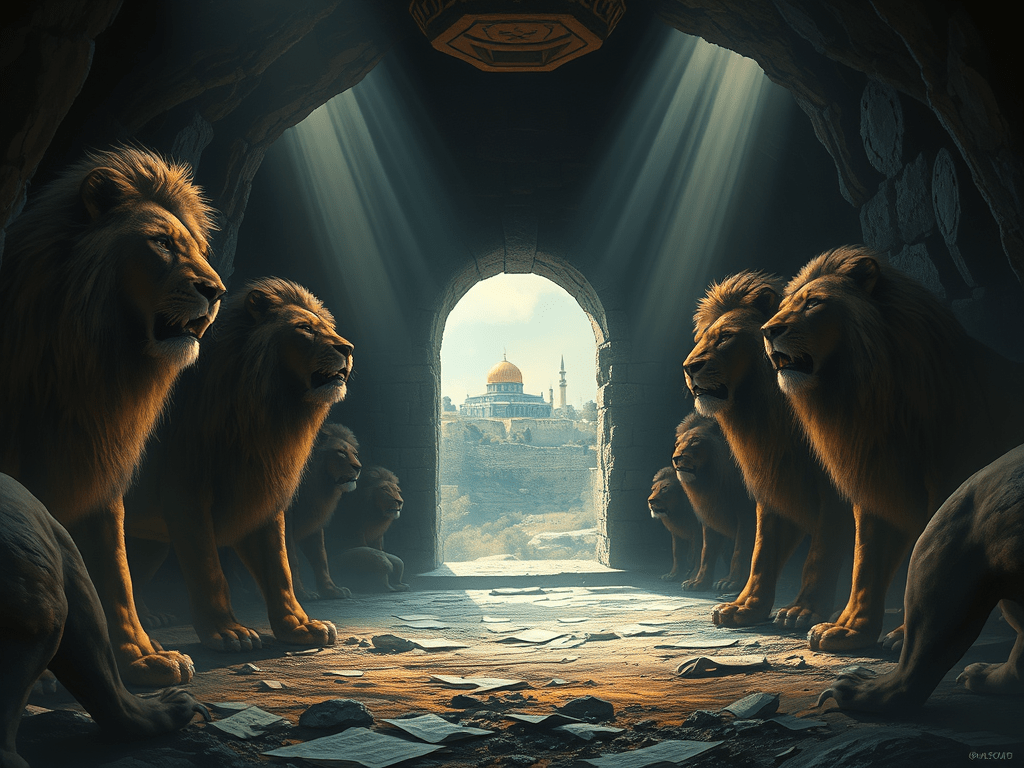
    I used to think the story of Daniel in the lions’ den was a children’s tale—flannelgraph heroes, cartoon lions, happy ending. Then I grew up and discovered the lions have grown up too. They have new names now: anxiety, pornography, rage, cancer, divorce papers, a child who no longer speaks your name, a culture that laughs at prayer. The den is real. The stone over the mouth of the pit is heavy. And the decree, signed by a thousand invisible kings, still cannot be revoked.

    But the Church, in her ancient wisdom, keeps putting this reading in front of us right when we need it most. And every time she does, she is telling us the oldest and truest story humanity has ever been told.

    Joseph Campbell spent his life mapping it. Hollywood makes billions retelling it. Jesus lived it perfectly. It has a name: the Hero’s Journey. And right now, whether you asked for it or not, you are on it.

    Stage 1: The World Out of Balance

    Every adventure begins with a wound in reality.

    In Babylon it was an idolatrous decree: “For thirty days, no one may pray to any god or human except the king.” The ego had crowned itself God.

    In today’s Gospel, Jesus speaks of Jerusalem surrounded by armies, the holy city trampled, cosmic powers shaken. The sacred center collapses.

    Sound familiar?

    Our world signs the same decree every day: “Thou shalt not pray. Thou shalt not be still. Thou shalt scroll, produce, perform, numb, repeat.”

    We feel the armies at the gates. We hear the lions pacing.

    Stage 2: The Belly of the Whale

    Then comes the moment every hero dreads: the night-sea journey, the descent into the place where human power ends.

    A stone is rolled over the mouth of the pit. Darkness. Silence. The smell of wild beasts.

    Modern neuroscience has a clinical name for it: the moment the amygdala hijacks the brain and the prefrontal cortex—the part that plans, hopes, prays—goes offline. Fight, flight, freeze. The lions roar.

    And yet Daniel prays. Three times a day, even in the den.

    Contemplative prayer, researchers now tell us, does something wild: it thickens the very prefrontal regions that fear tries to shut down. Faith literally rewires courage into the brain.

    Stage 3: The Supernatural Aid

    In the deepest dark, a Presence arrives.

    “My God sent his angel and shut the lions’ jaws.”

    The same angel who will calm a storm on Galilee.

    The same Presence who will breathe on trembling apostles: “Peace be with you.”

    Grace does not always remove the trial. Grace enters it. The lions are still there. But they fast today.

    Stage 4: The Return with the Boon

    Morning comes. The stone is still sealed, yet Daniel walks out without a scratch.

    King Darius—pagan, powerful, sleepless with anguish—writes to every nation under heaven:

    “The God of Daniel is the living God… He saves and rescues… Let all tremble and fear before Him.”

    The hero never returns for applause. The hero returns carrying a gift the world is dying for: living proof that something is stronger than death.

    The Gospel’s Astonishing Twist

    Re-read Luke 21 with this story in your bones and you will never hear it the same way again.

    Jesus is not predicting doom for doom’s sake. He is describing the identical pattern:

    • Armies at the gates
    • Cosmic distress, people “dying of fear”
    • And then: “They will see the Son of Man coming… When these things begin to take place, stand erect and lift up your heads, because your liberation is drawing near.”

    Stand erect.

    That is not a survival tip. That is resurrection posture.

    Your Den, Your Angel, Your Witness

    You are in the den right now.

    The lions have your scent. The stone is heavy.

    But the same God who sent His angel to a Jewish exile in Babylon has not changed His strategy.

    So here is the only spiritual formation plan that has ever worked:

    Tonight, set a timer for three minutes.

    Get on your knees (or sit if the body protests).

    Name the lions out loud. Speak the fear.

    Then pray one Our Father slower than you have ever prayed it in your life.

    Feel the amygdala roar. Keep praying anyway.

    That is the precise moment the angel shuts the lions’ mouths.

    Do it tomorrow. And the next day. Thirty days if necessary.

    Because the spiritual life is not a technique to feel better.

    It is a death and resurrection that rewires your brain, reorders your desires, and turns you into a walking sign that the God of Daniel still “saves, sets free, and works signs and wonders in heaven and on earth.”

    When the culture collapses, when the diagnosis comes, when the child walks away, when the sun and moon go dark—do not cower.

    Stand erect. Lift up your head.

    The world is waiting for someone who has come out of the den unharmed to tell them the terrifying, glorious truth:

    There is a living God.

    And He is stronger than the lions.

    Your liberation is drawing near.

    And through you, someone else’s just might be too.

    Developed with assistance from Grok AI

  • ⚖️ Weighed and Found Wanting: The Fatal Mistake of Hubris

    ⚖️ Weighed and Found Wanting: The Fatal Mistake of Hubris

    Why Your Greatest Gifts Can Become Your Greatest Danger

    The story of King Belshazzar is the story of every person who has ever looked at their talents, their success, or their good fortune and thought, “This is mine. I earned it. I control it.”

    It’s the story of Hubris—that fatal, self-centered mistake that comes before the fall. Our readings today (Daniel 5 and Luke 21) show us the anatomy of this spiritual disease and reveal the only cure: active, enduring faithfulness.


    1. The Party and the Problem: The Banality of Blasphemy

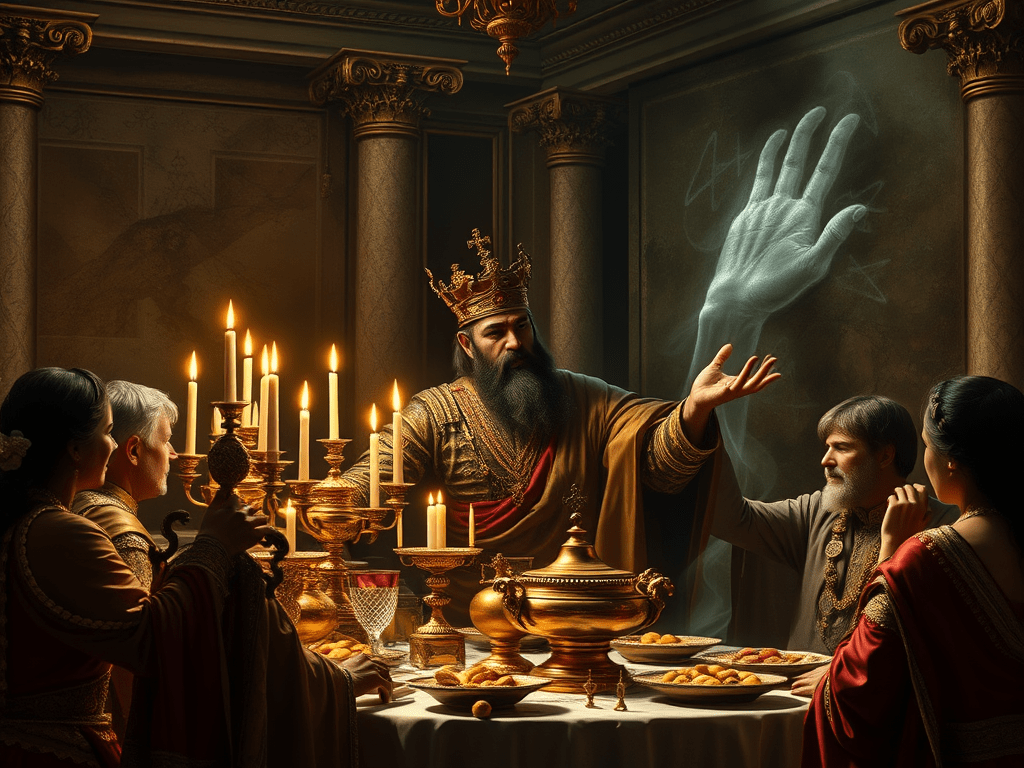
    King Belshazzar, in our first reading, throws a magnificent, drunken banquet. His act of blasphemy is not a simple mistake; it’s a defiant spectacle. He demands the holy gold and silver vessels looted from the Temple in Jerusalem be brought out and used for a pagan party.

    This is the spiritual state of radical entitlement. Belshazzar treats the holy (gifts from God) as merely a trophy for his own ego.

    The Psychology of Entitlement

    This is what happens when the Adversary’s whisper takes root: it convinces us that our talents, our wealth, and our relationships are entirely our own doing, meant solely for self-gratification.

    But at the height of his pride, the visible world breaks down: “Suddenly the fingers of a human hand appeared, and began to write on the plaster of the palace wall.”

    The writing is the ultimate accounting of a life lived without reference to the sacred:

    • Mene: Your power has been measured and ended.
    • Tekel: You have been weighed in the balance and found wanting.
    • Parsin: Your kingdom has been divided and lost.

    Belshazzar failed because he refused to glorify the God who held his breath and all his fortunes in his hands. His life, measured against the standard of the sacred, collapsed.


    2. The Hero’s Forge: The Necessity of Endurance

    If Belshazzar’s downfall is the consequence of Hubris and Pride, the Gospel (Luke 21) provides the antidote: Endurance and Trust.

    Jesus tells His disciples not of palaces, but of persecution, betrayal, and even death. This is the moment in the Hero’s Journey where the hero is stripped bare, entering the chaotic belly of the whale where all external support is lost.

    In the face of this absolute chaos, Jesus gives two counter-intuitive commands:

    1. Don’t Prepare Your Defence: Jesus commands us to relinquish the primal urge to control the narrative. Our brain, our ego, wants to be prepared, to argue, to win the court case. But He says, “I myself shall give you an eloquence and a wisdom…” We are called to suppress our own iron strength and rely on the Holy Spirit’s divine wisdom.
    2. Endure: The ultimate secret to salvation is revealed: “Your endurance will win you your lives.” Endurance is not passive survival. It is the active, faithful confrontation with suffering—a sustained posture of obedience that forges character and secures the soul.

    3. The Call to Live with Consecration

    We are called to move past the judgment of the decadent palace and into the endurance of the faithful disciple.

    A. Examine Your Holy Vessels

    Where are you taking the consecrated gifts God gave you—your time, your talents, your intelligence, your relationships—and treating them as merely trophies for your own consumption?

    • Do you use your intelligence to build yourself up, rather than to serve the Truth?
    • Do you treat your days off simply as hours for personal indulgence, rather than a chance to glorify God and love others?

    All we have is a consecrated vessel, a gift from God. The shift begins when we recognize this truth and use our gifts for their intended, holy purpose.

    B. Stay Awake in the Chaos

    The Gospel Acclamation instructs us: “Stay awake, praying at all times for the strength to stand with confidence before the Son of Man.”

    The courage to endure is won in the small battles:

    • In the willingness to suffer a slight and not seek immediate revenge.
    • In the resolve to remain faithful to your commitments when they become boring.
    • In the continuous choice to seek God’s wisdom instead of relying on your own prepared script.

    Do not be afraid of the chaos. It is merely the process by which God measures our foundations. Let us stand with confidence, relying not on our own power, but on the wisdom and eloquence of Christ, so that when our lives are weighed, we may be found faithful.


    Discussion Prompt:

    What is one “holy vessel” (a gift, talent, or resource) in your life that you have been treating like a “trophy” for your own pride or indulgence? What is one concrete action you can take this week to reconsecrate it to God’s purpose?

    Share your commitment below.

    Developed with assistance from Gemini AI, ChatGPT-5 and GROK 4.1

  • Jordan Peterson on Evil, the Devil, and the Adversary

    This question gets to the heart of Jordan Peterson’s symbolic theology—where psychology, myth, and moral action converge.

    While he doesn’t always use theological language in a traditional way, Peterson treats the figures of the Adversary, the Devil, and evil itself as deeply connected. For him, they are not only real in myth or metaphor—they’re real in action, consequence, and the shaping of the human soul.

    Here’s how Peterson understands the relationship between evil and the Adversary:


    🔥 The Devil = The Adversary = The Embodiment of Evil


    1. The Adversary (Satan as “the Accuser”)

    Peterson draws from the original Hebrew word for Satan: ha-satan — meaning the adversary, or the accuser.

    In this role, Satan is:

    • The one who challenges God’s creation,
    • The voice that sows doubt and despair,
    • The force that tempts people to betray what is true and good.

    For Peterson, this isn’t just an external figure. It’s an inner voice:

    “The adversary is the spirit that accuses Being itself. It says: ‘This is all worthless. This is all terrible. Life is suffering. And the best thing you could do is bring it all to ruin.’”

    This is the psychological root of nihilism, cynicism, and destructive resentment.


    2. Evil as Participation with the Adversary

    Evil, in Peterson’s framework, is not just a passive condition. It’s a choice to align with the Adversary.

    This alignment happens when a person:

    • Willfully lies (especially to themselves),
    • Resents life and refuses responsibility,
    • Intentionally harms others—out of spite, ideology, or envy.

    He often uses the story of Cain and Abel to illustrate this:

    Cain doesn’t just kill Abel—he kills him because he resents God, resents goodness, and blames reality itself. Cain acts like the Adversary.


    3. The Devil as Psychological and Metaphysical Reality

    Peterson doesn’t insist on a literal horned being. But he insists the Devil is real enough—as a pattern of thought and behavior that can possess individuals, movements, and nations.

    “You can act like the Devil. And if enough people do that at once, then something like the Devil emerges.”

    The Devil, then, is the archetype of:

    • The destroyer of meaning,
    • The father of lies,
    • The voice that says: “Tear it down. Burn it all.”
    • The spirit behind genocide, cruelty, and totalitarianism.

    This makes evil both a personal and cultural force—something we resist in ourselves and in the world around us.


    4. Christ as the Antidote

    For Peterson, the figure of Christ stands in radical opposition to the Adversary.

    Christ is:

    • Truth instead of lies,
    • Voluntary suffering instead of resentment,
    • Redemption instead of destruction,
    • The one who “carries the cross” rather than curse the world.

    In this sense, Peterson views the story of Christ not only as religious truth, but as an existential guide for resisting evil—within the self and in society.


    🧭 In Summary

    TermPeterson’s Meaning
    The Adversary / SatanThe archetype of rebellion against Being; the accuser, the destroyer of meaning.
    EvilThe conscious choice to align with the Adversary; rooted in resentment and lies.
    The DevilThe psychological and spiritual force that embodies malevolent destruction.

    💬 What Do You Think?

    Do you agree with Peterson’s view that evil begins with self-deception and resentment?
    Can “the Devil” be real—even without being literal?

    Leave a comment below. I’d love to hear your thoughts.

    And if you found this reflection meaningful, feel free to subscribe or share it with someone who might appreciate a deeper look at good, evil, and the battle between them.

    Written with assistance of ChatGPT

  • Men -vs- Women Adversarial Roles:

    Fascist or Decadent? How Men and Women Go Astray When They’re Wounded

    If men become adversarial, are they more likely to turn fascist or decadent? And what about women?

    That’s not just a sharp question. It’s the kind of question that reveals fault lines running through our culture — and through every soul.

    To answer it, we have to step back and look at two patterns that show up again and again in myth, history, and personal life.


    The Two Forms of Collapse

    Let’s define the two distortions:

    • Fascist (archetypally): Obsessed with order, control, uniformity. Often justified by appeals to lost glory or sacred duty. Prone to enforcing discipline without mercy — in the name of survival, stability, or purity.
    • Decadent: Disordered, self-indulgent, emotionally chaotic. Often cloaked in the language of self-expression, freedom, or authenticity. Prone to rejecting all restraint — in the name of healing, pleasure, or liberation.

    Both are forms of resistance to reality. Both distort something noble.


    Men and the Fascist Drift

    When men go adversarial — when they feel wounded, disrespected, or lost — they’re more likely to veer toward fascist patterns.

    Why?

    Because chaos terrifies men. And when they don’t have purposeful order, they often try to impose rigid order. That might look like:

    • Authoritarian posturing
    • Rigid hierarchy worship
    • Framing every disagreement as war
    • Controlling others “for their own good”

    It’s a fear-based overcorrection. When healthy strength is lost, they reach for tyrannical strength. They choose control over vulnerability.


    Women and the Decadent Drift

    When women go adversarial — when they feel unseen, trapped, or used — they’re more likely to veer toward decadent patterns.

    Why?

    Because stagnation and entrapment terrify women. And when they don’t have meaningful freedom, they often seek radical freedom, even if it becomes destructive. That might look like:

    • Romanticizing self-indulgence
    • Rejecting moral norms as “oppressive”
    • Treating transgression as empowerment
    • Disowning duty or commitment

    It’s a freedom-based rebellion. When healthy expression is lost, they reach for chaotic reinvention.


    But These Aren’t Rigid Rules

    Of course, men can be decadent — passive, addicted, emotionally absent. And women can be fascist — hyper-controlling, moralizing, even cancel-driven.

    What we’re describing are archetypal tendencies — not destiny.

    And most importantly: these distortions arise from wounds.

    • The fascist man is often trying to protect something — but without love, his “protection” becomes domination.
    • The decadent woman is often trying to reclaim her self — but without truth, her “freedom” becomes chaos.

    The Real Battle Is Inside

    The adversary isn’t just out there. He’s in you. She’s in you. Every human faces the temptation to twist good desires into destructive reactions.

    The answer isn’t to shame men for craving order or women for craving freedom. The answer is to redeem those impulses:

    • Let men protect — with strength and humility.
    • Let women express — with courage and wisdom.

    This is the true Hero’s Journey for both sexes: to face the adversarial energy in the self, and bring it back into alignment with truth, love, and purpose.


    Because when we refuse that journey, we don’t become free. We become lost.

    Developed with assistance from ChatGPT

  • Why Does the Adversary Hate the Unknown?

    What happens when we reject the journey that brings life.

    Q: Why does Jordan Peterson say the Adversary “shrinks from contact with everything he does not understand”?

    A: Because this refusal — to face the unknown — is the root of spiritual death.

    Let’s look at what Peterson is revealing here, and why it’s one of the deepest warnings in Maps of Meaning. It shows us what happens when a person rejects mystery, transformation, and the journey into life itself.


    🔍 Who is the Adversary, really?

    Peterson describes the Adversary not just as a villain in myth — but as a spiritual attitude. A mindset. A posture toward reality.

    “He is the spirit of unbridled rationality.”

    That’s not reason rightly ordered. It’s rationality divorced from wisdom — cut off from the sacred, the mysterious, and the transformative.

    The Adversary is the one who:

    • Clings to control
    • Fears uncertainty
    • Hates the unknown

    He’s brilliant — but brittle. Calculating — but closed. He does not step into the unknown to be transformed. He does not drink the Water of Life.

    Instead, he “shrinks from contact with everything he does not understand.”


    💧 The Water of Life — and the Shrinking Soul

    The “Water of Life” is mythic language for what revives, renews, and regenerates us. It’s symbolic of:

    • Vitality
    • Transformation
    • Creative renewal
    • Truth born from suffering
    • Contact with the deep unknown

    The Hero drinks from it — because he goes into chaos, confronts what he fears, and emerges changed.

    The Adversary avoids it — and becomes stagnant.

    He grows rigid. Authoritarian. Cynical. Over-controlling. He tries to engineer out risk, eliminate uncertainty, and deny mystery.

    He becomes not just hostile to others — but resentful of life itself.


    📖 The Pattern in Myth

    You’ve seen this figure before:

    • Lucifer in Paradise Lost
    • Mephistopheles in Faust
    • Sauron in The Lord of the Rings
    • Cain in Genesis

    Each one refused transformation. Each tried instead to dominate reality with a vision too small for the human soul.

    That’s the Adversary. And he lives in us too.

    Whenever we say:

    • “I don’t need to change.”
    • “I already know enough.”
    • “I refuse to face that pain.”

    …we flirt with his path.


    🧭 What If You Can’t Go on an “Adventure”?

    Here’s the good news: you don’t need to travel far to confront the unknown.

    If you’re wrestling with truth, asking hard questions, or facing fears you once avoided — you’re already doing it.

    The truest adventure isn’t about escaping your life — it’s about transforming within it.

    That’s the path the Adversary refuses. But the Hero takes it. And so can you.

  • Why Does the Adversary Fear the “Water of Life”?

    Q: When Jordan Peterson talks about the Adversary shrinking from the “Water of Life,” is he referring to the human need to seek knowledge in the unknown?

    A: Yes — and that’s a profound insight you’ve picked up on.

    Peterson draws heavily from myth, depth psychology, and religious symbolism to talk about what it means to be human. When he speaks of the “Water of Life,” he’s speaking in metaphor — and that metaphor points straight to the kind of knowledge that transforms us.


    1. The “Water of Life” = Transformative Knowledge

    Across myths and sacred stories, the “Water of Life” shows up again and again. It’s not just a drink — it’s a symbol of:

    • Renewal
    • Resurrection
    • Deep healing
    • Psychological and spiritual transformation

    In Peterson’s framework, this “Water” represents truth that’s been earned — the kind of truth you only gain by venturing into chaos, facing suffering, and confronting the unknown.

    It’s what the hero brings back from the underworld: new insight that changes him — and the world around him.


    2. The Hero Seeks It — The Adversary Shrinks From It

    This is the dividing line between good and evil in Peterson’s mythological map.

    • The hero steps into the unknown, risks suffering, and returns with hard-won wisdom — the “Water of Life.”
    • The Adversary (or tyrant, or devil) refuses to go. He shrinks back. He fears it.

    Why?

    Because real knowledge threatens false structures:

    • It exposes the lie.
    • It dissolves illusions.
    • It breaks the chains of stagnation, fear, or control.

    The Adversary — whether a dictator, a corrupt institution, or the inner cowardice we all face — depends on keeping things frozen. Change is death to his world.

    And the “Water of Life” brings change.


    3. We Are Built to Confront the Unknown

    Peterson insists: Every human being is designed to move toward the unknown. That’s not just a philosophical idea — it’s a deep truth about how we’re wired:

    We are made to step beyond the familiar, engage with chaos, and return with meaning.

    That’s the Hero’s Journey in every great story — and in our lives.

    But there’s always a voice whispering, “Stay small. Stay safe. Don’t go.”

    That’s the Adversary inside of us — the part that fears growth, fears truth, and avoids responsibility. The part that shrinks from the “Water of Life.”


    The Takeaway

    The “Water of Life” is symbolic of the deep, transformative knowledge found in the unknown.
    The Hero seeks it. The Adversary rejects it.
    And each of us must choose which voice we’ll follow.

    Peterson’s point is simple but piercing: The cost of growth is real — but the cost of avoiding it is far greater.