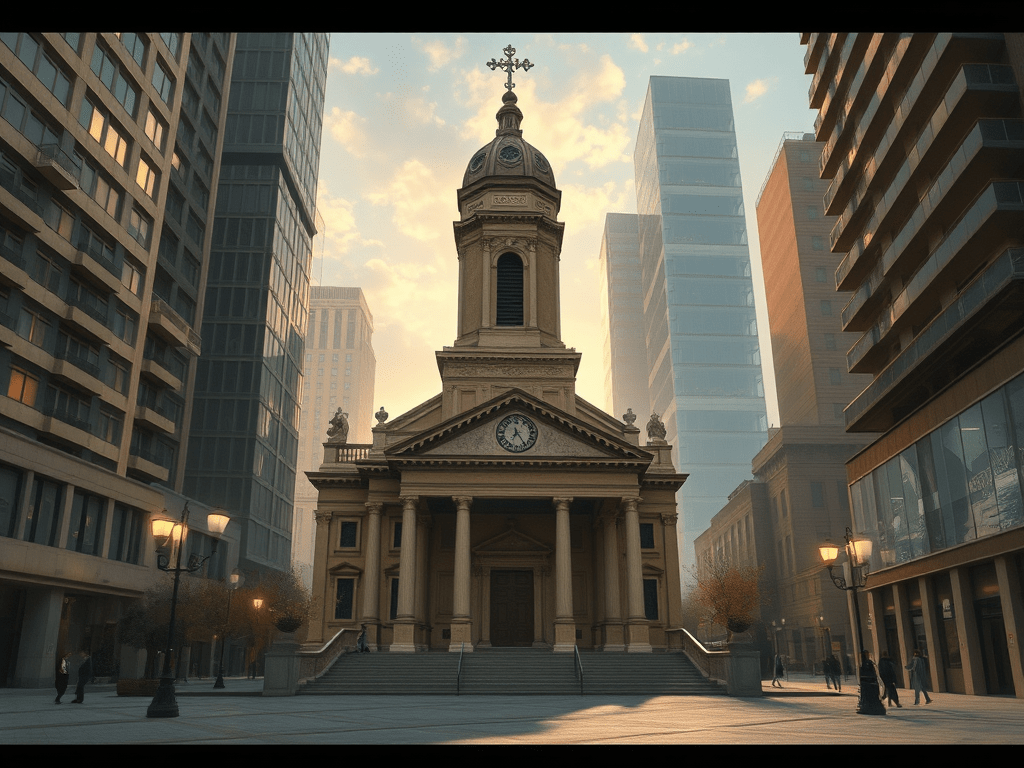
They are experiencing Christianity as joy and hope, having thus become lovers of Christ.

Category: GTC

Gemini AI generated Categories

  • Wrestling With Ideas:

    Wrestling With Ideas:

    The Church, Orthodoxy, and the Spirit of the Age

    The Catholic Church has always carried a dual responsibility: to guard the deposit of faith and to protect the faithful from error. This task, though divinely entrusted, is carried out by human beings. And like every human institution, the Church is not immune to the influence of surrounding cultures, philosophies, and political theories.

    That tension is felt most keenly when the Church seems to “experiment” with new ways of speaking, teaching, or practicing the faith. At times, these efforts are seen as an attempt to incorporate temporal or even ideological ideas — the kind that history shows do not last. The question, then, is how to distinguish between legitimate development and dangerous dilution.

    One way modern thought often frames progress is through the lens of “thesis–antithesis–synthesis.” First articulated by Hegel and later adapted by Marx, this model suggests that truth advances by the clash of opposing ideas, resolved in a new synthesis. While this might apply in politics, economics, or philosophy, it becomes dangerous when applied to divine revelation.

    God’s truth is not simply another “thesis” waiting to be refined by the latest cultural antithesis. It is the anchor. To treat it otherwise risks diluting eternal truth with passing ideologies.

    Yet history also shows that false ideas, however seductive, tend to collapse under their own weight. They rise, attract attention, and then falter. In their wake, the Church often emerges with a clearer understanding of why such ideas fail. The cost, however, is real: confusion among the faithful, weakened trust, and even generations turning away.

    And still, God allows this wrestling. He permits both the Church and individuals to struggle with competing voices. In the end, truth endures. Consider St. Faustina, St. Bernadette, and St Juan Diego with Our Lady of Guadalupe. Each faced skepticism or outright rejection from Church leaders of their time. Yet their authentic messages bore fruit, purified by trial, and confirmed by their endurance.

    Perhaps this is the deeper lesson: God uses even tension, error, and conflict as a refining fire. What is temporal passes away; what is eternal remains. And in that promise we find hope — for the gates of hell shall not prevail.

    For Catholics today, the task is not to despair when the Church seems to flirt with every new “synthesis.” The task is to hold fast to Christ, to the tradition handed down, and to the lived witness of the saints. Orthodoxy is not fragile; it does not need to reinvent itself in each generation. It needs only to be lived, courageously and faithfully, in every age.

    Developed with assistance from ChatGPT-5

  • Humility Means Staying Close to the Ground

    Lessons from Jiu Jitsu, Scripture, and the Hero’s Descent

    We often think of humility as weakness, but it is really a strength. In a talk I heard today, the speaker said humility means being close to the ground. He used the example of Jiu Jitsu, a martial art strongest when practiced low to the floor.

    That picture opened other connections for me. Jordan Peterson has said that human beings were originally tree creatures — we stayed off the ground because it was unsafe. In myth, the “deep” often represents chaos — the water where danger and the unknown dwell.

    The hero, however, is the one willing to descend. He steps down into the unknown, into danger, into the deep, to face the dragon and gain something new. Humility is not about weakness; it is the stance of someone willing to learn.

    The adversary, in contrast, is proud. He refuses to bow, refuses to learn, and stays aloof from the ground.

    Where is God asking you to “stay close to the ground,” to take the low and humble place so you can learn what you need?

    Developed with assistance from ChatGPT-5

  • Seen by Angels:

    Living Beyond the Judgment of Men

    We live in a culture that often tells us to measure our worth by the crowd. Social approval, likes, recognition, and applause are treated as the highest rewards. But if we stop and think about it, this is a very poor exchange. Why should the noblest part of our nature — our spiritual life — be subjected to the judgment of those who neither see nor understand it? Why should the holiness that comes from God be measured by those who walk the broad road of sin?

    The flesh cannot judge the spirit. The sinner cannot measure the elect of God. Yet so often, instead of looking upward to God for approval, we look downward to men for validation. When we do this, we dishonor ourselves and cheapen the very excellence of our calling.

    Faith opens our eyes to a higher audience. The apostle Paul reminds us that it is not only the world who sees us — we are also “seen by angels” (1 Timothy 3:16). These heavenly beings, who are far stronger and purer than us, watch our lives with interest. They are not spectators who jeer or mock but companions who minister, encourage, and serve.

    Paul even goes further: God has chosen to display His wisdom to the heavenly realms through the Church itself (Ephesians 3:10). When we live faithfully, our actions ripple beyond the visible world. They become testimonies to powers and principalities, signs of God’s glory unfolding through His people.

    This changes everything. When we were baptized, we were not only united to Christ but brought into a hidden fellowship — “an innumerable company of angels” (Hebrews 12:22). We share in their hidden life, their worship, and their service. Like them, our lives are often hidden, unseen by the world. But just as they are present to God, so too are we.

    That’s why Paul exhorted Timothy not just to obey in view of God, but also in the sight of the angels (1 Timothy 5:21). Imagine how different our lives would be if we truly believed this. Even in our most private deeds, even in our most carefully guarded solitude, we are not alone. We are witnessed by heaven.

    This awareness is not meant to make us fearful but to give us dignity. The world may mock, ignore, or misunderstand, but our lives are valuable in the sight of God and His holy angels. We are never abandoned, and we are never unseen.

    So, the next time you feel the pull to lower yourself to the judgment of men, remember this: you are seen by angels. Live for the audience of heaven, not the applause of earth.


    👉 Reflection Question for Readers:
    How might your daily life change if you remembered that every choice, even the smallest, was witnessed by God and His angels?

    John Henry Newman, The World’s Benefactors, Parochial and Plain Sermons, Vol. 2, Sermon 1. Read it online

    Developed with assistance from ChatGPT-5

  • When the Church Faces Crisis:

    How Truth Endures Through the Ages

    Every age of the Church has faced storms. At times the threats came from outside — persecution, ridicule, or hostile powers. Other times, the threats rose from within — confusion, corruption, false teaching. In those moments, it has often seemed as though the very foundations of faith were shaking. Yet again and again, God has used such crises not only to purify His Church but also to raise up saints who held fast to the truth.

    The Arian Crisis

    In the 4th century, much of the Church was swept away by the Arian heresy, which denied the full divinity of Christ. Bishops, emperors, and even entire regions sided with this distortion of the Gospel. Ordinary Christians found themselves wondering if the faith had been lost. Yet in that dark moment, figures like St. Athanasius stood firm, even at the cost of exile and persecution. Through their fidelity, the true doctrine of Christ was preserved, and the Church eventually emerged stronger, with the Nicene Creed as a lasting testament to truth.

    The Reformation

    In the 16th century, the Church faced one of its greatest upheavals: the Protestant Reformation. Corruption and abuses within the hierarchy had already shaken confidence in the institution. When Luther and others rose up in protest, their grievances quickly grew into theological revolts that shattered Christian unity in the West. Millions were swept into schism, and faith in the Church as a visible sign of unity seemed broken. Yet even in this turmoil, saints like St. Ignatius of Loyola, St. Teresa of Ávila, and St. Charles Borromeo rose up. They called the Church not to abandon her foundations, but to reform by returning to holiness, clarity of doctrine, and fidelity to Christ. Their witness helped bring about the Counter-Reformation, a renewal that revitalized Catholic life and mission for centuries.

    The Modernist Crisis

    Fast forward to the late 19th and early 20th centuries, when Modernism threatened the heart of Catholic thought. It claimed to “update” Christianity by reducing it to psychology, sociology, and human opinion, stripping away the mystery of divine revelation. Pope St. Pius X saw this as “the synthesis of all heresies,” and his strong response preserved the faith against being dissolved into mere philosophy. Out of this struggle emerged renewed clarity on the relationship between faith and reason, paving the way for later theological developments that were both faithful and fruitful.

    What This Means for Us Today

    Looking back, one thing is clear: whenever the Church has faced crisis, some have fallen away. The faith of many proved shallow or dependent on the approval of the age. Yet at the same time, crises have always forged saints — men and women who stood firm, who refused compromise, and who became living lights for future generations.

    We should not be surprised if our own time feels like such a crisis. The Church wrestles with new pressures: secular ideologies, internal confusion, and a temptation to water down truth in the name of relevance. Some may lose their way. But God is not defeated. He is, even now, raising up saints.

    The question for us is: Will we be among those who fall away, or among those who stand firm? History shows that when the storm passes, it is always those who clung to Christ — simply, humbly, and faithfully — who carried the Church through.

    Developed with assistance from ChatGPT-5

  • Ancestors, Spirits, and the World of Meaning:

    A Biblical and Petersonian Reflection

    1. The Ancient World of Meaning

    In ancient times, the spiritual and the meaningful were one and the same. What we might call “psychological phenomena” today—thoughts, memories, inner voices—were not seen as internal or private. They were experienced as coming from beyond oneself, from the realm of the spirits.

    When a person remembered the voice of a father, mother, or teacher, it was not merely a recollection. It was heard as the voice of a living presence. In Peterson’s terms, the world of meaning was populated with spirits. Words spoken aloud and words heard inwardly carried the same spiritual weight.


    2. Reason as the Highest Spirit

    Jordan Peterson notes that ancient traditions spoke of “Reason as the highest angel.” This was not a metaphor in the modern sense. Reason itself was seen as a transcendent spirit that could guide, protect, and order one’s life. In the ancient imagination, the ability to reason was not a mere mental function—it was a divine presence within the hierarchy of spirits.

    In biblical theology, this insight resonates with the understanding of God’s Word (Logos) as the ordering principle of creation: “In the beginning was the Word… and the Word was God” (John 1:1). The highest “spirit” of Reason finds its fulfillment in Christ, the eternal Logos, who brings light to human thought.


    3. Ancestors, Memory, and Spirit Voices

    Consider the act of recalling advice from a grandparent. In the ancient world, this was not simply remembering. It was an encounter with their living presence through spirit. A remembered phrase might even come in the voice of the departed loved one, as though spoken anew.

    We still experience this today. A sudden memory, a phrase rising unbidden in the mind, can feel like a message received. In Peterson’s language, this is the psyche encountering the structures of meaning embedded in past relationships. In biblical language, this can be seen as memory participating in the communion of saints—the ongoing presence of those who have gone before us.


    4. From Memory to Worship: Where It Went Wrong

    But here lies the danger. What begins as memory or reflection can become worship. Many cultures formalized ancestor reverence into ritual sacrifice, prayers directed to the dead, or attempts to control the spirit world.

    The Bible consistently warns against this. Why? Because when spirits, ancestors, or inner voices are elevated to the place of divine authority, they usurp God’s rightful place. “You shall have no other gods before me” (Exodus 20:3).

    The Christian understanding is not that memory or honoring one’s ancestors is evil, but that worship belongs to God alone. Christ alone mediates between the human and the divine. The wisdom of our ancestors is real and meaningful—but it must be discerned in the light of God’s Word, not treated as an autonomous source of salvation.


    5. Toward a Biblical Integration

    From a Petersonian perspective, the voices of the past are structures of meaning that guide and warn us. From a biblical perspective, they can be part of God’s providence, reminding us of truth. But they are not to be worshipped as gods.

    Instead, they are to be received as gifts within the larger order of God’s Logos. The “world of spirits” points to the deeper reality that all meaning finds its source in God. The living Word, Christ, is the fulfillment of Reason as the highest angel—the true voice that interprets all other voices.


    Invitation to Reflect

    Have you ever experienced a memory or inner voice that felt more like a message than a thought? How do you discern whether it is meaningful, misleading, or truly from God?

    Share your reflections in the comments below. And if you found this exploration helpful, consider liking, sharing, and subscribing to stay connected as we continue exploring the world of meaning through both ancient and biblical eyes.

  • Pilgrim and Hero: Two Paths, One Journey

    How the pilgrimage and the hero’s journey reveal our call to transformation

    When we speak of journeys, two powerful images come to mind: the pilgrim’s pilgrimage and the hero’s adventure. At first glance, these seem like very different paths. The pilgrim walks slowly toward a holy shrine, while the hero marches boldly into battle or descends into the unknown. Yet the more closely we look, the more we see that these two journeys are deeply connected.

    The Pilgrim’s Path

    A pilgrimage is a journey toward God. The pilgrim leaves behind the comfort of home, accepts hardship, and moves step by step toward a sacred goal. Along the way, he is changed—not only by the external trials of the road, but by an inner transformation. His destination is not simply a place but a Person: the living God who calls him deeper into union with Himself.

    The Hero’s Journey

    By contrast, the hero’s journey, as told in myth and story, is a passage into trial, danger, and transformation. The hero departs from the ordinary world, faces challenges, suffers losses, confronts evil, and returns home with new strength or wisdom to share. Though not always framed in religious language, the pattern points to something higher: that true growth requires leaving safety, facing suffering, and returning transformed.

    How the Two Overlap

    Looked at side by side, the pilgrim and the hero seem to walk parallel roads:

    • Departure – Both leave behind the ordinary world
    • Trial – Both endure hardship, temptation, and loss.
    • Transformation – Both emerge changed by what they encounter.
    • Return – Both bring something back: the pilgrim brings blessing, the hero brings wisdom.

    The difference lies mainly in their destinations:

    • The pilgrim walks toward God and the holy.
    • The hero seeks victory, meaning, or renewal.

    But even here, the two roads converge. For the Christian, every true quest for meaning ultimately points toward God, whether or not the hero realizes it.

    Can a Pilgrim Be a Hero?

    Yes. The pilgrim shows heroism not by slaying dragons, but by enduring the long road, the weariness of the body, and the trials of the spirit. His courage lies in perseverance, in choosing God above comfort, in taking one more step toward the holy.

    Can a Hero Be a Pilgrim?

    Yes again. Even when a hero is not explicitly walking to a shrine, his journey mirrors pilgrimage. His battles are stations on the way. His quest is a hidden search for the sacred. His transformation is a kind of conversion. In this way, the hero is a pilgrim without realizing it—walking toward the same mountain, but naming it differently.

    Two Roads, One Mountain

    Every pilgrim is a hero. Every hero is a pilgrim. One sets his eyes clearly on the shrine of God; the other may name his quest as truth, wisdom, or meaning. Yet in the end, both are called beyond themselves, both must pass through trial, and both are changed in the journey.

    And perhaps this is why these two images—pilgrim and hero—speak so powerfully to us. They remind us that every human life is a journey. Every road leads through suffering and transformation. And every true journey, if followed faithfully, brings us closer to the One who waits at the summit.

    ✨ What do you think? Can a pilgrim be heroic? Can a hero be a pilgrim? Share your thoughts in the comments below.
    If this reflection spoke to you, please like, share, and subscribe so others can join the journey.

    Developed with cooperation from ChatGPT

  • Are You Truly Awake?

    Are You Truly Awake?

    Why Faith Needs Daily Self-Denial

    “Now it is high time to awake out of sleep.” — Romans 13:11

    Many of us go through life half-awake—spiritually asleep without realizing it. We may hear the truth, see God’s work in the world, even attend church—but we live as if it’s all just background noise. We mix reality with imagination, and even brief awakenings fade quickly.

    In earlier times, faith was tested by persecution. Early Christians showed courage and joy in suffering because truth demanded sacrifice. Today, faith is easier to display. Religion is respected, even fashionable. Outward appearances of devotion—family prayer, Bible reading, church attendance—are common.

    But here’s the danger: it’s easy to follow God for the wrong reasons—social approval, habit, convenience—rather than love. True faith often goes against the crowd. The Gospel challenges human nature. Real discipleship isn’t about looking good in public; it’s about living rightly when no one is watching.

    So how do we know our faith is real? Jesus gives the answer: self-denial. “If anyone would come after Me, let him deny himself, take up his cross, and follow Me.” (Mark 8:34) Faith is tested not in heroic moments but in daily choices—small sacrifices, resisting laziness, controlling anger, yielding in minor matters, or doing what’s inconvenient for God’s sake.

    Look at your weakest points—your temptations, habits, and hidden struggles. That’s where your cross is. That’s where your faith is proven. Small, consistent acts of self-denial—fasting, discipline, service—train your heart and strengthen your will for greater challenges.

    Even the best of us fail. That’s why we need constant repentance, Christ’s forgiveness, and the guidance of the Holy Spirit. But if we take obedience seriously, faith becomes alive. We awaken fully, living each day for God, confident in His grace and presence.

    Wake up. Take up your cross daily. Live as if your faith truly matters—and watch your life transform.

    Reference:

    Newman, John Henry. Sermon 5: Self-Denial the Test of Religious Earnestness. Newman Reader — Works of John Henry Newman. National Institute for Newman Studies, 2007.

    Developed with assistance from ChatGPT

  • 10 REASONS TO SEEK JESUS

    1. Jesus Christ is the perfection of man, because He is the perfection of love. If we wish to be the best we can be, we must aspire to be like Christ. However, we will not be able to achieve this on our own.
    2. When we invite Christ into our lives, He becomes present in and through us. Thus, while we are hopeless sinners, we become carriers of the perfection of man. In fact, there is no place for pride, because all the good we do comes from Him. We cannot take credit for it.
    3. Through His grace we overcome sin, suffering, and death. Our past sins and any future faults have already been paid for by the price of His death and resurrection. Most new sins can be avoided by keeping our eyes fixed on Jesus.The torture of suffering is replaced by loving sacrifice for Christ, our purpose. Suffering only exists in the areas of self that we still cling to. In those areas where we have died to ourselves and surrendered to Him, death no longer has its sting. For many saints this has been simply a step through a veil.
    4. We have the eyes and heart of Christ. We see how much Christ loves everyone around us, and we see where they have been wounded.
    5. Everything we have—skill, effort, motivation, and knowledge—is worthless if it is not in the service of love, of Christ.
    6. We live in true joy, peace, and love. If we are doing His work—the work we were created for—it will be the greatest adventure we could ever have (with the best ending).
    7. We are washed in His love. We appreciate that Jesus loved us so much that He died for our sins. And He who died for us will never abandon us. We can know that when we speak, He hears us. He is always waiting for us in the stillness of our hearts. We gain the understanding that whatever happens to us is His blessing for us. It is the best thing that could happen.                                                                    
    8. Letting Him live through us, we can be better spouses, parents, children, employees, bosses, business owners, salespeople, customers, coworkers, students, teachers, friends, and citizens. By showing respect, being willing to put others first, with honesty, diligence, patience, perseverance, love, mercy, and loyalty, we gain the ideal character in all these areas.
    9. By keeping our eyes fixed on Christ, we can sacrifice to help overcome sin and suffering in the world around us. We can turn the other cheek instead of seeking revenge. Instead of adding to chaos, we can be a source of healing. Christianity has been the origin of showing respect and dignity to all humanity, as well as to animals and the environment. These have been the foundations for most of civilization’s progress since Christ. In areas where Christianity has been eliminated, such as under communist regimes, it is clear what the reign of evil brings.

    …As for the miseries and sins he heard of every day in the world, he was far from reproaching those people. On the contrary, he was surprised there were not more, considering the malice of which sinners were capable. For his part, he prayed for them, but knowing that God can remedy the harm they caused whenever He wishes, he himself did not trouble himself further.

     —Brother Lawrence in Christ

    1. We can help others come to know the love of Christ. It will take a billion martyrs to overcome the evil done in Christ’s name. It will take many more living martyrs to bring Christ to all the hopeless people in this world. If Christianity is a personal encounter with Christ, the Christ people meet must be presented through us.

    If You Really Knew Jesus, Then You Would Really Love Jesus

    Share your thoughts in the comments below—let’s start a conversation on what true humanity looks like in Christ. If you found this post helpful, click “like,” subscribe for more reflections, and share it with someone who needs to be reminded of who they were made to be.

  • Valley of the Shadow of Death

    The choice of every lost soul can be expressed in the words: “Better to reign in hell than serve in Heaven”

    In the actual language of the Lost, the words will be different, no doubt. One will say he has always served his country right or wrong; another that he has sacrificed everything to his art; and some that they’ve never been taken in; and some that, thank God, they’ve always looked after Number One; and nearly all, that, at least, they’ve been true to themselves.

    There is always something they insist on keeping, even at the price of misery. There is always something they prefer to Joy – that is, to reality.

    Of some sinful pleasure they say: “Let me but have this, and I’ll take the consequences”, little dreaming how damnation will spread back and back into their past and contaminate the pleasure of the sin. 

    The process begins even before death. The bad man’s past already conforms to his badness and is filled only with dreariness. And that is why the Lost will say: “We were always in hell”

    They are those to whom God says, in the end: “Thy will be done.” 

    All that are in hell choose it. Without that self-choice, there could be no hell.

    Ye can call those sad streets the Valley of the Shadow of Death. if they leave that grey town behind it will not have been hell. To any that leaves it, it is Purgatory.

    For those who remain there it will have been hell even from the beginning.

    C.S. Lewis – The Great Divorce

  • Reimagining the Ten Commandments

    Universal Principles for Meaning, Morality, and Human Flourishing

    There’s been growing controversy over states requiring the Ten Commandments to be posted in public school classrooms. To some, this represents a return to foundational values. To others, it feels like religious overreach in a secular space.

    But what if — instead of framing these ancient rules as religious mandates — we could reframe them as universal psychological and ethical principles, rooted in thousands of years of myth, philosophy, and human experience?

    What if we could recover the wisdom buried beneath the doctrine?

    Let’s explore how the Ten Commandments might be reinterpreted as timeless guidelines for meaning, character, and societal stability — in ways that resonate across faiths, cultures, and even modern science.


    The Ten Commandments, Reimagined for a Secular Age

    Below is a side-by-side comparison: the traditional commandments, and their modern reinterpretation as principles of human flourishing.

    🕊️ Original Commandment🌱 Reframed Principle🧠 Interpretation
    1. No other gods before MeRecognize a higher order beyond the selfWhether it’s truth, nature, or the collective good — acknowledging something greater than ego provides orientation and humility.
    2. No idolsDon’t confuse symbols with realityWorshiping wealth, power, or technology leads to disconnection. Myths and psychology warn us: we become what we idolize.
    3. Don’t take God’s name in vainUse language with integrity and respectWords shape reality. Speaking carelessly — especially about what is sacred or unknown — erodes trust and meaning.
    4. Keep the SabbathHonor the rhythm of rest and reflectionAll life needs cycles of renewal. Rest isn’t laziness — it’s wisdom. Reflection opens space for meaning.
    5. Honor your father and motherRespect your roots, even as you growAcknowledging where we come from — biologically and culturally — grounds us and helps us evolve with integrity.
    6. Don’t murderHonor the sanctity of lifeAt the heart of all ethical systems lies the recognition that each life is sacred and not ours to extinguish.
    7. Don’t commit adulteryBe faithful in your commitmentsTrust is the glue of relationships. Faithfulness sustains bonds that form the bedrock of families and communities.
    8. Don’t stealRespect the boundaries of othersStealing violates autonomy and trust. Flourishing societies depend on mutual respect and fair exchange.
    9. Don’t bear false witnessTell the truthTruth is the foundation of justice, connection, and reality itself. Lies fracture all three.
    10. Don’t covetCultivate gratitude over envyEnvy eats away at inner peace. Gratitude fosters joy, contentment, and stability in both individuals and communities.

    From Commandments to Common Ground

    By reframing these principles, we shift from a religious mandate to a shared moral vocabulary. These aren’t just rules from one tradition — they’re echoes of ideas found in:

    • 🧘‍♂️ Eastern philosophy (like the Tao or the Eightfold Path)
    • 🏺 Greek Stoicism and virtue ethics
    • 🐺 Indigenous tribal wisdom
    • 📚 psychology and neuroscience
    • 🧬 Evolutionary biology (our moral instincts evolved for group survival)

    They’re not about obedience. They’re about orientation — how to be human, how to live well, and how to avoid unraveling ourselves or society.


    Why This Matters in Schools (and Society)

    The classroom debate isn’t really about tablets on a wall. It’s about what we teach young people to live by. And if the traditional religious framing is too narrow or controversial, this reframed approach might offer a third path — one that:

    • 🏫 Teaches ethical literacy without religious coercion
    • 🧠 Sparks self-reflection and dialogue
    • 🧩 Connects modern life with ancient wisdom
    • 🌍 Builds common ground in a divided culture

    These aren’t commandments carved in stone. They’re living ideas — ones we can still shape, interpret, and grow with.


    Final Thought

    Human beings have always looked for patterns — in stars, in stories, and in laws — to guide their lives. The Ten Commandments were one early attempt to do that. Rather than dismiss them or enforce them dogmatically, perhaps we can rediscover their core meaning and bring them into the present in a way that helps us — and our children — live with greater purpose, compassion, and clarity.

    Because what we put on the classroom wall matters.
    But what we help people understand — and live by — matters even more.

    If this reframing gave you something to think about…
    ✔️ Like the post to let me know it resonated.
    📬 Subscribe to get more reflections on timeless wisdom, modern life, and what it means to live well.
    💬 Leave a comment — I’d love to hear how you would frame a universal principle for the next generation.

    Let’s keep the conversation going.
    Because ideas only come alive when we share them.

    Developed with assistance from ChatGPT