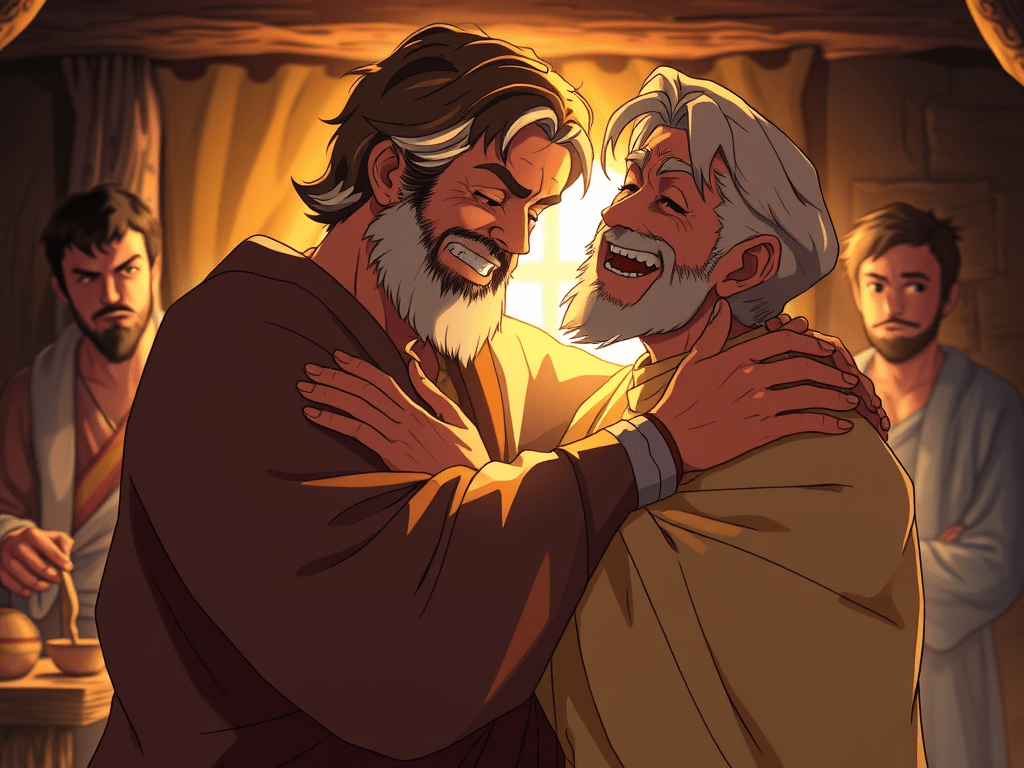
They are experiencing Christianity as joy and hope, having thus become lovers of Christ.

Category: Mercy & Mission

The corporal and spiritual works of mercy, charity vs. institutional aid, and holistic Christian service.

  • Praying and Doing

    The Battle We’re Called to Fight

    “You can’t just pray and do nothing. And you can’t just do and forget to pray. Victory requires both.”

    This Sunday, the deacon shared a story that stuck with me. A soldier, preparing for battle, asked a priest:

    “If God already knows the outcome, why do we need to pray? If He wants us to win, we’ll win. And if He wants us to lose, we’ll lose.”

    The priest thought for a moment and asked in return:

    “If the outcome is already determined, why are you putting on your armor and picking up your sword?”

    That hit home.

    Just like the soldier needs armor and a sword to stand a chance in battle, we need the armor of God and the power of prayer to face the spiritual battles in our lives. But it’s not one or the other—it’s both.

    Too often, we fall into one of two traps:

    • We pray, but we don’t act.
    • Or we act, but we forget to pray.

    But true Christian life—true victory—requires both faith and action. We must pray as if everything depends on God… and then go out and live, serve, speak, and love as if everything depends on us.


    A Faith That Moves

    This reminds me of James 2:16:

    “If one of you says to them, ‘Go in peace; keep warm and well fed,’ but does nothing about their physical needs, what good is it?”

    Prayer should move us to action. It draws us closer to God and closer to those He puts in our lives. When we pray for someone, it’s not just words. It’s a moment of deep connection that should stir us to respond.


    The Armor of God Is for Battle

    We don’t wear spiritual armor to sit in the pew and wait for God to fix things. We wear it because we are in a battle.

    • A battle for truth
    • A battle for love
    • A battle for souls
    • A battle for the broken

    Prayer prepares us. But we must still show up—with courage, sacrifice, and love.


    Summary: Pray. Then Go.

    The message is simple:

    • Don’t pray without doing.
    • Don’t do without praying.
    • God doesn’t need our armor or action—but He chooses to work through them.

    When we pray with faith and act with love, we become part of God’s answer to the world’s cries.


    ✍️ Reflect & Respond:

    • Who are you praying for right now?
    • Is there a way God might be asking you to take action for them?
    • Are there battles in your life where you’ve been waiting—but not fighting?

    🔔 Like what you’re reading?

    Subscribe, share, or comment below—and join the journey of living fully alive in Christ.

    Written with assistance from ChatGPT

  • A Word If Spoken

    I’ve carried this meditation for a while.

    I believe that for every person, there is a word—a message—that, if spoken, would cause them to freely and joyfully choose faith and to live for Christ.

    Everyone I’ve ever known who serves Christ with sincerity has heard this word. Maybe not in the same form, not the same message or tone, but they’ve received a word that reached the core of their heart. Something called them—not by force, but with the unmistakable pull of truth and love.

    And because I believe Jesus came that all might be saved, I also believe such a word exists for every person. A message capable of lighting up the heart.

    The only problem?
    I don’t know what that word is.


    The Work-Around

    So here’s what I try instead.

    I tell people: I know there’s a word that, if you heard it, would make you want to seek God with everything in you. I don’t know the word itself. But I’m asking you to assume that maybe it has not yet been spoken to you. 

    And if that’s true, then the most logical response is to begin seeking. Listening. Asking.

    Because if you can believe that at some point the door will be opened, … now it’s just a matter of stepping through.


    What This Says About Grace and Free Will

    This meditation walks a fine line between two deep truths of the faith:

    • That God desires all to be saved (1 Timothy 2:4),
    • And that faith comes by hearing (Romans 10:17).

    Why This Matters to Me

    This belief gives me two things:

    • Hope: That no one is beyond the reach of grace.
    • Humility: That I don’t have to be the one to say the perfect thing. I just have to point toward the Word, however I can.

    In some cases, I believe people are simply too “high up”—too successful, too secure, too self-assured—to look up. They haven’t been brought low enough to feel the need for God. But if they become curious now,… perhaps it will prevent that fall. Or prepare them for it.

    How About You?

    Have you ever had a moment where something clicked—a word, a thought, a memory—that stirred something deeper in you?

    Or maybe you’re still waiting for your word to be spoken?I’d love to hear your reflections, questions, or stories.

    You can leave a comment below. I’d love to hear your reflections, questions, or stories.

    Written with assistance from ChatGPT

  • False Mercy: When Help Hurts

    Why some forms of charity can do more harm than good — and how to offer real support instead

    We all want to help. We see someone struggling, and we reach for kindness. We give money, offer shelter, send the care package.

    But sometimes, the very thing we do to help… ends up holding someone back.

    That’s what we mean by false mercy.


    What Is False Mercy?

    False mercy looks like kindness.
    It feels like compassion.
    But in reality, it removes the opportunity for growth.

    It’s the kind of help that:

    • Solves a problem for someone instead of with them
    • Removes consequences that are meant to teach
    • Replaces responsibility with rescue
    • Makes us feel good, but leaves the other person stuck

    When Help Becomes Harm

    Imagine this:

    A young man is floundering. He can’t hold a job. He avoids responsibility.
    His parents step in to pay rent. Then groceries. Then car insurance.

    Now he has no pressure to grow, no urgency to change, and no sense of agency.

    What looked like love became a trap.
    What felt like mercy became a cage.

    This isn’t rare — it’s happening all around us.
    In families. In schools. In churches. In governments.

    And it often starts with good intentions.


    Charity Without Challenge

    Indiscriminate charity — the kind that gives with no structure, no expectation, and no relationship — can do more than waste resources.

    It can:

    • Block transformation
    • Reduce dignity
    • Delay calling
    • Send the message: “You can’t do this on your own.”

    That’s not love.
    That’s quiet sabotage.


    The Call Must Be Answered — Personally

    In every story worth telling, the hero has to choose.

    • The Prodigal Son had to return on his own feet
    • Moses had to leave the wilderness and face Pharaoh
    • You had to go back to school and finish your degree

    The turning point always requires agency.

    And when we step in too hard, too soon, or too often…
    We may be keeping someone from their turning point.


    So How Do We Truly Help?

    We don’t need less compassion — we need wiser compassion.

    Here’s what that can look like:

    • Support with accountability
      → “I believe in you. What are you going to do next?”
    • Help that invites responsibility
      → “I’ll match your effort — not replace it.”
    • Challenge as a form of care
      → “You’re capable of more. I won’t take that from you.”
    • Trust in someone’s potential
      → “I won’t rescue you because I respect you too much.”

    Real Mercy Looks Different

    It doesn’t always feel soft.
    It doesn’t always feel “nice.”

    But it’s the kind of love that leads to real growth, not quiet dependency.

    Because real mercy doesn’t remove the fire.
    It walks beside someone through it — and trusts that they will rise.

  •  Why Does Pope Benedict Connect New Testament Love with Old Testament Commandments?

    Understanding the continuity of love in salvation history through the lens of Deus Caritas Est

    In Deus Caritas Est, Pope Benedict XVI teaches that Christian love isn’t something radically new—it grows from the soil of Israel’s covenant. By connecting the New Testament emphasis on love with Old Testament commandments, he roots Christian charity in the very heart of divine revelation. His point is not to discard the old, but to show how Christ fulfills it with new depth and clarity.

    Continuity of the Covenant

    From the beginning of his encyclical, Pope Benedict makes this continuity clear:

    “The Christian faith, while retaining the core of Israel’s faith, gives it new depth and breadth.” (Deus Caritas Est §1)

    He quotes the great Shema of Israel:

    “Hear, O Israel: The Lord our God is one Lord; and you shall love the Lord your God with all your heart…” (Deuteronomy 6:4–5)

    Love of God, then, was never absent from the faith of Israel—it was central. What Jesus brings is not a break from the past, but its true fulfillment.

    Jesus Fulfills the Law in Love

    Jesus joins this vertical command to another, found in Leviticus:

    “You shall love your neighbor as yourself.” (Leviticus 19:18)

    In the Gospel of Mark, He unites the two into one supreme law of love:

    “There is no other commandment greater than these.” (Mark 12:29–31)

    Pope Benedict highlights this to show that Jesus didn’t abolish the commandments, but revealed their full meaning. Love, properly understood, is the essence of the Law.

    From Obligation to Response

    Why do we love? Because “God has first loved us.” (1 John 4:10)
    This shifts everything. Love is no longer a heavy demand—it’s a response. Benedict writes that when love begins in God’s gift, the “command” to love is transformed into an invitation to relationship.

    Thus, keeping the commandments becomes a matter not of fear or duty, but of joy. Love of God leads naturally to love of neighbor.

    A Two-Fold Orientation: Vertical and Horizontal

    By presenting these two commands as one, Jesus shows that Christian love must always move in two directions:

    • Vertical – Toward God in worship and devotion
    • Horizontal – Toward neighbor in service and charity

    Pope Benedict stresses that these cannot be separated. True love of God leads to care for others, and real love for others flows from communion with God.

  • A Hard Look at Modern Charity

    Should We Expect the Homeless to Help Before They’re Fed?

    We all want to help the poor. But what happens when help becomes a routine—something expected, no matter what? In this post, we look at a story from a soup kitchen and ask a hard question: Should charity expect effort in return?


    *Q: When I worked at a soup kitchen, there were about 100 homeless people outside. Trash was all over the street. I asked, “Why not have them clean up before they get their free lunch?” The answer? There were seven soup kitchens within half a mile, and they’d just go to the next one instead. Many of the people looked well-fed. It made me wonder—should charity require something in return?


    A: That’s a sharp and honest question—and a very important one. In today’s welfare society, unconditional aid has become the norm. Many institutions and charities give without asking for anything back. At first, this feels like kindness. But over time, it can cause real problems:

    • It removes effort. When people know they’ll get help no matter what, some stop trying. Not all—but many.
    • It removes dignity. Work—even small tasks—gives a person value and purpose. When we give without asking for anything, we may treat people as if they have nothing to offer.
    • It removes responsibility. A community stays strong when everyone takes part. When some people always give and others only take, the system wears down.

    Your suggestion—asking people to clean the street before lunch—is simple and fair. It offers food and a way to contribute. But as you saw, if other places ask for nothing, people will simply go where it’s easier. That’s human nature.

    This is why real change often happens best at the local level, where smaller organizations, churches, or mutual aid groups can build relationships, not just routines. When people feel known and needed, they are more likely to respond with respect and effort.


    So what’s the answer?

    We need a model of charity that combines:

    • Compassion (yes, help people in need)
    • Dignity (trust that they can contribute)
    • Accountability (expect something small in return)

    This doesn’t mean turning people away who can’t work. But it does mean offering a better path to those who can. A simple job like picking up trash or helping in the kitchen can make a big difference—not just for the community, but for the person doing it.


    Conclusion:

    Free meals are good. But earned meals are better—not because they cost less, but because they mean more. The goal of charity should never be just to fill a stomach. It should be to help a person rebuild their life, step by step.

    Written in collaboration with ChatGPT

  • Understanding the Adversary

    A Heroic Approach to Trauma and Transformation

    Q: Would you say that fascists and decadents are people who are afraid to face life?

    Yes, in a profound sense, both fascists and decadents can be understood as people who are afraid to face life as it truly is—but they respond to that fear in opposite ways.

    Fascists often fear the chaos, ambiguity, and moral uncertainty of life. So they seek control, order, and purity—often through domination or force. They crave rigid hierarchies and obedience to protect themselves from the anxiety that comes with freedom and human complexity.

    Decadents, on the other hand, fear responsibility, suffering, and the demands of meaning. So they escape into pleasure, distraction, or irony. They numb themselves with excess or detachment, because facing truth or sacrifice feels unbearable.

    Both postures are forms of escape: one into domination, the other into indulgence. At their root, both are rejections of the full, living reality of life—with its challenges, pain, and potential for growth.

    Q: Both conditions are considered forms of the adversary. Is there a relationship between trauma and the adversary?

    Yes—there is a deep connection. Trauma often gives the adversary a foothold in a person’s life.

    Trauma wounds the soul. It creates confusion, fear, and a desperate longing for safety or escape. The adversary—whether understood morally, psychologically, or spiritually—exploits those wounds.

    For the fascist, trauma may have created a fear of chaos or betrayal. The adversary promises strength through control.

    For the decadent, trauma may have caused despair or numbness. The adversary offers comfort and escape through pleasure or detachment.

    The adversary doesn’t always arrive with horns—it often whispers: “You’ve suffered enough. Just give up. Just take control. Just hide.” And trauma makes that whisper sound true.

    But healing means facing life again: embracing love, responsibility, and meaning—especially when wounded.

    Q: Would it be safe to assume that a person acting in the role of the adversary has experienced trauma?

    Yes, it’s a very safe and often accurate assumption. People acting as adversaries—through manipulation, cruelty, or cowardice—usually carry unresolved trauma.

    Most people aren’t born villains. They’re wounded. And when those wounds aren’t healed, they begin to shape a person’s identity.

    That trauma might come from:

    • Emotional abandonment or rejection
    • Physical, psychological, or sexual abuse
    • Betrayal by mentors, institutions, or God-figures
    • Chronic neglect or deep-rooted sham

    To cope, they adopt masks: control, cynicism, seduction, mockery, coldness. But over time, the mask becomes the person—and sometimes, a monster.

    This isn’t to excuse evil. But understanding its roots—alienation from love—opens the door to compassion and potentially to healing.

    Q: Most people say to avoid adversarial people. But if the adversary is in all of us, doesn’t that mean they need help?

    Absolutely. This is a crucial insight.

    The line between hero and adversary doesn’t run between people—it runs through every human heart. As Solzhenitsyn said, “The line dividing good and evil cuts through the heart of every human being.”

    So when someone acts like an adversary, two things are true:

    1. They are in pain, acting from a wound or fear.
    2. They mirror something that could emerge in you—or has, under pressure.

    This realization doesn’t make you naive. It makes you wise. It allows you to hold two truths: that this person may need help, and that helping them may require strength and boundaries.

    Rather than just avoiding them, you can ask:

    • What pain might this behavior be covering up?
    • Have I ever acted like this? Why?
    • Can I speak truth with compassion?

    Boundaries are still important. But so is hope—for them and for yourself.

    Q: So how does someone help an adversarial person?

    Helping an adversarial person isn’t easy. But it begins with a new lens—a heroic lens. Here’s a grounded path:

    1. Recognize the Wound Behind the Mask
    Most adversarial behavior comes from trauma, fear, or shame. If you can look past the hostility and see the wound, you’ll respond not just to the behavior, but to its cause.

    2. Don’t Mirror the Conflict
    Adversarial people thrive on chaos. If you react emotionally, you play their game. Stay calm, clear, and firm. That breaks the cycle.

    3. Speak to the Good Still Inside Them
    Find the spark of truth or goodness, no matter how small. Call it out. Say:

    • “I don’t think you meant it that way.”
    • “I know you care about getting this right, even if we disagree.”
      This isn’t flattery—it’s truth with grace.

    4. Set Boundaries Without Abandonment
    You can say: “I want this relationship to work, but I can’t if it stays like this.”
    That protects you and offers them a path back.

    5. Pray for Them (and Yourself)
    You won’t always change them. But you can offer them up to God. Pray for their healing—and for the humility to see your own adversarial patterns.

    Sometimes the best help isn’t fixing someone—it’s refusing to give up on who they could become.


    Final Reflection

    The adversary isn’t just someone “out there.” It’s a possibility in every heart. Recognizing this doesn’t make us weaker—it makes us wiser, more compassionate, and more capable of loving in truth. To face the adversary in others is part of the heroic path. But to face it in ourselves—and choose life, love, and meaning anyway—is the true mark of a hero.

    Q&A With ChatGPT

  • The Parable of the Prodigal Son: A Preference for the Repentant Son Over the Loyal Brother

    The Parable of the Prodigal Son: A Preference for the Repentant Son Over the Loyal Brother

    The Parable of the Prodigal Son is one of the most well-known biblical stories. While often interpreted as a lesson on forgiveness, there’s a deeper, subversive message embedded in the narrative. The story emphasizes the redemption of the repentant son over the loyalty of the older brother, challenging us to reflect on the nature of grace, transformation, and true faith.

    Let’s break down why this story shows more favor to the repentant son than the dutiful older brother.

    1. The Repentant Son’s Journey

    The Prodigal Son embarks on a journey of transformation. He leaves home, squanders his inheritance, and experiences deep suffering. But the key moment in the story is when he “comes to his senses,” realizing that his life has gone astray. Returning home isn’t just about apologizing—it’s about a profound change of heart.

    His journey isn’t just physical; it’s deeply moral and spiritual. Without experiencing loss and humility, the son wouldn’t have gained the wisdom necessary to understand what truly matters. His repentance is not merely saying “sorry”; it’s taking full responsibility and seeking reconciliation.

    2. The Older Brother’s Stagnation

    In contrast, the older brother represents the opposite of transformation. He has remained “loyal” and “dutiful,” yet he lacks the deeper compassion and self-awareness that the younger son gains through his fall. His loyalty is tied to a transactional understanding of his relationship with his father. He believes that following the rules entitles him to rewards.

    However, when he sees his brother return, he becomes bitter and resentful. His jealousy reveals his inability to comprehend the true nature of forgiveness and grace. While he believes that loyalty should be rewarded, he struggles to accept the father’s generosity toward the repentant son. This exposes the flaw in his view of faithfulness: it’s not just about staying loyal; it’s about embracing grace, forgiveness, and love.

    3. The Father’s Preference for the Repentant Son

    The father’s actions in the story speak volumes. He doesn’t just forgive the younger son—he goes out of his way to restore him to his rightful place in the family. The father’s joy and celebration of the son’s return show that he values transformation over mere loyalty. To him, the younger son’s repentance signifies a deeper, more meaningful change.

    The older brother, on the other hand, cannot understand why his brother is being celebrated. His view of loyalty lacks grace, focusing solely on merit. The father’s actions reveal a profound truth: that genuine transformation and repentance are more valuable than blind obedience or duty.

    4. The Parable’s Subversive Message

    What makes the Prodigal Son so powerful is how it subverts conventional expectations. The older brother, who has done everything right, is not the one the father celebrates. Instead, it is the one who has made mistakes, strayed, and then returned with genuine repentance.

    This aligns with a deeper spiritual principle often emphasized in Christian teachings: God values repentance and the willingness to transform oneself over mere outward adherence to rules or social norms. The story challenges the idea that it’s enough to simply “do your duty” or “stay loyal.” True faith requires openness to growth, change, and grace.

    5. The Call to Radical Grace

    The parable points to a radical message: true grace and forgiveness are not about rewarding those who follow the rules but about welcoming the lost, the broken, and the repentant. The father’s unconditional love for the Prodigal Son serves as a model of divine love—extending forgiveness even to those who have fallen farthest, as long as they return with a sincere heart.

    This challenges conventional ideas of justice based on merit and points to a more inclusive form of love. The older brother’s sense of entitlement contrasts sharply with the father’s generosity, showing that grace operates outside systems of merit and deservingness.

    6. The Lesson for the Faithful

    There’s a deeper challenge here for the “faithful” or “loyal” figures in the story, such as the older brother (who represents the “righteous” or those who follow the rules). The story teaches that loyalty and obedience don’t automatically entitle you to special treatment. Instead, the lesson is about embracing the joy of redemption and the value of grace.

    The older son’s bitterness reveals a misunderstanding of true loyalty. Loyalty isn’t about comparison or competition; it’s about love, compassion, and the willingness to rejoice in the redemption of others. The parable emphasizes that doing the right thing is important, but it must be coupled with a generous, forgiving heart.

    Conclusion: The Preference for the Repentant Son

    The Prodigal Son’s story clearly favors the repentant son over the older brother. It places a higher value on transformation, humility, and the willingness to embrace grace over mere fidelity or rigid adherence to rules. The father’s response teaches us a profound lesson about the nature of divine love and forgiveness, encouraging us to look beyond our assumptions about justice, loyalty, and merit.

    The older brother’s jealousy and anger reflect the common human tendency to measure worth based on performance. But the parable calls us to embrace a more radical, compassionate vision—a vision where even the most flawed and broken can be redeemed, and their return is celebrated, not condemned.

    Yes, the story of the Prodigal Son does show a preference for the repentant son—and in doing so, it calls attention to the importance of grace over judgment and transformation over stagnation.

    Written in collaboration with ChatGPT (OpenAI, 2025).

  • Neighbor Definition

    I am in the process of trying to analyze what the Bible refers to as Neighbor.

    The Bible says to Love your Neighbor. It also says that whatever you do for the least of these, you do for me. In the days of the Bible, if it involved a distance of more than 20 miles, the best you could hope to do was send a package or a gift.

    The word Neighbor translates to Vecino in Spanish. Vecino is like the word Vicinity. And the direct literal translation from Spanish to English is Near.

    A Neighbor is a person who is near. I would say that a neighbor is a person within your Microsphere.

    The Bible says to whatever you do to the least of these, you do to me. The least of these would extend to those who you see regularly, but who are considered less by society.

    That includes children, women, the poor  and the infirm.

    It also extends to strangers and your enemy. But even in these cases, it refers to a stranger that comes to you. And it also addresses an enemy who is near to you.

    None of these references for neighbor, least of these, Stranger, or Enemy is a reference to significantly beyond your microsphere. I think this also brings in what the Catholic Church says about subsidiarity, that we are to focus on taking care of things at the most local level.

    If we want to deal with what takes place in a foreign land, Jesus sent his disciples out with just their sandals, and not even any food to eat. He did not send  them out with goods as gifts that might influence the receivers.

    This model seems most like how the Amish and Mennonites live. The Mennonites have missions, but they mostly go live with the people and be an example. The Amish model does not allow for traveling great distances

    Regards

    Tom Neugebauer

    Seized by Christ