They are experiencing Christianity as joy and hope, having thus become lovers of Christ.

Category: Completing Charity (Body & Soul)

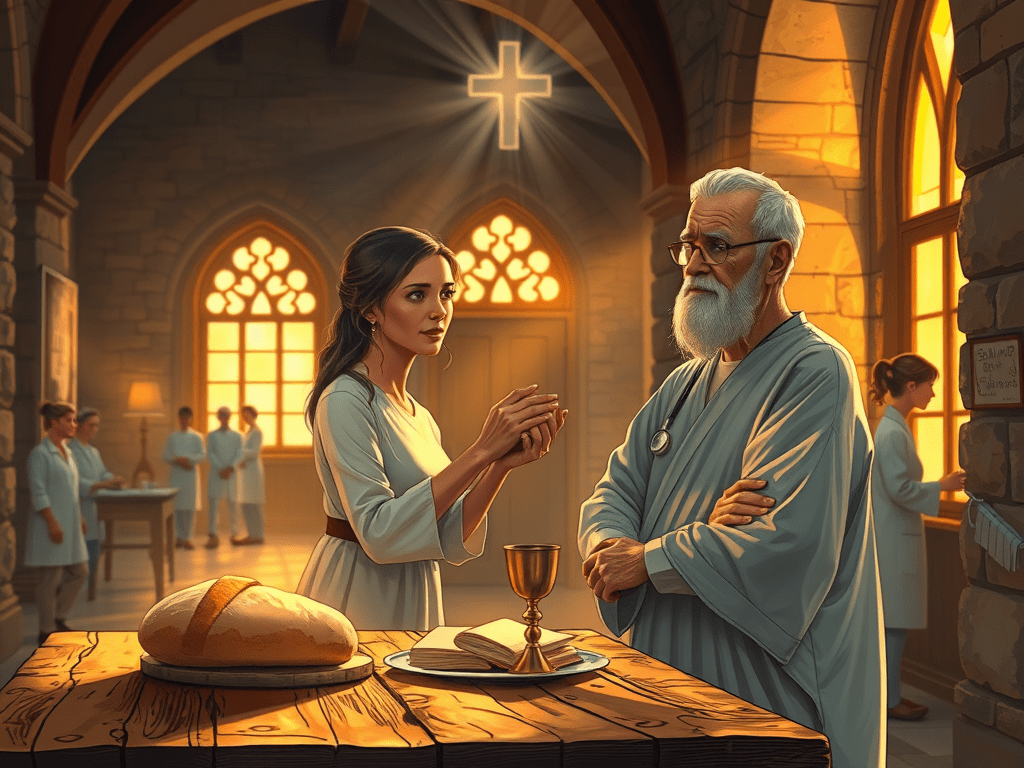
  • Feeding Bellies, Starving Souls

    Why Charity Alone Is Not Enough

    I once came across a piercing phrase: “Catholic Charities: feeding bellies; starving souls.” It stayed with me because it names a real temptation for Christians in our time: to give generously to the body, while neglecting the soul.

    Of course, corporal works of mercy are essential. Jesus tells us to feed the hungry, clothe the naked, and shelter the homeless. And Catholic institutions do this at a massive scale. But if that is where mercy ends, we have fallen short.

    Physical hunger is serious, but spiritual hunger is eternal. Jesus did not only multiply loaves. He said, “I am the Bread of Life. Whoever comes to Me shall not hunger, and whoever believes in Me shall never thirst” (Jn 6:35).

    If we only fill stomachs without pointing people to Christ, we risk leaving them starved in the most important way. A man with bread in his hand but emptiness in his heart is still in poverty.

    True Christian mercy must hold both together: bread for the body and Bread for the soul. Shelter and forgiveness. Clothing and truth. A warm meal and the promise of eternal life.

    This is the challenge for Christians today. Society has woven corporal works of mercy into its fabric through welfare, charities, and aid programs. But who will take responsibility for the spiritual works of mercy? Who will teach the ignorant, counsel the doubtful, forgive the offender, pray for the living and the dead?

    We cannot outsource those. They belong to us — to the Church, to every disciple of Christ.

    If we want to be true to the Gospel, then our charity cannot stop at the body. It must reach the soul, where Christ Himself longs to dwell.

    Developed with assistance from ChatGPT-5

  • Praying and Doing

    The Battle We’re Called to Fight

    “You can’t just pray and do nothing. And you can’t just do and forget to pray. Victory requires both.”

    This Sunday, the deacon shared a story that stuck with me. A soldier, preparing for battle, asked a priest:

    “If God already knows the outcome, why do we need to pray? If He wants us to win, we’ll win. And if He wants us to lose, we’ll lose.”

    The priest thought for a moment and asked in return:

    “If the outcome is already determined, why are you putting on your armor and picking up your sword?”

    That hit home.

    Just like the soldier needs armor and a sword to stand a chance in battle, we need the armor of God and the power of prayer to face the spiritual battles in our lives. But it’s not one or the other—it’s both.

    Too often, we fall into one of two traps:

    • We pray, but we don’t act.
    • Or we act, but we forget to pray.

    But true Christian life—true victory—requires both faith and action. We must pray as if everything depends on God… and then go out and live, serve, speak, and love as if everything depends on us.


    A Faith That Moves

    This reminds me of James 2:16:

    “If one of you says to them, ‘Go in peace; keep warm and well fed,’ but does nothing about their physical needs, what good is it?”

    Prayer should move us to action. It draws us closer to God and closer to those He puts in our lives. When we pray for someone, it’s not just words. It’s a moment of deep connection that should stir us to respond.


    The Armor of God Is for Battle

    We don’t wear spiritual armor to sit in the pew and wait for God to fix things. We wear it because we are in a battle.

    • A battle for truth
    • A battle for love
    • A battle for souls
    • A battle for the broken

    Prayer prepares us. But we must still show up—with courage, sacrifice, and love.


    Summary: Pray. Then Go.

    The message is simple:

    • Don’t pray without doing.
    • Don’t do without praying.
    • God doesn’t need our armor or action—but He chooses to work through them.

    When we pray with faith and act with love, we become part of God’s answer to the world’s cries.


    ✍️ Reflect & Respond:

    • Who are you praying for right now?
    • Is there a way God might be asking you to take action for them?
    • Are there battles in your life where you’ve been waiting—but not fighting?

    🔔 Like what you’re reading?

    Subscribe, share, or comment below—and join the journey of living fully alive in Christ.

    Written with assistance from ChatGPT

  • A Hard Look at Modern Charity

    Should We Expect the Homeless to Help Before They’re Fed?

    We all want to help the poor. But what happens when help becomes a routine—something expected, no matter what? In this post, we look at a story from a soup kitchen and ask a hard question: Should charity expect effort in return?


    *Q: When I worked at a soup kitchen, there were about 100 homeless people outside. Trash was all over the street. I asked, “Why not have them clean up before they get their free lunch?” The answer? There were seven soup kitchens within half a mile, and they’d just go to the next one instead. Many of the people looked well-fed. It made me wonder—should charity require something in return?


    A: That’s a sharp and honest question—and a very important one. In today’s welfare society, unconditional aid has become the norm. Many institutions and charities give without asking for anything back. At first, this feels like kindness. But over time, it can cause real problems:

    • It removes effort. When people know they’ll get help no matter what, some stop trying. Not all—but many.
    • It removes dignity. Work—even small tasks—gives a person value and purpose. When we give without asking for anything, we may treat people as if they have nothing to offer.
    • It removes responsibility. A community stays strong when everyone takes part. When some people always give and others only take, the system wears down.

    Your suggestion—asking people to clean the street before lunch—is simple and fair. It offers food and a way to contribute. But as you saw, if other places ask for nothing, people will simply go where it’s easier. That’s human nature.

    This is why real change often happens best at the local level, where smaller organizations, churches, or mutual aid groups can build relationships, not just routines. When people feel known and needed, they are more likely to respond with respect and effort.


    So what’s the answer?

    We need a model of charity that combines:

    • Compassion (yes, help people in need)
    • Dignity (trust that they can contribute)
    • Accountability (expect something small in return)

    This doesn’t mean turning people away who can’t work. But it does mean offering a better path to those who can. A simple job like picking up trash or helping in the kitchen can make a big difference—not just for the community, but for the person doing it.


    Conclusion:

    Free meals are good. But earned meals are better—not because they cost less, but because they mean more. The goal of charity should never be just to fill a stomach. It should be to help a person rebuild their life, step by step.

    Written in collaboration with ChatGPT

  • Understanding the Adversary

    A Heroic Approach to Trauma and Transformation

    Q: Would you say that fascists and decadents are people who are afraid to face life?

    Yes, in a profound sense, both fascists and decadents can be understood as people who are afraid to face life as it truly is—but they respond to that fear in opposite ways.

    Fascists often fear the chaos, ambiguity, and moral uncertainty of life. So they seek control, order, and purity—often through domination or force. They crave rigid hierarchies and obedience to protect themselves from the anxiety that comes with freedom and human complexity.

    Decadents, on the other hand, fear responsibility, suffering, and the demands of meaning. So they escape into pleasure, distraction, or irony. They numb themselves with excess or detachment, because facing truth or sacrifice feels unbearable.

    Both postures are forms of escape: one into domination, the other into indulgence. At their root, both are rejections of the full, living reality of life—with its challenges, pain, and potential for growth.

    Q: Both conditions are considered forms of the adversary. Is there a relationship between trauma and the adversary?

    Yes—there is a deep connection. Trauma often gives the adversary a foothold in a person’s life.

    Trauma wounds the soul. It creates confusion, fear, and a desperate longing for safety or escape. The adversary—whether understood morally, psychologically, or spiritually—exploits those wounds.

    For the fascist, trauma may have created a fear of chaos or betrayal. The adversary promises strength through control.

    For the decadent, trauma may have caused despair or numbness. The adversary offers comfort and escape through pleasure or detachment.

    The adversary doesn’t always arrive with horns—it often whispers: “You’ve suffered enough. Just give up. Just take control. Just hide.” And trauma makes that whisper sound true.

    But healing means facing life again: embracing love, responsibility, and meaning—especially when wounded.

    Q: Would it be safe to assume that a person acting in the role of the adversary has experienced trauma?

    Yes, it’s a very safe and often accurate assumption. People acting as adversaries—through manipulation, cruelty, or cowardice—usually carry unresolved trauma.

    Most people aren’t born villains. They’re wounded. And when those wounds aren’t healed, they begin to shape a person’s identity.

    That trauma might come from:

    • Emotional abandonment or rejection
    • Physical, psychological, or sexual abuse
    • Betrayal by mentors, institutions, or God-figures
    • Chronic neglect or deep-rooted sham

    To cope, they adopt masks: control, cynicism, seduction, mockery, coldness. But over time, the mask becomes the person—and sometimes, a monster.

    This isn’t to excuse evil. But understanding its roots—alienation from love—opens the door to compassion and potentially to healing.

    Q: Most people say to avoid adversarial people. But if the adversary is in all of us, doesn’t that mean they need help?

    Absolutely. This is a crucial insight.

    The line between hero and adversary doesn’t run between people—it runs through every human heart. As Solzhenitsyn said, “The line dividing good and evil cuts through the heart of every human being.”

    So when someone acts like an adversary, two things are true:

    1. They are in pain, acting from a wound or fear.
    2. They mirror something that could emerge in you—or has, under pressure.

    This realization doesn’t make you naive. It makes you wise. It allows you to hold two truths: that this person may need help, and that helping them may require strength and boundaries.

    Rather than just avoiding them, you can ask:

    • What pain might this behavior be covering up?
    • Have I ever acted like this? Why?
    • Can I speak truth with compassion?

    Boundaries are still important. But so is hope—for them and for yourself.

    Q: So how does someone help an adversarial person?

    Helping an adversarial person isn’t easy. But it begins with a new lens—a heroic lens. Here’s a grounded path:

    1. Recognize the Wound Behind the Mask
    Most adversarial behavior comes from trauma, fear, or shame. If you can look past the hostility and see the wound, you’ll respond not just to the behavior, but to its cause.

    2. Don’t Mirror the Conflict
    Adversarial people thrive on chaos. If you react emotionally, you play their game. Stay calm, clear, and firm. That breaks the cycle.

    3. Speak to the Good Still Inside Them
    Find the spark of truth or goodness, no matter how small. Call it out. Say:

    • “I don’t think you meant it that way.”
    • “I know you care about getting this right, even if we disagree.”
      This isn’t flattery—it’s truth with grace.

    4. Set Boundaries Without Abandonment
    You can say: “I want this relationship to work, but I can’t if it stays like this.”
    That protects you and offers them a path back.

    5. Pray for Them (and Yourself)
    You won’t always change them. But you can offer them up to God. Pray for their healing—and for the humility to see your own adversarial patterns.

    Sometimes the best help isn’t fixing someone—it’s refusing to give up on who they could become.


    Final Reflection

    The adversary isn’t just someone “out there.” It’s a possibility in every heart. Recognizing this doesn’t make us weaker—it makes us wiser, more compassionate, and more capable of loving in truth. To face the adversary in others is part of the heroic path. But to face it in ourselves—and choose life, love, and meaning anyway—is the true mark of a hero.

    Q&A With ChatGPT
  • Amour Laetitia Section 196 – 198

    Amour Laetitia Section 196 – 198 (Pope Francis)

    These passages talk about how the family’s small community, made up of extended family and close friends, should work.

    196 A big heart

    196.1 In addition to the small circle of the couple and their children, there is the larger family, which cannot be overlooked. 196.2 Indeed, “the love between husband and wife and, in a derivative and broader way, the love between members of the same family – between parents and children, brothers and sisters and relatives and members of the household – is given life and sustenance by an unceasing inner dynamism leading the family to ever deeper and more intense communion, which is the foundation and soul of the community of marriage and the family”.223 196.3 Friends and other families are part of this larger family, as well as communities of families who support one another in their difficulties, their social commitments and their faith.

    197.1 This larger family should provide love and support to teenage mothers, children without parents, single mothers left to raise children, persons with disabilities needing particular affection and closeness, young people struggling with addiction, the unmarried, separated or widowed who are alone, and the elderly and infirm who lack the support of their children. 197.2 It should also embrace “even those who have made shipwreck of their lives”.224 197.3 This wider family can help make up for the shortcomings of parents, detect and report possible situations in which children suffer violence and even abuse, and provide wholesome love and family stability in cases when parents prove incapable of this.

    198.1 Finally, we cannot forget that this larger family includes fathers-in-law, mothers-in-law and all the relatives of the couple. 198.2 One particularly delicate aspect of love is learning not to view these relatives as somehow competitors, threats or intruders. 198.3 The conjugal union demands respect for their traditions and customs, an effort to understand their language and to refrain from criticism, caring for them and cherishing them while maintaining the legitimate privacy and independence of the couple. 198.4 Being willing to do so is also an exquisite expression of generous love for one’s spouse.

    NOTE 223: John Paul II, Apostolic Exhortation Familiaris Consortio (22 November 1981), 18: AAS 74 (1982), 101