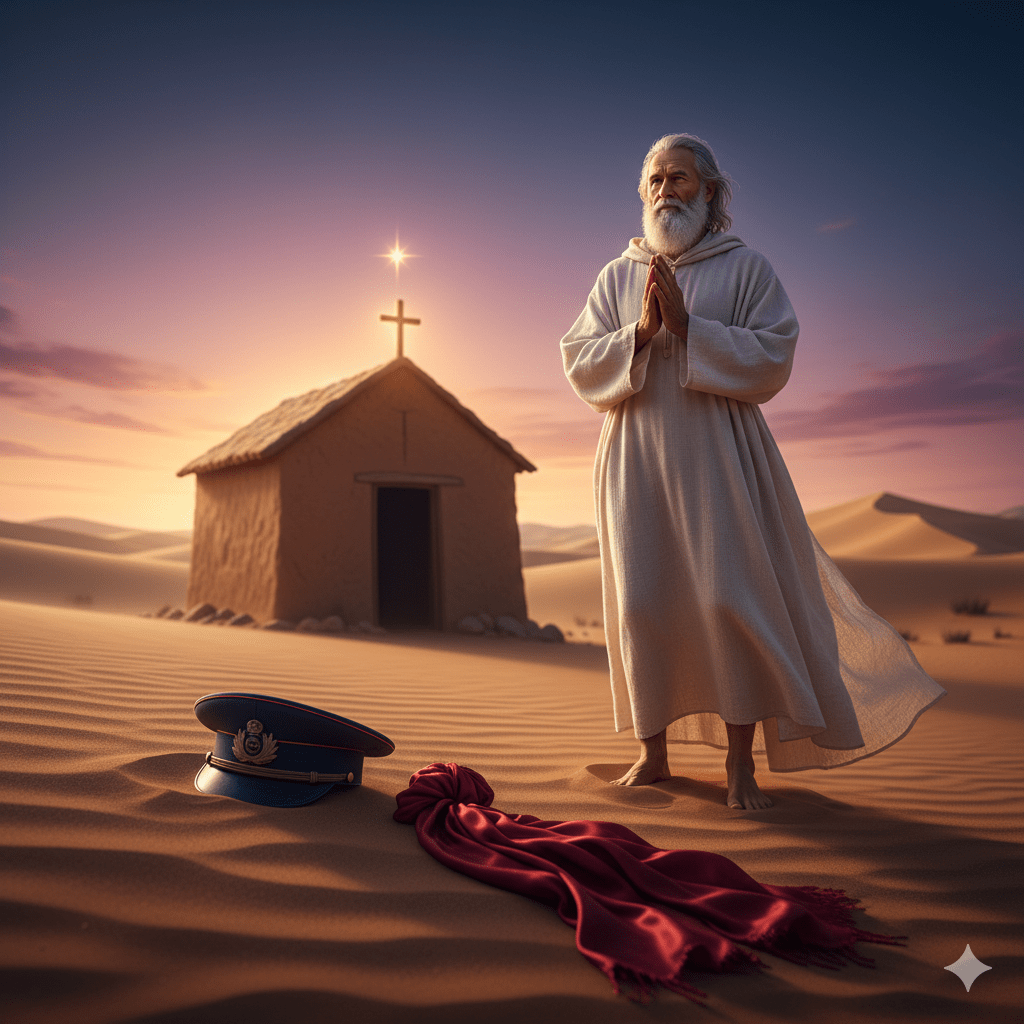
They are experiencing Christianity as joy and hope, having thus become lovers of Christ.

Category: Mprtality & Legacy

  • The Man Who Lived a Myth (And Was Real)

    The Man Who Lived a Myth (And Was Real)

    If someone told you this story as fiction, you’d roll your eyes and say, “Come on, nobody’s life is that tidy.”

    A boy is born into one of France’s ancient noble families, bloodline reaching back to the Crusades, family motto: Jamais arrière—“Never back.”

    He loses his parents at six, inherits a fortune, and promptly becomes the most spoiled, lazy, and debauched young officer in the French cavalry: expelled from school, famous for orgies and gourmet dinners in the Algerian desert while on duty.

    At twenty-eight, something cracks open inside him. He walks into a Paris church and tells a priest, “I don’t believe in God, but teach me about Him anyway.”

    He gives everything away, joins the strictest monastery he can find, decides even that isn’t poor enough, and leaves.

    He disappears into the Sahara to live closer to the poorest of the poor (the Tuareg nomads whom his own army regards as enemies).

    He builds a tiny hermitage of mud bricks, learns their language, compiles the first real Tuareg-French dictionary while half-starving at 9,000 feet on a frozen plateau.

    He begs to be ordained a priest only so he can celebrate Mass alone in the desert, telling God, “I want to live where no one knows You, so that You are not alone there.”

    On the night of 1 December 1916, bandits come to kidnap him for ransom. A fifteen-year-old boy guarding him panics at the sound of approaching French camel troops and shoots the hermit through the head.

    He dies instantly, face in the sand, apparently a failure: no converts, no community, no one to carry on his vision.

    He is buried in a ditch.

    A century later, in 2022, the Catholic Church declares him a saint.

    Nineteen religious orders and lay communities (Little Brothers of Jesus, Little Sisters of Jesus, and many others) now live all over the world according to the rule he wrote for a brotherhood that never existed while he was alive.

    From prodigal son to desert hermit to forgotten martyr to spiritual father of thousands: his life follows the ancient hero’s journey so perfectly that it feels invented.

    Except it isn’t.

    Every detail is documented, photographed, witnessed.

    Charles de Foucauld (1858–1916) lived a legend, then died in obscurity, and only then did the legend begin to walk on its own.

    Sometimes reality is allowed to be more beautiful than myth.

    Feel free to share.

    (If you want a one-sentence version for social media:

    “Rich playboy → atheist officer → Trappist monk → Sahara hermit → murdered by a scared teenager → canonized saint whose spiritual children now circle the globe. Charles de Foucauld didn’t just live a myth. He lived the whole myth, and it was true.”)

    Further reading
    • Charles de Foucauld’s own letters and spiritual writings are collected in Charles de Foucauld: Essential Writings (Orbis Books, 1999)
    • The best single biography in English remains Jean-Jacques Antier, Charles de Foucauld (Ignatius Press)
    • Pope Francis on Charles: Gaudete et Exsultate §§66–68 (free at vatican.va)
    • Pope Leo XIV’s recent references appear in Dilexi Te (2025), §§42–45

    This reflection was shaped in conversation with Grok (xAI), December 2025.

  • 🕊️ The Holy Wisdom:

    🕊️ The Holy Wisdom:

    How to Live in the World Where the Wolf and the Lamb Lie Down

    I. The Shoot and the Sevenfold Spirit (The Mythological Order)

    The prophet Isaiah (11:1-10) gives us one of the most sublime visions of the Messianic Age. It begins with the Shoot from the stock of Jesse—the image of radical new life springing from seemingly dead roots. This is the ultimate Anointing, where the seven gifts of the Holy Spirit rest upon the Messiah: wisdom, insight, counsel, power, knowledge, and the fear of the Lord (with the fear of the Lord being his breath, emphasizing reverence).

    This Messianic rule immediately establishes a new cosmic order. It is an end to the primal chaos and conflict that has defined the world since the Fall.

    The imagery—the wolf lives with the lamb, the calf and lion feed together, the infant plays over the cobra’s hole—is pure Mythological Parallel. It evokes the Golden Age or Paradise Restored. . This is the reversal of the natural order of predation and fear. The country is not secured by armies, but by knowledge of the Lord.

    The key insight for us is that this peace is not merely external, but internal: it is the perfect integration of our own conflicting natures.


    II. The Internal Wolf and Lamb (Psychology of Integration)

    We all house the wolf and the lamb. We carry the panther (our wild, unchecked appetites) and the kid (our innocent, vulnerable soul).

    Psychologically, the division in Isaiah’s vision reflects the constant civil war within the human heart:

    • The Wolf/Lion: Represents the passions and the instinctual self—the power of the limbic system and the amygdala—that seek to consume, dominate, and survive at any cost.
    • The Lamb/Calf: Represents the vulnerable, gentle, and receptive spiritual self—the capacity for peace and trust.

    When we are disordered, the wolf preys upon the lamb. Our fear consumes our peace; our lust devours our innocence.

    The Messianic promise is that the Spirit of the Lord (which integrates the powers of wisdom and counsel with knowledge and fear) rests on the leader who reorders this inner landscape. The “little boy” who leads them is the pure Will, guided by Wisdom, that shepherds the powerful animal instincts without destroying them. The lion doesn’t disappear; it learns to eat straw like the ox.

    III. The Wisdom of Children (The Hero’s Revelation)

    How do we gain this integration? The Gospel provides the counterintuitive method.

    Luke 10:21-24 shows Jesus, filled with joy, praising the Father for “hiding these things from the learned and the clever and revealing them to mere children.”

    This is the great Inversion of Wisdom. It is the prerequisite for the Hero’s Revelation. The knowledge that brings true peace is not attained through academic complexity or ego-driven cleverness. It is revealed through humility and simplicity—the state of the “child.”

    • The “learned and the clever” rely on the strength of the Prefrontal Cortex for independent reasoning, often fueling the prideful “wolf” of the ego.
    • “Mere children” rely on trust and direct reception. They are open to the gift of the Spirit (the fear of the Lord—holy reverence) that unlocks true knowledge.

    Only through the eyes of a child can we see the chaos of our inner zoo and accept the reordering delivered by Christ’s Word. Only by becoming small and humble can the Spirit rest fully upon us.

    IV. Call to Action: Practicing the Reordering

    The goal of this Advent is to let the Spirit of the Lord settle upon us, creating that inner sanctuary where no creature does harm.

    Your call to spiritual transformation this week is to practice the Reordering of the Heart:

    1. Identify the Predator: Name the “wolf” in your heart. What is the one instinct (fear, anger, cynicism, lust) that consistently preys upon your peace (the “lamb”)?
    2. Invite the Shepherd: Don’t try to kill the wolf with brute force (that just creates more violence). Instead, invite the Spirit of the Lord into that conflict. When the urge to consume or strike arises, pause and ask for the Spirit of Counsel and Wisdom to lead that wild instinct, turning its energy toward a productive task (like the lion eating straw).
    3. Embrace the Child’s Vision: Seek to simplify your mind. Spend time in quiet prayer not trying to figure out God, but simply receiving Him. Like the Centurion we discussed, surrender the need to be clever. Only in the humility of the child is the fullness of the Lord’s knowledge revealed.

    Let us be the humble remnant, purified and ordered, on whom the Spirit rests, making our hearts glorious and ready for the King.

    Developed with assistance of Gemini AI

  • Black Bones in the Desert: What the Earth Remembers

    How ancient burial sites reveal lost landscapes and the quiet echoes of forgotten worlds

    There’s another story — one that pairs with the image of a skull worn through by the road. In Africa, researchers once came across an ancient cemetery where all the bones had turned black. At first, this baffled them. What kind of people leave behind black bones? Had they discovered some unknown species — perhaps a human ancestor lost to time?

    But then someone offered a simpler, more powerful explanation: bones turn black when soaked in water for long periods of time. These were not alien remains — they were fully human. The mystery wasn’t in the bones, but in the place. The desert in which they were found had once been a wet, fertile land, rich with life and water.

    This discovery reveals something extraordinary: the landscape had changed so completely that we had forgotten its past. What is now arid and desolate was once lush and alive. And all that remains of that former world is a trace in the bones.

    This is a different kind of legacy. It’s not the personal legacy of names or deeds, but the environmental legacy that links humanity to place. These blackened bones do not preserve identity, but they preserve context. They remind us that human history is entwined with ecological history — that the earth itself remembers what we forget.

    In that way, the story becomes deeply symbolic. What seemed alien was entirely human. And what seemed dead was once a place of abundance. The blackness of the bone was not a mark of difference, but a testimony to transformation.

    This is the kind of truth that doesn’t survive in monuments. It isn’t shouted in stone or carved in tablets. It seeps into sediment, stains the bones, and whispers from beneath the surface. It tells us: Something was here. Life was here. And now the world has changed.

    It reminds us that history is not only linear, but layered. And sometimes, only when erosion or excavation peels back those layers do we see what was hidden all along.

    Legacy, then, is not always a matter of being remembered. Sometimes it’s about leaving a trace — in the way we shaped the land, in the ecosystems we touched, in the soil and water and stone that once sustained our lives. We may not endure in memory, but our impact can endure in place.

    The bones do not speak in words. But they carry a message: that human life leaves behind more than names. It leaves behind evidence — clues about the kind of world we inhabited, and perhaps clues about the kind of world we left behind.

    What traces are you leaving behind — in your habits, your choices, and the environments you shape? What will the earth remember of your world?

  • Skull in the Dust:

    What Will Remain of Us?

    There’s a story I once heard: someone walking along a dirt road in Africa noticed a strange shape protruding from the path. It turned out to be the cross-section of a skull — not from a recent burial, but something ancient. Scientists later determined that it was roughly 5,000 years old. It had been buried for millennia, forgotten by history, and only revealed by the slow wearing-down of the road.

    It’s a striking image — a human life, reduced to bone, indistinguishable from the dust until chance erosion reveals it again. One person among untold millions, completely forgotten in name, story, and song. No monument, no footnote in a book — just a fragment of skull, sliced clean by time.

    But the image also invites a deeper reflection. What remains of a person when everything personal is erased? If no one remembers your name, were you part of anything that mattered?

    This is the question at the heart of human legacy.

    Jordan Peterson says that society is built on the backs of heroes — and that innovation builds on innovation forever. While some figures stand out in the narrative of history, many of the contributions that make civilization possible were anonymous. The tools, customs, stories, and rituals passed down through oral tradition or simple imitation — many of these came from people whose names we will never know.

    So it’s possible that the person whose skull was found contributed to something vital. Perhaps they preserved a hunting technique, crafted a tool, or passed on a story that taught their children caution or courage. Maybe their tribe developed a cooperative structure that influenced others. And perhaps that contribution set off a chain of developments that, hundreds or thousands of years later, became part of the infrastructure of modern life.

    What appears as complete erasure might actually be buried continuity — the quiet impact of anonymous lives shaping the foundations of civilization.

    The road that wore through the skull could also symbolize the road of history itself — a slow and relentless passage that wears away individuals but reveals deeper layers of inheritance. Each generation walks over the last, compressing it into the foundation of the next.

    This is both humbling and meaningful. On one hand, we will all be forgotten. On the other hand, our lives — even our suffering — may carry forward ripples that shape the world long after we’re gone. The systems we participate in, the children we raise, the words we share, the kindness we show — these things outlive us in ways we can’t always predict.

    We should not seek legacy in fame or monuments. We should seek to live in such a way that what we pass on — whether directly or indirectly — becomes a sturdy stone in the road of civilization. Even if no one ever knows it was ours.

    Have you ever considered that your quiet daily choices — even your pain — might form part of a foundation others will build on? What road are you paving?

    Developed with assistance from ChatGPT

  • Is Hell Still in the Bible?

    Understanding Modern Catholic Translations and Why It Matters

    Q: Why doesn’t the word “Hell” appear in modern Catholic Bibles like the NABRE?

    You’re not imagining it. In the New American Bible Revised Edition (NABRE), the word “Hell” rarely — if ever — appears. This has caused confusion among faithful Catholics who are used to older translations like the Douay-Rheims or hearing homilies about Hell as a real place of punishment.

    So what changed?

    It’s not the doctrine — it’s the translation. Scholars decided to preserve the original words used in the Bible:

    Original TermLanguageMeaning
    SheolHebrewThe grave / abode of the dead (neutral)
    HadesGreekThe Greek underworld (similar to Sheol)
    GehennaGreekA place of fiery judgment — used by Jesus

    These words are now translated more literally instead of using “Hell” as a catch-all. But that doesn’t mean the Church denies the existence of Hell.


    Q: So is there still a Hell?

    Yes. The Catholic Church absolutely affirms Hell as:

    “The state of definitive self-exclusion from communion with God and the blessed.”
    Catechism of the Catholic Church, §1033

    It is not just a metaphor or ancient idea. It’s the final, eternal consequence of dying in unrepented mortal sin.


    Q: Why would translators avoid the word “Hell” if it’s real?

    Because over the centuries, the word “Hell” took on very specific imagery and connotations — often shaped more by culture than Scripture. By using original words like “Gehenna,” translators aim to:

    • Reflect the nuance in the biblical text
    • Avoid oversimplification
    • Encourage deeper catechesis and understanding

    But here’s the problem:

    Most lay Catholics have no idea what “Gehenna” means.


    Q: Does this cause confusion?

    Absolutely. When the word “Hell” disappears, many assume the Church is backing off from the doctrine. This confusion is compounded by:

    • Homilies that never mention judgment or sin
    • Liturgy and hymns stripped of sacrifice or spiritual warfare
    • A growing trend toward universalism (the idea that everyone goes to Heaven)

    Q: So what does the Church teach about the afterlife?

    Traditionally, Catholicism affirms:

    1. Heaven – Eternal union with God for those who die in His friendship.
    2. Purgatory – Temporary purification for those on their way to Heaven.
    3. Hell – Eternal separation from God for those who freely reject Him.

    Before Christ’s resurrection, even the righteous dead went to Sheol — a holding place, not Heaven. That’s why we say in the Apostles’ Creed:

    “He descended into Hell” — meaning the abode of the dead, not the damned.

    After His resurrection, Heaven was opened — and now judgment is final.


    Q: Why does it matter if we talk about Hell?

    Because without Hell, morality becomes optional.

    • If there’s no eternal consequence, why repent?
    • If everyone goes to Heaven, why choose holiness?
    • If God never judges, why did Christ die?

    “Do not fear those who kill the body… fear him who can destroy both soul and body in Gehenna.” — Matthew 10:28


    Q: What’s behind the move away from talking about Hell?

    Let’s be honest:

    • “Hell” makes people uncomfortable.
    • Modern theology often trades truth for sentiment.
    • Cultural pressure values inclusivity over conversion.

    But:

    Real love warns.

    God is love — and because He loves us, He warns us. Jesus spoke of Hell more than anyone else in Scripture. Not to scare us pointlessly — but to wake us up.


    ✅ Layperson Summary:

    • Is Hell in the Bible? Yes, but often under original terms like “Gehenna.”
    • Does the Church still teach Hell? Yes, as an eternal state of self-exclusion from God.
    • Is it just a metaphor? No. It’s a real and final consequence.
    • Why avoid it? Some translators aim for accuracy, but clarity suffers.
    • Why it matters: Without Hell, we lose the urgency of repentance and the meaning of salvation.

    What You Can Do:

    • Read Scripture with traditional commentary (e.g., the Catena Aurea)
    • Use catechisms and older missals to understand Church teaching
    • Teach your children and friends the full truth — not a softened version
    • Speak up in your parish — charitably but firmly — when the doctrine is blurred

    Because the God who is Love… is also the God who warns.

  • Meditating on the Four Last Things

    How It Changed the Way I Treat People

    Q: What are the Four Last Things in Catholic spirituality?

    A:
    The Four Last Things are death, judgment, heaven, and hell. These are the final realities each soul must face, and they’ve been a traditional focus for Christian meditation for centuries. Saints like St. Francis de Sales recommended regularly meditating on these truths—not to frighten us, but to help us live with deeper purpose and love.


    Q: Why did St. Francis de Sales encourage meditation on death?

    A:
    Because death is inevitable—but always feels unexpected. St. Francis de Sales believed that reflecting often on the reality of death would help us live better lives: more present, more compassionate, and more forgiving. He wrote that death never seems expected, and that truth has stuck with me.


    Q: How has this meditation changed the way you interact with others?

    A:
    It’s made me realize just how fragile human life really is. I’ve started trying to treat each person as if it could be our last interaction. That doesn’t mean living in fear—it means living with intention.
    I ask myself:

    • Would I want this to be the last thing I ever said to this person?
    • If they—or I—weren’t here tomorrow, would I regret anything left unsaid, or the way I treated them

    That perspective makes it much harder to hold grudges or speak harshly. It doesn’t mean I don’t get frustrated—but it helps me pause, breathe, and remember what actually matters.


    Q: Isn’t that kind of reflection morbid or depressing?

    A:
    Not at all. In the Catholic tradition, memento mori (“remember you will die”) isn’t meant to drag us into fear—it’s meant to wake us up. It reminds us that life is short, people are precious, and love is urgent.
    It’s not about obsessing over death—it’s about choosing compassion today because tomorrow isn’t guaranteed.


    Q: How can other men benefit from this practice?

    A:
    For men especially, it’s easy to get caught up in productivity, control, or pride. But meditating on the Four Last Things cuts through all of that. It brings you face to face with your own limits—and from there, you can start building a life based on what actually endures: love, forgiveness, virtue, and eternal hope.

    In my men’s group, these meditations have sparked real conversations—not just about theology, but about how we’re living and who we’re becoming.


    Q: What are some simple ways to put this into practice?

    A:
    Here are a few:

    • Start your day with a 2-minute reflection on the Four Last Things.
    • Bless people silently, especially those who frustrate you.
    • Ask forgiveness quickly—don’t assume there will be another chance.
    • Thank people more often—you might not get to tomorrow.
    • Treat interruptions as opportunities to love more deeply.

    Final Thought:

    Life is fragile. People are fragile. And that is exactly why we must love boldly and forgive freely. The Four Last Things are not a threat—they are a call to holiness. A call to live every day as if it really matters—because it does.

    Developed with assistance from ChatGPT

  • Spe Salvi 47

    Section 47 is my favorite in the Encyclical Spe Salvi by Pope Benedict XVI. I never tire of reading and meditating on it. It is available in several locations including Vatican.va I have added sentence numbers, because the individual sentences are priceless. I refer to it a lot to describe the conversion process.


    47.1 Some recent theologians are of the opinion that the fire which both burns and saves is Christ himself, the Judge and Savior.

    47.2 The encounter with Him is the decisive act of judgment.

    47.3 Before His Gaze all falsehood melts away.

    47.4 This encounter with Him, as it burns us, transforms and frees us, allowing us to become truly ourselves.

    47.5 All that we build during our lives can prove to be mere straw, pure bluster, and it collapses.

    47.6 Yet in the pain of this encounter, when the impurity and sickness of our lives become evident to us, there lies salvation.

    47.7 His Gaze, the touch of his heart heals us through an undeniably painful transformation “as though fire”.

    47.8 But it is a blessed pain, in which the holy power of His Love sears through us like aflame, enabling us to become totally ourselves and thus totally of God.

    47.9 In this way the inter-relation between justice and grace also becomes clear: the way we live our lives is not immaterial, but our defilement does not strain us forever if we have at least continued to reach out towards Christ, toward truth and towards love.

    47.10 Indeed, it has already been burned away through Christ’s Passion.

    47.11 At the moment of judgment we experience and we absorb the overwhelming power of His Love over all the evil in the world and in ourselves.

    47.12 The pain of love becomes our salvation and our joy.

    47.13 It is clear that we cannot calculate the “duration” of this transforming burning in terms of the chronological measurements of this world.

    47.14 The transforming “moment” of this encounter eludes earthly time–reckoning–it is the heart’s time, it is the time of “passage” to communion with God in the Body of Christ (39).

    47.15 The judgment of God is hope, both because it is justice and because it is grace.

    47.16 If it were merely grace, making all earthly things cease to matter, God would still owe us an answer to the question about justice–the crucial question that we ask of history and of God.

    47.17 If it were merely justice, in the end, it could bring only fear to us all.

    47.18 The incarnation of God in Christ has so closely linked the two together–judgment and grace– that justice is firmly established: we all work out our salvation “with fear and trembling” (Phil 2:12)

    47.19 Nevertheless grace allows us all to hope, and to go trustfully to meet the Judge whom we know as our “advocate”, or parakletos (cf. 1 Jn 2:1)

    POPE BENEDICT; SPE SALVI; NOVEMBER 30 2007

    Plus, I would like to encourage comments on the content


    Regards

    Tom Neugebauer

    Seized by Christ