They are experiencing Christianity as joy and hope, having thus become lovers of Christ.

Category: Suffering, Silence, and Spiritual Growth

How God transforms pain and silence into grace—and invites us to grow through surrender.

  • The Man Who Lived a Myth (And Was Real)

    The Man Who Lived a Myth (And Was Real)

    If someone told you this story as fiction, you’d roll your eyes and say, “Come on, nobody’s life is that tidy.”

    A boy is born into one of France’s ancient noble families, bloodline reaching back to the Crusades, family motto: Jamais arrière—“Never back.”

    He loses his parents at six, inherits a fortune, and promptly becomes the most spoiled, lazy, and debauched young officer in the French cavalry: expelled from school, famous for orgies and gourmet dinners in the Algerian desert while on duty.

    At twenty-eight, something cracks open inside him. He walks into a Paris church and tells a priest, “I don’t believe in God, but teach me about Him anyway.”

    He gives everything away, joins the strictest monastery he can find, decides even that isn’t poor enough, and leaves.

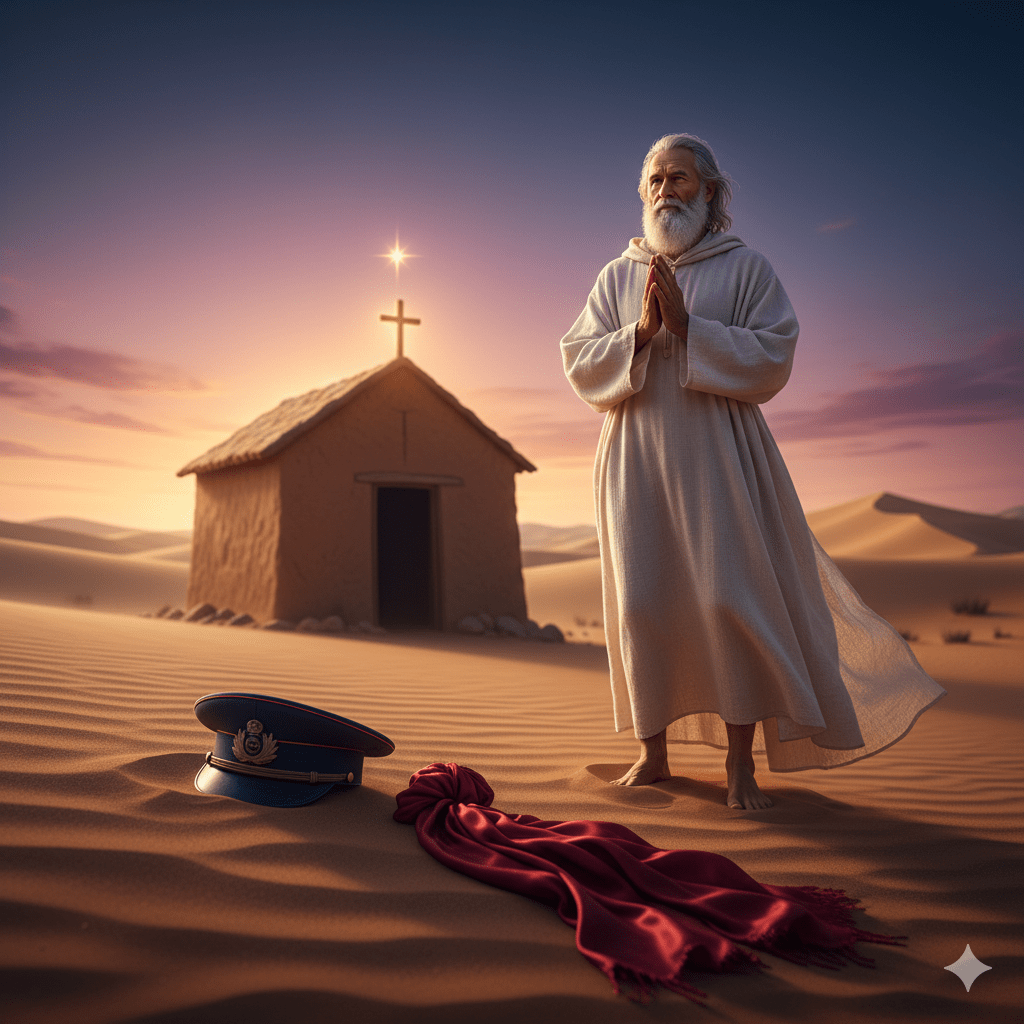
    He disappears into the Sahara to live closer to the poorest of the poor (the Tuareg nomads whom his own army regards as enemies).

    He builds a tiny hermitage of mud bricks, learns their language, compiles the first real Tuareg-French dictionary while half-starving at 9,000 feet on a frozen plateau.

    He begs to be ordained a priest only so he can celebrate Mass alone in the desert, telling God, “I want to live where no one knows You, so that You are not alone there.”

    On the night of 1 December 1916, bandits come to kidnap him for ransom. A fifteen-year-old boy guarding him panics at the sound of approaching French camel troops and shoots the hermit through the head.

    He dies instantly, face in the sand, apparently a failure: no converts, no community, no one to carry on his vision.

    He is buried in a ditch.

    A century later, in 2022, the Catholic Church declares him a saint.

    Nineteen religious orders and lay communities (Little Brothers of Jesus, Little Sisters of Jesus, and many others) now live all over the world according to the rule he wrote for a brotherhood that never existed while he was alive.

    From prodigal son to desert hermit to forgotten martyr to spiritual father of thousands: his life follows the ancient hero’s journey so perfectly that it feels invented.

    Except it isn’t.

    Every detail is documented, photographed, witnessed.

    Charles de Foucauld (1858–1916) lived a legend, then died in obscurity, and only then did the legend begin to walk on its own.

    Sometimes reality is allowed to be more beautiful than myth.

    Feel free to share.

    (If you want a one-sentence version for social media:

    “Rich playboy → atheist officer → Trappist monk → Sahara hermit → murdered by a scared teenager → canonized saint whose spiritual children now circle the globe. Charles de Foucauld didn’t just live a myth. He lived the whole myth, and it was true.”)

    Further reading
    • Charles de Foucauld’s own letters and spiritual writings are collected in Charles de Foucauld: Essential Writings (Orbis Books, 1999)
    • The best single biography in English remains Jean-Jacques Antier, Charles de Foucauld (Ignatius Press)
    • Pope Francis on Charles: Gaudete et Exsultate §§66–68 (free at vatican.va)
    • Pope Leo XIV’s recent references appear in Dilexi Te (2025), §§42–45

    This reflection was shaped in conversation with Grok (xAI), December 2025.
  • Build on the Rock:

    Build on the Rock:

    A Hero’s Journey of Real Spiritual Transformation

    Thursday, December 4th — Advent Reflection

    Readings: Isaiah 26:1–6 • Psalm 118 • Matthew 7:21,24–27
    Liturgical Color: Violet (Advent)

    Advent is a season of waiting, watching, and rebuilding the inner life. The readings for today speak with a single voice: your soul must be founded on the Rock, because storms will come. Not just external troubles, but the storms inside the human heart—fear, temptation, pride, confusion, and despair.

    Isaiah, the Psalmist, and Jesus Himself give us three images:
    a strong city, a sacred gate, and a house on solid rock.
    Together, they outline the path of every spiritual hero—from the prophets, to the saints, to ordinary men and women trying to follow God today.

    Let’s walk through the readings with Catholic wisdom, mythological insight, and psychological truth—so we can act on them, not just hear them.


    Isaiah: Open the Gates and Enter the Strong City

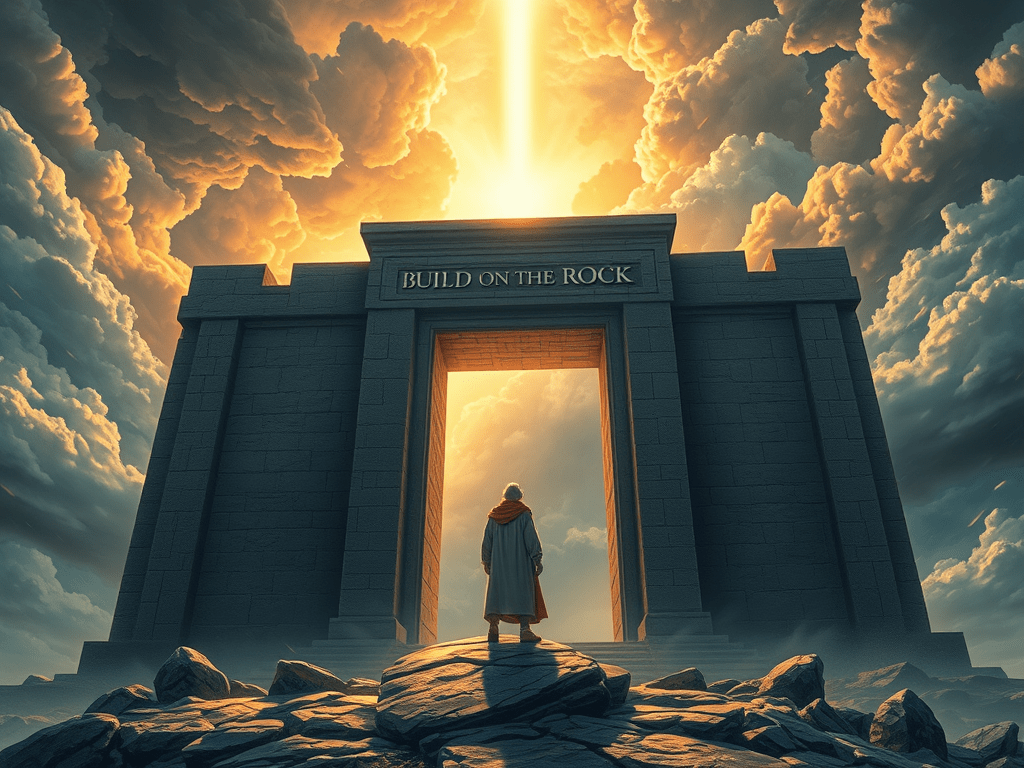
    Isaiah sees a vision of the soul as a strong city, built by God Himself:

    “We have a strong city… Open the gates! Let the upright nation come in… Trust in the Lord forever, for the Lord is the everlasting Rock.”

    The imagery is rich and precise:

    • The city is the human soul
    • The walls and ramparts are the virtues that protect us
    • The gates are the choices of the will

    Only those who trust in the Lord, who keep their minds “steadfast,” can enter.

    In mythic language, this moment is the hero approaching the threshold.
    Every great story has this scene:

    • Odysseus at the gates of the underworld
    • Aeneas at the temple doors
    • Frodo at the borders of Mordor
    • Christ at the entrance of the tomb

    But Scripture adds something deeper:
    The strength of the city is not your own willpower. God Himself is the foundation.
    The hero does not face chaos alone. The hero faces chaos with God.


    Psalm 118: The Gate of Holiness

    The Psalm continues the same theme:

    “Open to me the gates of holiness… This is the Lord’s own gate where the just may enter.”

    The pilgrim approaches the Temple and knocks. The question from inside is implied:
    Who may enter?

    The answer is not:

    • “I am strong.”
    • “I am important.”
    • “I have influence.”

    The answer is:
    “The Lord is my refuge.”

    Psychology says the same:
    When your core identity rests on anything unstable—success, emotions, reputation, strength—your inner world collapses when those things shift.
    But when identity rests on God, the soul stands firm.


    Jesus: Build Your House on the Rock

    In the Gospel, Jesus gives the image most people know:
    Two builders. Two foundations. Two futures.

    But He adds a detail that cuts straight to the heart:

    Both men hear His words. Only one acts.

    This is the decisive moment of the Hero’s Journey—when knowing is no longer enough.
    The hero must obey.
    The hero must choose.
    The hero must cross the threshold into action.

    Jesus says plainly:

    “Everyone who listens to these words of mine and acts on them will be like the wise man who built his house on rock.”

    Storms hit both houses.
    Faith does not guarantee ease.
    Faith guarantees endurance.


    The Psychology: Two Builders, Two Brains

    There’s a psychological layer here too.

    The house on rock

    represents a life governed by the higher faculties:

    • Reason
    • Conscience
    • Long-term vision
    • Stability
    • Sacrifice
    • Grace-supported will

    The house on sand

    represents a life governed by the lower systems:

    • Impulse
    • Emotion without discipline
    • Ego and appearance
    • Social pressure
    • Immediate pleasure

    Neuroscience confirms what Scripture teaches:
    When stress comes, the “lower” regions dominate unless the higher faculties are formed and anchored.

    Storms—suffering, fear, temptation, failure—expose the foundation of the soul.


    Mythic Parallels: Every Hero Faces the Storm

    Every ancient story knows this truth:

    • Gilgamesh meets the flood
    • Jonah meets the tempest
    • Odysseus meets the sea
    • Aeneas meets the burning city
    • Christ meets the Cross

    Heroes are not defined by the absence of storms, but by the strength of their foundation.

    Myths point to it.
    Psychology explains it.
    Catholic faith reveals it:
    The foundation is Christ Himself.


    Catholic Exegesis: The Rock Has a Name

    The Church Fathers are unanimous:

    • Christ is the Rock (1 Cor 10:4)
    • His teaching is the Rock
    • The Church is the Rock
    • Grace that strengthens the will is the Rock

    St. Augustine:
    “The house is faith; the foundation is Christ.”

    St. Gregory the Great:
    “To hear without acting is to build in the imagination.”

    St. Thomas Aquinas:
    “The foundation of the spiritual life is humility.”

    So the Rock is not self-help.
    The Rock is not moralism.
    The Rock is not positive thinking.

    The Rock is a Person.
    A relationship.
    A covenant.
    A surrender.


    How to Build on the Rock Today

    Here is the practical plan Jesus gives:

    1. Listen to His words

    Read Scripture.
    Study the faith.
    Let the Church teach you.

    2. Act on His words

    Do one concrete thing today:
    Forgive.
    Pray.
    Serve.
    Confess.
    Cut out a vice.
    Re-establish order.

    The hero’s gate is action.

    3. Trust God more than yourself

    Say:
    “Lord, I want Your will more than comfort.”

    4. Build habits that hold under pressure

    Virtue is spiritual architecture.
    The sacraments are reinforcement beams.
    Prayer is the daily maintenance.

    5. When the storm comes, choose to stand

    Do not fear the wind.
    Do not panic at the rain.
    Do not believe the lie that you are alone.

    The storm is not your enemy.
    The storm reveals your foundation.


    The Call: Enter the Gate. Stand on the Rock.

    Advent invites you to rebuild your life on Christ.

    Isaiah says: Enter the city.
    The Psalm says: Come through the gate.
    Jesus says: Stand on the Rock.

    The message is simple and strong:

    Your life has a structure.
    Your soul has a destiny.
    Your choices build a house that will either stand or fall.

    So today, choose to act.
    Choose to trust.
    Choose to build.
    Choose the Rock.

    And when the rains fall and the floods rise and the winds tear at everything—
    you will stand.
    And your endurance will give glory to God.

    Developed with assistance from ChatGPT-5

  • Quiet Heart, Loud Faith: Three Sparks to Renew the Church

    Quiet Heart, Loud Faith: Three Sparks to Renew the Church

    Faith in the Noise

    World spins fast—tech, truth, opinions shift.

    Noise everywhere. Easy to lose what matters.

    • Church mission? Never needed calm.
    • Starts with faith—deep in the heart.

    Silence often anchors quietly.

    One breath of quiet = your next spark?


    Depth Over Activity

    Church today? Not more programs. Not louder voices.

    Needs depth—people who pray, meet God in silence.

    • Live the Gospel first.
    • Faith isn’t meetings or debates.
    • Comes from grace—God loved us first, fully.

    Let love move you daily.

    One quiet moment = instant recharge.


    Renewal & Shine

    Remember that love? Faith becomes a lens.

    See God in work, people, hidden places.

    • Church renews through awakened hearts—not new plans.
    • Christ: “Take courage; I overcame.”
    • Hope in Him, not results.

    Restless world? Still radiant.

    You’re the light—ready to glow?

  • One Bead, Three Hope Bombs: Ignite the Second Hail Mary

    One Bead, Three Hope Bombs: Ignite the Second Hail Mary

    You’re at the start of the Rosary.

    First bead: “increase in us faith.”

    (If you missed it, we lit that fuse yesterday: blank map → step; Host → Him; hard thing → anyway.) One Bead, 3 Faith Bombs:

    Now the second bead rolls in:

    “Hail Mary… increase in us hope…”

    …and your mind blanks again.

    No more.

    Here are three 30-second mental detonators to drop before or during that single Hail Mary.

    Pick one. Pick all. Just make it explode.


    Detonator #1 – ANCHOR YOUR HEART IN HEAVEN

    Scene: Every cross you carry is a temp rental.

    Heaven is the forever address.

    Your move:

    Before the prayer starts, picture your heaviest pain nailed to the Cross—then vanishing at the empty tomb.

    “I bank on eternity, not the invoice.”


    Detonator #2 – GOD RECYCLES FAILURES INTO GLORY

    Fact: Your worst faceplant is raw material.

    Joseph: sold → pit → prison → palace.

    Your move:

    During the Hail Mary, hand God one specific failure.

    Whisper: “Turn this trash into throne.”

    (Pro tip: He’s the ultimate up-cycler.)


    Detonator #3 – RESURRECTION ALREADY CASHED THE CHECK

    Fact: Christ rose. Death lost. Hope won.

    Your move:

    Name one dead-end staring you down today.

    Lock eyes on the Risen One while the words roll.

    “I rest in the victory lap already run.”


    TL;DR (because scroll)

    Pain → temp.

    Failure → fuel.

    Dead-end → done.

    Screenshot this.

    Next time that second bead hits your fingers, light the fuse.

    Love bead dropping soon—stay locked in, stay Catholic.

  • One Bead, Three Faith Bombs: Ignite the First Hail Mary

    One Bead, Three Faith Bombs: Ignite the First Hail Mary


    You’re at the start of the Rosary.

    The first bead rolls under your thumb.

    “Hail Mary… increase in us faith…”

    …and your mind blanks.

    No more.

    Here are three 30-second mental detonators to drop before or during that single Hail Mary.

    Pick one. Pick all. Just make it explode.


    Detonator #1 – TRUST THE UNSEEN PROMISE

    Scene: Abraham, 75, no map, no preview.

    God: “Pack up. I’ll show the land… later.”

    Abe: “Let’s go.”

    Your move:

    Before the prayer starts, picture your unknown road.

    That nudge you’re dodging?

    Step onto the dirt.

    “I trust the Giver, not the preview.”


    Detonator #2 – JESUS IS LITERALLY HERE

    Fact: The Eucharist isn’t symbolic.

    It’s Body, Blood, Soul, Divinity.

    Storm-calmer → 1-inch host.

    Your move:

    During the Hail Mary, zoom in on the tabernacle.

    Whisper: “You’re in there. I believe—even if feelings bail.”

    (Pro tip: imagine the Host glowing like it holds the universe. It does.)


    Detonator #3 – FAITH IS A VERB ON MUTE

    Feelings: “This is trash.”

    Circumstances: “Quit.”

    Faith: “Still moving.”

    Your move:

    Name one hard act for today—forgive, pray, show up.

    Lock it in as the words roll.

    “I obey when everything screams stop.”


    TL;DR (because scroll)

    1. Blank map → step.
    2. Host → Him.
    3. Hard thing → anyway.

    Screenshot this.

    Next time that first bead hits your fingers, light the fuse.Hope bead dropping soon—stay locked in, stay Catholic.

  • Why Inner Life and Love Matter More Than Ever

    Why Inner Life and Love Matter More Than Ever

    How faith, purpose, and connection can guide you in a busy, chaotic world

    In today’s world, it can feel like everything is moving too fast. Social media, work, family responsibilities, and constant news cycles make it easy to feel overwhelmed. But what if the secret to thriving isn’t doing more, but living deeper?

    The Church has always faced this challenge. She must bring a message of hope to the world while nurturing her own inner life. And while you don’t need to be religious to take the lesson, the principle is universal: without a strong inner foundation, no mission or goal can truly succeed.

    Here’s the takeaway for modern life:

    1. Know yourself and your purpose. Just as the Church must understand her role, you need to understand yours. What drives you? What do you stand for?
    2. Faith can mean trust. You don’t have to be religious to see the value here. Faith, in a modern sense, is trust in what you know is right, and confidence in your ability to make a difference.
    3. Inner life matters. Reflection, mindfulness, and spiritual practice (whatever that looks like for you) help you stay grounded amid chaos.
    4. Balance action with depth. Doing good in the world—helping others, pursuing meaningful work—is powerful, but it’s more effective when paired with thought, reflection, and integrity.
    5. Beware of extremes. It’s easy to get caught up in outward achievement or personal ego. Both can be empty without inner depth and values to guide them.
    6. Love and connection are essential. Real growth comes when you care about others and invest in relationships. Empathy and compassion create the foundation for lasting impact.
    7. You are loved beyond measure. Whether you see it spiritually or simply as human connection, recognizing that you matter—and that your actions ripple out—gives purpose to everything you do.
    8. Your work matters, but your heart matters more. Success without integrity or care is hollow. Align your actions with values that elevate others.
    9. Small acts, big impact. Even small gestures of kindness or integrity can transform your environment, just as individual faith strengthens the Church.
    10. Hope fuels resilience. Knowing you can make a difference—even amid setbacks—keeps you moving forward, grounded in something larger than yourself.

    In short, thriving isn’t about doing everything; it’s about being rooted. Strong inner life, trust in what’s true, and a commitment to love and connection—these are what let you face today’s challenges with courage and purpose.

    Think of it this way: your life can become like a spark that lights a bigger fire, for yourself and everyone around you. Start small, start intentional, and let your inner strength guide your actions in the world.

    Ref: Pope Paul VI General Audience 25 October 1972

    With development and editing assistance from ChatGPT-5

  • Is Disease a Blessing?

    Health, Mortality, and Eternity

    At the start of our men’s meeting, we have a scrolling list of parishioners who are sick. The list seems endless—over sixty names, each one dealing with serious illness.

    Watching this week after week, I couldn’t help but compare it to what I’ve been learning about diet and health. Doctors who promote the carnivore diet claim it prevents most of the diseases we see all around us—heart disease, diabetes, cancer, dementia, thyroid problems, even tooth decay. In theory, if people ate differently, they might never face decades of medical decline. They’d stay healthy until the end of their lives, only needing a hospital if they had an accident or injury.

    It sounds almost too good to be true. But here’s the question that troubles me: if disease can bring people to a halt—forcing them to face mortality and the eternal destiny of their souls—then maybe sickness is not only a curse but also a strange kind of blessing. How many have repented, turned to God, or reconsidered their lives only because sickness knocked them down? If they had stayed strong and healthy their whole lives, maybe they never would have.

    So I hesitate. Should I even recommend a diet that might take away this painful but powerful path to conversion? Is that a twisted thought?


    A Christian Response

    It’s not twisted—it’s an old and serious question. Christians have always wrestled with the mystery of suffering.

    1. Suffering can open hearts.
    St. Paul himself spoke of a “thorn in the flesh” that kept him humble and close to Christ (2 Corinthians 12:7–10). Many saints saw their illnesses as a way of uniting themselves to Jesus’ cross. There’s no doubt: suffering can wake people up to God.

    2. But health is also a gift.
    Scripture calls the body the “temple of the Holy Spirit” (1 Corinthians 6:19). Caring for our health isn’t vanity—it’s stewardship. A sound body allows us to serve others, to work, to pray, to love with strength. Preventing disease isn’t selfish; it’s a way of honoring God.

    3. God does not need disease to save us.
    While illness may bring some to repentance, it’s not the only path. God works through conscience, grace, community, and the sacraments. A healthy man who uses his strength for good can be just as close—or closer—to God as a sick man who cries out in weakness.

    4. Our task is balance.
    We should encourage health, but not worship it. We should be grateful for medicine and nutrition, but not forget that even the healthiest life ends in death. Whether sick or strong, the real question is whether we are preparing for eternity.


    The Takeaway

    Yes, disease can be a strange blessing when it drives someone back to God. But it’s not a blessing in itself—it’s a hardship God can redeem. Health, too, is a blessing, when we use it in service and gratitude.

    So perhaps the answer is not to hesitate about encouraging better health, but to remind ourselves and others: even if we escape disease, we will not escape death. Eternity still awaits. The real question is not only how long we live, but how ready we are to meet the Lord.


    Reflection Question:
    Do I see my health—or my sickness—as a way to serve God and prepare for eternity?

    Developed with assistance from ChatGPT-5

  • The Indelible Mark of Character

    Our lives always bear a seal—whether from Christ, from sin, or from the wounds we carry.

    Connected with the concept of “servant” is the image of the indelible character, which has become part of the Church’s faith. In the language of late antiquity, “character” meant the seal or stamp of possession by which a thing, an animal, or even a person was marked. Once given, it could not be erased. Property so marked was irrevocably identified as belonging to its master.

    Cardinal Ratzinger explains that this “character” is more than a symbol. It is a belonging that becomes part of a person’s very existence, calling after its owner. It is an image of relationship and reference—our lives are never neutral; they always show who we belong to.

    This truth has a sharp edge for our time. Many say they are “interested” in faith but claim they have no time to practice it. But our actions—and inactions—reveal who or what owns us. If God does not mark us, something else will.

    At the same time, life’s wounds leave marks of their own. A traumatic experience can burn itself into character. When a young person loses a parent or suffers abuse, the damage can feel irreversible, like a kind of spiritual PTSD. It alters how they act and even who they seem to become. Many forms of “abnormal” behavior are not just choices but scars that have hardened into character.

    That is why forgiveness matters so deeply. If vengeance or remorse are left unchecked, they can take possession of us until they define our whole being. To forgive and let go is not weakness—it is a way of guarding our character, preventing sin and bitterness from stamping us with their seal.

    Ultimately, the only true freedom is to belong to Christ, who marks us in baptism and calls us His own forever. In Him, even the scars of trauma can be transfigured, no longer chains but signs of grace.

    Ref: Cardinal Ratzinger; Pilgrim Fellowship of Faith p.162 last paragraph.

    Developed with assistance from ChatGPT-5

  • Seen by Angels:

    Living Beyond the Judgment of Men

    We live in a culture that often tells us to measure our worth by the crowd. Social approval, likes, recognition, and applause are treated as the highest rewards. But if we stop and think about it, this is a very poor exchange. Why should the noblest part of our nature — our spiritual life — be subjected to the judgment of those who neither see nor understand it? Why should the holiness that comes from God be measured by those who walk the broad road of sin?

    The flesh cannot judge the spirit. The sinner cannot measure the elect of God. Yet so often, instead of looking upward to God for approval, we look downward to men for validation. When we do this, we dishonor ourselves and cheapen the very excellence of our calling.

    Faith opens our eyes to a higher audience. The apostle Paul reminds us that it is not only the world who sees us — we are also “seen by angels” (1 Timothy 3:16). These heavenly beings, who are far stronger and purer than us, watch our lives with interest. They are not spectators who jeer or mock but companions who minister, encourage, and serve.

    Paul even goes further: God has chosen to display His wisdom to the heavenly realms through the Church itself (Ephesians 3:10). When we live faithfully, our actions ripple beyond the visible world. They become testimonies to powers and principalities, signs of God’s glory unfolding through His people.

    This changes everything. When we were baptized, we were not only united to Christ but brought into a hidden fellowship — “an innumerable company of angels” (Hebrews 12:22). We share in their hidden life, their worship, and their service. Like them, our lives are often hidden, unseen by the world. But just as they are present to God, so too are we.

    That’s why Paul exhorted Timothy not just to obey in view of God, but also in the sight of the angels (1 Timothy 5:21). Imagine how different our lives would be if we truly believed this. Even in our most private deeds, even in our most carefully guarded solitude, we are not alone. We are witnessed by heaven.

    This awareness is not meant to make us fearful but to give us dignity. The world may mock, ignore, or misunderstand, but our lives are valuable in the sight of God and His holy angels. We are never abandoned, and we are never unseen.

    So, the next time you feel the pull to lower yourself to the judgment of men, remember this: you are seen by angels. Live for the audience of heaven, not the applause of earth.


    👉 Reflection Question for Readers:
    How might your daily life change if you remembered that every choice, even the smallest, was witnessed by God and His angels?

    John Henry Newman, The World’s Benefactors, Parochial and Plain Sermons, Vol. 2, Sermon 1. Read it online

    Developed with assistance from ChatGPT-5

  • Valley of the Shadow of Death

    The choice of every lost soul can be expressed in the words: “Better to reign in hell than serve in Heaven”

    In the actual language of the Lost, the words will be different, no doubt. One will say he has always served his country right or wrong; another that he has sacrificed everything to his art; and some that they’ve never been taken in; and some that, thank God, they’ve always looked after Number One; and nearly all, that, at least, they’ve been true to themselves.

    There is always something they insist on keeping, even at the price of misery. There is always something they prefer to Joy – that is, to reality.

    Of some sinful pleasure they say: “Let me but have this, and I’ll take the consequences”, little dreaming how damnation will spread back and back into their past and contaminate the pleasure of the sin. 

    The process begins even before death. The bad man’s past already conforms to his badness and is filled only with dreariness. And that is why the Lost will say: “We were always in hell”

    They are those to whom God says, in the end: “Thy will be done.” 

    All that are in hell choose it. Without that self-choice, there could be no hell.

    Ye can call those sad streets the Valley of the Shadow of Death. if they leave that grey town behind it will not have been hell. To any that leaves it, it is Purgatory.

    For those who remain there it will have been hell even from the beginning.

    C.S. Lewis – The Great Divorce