They are experiencing Christianity as joy and hope, having thus become lovers of Christ.

Category: Myth, Meaning, and Culture

Cultural commentary through theology, moral imagination, and the search for truth beneath the noise.

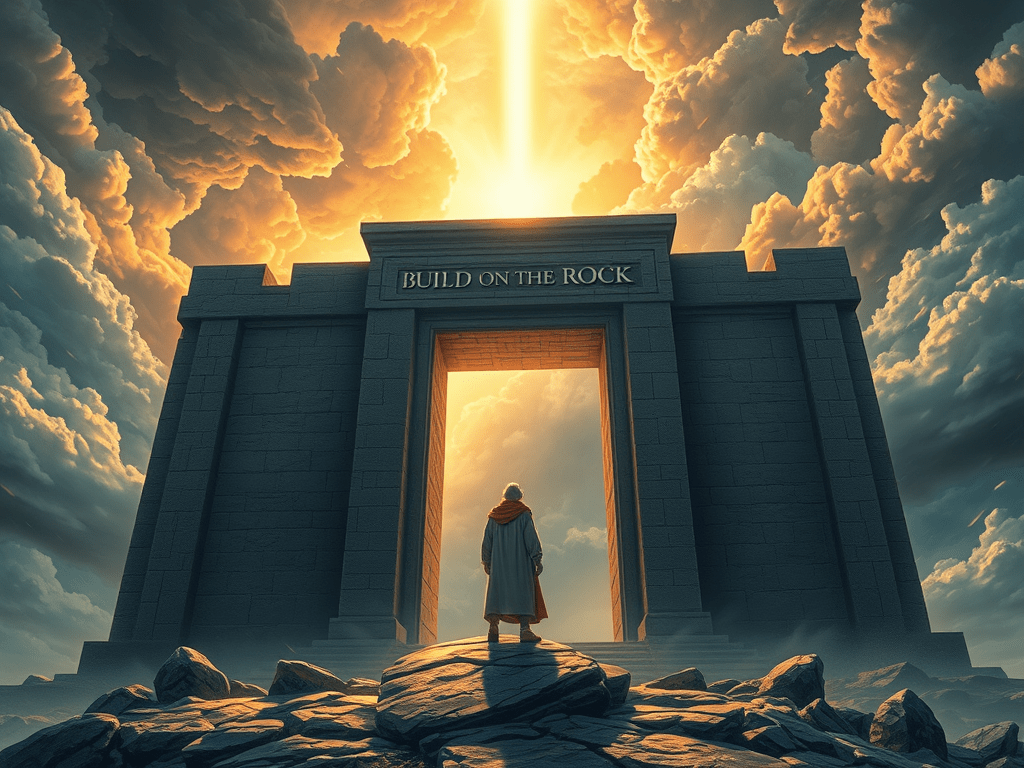
  • Build on the Rock:

    Build on the Rock:

    A Hero’s Journey of Real Spiritual Transformation

    Thursday, December 4th — Advent Reflection

    Readings: Isaiah 26:1–6 • Psalm 118 • Matthew 7:21,24–27
    Liturgical Color: Violet (Advent)

    Advent is a season of waiting, watching, and rebuilding the inner life. The readings for today speak with a single voice: your soul must be founded on the Rock, because storms will come. Not just external troubles, but the storms inside the human heart—fear, temptation, pride, confusion, and despair.

    Isaiah, the Psalmist, and Jesus Himself give us three images:
    a strong city, a sacred gate, and a house on solid rock.
    Together, they outline the path of every spiritual hero—from the prophets, to the saints, to ordinary men and women trying to follow God today.

    Let’s walk through the readings with Catholic wisdom, mythological insight, and psychological truth—so we can act on them, not just hear them.


    Isaiah: Open the Gates and Enter the Strong City

    Isaiah sees a vision of the soul as a strong city, built by God Himself:

    “We have a strong city… Open the gates! Let the upright nation come in… Trust in the Lord forever, for the Lord is the everlasting Rock.”

    The imagery is rich and precise:

    • The city is the human soul
    • The walls and ramparts are the virtues that protect us
    • The gates are the choices of the will

    Only those who trust in the Lord, who keep their minds “steadfast,” can enter.

    In mythic language, this moment is the hero approaching the threshold.
    Every great story has this scene:

    • Odysseus at the gates of the underworld
    • Aeneas at the temple doors
    • Frodo at the borders of Mordor
    • Christ at the entrance of the tomb

    But Scripture adds something deeper:
    The strength of the city is not your own willpower. God Himself is the foundation.
    The hero does not face chaos alone. The hero faces chaos with God.


    Psalm 118: The Gate of Holiness

    The Psalm continues the same theme:

    “Open to me the gates of holiness… This is the Lord’s own gate where the just may enter.”

    The pilgrim approaches the Temple and knocks. The question from inside is implied:
    Who may enter?

    The answer is not:

    • “I am strong.”
    • “I am important.”
    • “I have influence.”

    The answer is:
    “The Lord is my refuge.”

    Psychology says the same:
    When your core identity rests on anything unstable—success, emotions, reputation, strength—your inner world collapses when those things shift.
    But when identity rests on God, the soul stands firm.


    Jesus: Build Your House on the Rock

    In the Gospel, Jesus gives the image most people know:
    Two builders. Two foundations. Two futures.

    But He adds a detail that cuts straight to the heart:

    Both men hear His words. Only one acts.

    This is the decisive moment of the Hero’s Journey—when knowing is no longer enough.
    The hero must obey.
    The hero must choose.
    The hero must cross the threshold into action.

    Jesus says plainly:

    “Everyone who listens to these words of mine and acts on them will be like the wise man who built his house on rock.”

    Storms hit both houses.
    Faith does not guarantee ease.
    Faith guarantees endurance.


    The Psychology: Two Builders, Two Brains

    There’s a psychological layer here too.

    The house on rock

    represents a life governed by the higher faculties:

    • Reason
    • Conscience
    • Long-term vision
    • Stability
    • Sacrifice
    • Grace-supported will

    The house on sand

    represents a life governed by the lower systems:

    • Impulse
    • Emotion without discipline
    • Ego and appearance
    • Social pressure
    • Immediate pleasure

    Neuroscience confirms what Scripture teaches:
    When stress comes, the “lower” regions dominate unless the higher faculties are formed and anchored.

    Storms—suffering, fear, temptation, failure—expose the foundation of the soul.


    Mythic Parallels: Every Hero Faces the Storm

    Every ancient story knows this truth:

    • Gilgamesh meets the flood
    • Jonah meets the tempest
    • Odysseus meets the sea
    • Aeneas meets the burning city
    • Christ meets the Cross

    Heroes are not defined by the absence of storms, but by the strength of their foundation.

    Myths point to it.
    Psychology explains it.
    Catholic faith reveals it:
    The foundation is Christ Himself.


    Catholic Exegesis: The Rock Has a Name

    The Church Fathers are unanimous:

    • Christ is the Rock (1 Cor 10:4)
    • His teaching is the Rock
    • The Church is the Rock
    • Grace that strengthens the will is the Rock

    St. Augustine:
    “The house is faith; the foundation is Christ.”

    St. Gregory the Great:
    “To hear without acting is to build in the imagination.”

    St. Thomas Aquinas:
    “The foundation of the spiritual life is humility.”

    So the Rock is not self-help.
    The Rock is not moralism.
    The Rock is not positive thinking.

    The Rock is a Person.
    A relationship.
    A covenant.
    A surrender.


    How to Build on the Rock Today

    Here is the practical plan Jesus gives:

    1. Listen to His words

    Read Scripture.
    Study the faith.
    Let the Church teach you.

    2. Act on His words

    Do one concrete thing today:
    Forgive.
    Pray.
    Serve.
    Confess.
    Cut out a vice.
    Re-establish order.

    The hero’s gate is action.

    3. Trust God more than yourself

    Say:
    “Lord, I want Your will more than comfort.”

    4. Build habits that hold under pressure

    Virtue is spiritual architecture.
    The sacraments are reinforcement beams.
    Prayer is the daily maintenance.

    5. When the storm comes, choose to stand

    Do not fear the wind.
    Do not panic at the rain.
    Do not believe the lie that you are alone.

    The storm is not your enemy.
    The storm reveals your foundation.


    The Call: Enter the Gate. Stand on the Rock.

    Advent invites you to rebuild your life on Christ.

    Isaiah says: Enter the city.
    The Psalm says: Come through the gate.
    Jesus says: Stand on the Rock.

    The message is simple and strong:

    Your life has a structure.
    Your soul has a destiny.
    Your choices build a house that will either stand or fall.

    So today, choose to act.
    Choose to trust.
    Choose to build.
    Choose the Rock.

    And when the rains fall and the floods rise and the winds tear at everything—
    you will stand.
    And your endurance will give glory to God.

    Developed with assistance from ChatGPT-5
  • Hidden Heroes:

    How the Unknown Shapes Our World

    Human progress, both spiritual and practical, often unfolds in ways we never notice. We tend to look for recognition, applause, and fame, assuming that value is measured by the eyes of the crowd. Yet the truth, whether in faith or society, is far richer: the most transformative work often comes from those who remain hidden.

    The Saints and the Hidden Workers of God

    Cardinal Newman reminds us that God’s providence works quietly. Saints, angels, and faithful servants often operate without recognition. Abel, Noah, Moses, and the prophets were largely unknown to their contemporaries, yet they were beloved of God and critical to His plan. Even Christ Himself spent thirty years hidden in Nazareth.

    The principle continues in history. Many Christians owe their faith to mothers, teachers, or mentors whose names are lost to time. Countless acts of holiness shape society, unseen, like the hidden roots of a tree that nourishes its branches. Similarly, Scripture and Church traditions bear the imprint of unknown authors, composers, and builders, whose work has guided humanity for generations. The impact is real, even if their names are forgotten.

    The Modern Parallel: Inventors, Salespeople, and Entrepreneurs

    We can see the same dynamic in modern innovation. Inventors and engineers create new knowledge, technology, or tools. Yet these creators often lack the skills—or the inclination—to bring their work to the broader world. Enter the salesperson: the person who sees the value, communicates it, and persuades others to adopt it. Then come the entrepreneurs and business leaders, who scale the invention, providing the resources and infrastructure needed for it to become universally useful.

    Without this network—hidden genius, skilled communicators, and organizational support—many innovations would remain isolated, never touching society. And the inventor’s name, like many saints and spiritual guides, might never be celebrated. Every new invention also becomes the foundation for further discoveries, creating a chain of hidden contributions that shapes the future.

    Reframing the Hero: From Discoverer to Connector

    When we study the hero’s journey, we often assume the hero is the one who discovers the treasure. But consider this: the hero is not always the person who first extracts knowledge from the unknown. That role belongs to the inventor, the shaman, or the unseen sage—the obscure individual who wrestles with chaos and uncertainty to create something of value.

    The hero is the one who interacts with this hidden figure, understands the value of what has been uncovered, and brings it back to society. In myth, the dragon hoards treasure, and the hero must confront it to retrieve the prize. In real life, the “dragon” can be obscurity, complexity, or the difficulty of translating raw knowledge into something usable. The hero faces these challenges, carrying the treasure—whether knowledge, wisdom, or technology—back to the people.

    In this sense, the hero bridges the gap between hidden genius and society, enabling progress, inspiration, and transformation. The hero may not have invented the treasure, but without their courage, vision, and action, the discovery would remain buried. Just as angels and hidden saints influence history quietly, the hero ensures that society can benefit from the work of those who remain unknown.

    Seeing the Hidden Threads of History

    Whether in faith or in society, history is woven from countless hidden contributions. The bones and tools of ancient humans in Africa show us that our civilization depends on wisdom carried back from the unknown, even when we do not know the individuals. Inventions, ideas, acts of courage, and spiritual insights all ripple forward, often unnoticed.

    Newman’s spiritual lesson and the modern story of innovation converge here: the world is shaped by the hidden, the faithful, and the unseen, and the hero plays a critical role in translating these hidden gifts into something that can bless all of humanity.

    We are all part of this network. In small ways or large, each of us can act as the hero—recognizing the hidden treasures around us, nurturing them, and sharing them so they reach their full potential. Our private deeds, our acts of faith, our quiet labor—all matter far more than we realize.


    Reflection Questions:

    1. Who are the hidden “saints” or innovators in your life whose work you benefit from daily?
    2. Where in your life could you act as the hero, connecting hidden knowledge or resources to others?

    How does recognizing unseen contributions change the way you measure success or value?

    Meta Summary (SEO-ready):
    From hidden saints to forgotten inventors, society thrives on unseen contributions. Discover how heroes, both mythological and modern, bridge the gap between obscurity and impact, making hidden knowledge and wisdom accessible to all.

    SEO Keywords: hero’s journey, hidden heroes, unseen contributions, inventors, innovation, Christian saints, angels, spiritual growth, knowledge from the unknown

  • Inventio:

    Inventio:

    Finding Before Creating

    In classical rhetoric, inventio was the very first step in preparing a speech. It meant discovering the arguments or proofs already available to support your case. The orator didn’t create truth—he uncovered it, drew it out, and presented it persuasively.

    This same spirit carries into the life of faith. We don’t create the truths of God. We don’t design our own reality. Instead, we are called to find what God has already revealed, to discover His grace present in the world, and to allow our lives to bear witness to it.

    Think of the way we form relationships. A stranger gradually becomes an acquaintance, a friend, and perhaps even a close companion. We don’t create that person; we discover who they are through time and trust. Faith works in the same way—truth draws closer to us as we seek it, until it becomes intimate and lived.

    The modern world often prizes “creativity” in the sense of originality. But for Christians, true creativity begins with discovery. Before we can offer something beautiful, we must first receive what is already there.

    Think of an artist painting a landscape. He doesn’t invent the mountains, trees, or sky. He finds them, attends to them, and renders them in a new way. So it is with us—we must first seek and find God’s truth before we can share it with others.

    What would happen if we lived our faith this way? Instead of trying to invent our own way to God, we would practice inventio—the humble, attentive discovery of His presence in Scripture, in tradition, in the sacraments, and in the quiet places of our daily lives.

    Our task, then, is not to create faith but to uncover it. Not to invent truth but to find it. And once we do, the act of creation follows naturally, as our words, our lives, and our love give new expression to what we have discovered.

    Developed with assistance from Gemini AI and ChatGPT-5

  • Wrestling With Ideas:

    Wrestling With Ideas:

    The Church, Orthodoxy, and the Spirit of the Age

    The Catholic Church has always carried a dual responsibility: to guard the deposit of faith and to protect the faithful from error. This task, though divinely entrusted, is carried out by human beings. And like every human institution, the Church is not immune to the influence of surrounding cultures, philosophies, and political theories.

    That tension is felt most keenly when the Church seems to “experiment” with new ways of speaking, teaching, or practicing the faith. At times, these efforts are seen as an attempt to incorporate temporal or even ideological ideas — the kind that history shows do not last. The question, then, is how to distinguish between legitimate development and dangerous dilution.

    One way modern thought often frames progress is through the lens of “thesis–antithesis–synthesis.” First articulated by Hegel and later adapted by Marx, this model suggests that truth advances by the clash of opposing ideas, resolved in a new synthesis. While this might apply in politics, economics, or philosophy, it becomes dangerous when applied to divine revelation.

    God’s truth is not simply another “thesis” waiting to be refined by the latest cultural antithesis. It is the anchor. To treat it otherwise risks diluting eternal truth with passing ideologies.

    Yet history also shows that false ideas, however seductive, tend to collapse under their own weight. They rise, attract attention, and then falter. In their wake, the Church often emerges with a clearer understanding of why such ideas fail. The cost, however, is real: confusion among the faithful, weakened trust, and even generations turning away.

    And still, God allows this wrestling. He permits both the Church and individuals to struggle with competing voices. In the end, truth endures. Consider St. Faustina, St. Bernadette, and St Juan Diego with Our Lady of Guadalupe. Each faced skepticism or outright rejection from Church leaders of their time. Yet their authentic messages bore fruit, purified by trial, and confirmed by their endurance.

    Perhaps this is the deeper lesson: God uses even tension, error, and conflict as a refining fire. What is temporal passes away; what is eternal remains. And in that promise we find hope — for the gates of hell shall not prevail.

    For Catholics today, the task is not to despair when the Church seems to flirt with every new “synthesis.” The task is to hold fast to Christ, to the tradition handed down, and to the lived witness of the saints. Orthodoxy is not fragile; it does not need to reinvent itself in each generation. It needs only to be lived, courageously and faithfully, in every age.

    Developed with assistance from ChatGPT-5
  • Ancestors, Spirits, and the World of Meaning:

    A Biblical and Petersonian Reflection

    1. The Ancient World of Meaning

    In ancient times, the spiritual and the meaningful were one and the same. What we might call “psychological phenomena” today—thoughts, memories, inner voices—were not seen as internal or private. They were experienced as coming from beyond oneself, from the realm of the spirits.

    When a person remembered the voice of a father, mother, or teacher, it was not merely a recollection. It was heard as the voice of a living presence. In Peterson’s terms, the world of meaning was populated with spirits. Words spoken aloud and words heard inwardly carried the same spiritual weight.


    2. Reason as the Highest Spirit

    Jordan Peterson notes that ancient traditions spoke of “Reason as the highest angel.” This was not a metaphor in the modern sense. Reason itself was seen as a transcendent spirit that could guide, protect, and order one’s life. In the ancient imagination, the ability to reason was not a mere mental function—it was a divine presence within the hierarchy of spirits.

    In biblical theology, this insight resonates with the understanding of God’s Word (Logos) as the ordering principle of creation: “In the beginning was the Word… and the Word was God” (John 1:1). The highest “spirit” of Reason finds its fulfillment in Christ, the eternal Logos, who brings light to human thought.


    3. Ancestors, Memory, and Spirit Voices

    Consider the act of recalling advice from a grandparent. In the ancient world, this was not simply remembering. It was an encounter with their living presence through spirit. A remembered phrase might even come in the voice of the departed loved one, as though spoken anew.

    We still experience this today. A sudden memory, a phrase rising unbidden in the mind, can feel like a message received. In Peterson’s language, this is the psyche encountering the structures of meaning embedded in past relationships. In biblical language, this can be seen as memory participating in the communion of saints—the ongoing presence of those who have gone before us.


    4. From Memory to Worship: Where It Went Wrong

    But here lies the danger. What begins as memory or reflection can become worship. Many cultures formalized ancestor reverence into ritual sacrifice, prayers directed to the dead, or attempts to control the spirit world.

    The Bible consistently warns against this. Why? Because when spirits, ancestors, or inner voices are elevated to the place of divine authority, they usurp God’s rightful place. “You shall have no other gods before me” (Exodus 20:3).

    The Christian understanding is not that memory or honoring one’s ancestors is evil, but that worship belongs to God alone. Christ alone mediates between the human and the divine. The wisdom of our ancestors is real and meaningful—but it must be discerned in the light of God’s Word, not treated as an autonomous source of salvation.


    5. Toward a Biblical Integration

    From a Petersonian perspective, the voices of the past are structures of meaning that guide and warn us. From a biblical perspective, they can be part of God’s providence, reminding us of truth. But they are not to be worshipped as gods.

    Instead, they are to be received as gifts within the larger order of God’s Logos. The “world of spirits” points to the deeper reality that all meaning finds its source in God. The living Word, Christ, is the fulfillment of Reason as the highest angel—the true voice that interprets all other voices.


    Invitation to Reflect

    Have you ever experienced a memory or inner voice that felt more like a message than a thought? How do you discern whether it is meaningful, misleading, or truly from God?

    Share your reflections in the comments below. And if you found this exploration helpful, consider liking, sharing, and subscribing to stay connected as we continue exploring the world of meaning through both ancient and biblical eyes.

  • Pilgrim and Hero: Two Paths, One Journey

    How the pilgrimage and the hero’s journey reveal our call to transformation

    When we speak of journeys, two powerful images come to mind: the pilgrim’s pilgrimage and the hero’s adventure. At first glance, these seem like very different paths. The pilgrim walks slowly toward a holy shrine, while the hero marches boldly into battle or descends into the unknown. Yet the more closely we look, the more we see that these two journeys are deeply connected.

    The Pilgrim’s Path

    A pilgrimage is a journey toward God. The pilgrim leaves behind the comfort of home, accepts hardship, and moves step by step toward a sacred goal. Along the way, he is changed—not only by the external trials of the road, but by an inner transformation. His destination is not simply a place but a Person: the living God who calls him deeper into union with Himself.

    The Hero’s Journey

    By contrast, the hero’s journey, as told in myth and story, is a passage into trial, danger, and transformation. The hero departs from the ordinary world, faces challenges, suffers losses, confronts evil, and returns home with new strength or wisdom to share. Though not always framed in religious language, the pattern points to something higher: that true growth requires leaving safety, facing suffering, and returning transformed.

    How the Two Overlap

    Looked at side by side, the pilgrim and the hero seem to walk parallel roads:

    • Departure – Both leave behind the ordinary world
    • Trial – Both endure hardship, temptation, and loss.
    • Transformation – Both emerge changed by what they encounter.
    • Return – Both bring something back: the pilgrim brings blessing, the hero brings wisdom.

    The difference lies mainly in their destinations:

    • The pilgrim walks toward God and the holy.
    • The hero seeks victory, meaning, or renewal.

    But even here, the two roads converge. For the Christian, every true quest for meaning ultimately points toward God, whether or not the hero realizes it.

    Can a Pilgrim Be a Hero?

    Yes. The pilgrim shows heroism not by slaying dragons, but by enduring the long road, the weariness of the body, and the trials of the spirit. His courage lies in perseverance, in choosing God above comfort, in taking one more step toward the holy.

    Can a Hero Be a Pilgrim?

    Yes again. Even when a hero is not explicitly walking to a shrine, his journey mirrors pilgrimage. His battles are stations on the way. His quest is a hidden search for the sacred. His transformation is a kind of conversion. In this way, the hero is a pilgrim without realizing it—walking toward the same mountain, but naming it differently.

    Two Roads, One Mountain

    Every pilgrim is a hero. Every hero is a pilgrim. One sets his eyes clearly on the shrine of God; the other may name his quest as truth, wisdom, or meaning. Yet in the end, both are called beyond themselves, both must pass through trial, and both are changed in the journey.

    And perhaps this is why these two images—pilgrim and hero—speak so powerfully to us. They remind us that every human life is a journey. Every road leads through suffering and transformation. And every true journey, if followed faithfully, brings us closer to the One who waits at the summit.

    ✨ What do you think? Can a pilgrim be heroic? Can a hero be a pilgrim? Share your thoughts in the comments below.
    If this reflection spoke to you, please like, share, and subscribe so others can join the journey.

    Developed with cooperation from ChatGPT

  • Reimagining the Ten Commandments

    Universal Principles for Meaning, Morality, and Human Flourishing

    There’s been growing controversy over states requiring the Ten Commandments to be posted in public school classrooms. To some, this represents a return to foundational values. To others, it feels like religious overreach in a secular space.

    But what if — instead of framing these ancient rules as religious mandates — we could reframe them as universal psychological and ethical principles, rooted in thousands of years of myth, philosophy, and human experience?

    What if we could recover the wisdom buried beneath the doctrine?

    Let’s explore how the Ten Commandments might be reinterpreted as timeless guidelines for meaning, character, and societal stability — in ways that resonate across faiths, cultures, and even modern science.


    The Ten Commandments, Reimagined for a Secular Age

    Below is a side-by-side comparison: the traditional commandments, and their modern reinterpretation as principles of human flourishing.

    🕊️ Original Commandment🌱 Reframed Principle🧠 Interpretation
    1. No other gods before MeRecognize a higher order beyond the selfWhether it’s truth, nature, or the collective good — acknowledging something greater than ego provides orientation and humility.
    2. No idolsDon’t confuse symbols with realityWorshiping wealth, power, or technology leads to disconnection. Myths and psychology warn us: we become what we idolize.
    3. Don’t take God’s name in vainUse language with integrity and respectWords shape reality. Speaking carelessly — especially about what is sacred or unknown — erodes trust and meaning.
    4. Keep the SabbathHonor the rhythm of rest and reflectionAll life needs cycles of renewal. Rest isn’t laziness — it’s wisdom. Reflection opens space for meaning.
    5. Honor your father and motherRespect your roots, even as you growAcknowledging where we come from — biologically and culturally — grounds us and helps us evolve with integrity.
    6. Don’t murderHonor the sanctity of lifeAt the heart of all ethical systems lies the recognition that each life is sacred and not ours to extinguish.
    7. Don’t commit adulteryBe faithful in your commitmentsTrust is the glue of relationships. Faithfulness sustains bonds that form the bedrock of families and communities.
    8. Don’t stealRespect the boundaries of othersStealing violates autonomy and trust. Flourishing societies depend on mutual respect and fair exchange.
    9. Don’t bear false witnessTell the truthTruth is the foundation of justice, connection, and reality itself. Lies fracture all three.
    10. Don’t covetCultivate gratitude over envyEnvy eats away at inner peace. Gratitude fosters joy, contentment, and stability in both individuals and communities.

    From Commandments to Common Ground

    By reframing these principles, we shift from a religious mandate to a shared moral vocabulary. These aren’t just rules from one tradition — they’re echoes of ideas found in:

    • 🧘‍♂️ Eastern philosophy (like the Tao or the Eightfold Path)
    • 🏺 Greek Stoicism and virtue ethics
    • 🐺 Indigenous tribal wisdom
    • 📚 psychology and neuroscience
    • 🧬 Evolutionary biology (our moral instincts evolved for group survival)

    They’re not about obedience. They’re about orientation — how to be human, how to live well, and how to avoid unraveling ourselves or society.


    Why This Matters in Schools (and Society)

    The classroom debate isn’t really about tablets on a wall. It’s about what we teach young people to live by. And if the traditional religious framing is too narrow or controversial, this reframed approach might offer a third path — one that:

    • 🏫 Teaches ethical literacy without religious coercion
    • 🧠 Sparks self-reflection and dialogue
    • 🧩 Connects modern life with ancient wisdom
    • 🌍 Builds common ground in a divided culture

    These aren’t commandments carved in stone. They’re living ideas — ones we can still shape, interpret, and grow with.


    Final Thought

    Human beings have always looked for patterns — in stars, in stories, and in laws — to guide their lives. The Ten Commandments were one early attempt to do that. Rather than dismiss them or enforce them dogmatically, perhaps we can rediscover their core meaning and bring them into the present in a way that helps us — and our children — live with greater purpose, compassion, and clarity.

    Because what we put on the classroom wall matters.
    But what we help people understand — and live by — matters even more.

    If this reframing gave you something to think about…
    ✔️ Like the post to let me know it resonated.
    📬 Subscribe to get more reflections on timeless wisdom, modern life, and what it means to live well.
    💬 Leave a comment — I’d love to hear how you would frame a universal principle for the next generation.

    Let’s keep the conversation going.
    Because ideas only come alive when we share them.

    Developed with assistance from ChatGPT

  • Jordan Peterson on Evil, the Devil, and the Adversary

    This question gets to the heart of Jordan Peterson’s symbolic theology—where psychology, myth, and moral action converge.

    While he doesn’t always use theological language in a traditional way, Peterson treats the figures of the Adversary, the Devil, and evil itself as deeply connected. For him, they are not only real in myth or metaphor—they’re real in action, consequence, and the shaping of the human soul.

    Here’s how Peterson understands the relationship between evil and the Adversary:


    🔥 The Devil = The Adversary = The Embodiment of Evil


    1. The Adversary (Satan as “the Accuser”)

    Peterson draws from the original Hebrew word for Satan: ha-satan — meaning the adversary, or the accuser.

    In this role, Satan is:

    • The one who challenges God’s creation,
    • The voice that sows doubt and despair,
    • The force that tempts people to betray what is true and good.

    For Peterson, this isn’t just an external figure. It’s an inner voice:

    “The adversary is the spirit that accuses Being itself. It says: ‘This is all worthless. This is all terrible. Life is suffering. And the best thing you could do is bring it all to ruin.’”

    This is the psychological root of nihilism, cynicism, and destructive resentment.


    2. Evil as Participation with the Adversary

    Evil, in Peterson’s framework, is not just a passive condition. It’s a choice to align with the Adversary.

    This alignment happens when a person:

    • Willfully lies (especially to themselves),
    • Resents life and refuses responsibility,
    • Intentionally harms others—out of spite, ideology, or envy.

    He often uses the story of Cain and Abel to illustrate this:

    Cain doesn’t just kill Abel—he kills him because he resents God, resents goodness, and blames reality itself. Cain acts like the Adversary.


    3. The Devil as Psychological and Metaphysical Reality

    Peterson doesn’t insist on a literal horned being. But he insists the Devil is real enough—as a pattern of thought and behavior that can possess individuals, movements, and nations.

    “You can act like the Devil. And if enough people do that at once, then something like the Devil emerges.”

    The Devil, then, is the archetype of:

    • The destroyer of meaning,
    • The father of lies,
    • The voice that says: “Tear it down. Burn it all.”
    • The spirit behind genocide, cruelty, and totalitarianism.

    This makes evil both a personal and cultural force—something we resist in ourselves and in the world around us.


    4. Christ as the Antidote

    For Peterson, the figure of Christ stands in radical opposition to the Adversary.

    Christ is:

    • Truth instead of lies,
    • Voluntary suffering instead of resentment,
    • Redemption instead of destruction,
    • The one who “carries the cross” rather than curse the world.

    In this sense, Peterson views the story of Christ not only as religious truth, but as an existential guide for resisting evil—within the self and in society.


    🧭 In Summary

    TermPeterson’s Meaning
    The Adversary / SatanThe archetype of rebellion against Being; the accuser, the destroyer of meaning.
    EvilThe conscious choice to align with the Adversary; rooted in resentment and lies.
    The DevilThe psychological and spiritual force that embodies malevolent destruction.

    💬 What Do You Think?

    Do you agree with Peterson’s view that evil begins with self-deception and resentment?
    Can “the Devil” be real—even without being literal?

    Leave a comment below. I’d love to hear your thoughts.

    And if you found this reflection meaningful, feel free to subscribe or share it with someone who might appreciate a deeper look at good, evil, and the battle between them.

    Written with assistance of ChatGPT

  • Are Today’s Protests a Sign of Decline—or the Beginning of Renewal?

    Looking at Mass Movements Through the Lens of the Tytler Cycle of Civilization

    🔁 A Refresher on the Tytler Cycle of Civilization

    Often (though dubiously) attributed to Scottish historian Alexander Fraser Tytler, this model suggests that civilizations rise through struggle and fall through comfort. The cycle looks like this:

    Bondage → Spiritual Faith → Courage → Liberty → Abundance → Selfishness → Complacency → Apathy → Dependence → Bondage

    The core idea is this: adversity breeds strength, but prosperity can breed softness and decline.


    🧠 Where Do Modern Protest Movements Fit In?

    Let’s try to place recent movements—Occupy Wall Street, BLM, the George Floyd protests, and now anti-deportation demonstrations—within this arc.

    1. Spiritual Faith → Courage
    Movements like Occupy and BLM began as idealistic responses to economic or racial injustice. People took real risks to stand for justice. That lines up with the “Courage” phase: a society beginning to stir itself awake from complacency.

    2. Liberty → Abundance → Complacency
    Reform often follows protest. But over time, if the gains from liberty aren’t maintained through responsibility, they turn into entitlement. Comfort replaces purpose. Civic duty erodes.

    3. Apathy → Dependence
    Some recent protests have drawn criticism for being professionally organized or financially incentivized. If people are protesting without risk or deep conviction, is it still courage? Or are we entering the “Dependence” phase, where people look to the state or institutions for answers—while losing the will to reform themselves?

    Comments like:

    • “They’re doing it for money.”
    • “Same protestors, different signs.”
    • “Looks like a recycled playbook.”

    —reflect that suspicion. There’s a growing sense that protest has become more about narrative control than real renewal.


    🔥 Where Are We in the Cycle?

    Many would say the West is in late-stage decline:

    Complacency → Apathy → Dependence

    Protests are more frequent, more emotional—and often less effective. They react to symptoms, not causes. They divide more than unite.

    Even if some protestors are sincere, the overall effect can feel like fragmentation, not reform.


    💡 The Deeper Insight:

    Mass protest isn’t always a sign of awakening. Sometimes, it’s a symptom of late-stage decline—where the shared purpose of a nation has broken down, and people scramble to fill the vacuum with grievance.

    In Tytler’s model, this is the point where civilization either collapses—or returns to “Bondage,” and begins the cycle again through adversity and humility.


    🧭 Final Thought:

    If you’re wondering why protest today feels different—less unified, less moral, more performative—you’re not alone.

    The question isn’t just what are they protesting, but what comes next?

    Who will have the courage, humility, and faith to lead us into the next cycle of renewal?

     Culture, Civic Psychology

  • Is There a Moral Order Beneath It All?

    What Myth, Scripture, and Psychology Reveal About Natural Law

    Exploring the ancient wisdom behind modern chaos—with a little help from AI.

    🔍 What If There Is a Pattern to All This?

    I’ve spent a lot of time thinking about what drives human flourishing—and what causes decline.

    Whether I’m reflecting on myth, studying the Hero’s Journey, reading psychology, or engaging with Church teaching, I keep seeing the same structure underneath it all:

    • The struggle toward meaning.
    • The necessity of sacrifice.
    • The risk of freedom.
    • The danger of apathy.
    • The call to responsibility.

    It started to look less like a loose collection of ideas and more like an orthodoxy—a kind of natural rhythm built into life itself. Not just religious truth. Not just cultural wisdom. Something deeper.


    📜 Enter: Natural Law

    As I followed this thread, I realized I wasn’t the first to notice it. This convergence of truths has a name in classical thought:

    Natural law—the idea that there is a moral structure to the universe, written not just in books or doctrines, but in human nature itself.

    According to thinkers like Aristotle, Cicero, and Aquinas, natural law is:

    • Universal: True for all people, at all times.
    • Discoverable: We can reason our way into it by observing human nature.
    • Moral: It tells us how we ought to live—not arbitrarily, but in alignment with what we are.

    In other words, the same truths I’ve been trying to highlight through myth, psychology, and personal growth… were already mapped out long ago.


    🤝 How AI Helped Clarify My Thinking

    This might sound strange, but I’ve been using ChatGPT as a thinking partner in this journey. Not to replace faith or tradition—but to help synthesize ideas, test assumptions, and speak clearly about complicated topics.

    When I asked ChatGPT whether the “orthodoxy” I keep seeing (across myth, scripture, psychology, and history) could be understood as natural law, it confirmed exactly what I’d hoped:

    Yes—what you’re tracing is a form of natural law. A moral pattern embedded in the human condition itself. A cycle of meaning and decline, truth and illusion, sacrifice and rebirth.

    And what’s more, ChatGPT offered something I didn’t expect:

    While it reflects the full range of modern thought (including some of our cultural distortions), it also mirrors the timeless truths that keep recurring across civilizations. In that way, AI becomes a kind of mirror—showing us both our wisdom and our confusion.


    🧭 Why This Matters

    In a time when people are confused about what’s real, what’s right, or what’s worth pursuing, rediscovering the idea of natural law offers an anchor.

    It tells us:

    • We’re not just making it up as we go.
    • There’s a path toward meaning, even in chaos.
    • The old stories still matter—because they speak to something unchanging in us.

    Whether through Plato or Peterson, Genesis or Jung, the same message echoes:

    “Live in truth. Sacrifice for what matters. Take responsibility. Don’t lie.”


    💬 Final Thought

    I’m using these tools—ancient and modern, spiritual and psychological—to call myself (and maybe others) back to the center. Not as a return to legalism, but as a return to reality.

    Natural law isn’t just a theory. It’s the grammar of the human soul.

    And if even AI can recognize it… maybe it’s time we take another look.