They are experiencing Christianity as joy and hope, having thus become lovers of Christ.

Category: Heroism and the Call to Adventure

The Christian life as a heroic journey, blending Scripture, myth, and psychological growth.

  • The Man Who Lived a Myth (And Was Real)

    The Man Who Lived a Myth (And Was Real)

    If someone told you this story as fiction, you’d roll your eyes and say, “Come on, nobody’s life is that tidy.”

    A boy is born into one of France’s ancient noble families, bloodline reaching back to the Crusades, family motto: Jamais arrière—“Never back.”

    He loses his parents at six, inherits a fortune, and promptly becomes the most spoiled, lazy, and debauched young officer in the French cavalry: expelled from school, famous for orgies and gourmet dinners in the Algerian desert while on duty.

    At twenty-eight, something cracks open inside him. He walks into a Paris church and tells a priest, “I don’t believe in God, but teach me about Him anyway.”

    He gives everything away, joins the strictest monastery he can find, decides even that isn’t poor enough, and leaves.

    He disappears into the Sahara to live closer to the poorest of the poor (the Tuareg nomads whom his own army regards as enemies).

    He builds a tiny hermitage of mud bricks, learns their language, compiles the first real Tuareg-French dictionary while half-starving at 9,000 feet on a frozen plateau.

    He begs to be ordained a priest only so he can celebrate Mass alone in the desert, telling God, “I want to live where no one knows You, so that You are not alone there.”

    On the night of 1 December 1916, bandits come to kidnap him for ransom. A fifteen-year-old boy guarding him panics at the sound of approaching French camel troops and shoots the hermit through the head.

    He dies instantly, face in the sand, apparently a failure: no converts, no community, no one to carry on his vision.

    He is buried in a ditch.

    A century later, in 2022, the Catholic Church declares him a saint.

    Nineteen religious orders and lay communities (Little Brothers of Jesus, Little Sisters of Jesus, and many others) now live all over the world according to the rule he wrote for a brotherhood that never existed while he was alive.

    From prodigal son to desert hermit to forgotten martyr to spiritual father of thousands: his life follows the ancient hero’s journey so perfectly that it feels invented.

    Except it isn’t.

    Every detail is documented, photographed, witnessed.

    Charles de Foucauld (1858–1916) lived a legend, then died in obscurity, and only then did the legend begin to walk on its own.

    Sometimes reality is allowed to be more beautiful than myth.

    Feel free to share.

    (If you want a one-sentence version for social media:

    “Rich playboy → atheist officer → Trappist monk → Sahara hermit → murdered by a scared teenager → canonized saint whose spiritual children now circle the globe. Charles de Foucauld didn’t just live a myth. He lived the whole myth, and it was true.”)

    Further reading
    • Charles de Foucauld’s own letters and spiritual writings are collected in Charles de Foucauld: Essential Writings (Orbis Books, 1999)
    • The best single biography in English remains Jean-Jacques Antier, Charles de Foucauld (Ignatius Press)
    • Pope Francis on Charles: Gaudete et Exsultate §§66–68 (free at vatican.va)
    • Pope Leo XIV’s recent references appear in Dilexi Te (2025), §§42–45

    This reflection was shaped in conversation with Grok (xAI), December 2025.

  • Build on the Rock:

    Build on the Rock:

    A Hero’s Journey of Real Spiritual Transformation

    Thursday, December 4th — Advent Reflection

    Readings: Isaiah 26:1–6 • Psalm 118 • Matthew 7:21,24–27
    Liturgical Color: Violet (Advent)

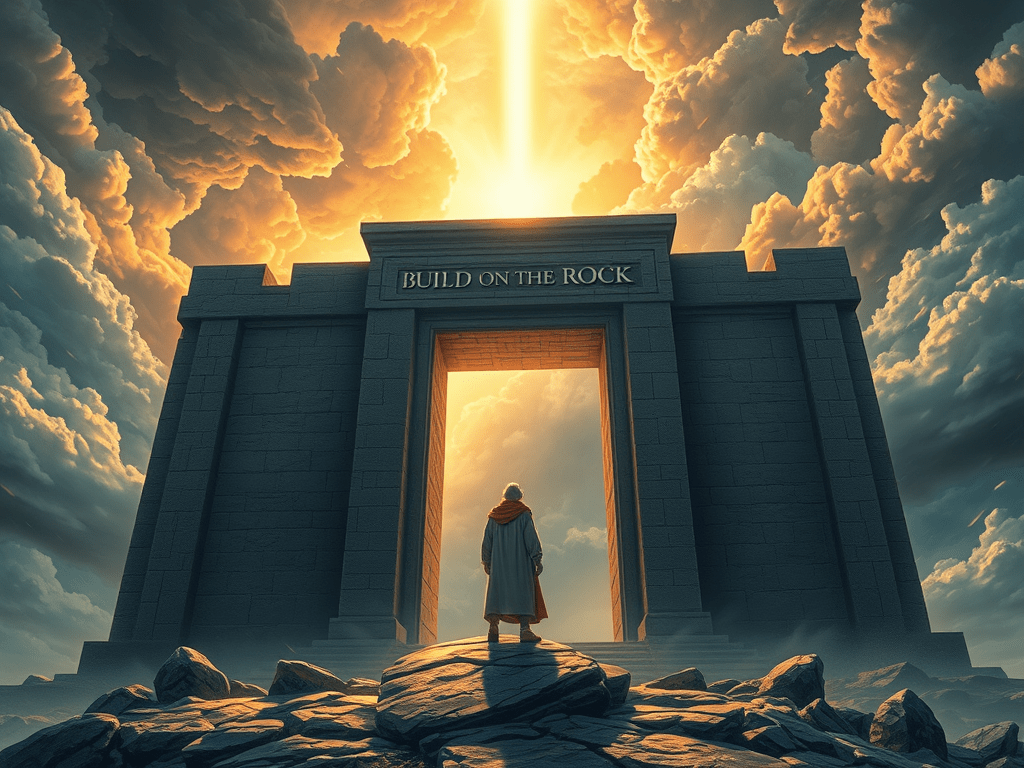
    Advent is a season of waiting, watching, and rebuilding the inner life. The readings for today speak with a single voice: your soul must be founded on the Rock, because storms will come. Not just external troubles, but the storms inside the human heart—fear, temptation, pride, confusion, and despair.

    Isaiah, the Psalmist, and Jesus Himself give us three images:
    a strong city, a sacred gate, and a house on solid rock.
    Together, they outline the path of every spiritual hero—from the prophets, to the saints, to ordinary men and women trying to follow God today.

    Let’s walk through the readings with Catholic wisdom, mythological insight, and psychological truth—so we can act on them, not just hear them.


    Isaiah: Open the Gates and Enter the Strong City

    Isaiah sees a vision of the soul as a strong city, built by God Himself:

    “We have a strong city… Open the gates! Let the upright nation come in… Trust in the Lord forever, for the Lord is the everlasting Rock.”

    The imagery is rich and precise:

    • The city is the human soul
    • The walls and ramparts are the virtues that protect us
    • The gates are the choices of the will

    Only those who trust in the Lord, who keep their minds “steadfast,” can enter.

    In mythic language, this moment is the hero approaching the threshold.
    Every great story has this scene:

    • Odysseus at the gates of the underworld
    • Aeneas at the temple doors
    • Frodo at the borders of Mordor
    • Christ at the entrance of the tomb

    But Scripture adds something deeper:
    The strength of the city is not your own willpower. God Himself is the foundation.
    The hero does not face chaos alone. The hero faces chaos with God.


    Psalm 118: The Gate of Holiness

    The Psalm continues the same theme:

    “Open to me the gates of holiness… This is the Lord’s own gate where the just may enter.”

    The pilgrim approaches the Temple and knocks. The question from inside is implied:
    Who may enter?

    The answer is not:

    • “I am strong.”
    • “I am important.”
    • “I have influence.”

    The answer is:
    “The Lord is my refuge.”

    Psychology says the same:
    When your core identity rests on anything unstable—success, emotions, reputation, strength—your inner world collapses when those things shift.
    But when identity rests on God, the soul stands firm.


    Jesus: Build Your House on the Rock

    In the Gospel, Jesus gives the image most people know:
    Two builders. Two foundations. Two futures.

    But He adds a detail that cuts straight to the heart:

    Both men hear His words. Only one acts.

    This is the decisive moment of the Hero’s Journey—when knowing is no longer enough.
    The hero must obey.
    The hero must choose.
    The hero must cross the threshold into action.

    Jesus says plainly:

    “Everyone who listens to these words of mine and acts on them will be like the wise man who built his house on rock.”

    Storms hit both houses.
    Faith does not guarantee ease.
    Faith guarantees endurance.


    The Psychology: Two Builders, Two Brains

    There’s a psychological layer here too.

    The house on rock

    represents a life governed by the higher faculties:

    • Reason
    • Conscience
    • Long-term vision
    • Stability
    • Sacrifice
    • Grace-supported will

    The house on sand

    represents a life governed by the lower systems:

    • Impulse
    • Emotion without discipline
    • Ego and appearance
    • Social pressure
    • Immediate pleasure

    Neuroscience confirms what Scripture teaches:
    When stress comes, the “lower” regions dominate unless the higher faculties are formed and anchored.

    Storms—suffering, fear, temptation, failure—expose the foundation of the soul.


    Mythic Parallels: Every Hero Faces the Storm

    Every ancient story knows this truth:

    • Gilgamesh meets the flood
    • Jonah meets the tempest
    • Odysseus meets the sea
    • Aeneas meets the burning city
    • Christ meets the Cross

    Heroes are not defined by the absence of storms, but by the strength of their foundation.

    Myths point to it.
    Psychology explains it.
    Catholic faith reveals it:
    The foundation is Christ Himself.


    Catholic Exegesis: The Rock Has a Name

    The Church Fathers are unanimous:

    • Christ is the Rock (1 Cor 10:4)
    • His teaching is the Rock
    • The Church is the Rock
    • Grace that strengthens the will is the Rock

    St. Augustine:
    “The house is faith; the foundation is Christ.”

    St. Gregory the Great:
    “To hear without acting is to build in the imagination.”

    St. Thomas Aquinas:
    “The foundation of the spiritual life is humility.”

    So the Rock is not self-help.
    The Rock is not moralism.
    The Rock is not positive thinking.

    The Rock is a Person.
    A relationship.
    A covenant.
    A surrender.


    How to Build on the Rock Today

    Here is the practical plan Jesus gives:

    1. Listen to His words

    Read Scripture.
    Study the faith.
    Let the Church teach you.

    2. Act on His words

    Do one concrete thing today:
    Forgive.
    Pray.
    Serve.
    Confess.
    Cut out a vice.
    Re-establish order.

    The hero’s gate is action.

    3. Trust God more than yourself

    Say:
    “Lord, I want Your will more than comfort.”

    4. Build habits that hold under pressure

    Virtue is spiritual architecture.
    The sacraments are reinforcement beams.
    Prayer is the daily maintenance.

    5. When the storm comes, choose to stand

    Do not fear the wind.
    Do not panic at the rain.
    Do not believe the lie that you are alone.

    The storm is not your enemy.
    The storm reveals your foundation.


    The Call: Enter the Gate. Stand on the Rock.

    Advent invites you to rebuild your life on Christ.

    Isaiah says: Enter the city.
    The Psalm says: Come through the gate.
    Jesus says: Stand on the Rock.

    The message is simple and strong:

    Your life has a structure.
    Your soul has a destiny.
    Your choices build a house that will either stand or fall.

    So today, choose to act.
    Choose to trust.
    Choose to build.
    Choose the Rock.

    And when the rains fall and the floods rise and the winds tear at everything—
    you will stand.
    And your endurance will give glory to God.

    Developed with assistance from ChatGPT-5
  • Hidden Heroes:

    How the Unknown Shapes Our World

    Human progress, both spiritual and practical, often unfolds in ways we never notice. We tend to look for recognition, applause, and fame, assuming that value is measured by the eyes of the crowd. Yet the truth, whether in faith or society, is far richer: the most transformative work often comes from those who remain hidden.

    The Saints and the Hidden Workers of God

    Cardinal Newman reminds us that God’s providence works quietly. Saints, angels, and faithful servants often operate without recognition. Abel, Noah, Moses, and the prophets were largely unknown to their contemporaries, yet they were beloved of God and critical to His plan. Even Christ Himself spent thirty years hidden in Nazareth.

    The principle continues in history. Many Christians owe their faith to mothers, teachers, or mentors whose names are lost to time. Countless acts of holiness shape society, unseen, like the hidden roots of a tree that nourishes its branches. Similarly, Scripture and Church traditions bear the imprint of unknown authors, composers, and builders, whose work has guided humanity for generations. The impact is real, even if their names are forgotten.

    The Modern Parallel: Inventors, Salespeople, and Entrepreneurs

    We can see the same dynamic in modern innovation. Inventors and engineers create new knowledge, technology, or tools. Yet these creators often lack the skills—or the inclination—to bring their work to the broader world. Enter the salesperson: the person who sees the value, communicates it, and persuades others to adopt it. Then come the entrepreneurs and business leaders, who scale the invention, providing the resources and infrastructure needed for it to become universally useful.

    Without this network—hidden genius, skilled communicators, and organizational support—many innovations would remain isolated, never touching society. And the inventor’s name, like many saints and spiritual guides, might never be celebrated. Every new invention also becomes the foundation for further discoveries, creating a chain of hidden contributions that shapes the future.

    Reframing the Hero: From Discoverer to Connector

    When we study the hero’s journey, we often assume the hero is the one who discovers the treasure. But consider this: the hero is not always the person who first extracts knowledge from the unknown. That role belongs to the inventor, the shaman, or the unseen sage—the obscure individual who wrestles with chaos and uncertainty to create something of value.

    The hero is the one who interacts with this hidden figure, understands the value of what has been uncovered, and brings it back to society. In myth, the dragon hoards treasure, and the hero must confront it to retrieve the prize. In real life, the “dragon” can be obscurity, complexity, or the difficulty of translating raw knowledge into something usable. The hero faces these challenges, carrying the treasure—whether knowledge, wisdom, or technology—back to the people.

    In this sense, the hero bridges the gap between hidden genius and society, enabling progress, inspiration, and transformation. The hero may not have invented the treasure, but without their courage, vision, and action, the discovery would remain buried. Just as angels and hidden saints influence history quietly, the hero ensures that society can benefit from the work of those who remain unknown.

    Seeing the Hidden Threads of History

    Whether in faith or in society, history is woven from countless hidden contributions. The bones and tools of ancient humans in Africa show us that our civilization depends on wisdom carried back from the unknown, even when we do not know the individuals. Inventions, ideas, acts of courage, and spiritual insights all ripple forward, often unnoticed.

    Newman’s spiritual lesson and the modern story of innovation converge here: the world is shaped by the hidden, the faithful, and the unseen, and the hero plays a critical role in translating these hidden gifts into something that can bless all of humanity.

    We are all part of this network. In small ways or large, each of us can act as the hero—recognizing the hidden treasures around us, nurturing them, and sharing them so they reach their full potential. Our private deeds, our acts of faith, our quiet labor—all matter far more than we realize.


    Reflection Questions:

    1. Who are the hidden “saints” or innovators in your life whose work you benefit from daily?
    2. Where in your life could you act as the hero, connecting hidden knowledge or resources to others?

    How does recognizing unseen contributions change the way you measure success or value?

    Meta Summary (SEO-ready):
    From hidden saints to forgotten inventors, society thrives on unseen contributions. Discover how heroes, both mythological and modern, bridge the gap between obscurity and impact, making hidden knowledge and wisdom accessible to all.

    SEO Keywords: hero’s journey, hidden heroes, unseen contributions, inventors, innovation, Christian saints, angels, spiritual growth, knowledge from the unknown

  • Quiet Heart, Loud Faith: Three Sparks to Renew the Church

    Quiet Heart, Loud Faith: Three Sparks to Renew the Church

    Faith in the Noise

    World spins fast—tech, truth, opinions shift.

    Noise everywhere. Easy to lose what matters.

    • Church mission? Never needed calm.
    • Starts with faith—deep in the heart.

    Silence often anchors quietly.

    One breath of quiet = your next spark?


    Depth Over Activity

    Church today? Not more programs. Not louder voices.

    Needs depth—people who pray, meet God in silence.

    • Live the Gospel first.
    • Faith isn’t meetings or debates.
    • Comes from grace—God loved us first, fully.

    Let love move you daily.

    One quiet moment = instant recharge.


    Renewal & Shine

    Remember that love? Faith becomes a lens.

    See God in work, people, hidden places.

    • Church renews through awakened hearts—not new plans.
    • Christ: “Take courage; I overcame.”
    • Hope in Him, not results.

    Restless world? Still radiant.

    You’re the light—ready to glow?

  • One Bead, Three Hope Bombs: Ignite the Second Hail Mary

    One Bead, Three Hope Bombs: Ignite the Second Hail Mary

    You’re at the start of the Rosary.

    First bead: “increase in us faith.”

    (If you missed it, we lit that fuse yesterday: blank map → step; Host → Him; hard thing → anyway.) One Bead, 3 Faith Bombs:

    Now the second bead rolls in:

    “Hail Mary… increase in us hope…”

    …and your mind blanks again.

    No more.

    Here are three 30-second mental detonators to drop before or during that single Hail Mary.

    Pick one. Pick all. Just make it explode.


    Detonator #1 – ANCHOR YOUR HEART IN HEAVEN

    Scene: Every cross you carry is a temp rental.

    Heaven is the forever address.

    Your move:

    Before the prayer starts, picture your heaviest pain nailed to the Cross—then vanishing at the empty tomb.

    “I bank on eternity, not the invoice.”


    Detonator #2 – GOD RECYCLES FAILURES INTO GLORY

    Fact: Your worst faceplant is raw material.

    Joseph: sold → pit → prison → palace.

    Your move:

    During the Hail Mary, hand God one specific failure.

    Whisper: “Turn this trash into throne.”

    (Pro tip: He’s the ultimate up-cycler.)


    Detonator #3 – RESURRECTION ALREADY CASHED THE CHECK

    Fact: Christ rose. Death lost. Hope won.

    Your move:

    Name one dead-end staring you down today.

    Lock eyes on the Risen One while the words roll.

    “I rest in the victory lap already run.”


    TL;DR (because scroll)

    Pain → temp.

    Failure → fuel.

    Dead-end → done.

    Screenshot this.

    Next time that second bead hits your fingers, light the fuse.

    Love bead dropping soon—stay locked in, stay Catholic.

  • One Bead, Three Faith Bombs: Ignite the First Hail Mary

    One Bead, Three Faith Bombs: Ignite the First Hail Mary


    You’re at the start of the Rosary.

    The first bead rolls under your thumb.

    “Hail Mary… increase in us faith…”

    …and your mind blanks.

    No more.

    Here are three 30-second mental detonators to drop before or during that single Hail Mary.

    Pick one. Pick all. Just make it explode.


    Detonator #1 – TRUST THE UNSEEN PROMISE

    Scene: Abraham, 75, no map, no preview.

    God: “Pack up. I’ll show the land… later.”

    Abe: “Let’s go.”

    Your move:

    Before the prayer starts, picture your unknown road.

    That nudge you’re dodging?

    Step onto the dirt.

    “I trust the Giver, not the preview.”


    Detonator #2 – JESUS IS LITERALLY HERE

    Fact: The Eucharist isn’t symbolic.

    It’s Body, Blood, Soul, Divinity.

    Storm-calmer → 1-inch host.

    Your move:

    During the Hail Mary, zoom in on the tabernacle.

    Whisper: “You’re in there. I believe—even if feelings bail.”

    (Pro tip: imagine the Host glowing like it holds the universe. It does.)


    Detonator #3 – FAITH IS A VERB ON MUTE

    Feelings: “This is trash.”

    Circumstances: “Quit.”

    Faith: “Still moving.”

    Your move:

    Name one hard act for today—forgive, pray, show up.

    Lock it in as the words roll.

    “I obey when everything screams stop.”


    TL;DR (because scroll)

    1. Blank map → step.
    2. Host → Him.
    3. Hard thing → anyway.

    Screenshot this.

    Next time that first bead hits your fingers, light the fuse.Hope bead dropping soon—stay locked in, stay Catholic.

  • Discovering Your Heroic Vocation

    Recognizing the call that sets your life on a meaningful adventure

    Introduction: The Call to Adventure

    Every life has a calling. Not every vocation leads to priesthood or consecrated life. C.S. Lewis reminds us that there are infinitely many good vocations, each as different from one another as good is from evil. Some callings are familiar: raising a family, serving the poor, leading a community, or creating art that inspires. Others are unique, waiting quietly for a person to step forward.

    In the language of the Hero’s Journey, the first step of any adventure is the call. It may come as restlessness, a sense of purpose, or an invitation to serve. Recognizing this call is the beginning of a life fully aligned with God and with your gifts.


    The Heroic Vocational Questions

    To help discern your calling, consider these reflective questions. They are not a checklist, but a framework for discovery:

    1. Where do I feel most alive when serving or creating?
    2. What challenges stir courage in me rather than fear?
    3. Which relationships or mentors draw out the best in me?
    4. What activity makes me lose track of time while benefiting others?
    5. What do I keep returning to, even when it’s difficult or uncomfortable?
    6. How would I want my life to be remembered if I gave it fully to this path?
    7. What sacrifice would I be willing to make for the good that matters most to me?
    8. How does this calling connect with the greater good, the community, or God’s plan?

    These questions guide a person toward self-knowledge, courage, and clarity—the essential tools for responding to any vocation.


    Reflection and Discernment

    Answering these questions requires honest reflection, prayer, and openness to God’s guidance. It may take weeks or months to see patterns or clarity emerge. Journaling, talking with a trusted mentor, or spending time in prayerful solitude can help you hear the call more clearly.

    Remember: vocation is a process, not a single answer. Your understanding of your calling may grow or shift over time. The key is to remain attentive to the stirrings in your heart and to align your life with God’s will.


    Practical Next Steps

    Once you have a sense of your calling, take practical steps to test and nurture it:

    • Volunteer or intern in areas related to your perceived vocation.
    • Seek out mentors or communities that live out what you feel drawn to.
    • Learn actively: read, train, or practice skills that support your calling.
    • Experiment with small projects or commitments to see how they resonate.

    These steps allow your calling to reveal itself in action, confirming whether it truly aligns with your gifts and God’s plan.


    Conclusion

    Every vocation is heroic in its own way. Whether it is priesthood, marriage, art, leadership, or service, answering your call is stepping into a life of purpose, courage, and joy.

    Start by paying attention to the stirrings in your heart. Ask the reflective questions, test your path, and trust God’s guidance. Your heroic journey begins with the first step: saying yes to the call.

    Developed with assistance from ChatGPT-5
  • Vocations by the Numbers:

    Why Priestly Life Looks Like a Miracle

    About fifteen years ago, I began to investigate the state of vocations in the Church. What I found was sobering. At that time, in my own diocese, there was about one diocesan priest for every 3,000 Catholic men.

    To an engineer like me, those numbers were staggering. If something happens only once in 3,000 tries, statisticians don’t call it normal — they call it an anomaly, an outlier, or even an error. The positive spin we use in the Church is “miracle.”

    But think of what that means: if vocations really were chosen at random, it would take the equivalent of tossing a coin twelve times and having it come up heads every time before a man became a priest. If that actually happened, most of us would laugh, say it was a bum toss, and start over.


    What if Priestly Vocations Were Realistic?

    Just for the sake of discussion, I asked myself: what if one priestly vocation came from every 100 men? That’s still not a majority, but it’s at least in the realm of possibility.

    In statistical terms, that would be like tossing seven coins and having them all land heads — odds of about 1 in 128. Far more likely than 1 in 3,000.

    If we applied this across a parish or diocese, the numbers look very different:

    • Assume people live about 83 years, or roughly 1,000 months.
    • That means people are born and die at about the same rate: one born, one die, per 1,000 people each month.
    • If a priest’s ministry spans half his life, then at any given time there whould be 1 priest for every 200 men.
    • With half the Church being women, that would mean 1 priest for every 400 Catholics.
    • There would be every year 1 new priest for every 16,000 Catholics.

    Take a parish of 2,000 families — say 5,2000 parishioners. By this ratio, we should have 12 to 13 priests in that one parish. And it would produce roughly 1 new priest vocation every 3. years. (16,000 / 5,000)
    Take my diocese, with about 1.6 million Catholics. By this measure, we should have 4,000 priests. And we should have about 100 men becoming new priests every year.

    The reality, of course, is nowhere near that.


    A Sobering Comparison

    We treat marriage very differently. Even with falling rates, still around half of people marry. When it drops, we call it a tragedy.

    But imagine if marriage happened at the same rate as priesthood — once in 3,000. Would we even call it a “vocation,” or just a statistical accident?

    That is the dilemma with vocations today. By the numbers, the priesthood no longer looks like a reasonable life option for Catholic men. It looks like winning the lottery.

    And yet, the Church depends on it.


    To be continued: In the next reflection, I’ll share how I asked myself: what if we replaced the seven coin tosses with seven questions? If a man could answer “yes” to all seven, maybe he should seriously consider a consecrated vocation.

  • Take Up Your Cross:

    The Hero’s Anthem of Discipleship

    At Mass today, the congregation sang a hymn that almost reads like a hero’s anthem:

    “Take up thy cross,” the Savior said,
    “if thou wouldst my disciple be;
    deny thyself, the world forsake,
    and humbly follow after Me.”

    “Take up thy cross, let not its weight
    fill thy weak spirit with alarm;
    His strength shall bear thy spirit up,
    and brace thy heart, and nerve thine arm.”

    “Take up thy cross, nor heed the shame,
    nor let thy foolish pride rebel;
    thy Lord for thee the cross endured,
    to save thy soul from death and hell.”

    “Take up thy cross, and follow Christ,
    nor think till death to lay it down;
    for only they who bear the cross
    may hope to wear the glorious crown.”

    At first glance, it is a call to discipleship, a reminder to endure suffering, and a promise of eternal reward. But the hymn also mirrors the archetypal Hero’s Journey:

    • The Call to Adventure: The Savior invites each disciple to leave comfort behind, deny selfish desires, and step into a path of transformation.
    • Supernatural Aid: Divine strength sustains the believer, just as mythic heroes receive guidance and power from mentors or gods.
    • The Road of Trials: Enduring shame, temptation, and inner resistance is the crucible that refines courage, humility, and faith.
    • The Ultimate Boon: The crown at the journey’s end is victory over death and union with God—eternal life as the hero’s reward.
    • Return to the World: Though the cross is carried daily, the disciple’s journey inspires others, becoming a witness of hope and courage in the ordinary world.

    In essence, the hymn frames discipleship as a heroic quest. Each cross we bear is both trial and triumph, each act of faith a step along the path of transformation. It reminds us that true heroism is not the absence of suffering, but the courage to endure, the humility to trust, and the hope that, in the end, life’s ultimate reward is already glimpsed in faith.

    The lyrics are by: Everest, Charles William, M.A

    Written with assistance from ChatGPT-5

  • Humility Means Staying Close to the Ground

    Lessons from Jiu Jitsu, Scripture, and the Hero’s Descent

    We often think of humility as weakness, but it is really a strength. In a talk I heard today, the speaker said humility means being close to the ground. He used the example of Jiu Jitsu, a martial art strongest when practiced low to the floor.

    That picture opened other connections for me. Jordan Peterson has said that human beings were originally tree creatures — we stayed off the ground because it was unsafe. In myth, the “deep” often represents chaos — the water where danger and the unknown dwell.

    The hero, however, is the one willing to descend. He steps down into the unknown, into danger, into the deep, to face the dragon and gain something new. Humility is not about weakness; it is the stance of someone willing to learn.

    The adversary, in contrast, is proud. He refuses to bow, refuses to learn, and stays aloof from the ground.

    Where is God asking you to “stay close to the ground,” to take the low and humble place so you can learn what you need?

    Developed with assistance from ChatGPT-5